Indicator species follow-up thoughts

I appreciated each and every one of the thoughtful comments that I received on my “female cyclist’s manifesto” post.  I want to explore some of these views in a more organized manner than comment replies allow.

Like any cyclist, male or female, it takes time to become comfortable riding as regular traffic, but not that much time.  – Stacy

This one little sentence really got me thinking.  When we fail to view cyclists as drivers, as equal road users, we set ourselves up for trouble.  Imagine that you had never driven an automobile before, and someone hands you the keys and expects you to be able to operate that vehicle safely and competently on the streets.  Pretty overwhelming, huh?

In effect, that is how many people view bicycling in the U.S.  Most states have comprehensive, rigorous (and expensive) training programs for young [automobile] drivers.  Here is an example of the requirements in my home state (Iowa):

Typically, the course includes 30 hours of classroom instruction and six hours of lab time. At least three of these “lab” hours must be behind the wheel of a car; the other three may be either behind the wheel or using a simulator.  According to Iowa law, driver education courses must be offered or made available by your local school district.

I (by which I mean my parents — thanks, Mom and Dad!) paid well over three hundred dollars to take that drivers’ ed class in high school, yet I balked (as many do) at paying just $75 for a comprehensive cycling course.  Definitely something wrong with that picture!

We have no comparable requirements for cycling education.  Instead, it is left to individual cyclists to seek out training, and many cycling education programs are not nearly comprehensive enough to prepare cyclists to feel truly comfortable on the roadways.

Imagine if all schools incorporated age-appropriate cycling education and skill training in their curriculum.  We would eventually have a population of road users (both motorists and cyclists) who knew how to safely and respectfully interact with one another on the road.

There is also the simple fact that, similar to learning how to drive a car, learning how to operate your bicycle as part of the traffic system takes time and practice, above and beyond what you learn in even the best class.

——————————

I used to be very much a “take the lane” type of person, and I still am. I am an LCI and have taken similar classes to [CyclingSavvy]. I didn’t ever understand the “need” for cycle tracks or buffeted bike lanes UNTIL I took my 4-year-old on a ride that I do all the time and it terrified me. I realized that this is what it feels like for an inexperienced or less confident rider. There is no way that I would take my son on a road where we need to “take the lane.” We actually rode on the sidewalk for part of this little 3 mile stretch, a cardinal sin in my mind. I still ride with him on the street but we are limited in the areas we can go when he is on his own bike.  -Elle, Tiny Helmets Big Bikes

First, Elle’s adventures as a car-free, cycling mother of two little boys are a huge inspiration (and I am jealous of her cargo bike fleet!).  I’m happy she weighed in here, because, while Gabriel is still a few years away from cycling on his own bike with Matthew or I playing “wingman,” this is certainly something I’ve thought about.

At this point, I feel that there are certainly some (many?) roads where I would not feel comfortable with a preschooler or elementary-school-aged child riding his/her own bike, even with an accompanying parent, for many reasons.

First, while speed is NOT a requirement for using the roads, there are certainly places where maintaining some kind of reasonable minimum speed (say 8mph, excluding hills) can be useful.  Small children on small, gearless bikes may not be capable of this.

Speed aside, there is a lot of work we do while driving (whether a car or a bike), taking in visual cues both in front of us and in our peripheral vision, anticipating what other road users will do based on previous experience, responding to/avoiding hazards in the roadway, etc.  As adults, we do these things simultaneously and almost unthinkingly.  This level of processing and responding is beyond the capability of young children.

So, while it is imperative that we educate our children about cycling, and give them an opportunity to practice those skills, there is still an age-appropriate factor.  Though I’m not sure of an exact age, my plan is to let Gabriel ride his own bike on short trips and small streets, using a child seat on my bike (and eventually a trail-a-bike) for longer journeys and those that involve larger, higher-speed roads, gradually giving him both more freedom and more responsibility.

While I haven’t had the experience of cycling with my own child, I led a bike-to-school program for kids in sixth- through eighth-grades for two years.  We specifically targeted this age-group as having the developmental maturity to understand and follow the rules of the road and to ride our chosen routes with a relatively high (5:1) child to adult-leader ratio.  We also geared our education and training to give the students the skills they needed to ride these same routes on their own.

———————–

I am fortunate to live in a city with a great greenway/bike path system, and I pretty much stick to that these days, and also just ride for exercise and fun so my destination doesn’t matter much. Many people are able to use that system for commuting – and it works well if downtown is your destination. But the problem is that there’s really only one north/south route along the Platte river, so you end up having to go 10-12 miles out of the way if you want to go north or south in my part of town . . .  –EcoCatLady

Greenways can be great, especially if they are installed in locations where conflict points (i.e., intersections and driveways) are eliminated.  Unfortunately, they often have the limitations EcoCatLady points out — useful for transportation if you live and work very near one, otherwise, not so much.

Also, even a [would-be] cyclist who lives relatively near a greenway will be unable to use the route for transportation if he/she is not able to navigate the roads to get to the greenway in the first place (read this cyclist’s inspiring story of learning to use large roads to connect to the trail system near his house).

Because of the relatively high cost (in both money and land) of installing such infrastructure (a cost which still pales in comparison to the cost of installing urban freeways), it is unlikely that greenways will ever be able to serve the needs of all cyclists, so being able to use the existing public ways that were built for people to use (i.e., all of our roads!) is important.

——————————

I will agree that sharrows may be BS – the ones I saw in Baltimore ranged from the door zone to half way underneath parked cars.  -Angelo

Just like many things, sharrows can be done well or poorly.  In addition to the problem of poor placement, there is also the risk that road users will assume that cyclists can ONLY use lanes with sharrows, which are usually only found in the right-most lane, i.e., not where you would travel if preparing for a left turn.

Personally, I could take or leave them, but well-placed (i.e., in the center of the traffic lane/between the tire tracks and NOT in the door zone, parking lane, debris-filled edge of the road, etc.) sharrows can help cyclists, especially those new to the idea of lane control, feel more comfortable on the roads.  If it is a way to divert paint from dangerous-by-design bike lanes to something more safe and useful on our roadways, I’m okay with it.

While I have not addressed all of the comments in the original post, I will pause here for now.  Again, thanks to all who have read and commented (or just read and considered).  I’d love to keep this discussion going.

Bike-by viewing

This morning was a good morning for fenders.  While there was no rain on the way to or from my physical therapy appointment, the wet pavement would have made things messy.  The fog also mandated lights and my reflective, high-vis vest (I temporarily ditched the vest to remove my jacket at a stop light, then shoved the vest in my crate when the light turned green before I had a chance to put it on again — thanks to the kind lady in the van who let me know that the vest fell out of my crate).

Given the combination of wet pavement and poor visibility, I took things a bit slower than usual, but still made it to my appointment in plenty of time.  Even though it did not rain at all during the morning commute, the forecast seemed to have scared most other cyclists into other forms of transportation.

On the way home, I took a little detour to bike by a house-of-interest (we’ve been looking for the right place for, oh, four years now, and renting until “the one” comes along).  My detour gave me the opportunity to ride along a stretch of the “new and improved” (ahem) Manchester road.  I didn’t pause to snap my own picture, but, if I had, it would have looked very similar to this photo of the same stretch.

Manchester1_EditedReplace the parked truck (on the right) with two or three different parked vehicles, all smaller, all theoretically capable of fitting within the parking lane so as not to encroach on the “buffer” zone, but yet all somehow not capable of actually parking that way, and replace the garbage truck with a tractor-trailer.

I made a right on red into this mess, with the tractor trailer approaching from the rear, still well behind me when I turned.  I only needed to use Manchester for a block (before making a left turn), and no way was I going to be stuck in that bike lane between the parked cars and the 18-wheeler.  Not happening.

This, of course, put me in the unenviable position of controlling a traffic lane next to a bike lane (which often leads to higher levels of motorist incivility).  Fortunately, the truck driver was patient (as many motorists are), and I was soon to my left turn pocket, leaving him free to continue his trip.

He may very well have appreciated my lane positioning, as it left no chance of me being in his blind spot.  No truck driver every WANTS to be in this position.

That little adventure over, I crossed some seriously whack train tracks (they were in such bad shape that I straddle-walked my bike across, rather than riding) and proceeded on my house-scouting trip.  The result?  Yet another one that probably isn’t the one for us (okay sized yard, but poor sunlight due to a tree on the property next door).  And so it goes.

Twisted vertebrae

Last Thursday’s post, where I shared my thoughts about bike facilities and infrastructure, garnered quite a few hits and is sparking some good discussions.  The thoughts I shared there had been percolating for quite some time, and it felt good to get them off my chest and out into the world.

While the post took quite a bit of time (and mental energy), it was far from the only thing noteworthy last week.

On Wednesday, I started physical therapy for mid-back pain that I’ve had since our trip to Wisconsin in July.  After three months of hoping it would go away on its own, I finally faced facts and sought answers and help.  Turns out that repeatedly twisting around in the car to tend to a toddler in the back seat = very bad for back (shocker!) — as a result, I have a couple of vertebrae that are rotated [slightly] out of place.

My doctor actually recommended that I visit a chiropractor (which I’ve never done), and then perhaps use PT as a follow-up.  Lacking a great chiropractic recommendation, I started with the PT (something I’ve done before for other back issues), and that’s the route I’m going for now.  I chose a therapist who uses manual techniques and myofascial release to encourage the muscles to relax enough to help things move back into place.  My initial visit left me quite sore the next day, but nothing that I couldn’t live with.

I can’t help but miss the health insurance I had three jobs ago (four, if you count my current part-time gig) which covered 100% of physical therapy.  Now it’s forty bucks a visit.  I know it could be worse, but that definitely stings a bit, and it adds up fast!  Hopefully this resolves quickly, but the fact that it’s been an issue for over three months now might not bode well.

Fortunately, biking doesn’t seem to be an issue, and I’m able to bike to my PT appointments, so I’ll probably be doing more biking during these next few weeks than I otherwise would.  There’s something very satisfying about feeling good enough to bike to health-related appointments, and it makes me thankful for relatively good, if imperfect, health.

I am the indicator species — A female cyclist’s manifesto

In biology, indicator species are used to determine the health of a given ecological region, with their presence (or absence) indicating either good or poor conditions.

In the world of bicycle advocacy and planning, women are often considered the indicator species, as described in this Scientific American article about getting more cyclists on the roads:

Women are considered an “indicator species” for bike-friendly cities for several reasons. First, studies across disciplines as disparate as criminology and child ­rearing have shown that women are more averse to risk than men. In the cycling arena, that risk aversion translates into increased demand for safe bike infrastructure as a prerequisite for riding. Women also do most of the child care and household shopping, which means these bike routes need to be organized around practical urban destinations to make a difference.

At present in the U.S., women are far less likely than men to use bikes for transportation, and thus a city’s percentage of female bicyclists is used as one measure of a city’s “bike friendliness.”

While some female cyclists object to being referred to as an indicator species, I see it as an opportunity.

Here’s the thing.  I am that indicator species, part of the demographic being catered to by bicycle advocacy groups.  Not only am I a female cyclist, I am a parent.

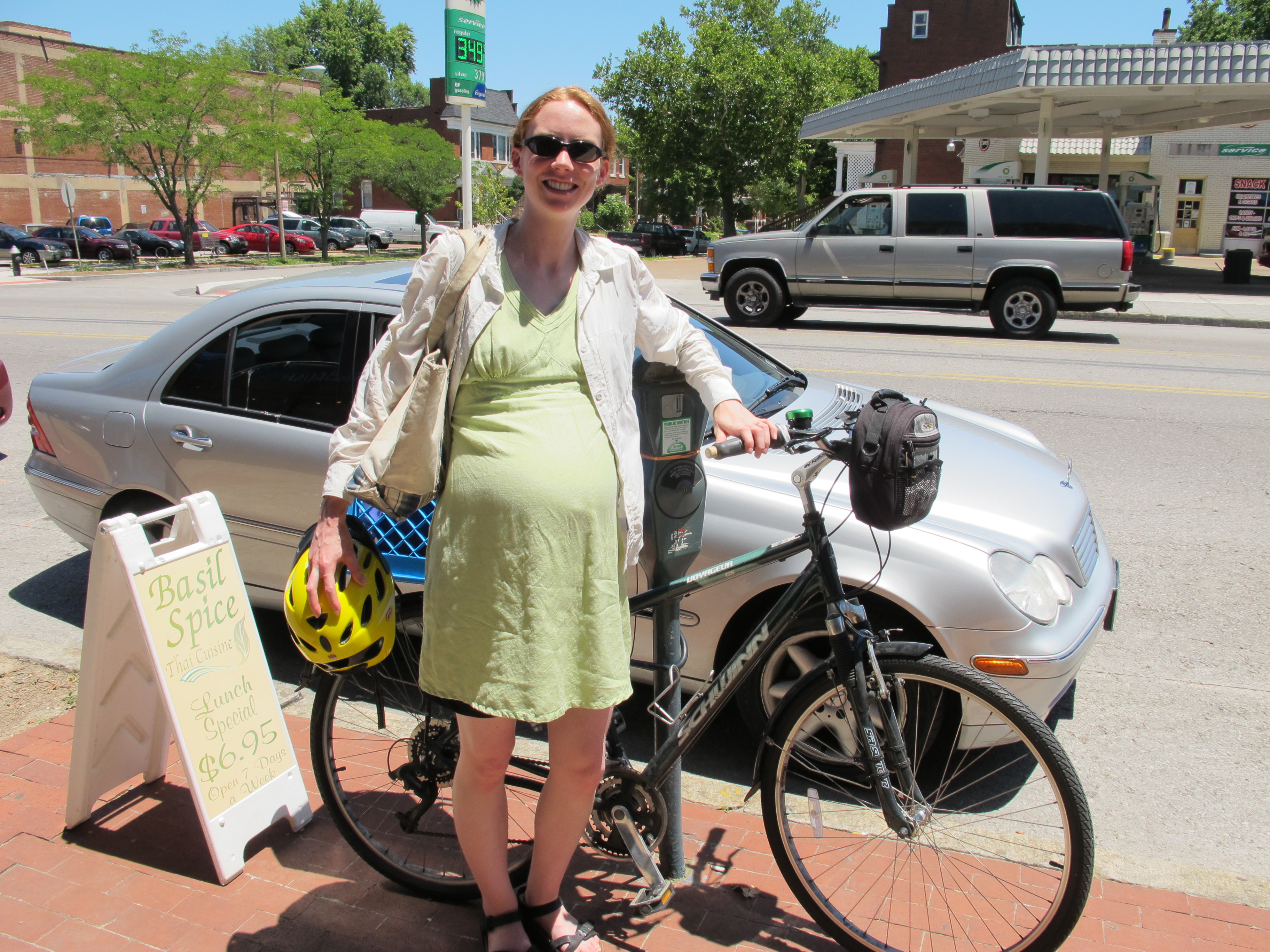
I cycled throughout my pregnancy . . .

Biking to lunch at 37 weeks

. . . and I regularly use a bicycle for trips with my son.

Perhaps that qualifies me as not just an indicator, but as an über-indicator.

And this member of the indicator species is very frustrated.  I’m frustrated with bike advocates and planners who continue to implement dangerous-by-design bicycle “improvements” that marginalize cyclists and contribute to the myth that cyclists and motorists belong in separate spaces, when the spaces for cyclists (be it bike lane, buffered bike lane, or cycle track) invariably increase crash risk at intersections — the place where cyclists are in the most danger of car-bike collisions.

I am a member of the indicator species, and I object!

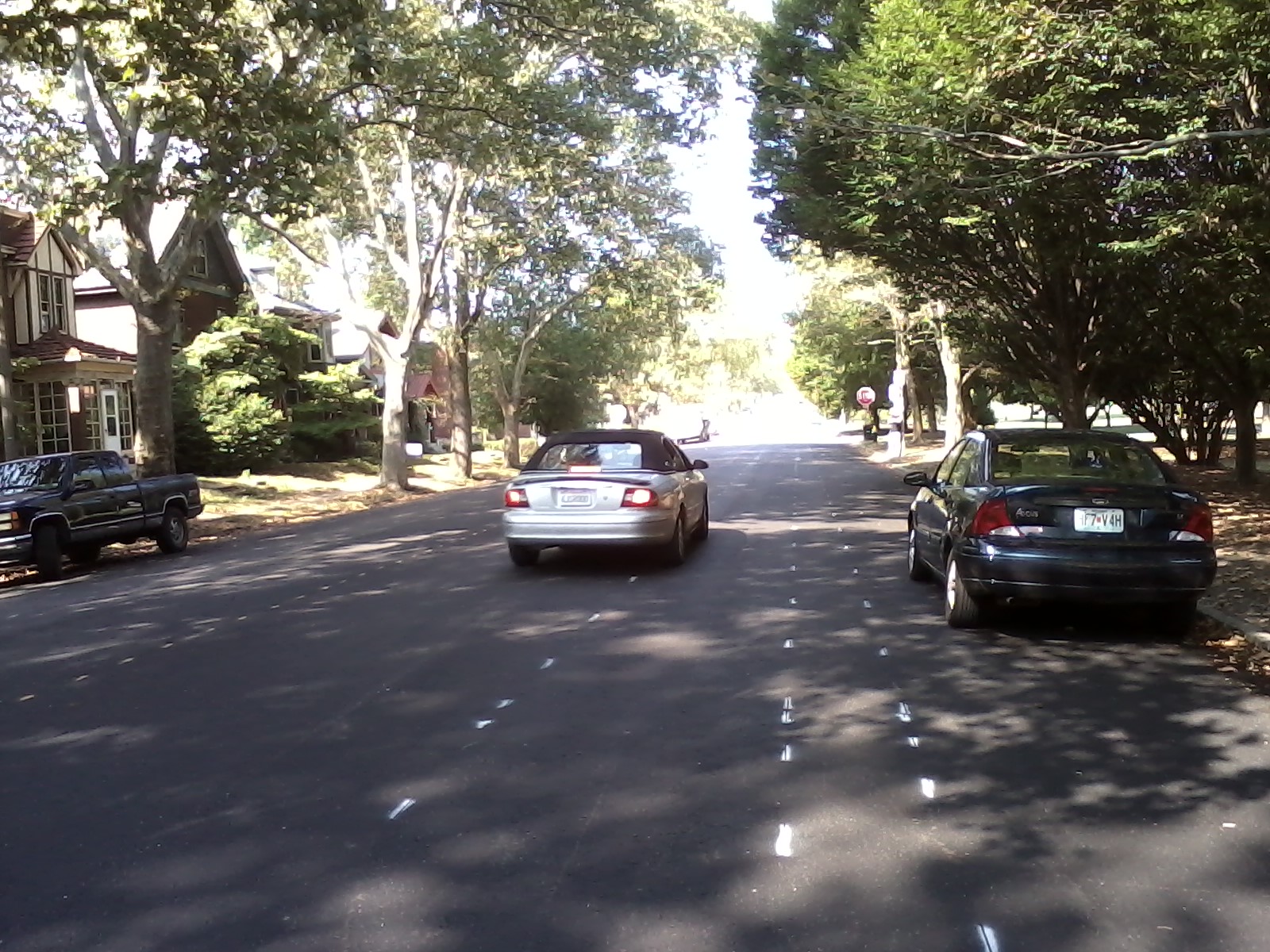
Paint guide markings for the new buffered bike lanes on Arsenal, west of Grand

I’m tired of heading out on my bike to discover a formerly great route now made unfriendly and dangerous by the these roadway “improvements,” as I wrote in an unpublished post after encountering yet another tragedy of good intentions (above photo: street that formerly had a lane of traffic in each direction, plus a center turn lane, allowing cyclists to take the lane and motorists to pass in the turn lane — shown now with center turn lane eliminated and bike lanes added along a [narrow] buffer to between the bike lanes and parked cars):

Bike/ped organizations are assuming that the paint will lure new bicycle commuters, thus increasing their “counts,” while taking for granted that the cyclists who have already been riding, who are already committed to this form of transportation, who have been educated about how to safely coexist with traffic . . . that these cyclists will continue riding, despite roadway “solutions” that actually make things MORE dangerous for cyclists.  Maybe we will, but maybe we won’t.  Maybe you will make the roads so unpleasant, so littered with dangerous paint, that we will throw in our hats.  We, who have been the face of cycling for years, we, who are even now encouraging others to try bike commuting for the first time, we, who support your bottom line goals of getting more people on bicycles, just not the way you are going about it.

I’m tired of those who choose to ignore the growing body of evidence showing the dangers of a variety of bicycle facilities.¹

The best-designed bike lanes and cycle tracks do not prevent tragedy:

These are but two examples (of far too many), both from supposed “meccas” of bicycling.  All the special paint or buffers in the world cannot change the fact that the safest place for a cyclist to operate is in the lane as part of traffic.

Now, I understand that this is an uncomfortable place for many cyclists to ride (though hardly more uncomfortable than either of the bike lanes pictured below).  I know the surveys and polls show that you will get more cyclists on the streets if you install bike lanes (or other facilities).  This is great in terms of sheer numbers, and more cyclists on the roads makes everything safer for other cyclists, attracts more cyclists, etc.

However, bikes lanes (buffered or not) are basically a gauntlet of potential dangers, even for an experienced, educated cyclist.  By installing more bike lanes to attract newbie/novice bicyclists, cities across the country are creating dangerous places (made more dangerous by the [false] perception of safety) for the most inexperienced riders out there.

Somewhat ironically, I have been in the “bike lane advocate” camp.  From 2009-2012, I managed a grant focused on increasing active transportation: I met with mayors, city administrators and city council members and worked to implement Complete Streets policies (we succeeded).  The grant was geared toward policy change and community education and involvement (including starting a bike-to-school program).  We had very limited funds for infrastructure improvements, so while we were not making changes, bike lanes, along with sidewalks for pedestrian access, were certainly something I frequently mentioned as an important part of creating a “complete street.”

I think it’s important to note where I come from, because I did not always hold my current views.  I, like many other cycling advocates and city leaders and planners across the country, saw a compelling case for bike lanes in terms of increasing cycling numbers.

In April/June 2011, I took CyclingSavvy.  Thankfully, I was open-minded enough to hear and process the information in the course and conclude that some of my previously held beliefs were simply incorrect.  It is a shame that others refuse to attend the class outright, or attend with closed minds, going back to their jobs, or their soapboxes, and maintaining the status quo — directly or indirectly promoting a culture of fear, vulnerability, and separation.

So what’s the answer?  Are all “bike facilities” bad?  The short answer is “no.”  The long answer?

I recently had an opportunity to respond to a Bike St. Louis survey about the next phase of their bicycle planning . Here is the feedback I provided:

Regarding the types of on-road bike facilities listed above [bike lanes, buffered bike lanes, and cycle tracks], I selected “I prefer no facility” because I feel/would feel very uncomfortable using any of the bike facilities (I have ridden in a cycle track in Washington, DC).

While cycle tracks offer some level of protection from being side-swiped, they present the same dangers at intersections and driveways as bike lanes, perhaps worse due to poor visibility caused by parked cars, less relevance to motorists, and the increased perception of safety that leaves cyclists exposed to the dangers of collisions at intersections, already the place where most car-bike collisions occur.

The most recent cyclist death in Copenhagen (not to mention quite a few right-hook deaths in U.S. cities over the past 2-3 years) clearly illustrates the problem with facilities such as bike lanes and cycle tracks.

I strongly encourage GRG and the City of St. Louis to focus on solutions that include sharrows and signage (including “Bikes May Use Full Lane and way-finding for cyclists), neighborhood greenways (i.e., convenient routes for cyclists that minimize stop signs and utilize other traffic-calming measures including speed humps and streets that are limited-access for motorists), as well as supporting and promoting high-quality, comprehensive bicycle education programs.   In my experience, many roadways have plenty of capacity for motorists and cyclists to co-exist, IF the cyclists are well-educated in operating their bicycle as part of traffic.

The good news is that there are ways we can spend money, there are improvements we can make, on both infrastructure and education, that will encourage more people (including other members of the indicator species) to use bicycles without compromising safety.

————————

1. http://www.bikexprt.com/bikepol/facil/sidepath/sidecrash.htm
http://www.humantransport.org/bicycledriving/sciencepolitics2/
http://ianbrettcooper.blogspot.com/2012/08/bicycle-infrastructure-studies.html

*Manchester bike lane photos courtesy of Karen at Commute St. Louis

Camping

So, camping.  Our last camping trip was over two years ago.  It involved a nine-week-old baby, unforecasted rain and chilly temperatures, a leaky tent, very little hiking, and an early return. Gabriel’s look says it all.  (I can’t believe he was ever that tiny!!!)

IMG_7347
“WTF, guys? Can we please go home already?”

A few months after that adventure, we received a new tent as a Christmas present.  Despite being an upgrade over our leaky, musty version, it sat untouched for almost two years.  This is more related to our “garden” baby than to our actual baby.

In retrospect, hiking/camping with a small, very portable infant was relatively easy, but despite our best intentions to do a lot of hiking and camping those first months (when we were both not working due to maternity/paternity leave anyway), there was just that one trip.

For our great return to camping, we left Gabriel with Baba, and had our first multi-night kid-free time in over a year.

We planned our adventure to southern Illinois, home to some state parks, national forests, and wineries.  Thanks to Congress, we had to remove the national forest from our itinerary.

Saturday morning, we loaded the car and drove through two-and-a-half hours of rain to Giant City State Park (just south of Carbondale, IL).  We kept peering at the sky, thinking that certainly, at any moment, the rain would stop and it would clear.

Failing that, we decided to stop in Carbondale for lunch.  We ate at Longbranch Coffeehouse and Vegetarian Cafe, a spot I’d scoped out ahead of time.  We enjoyed their house recipe veggie burger and a breakfast burrito-type thing — a fun stop and tasty food — would definitely return!

It finally did stop raining, just as we arrived at the state park to be met by a “Campground Full” sign.  We continued to the host’s site to discuss just what they meant by “full.”

Turns out there was exactly ONE tent site left in the entire campground, so we paid our eight dollars and proceeded to stake our claim.  I really didn’t want to set up our nice, clean, dry tent on the wet, muddy ground, so we hung our claim tag and drove to some short hiking loops.

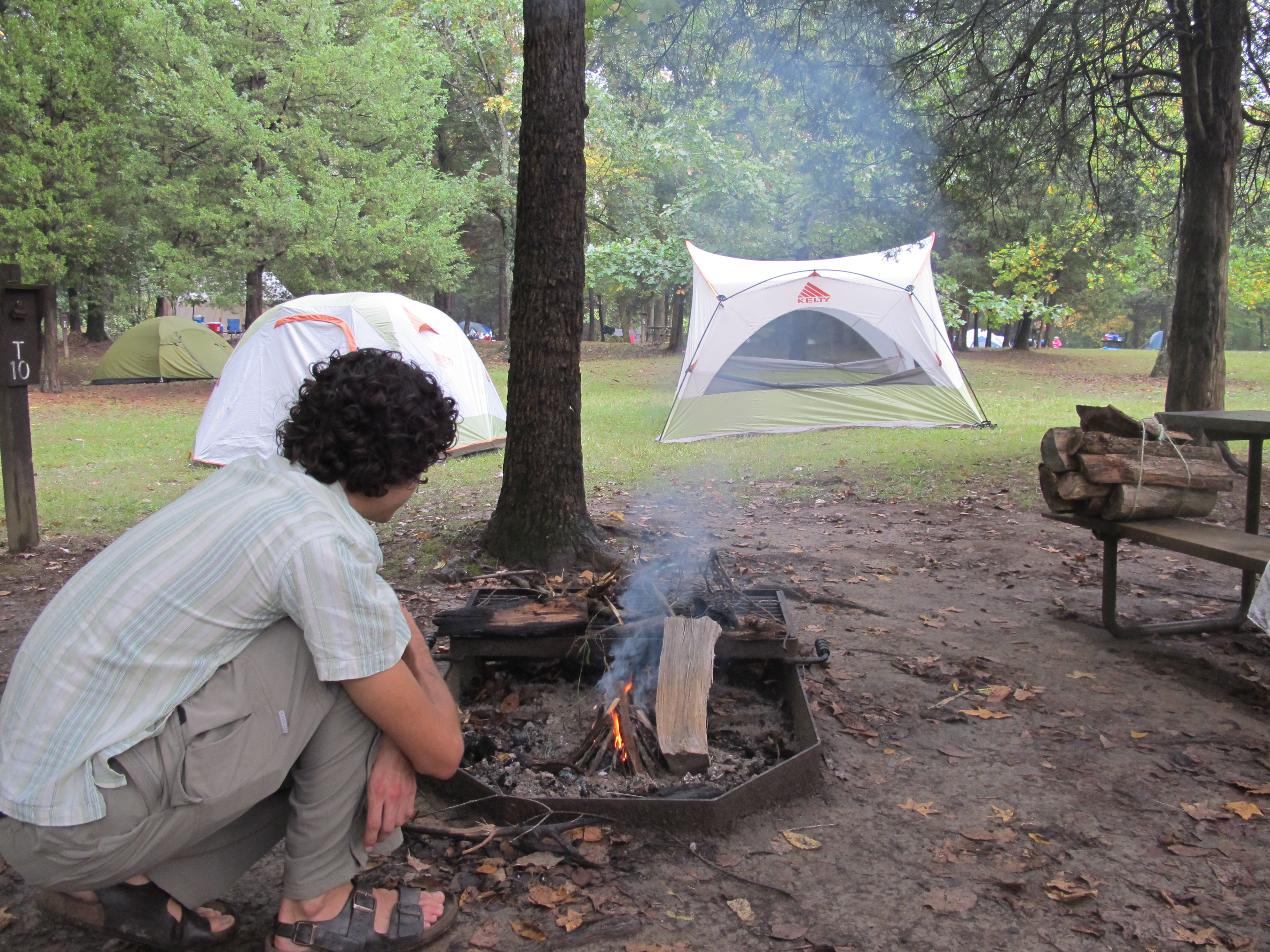
We returned a few hours later to slightly less wet ground, and went about setting up camp.  Between our new tent, new screen house, almost new sleeping bags (which I decided I loathe), and a couple of new backpacks, I felt like we were doing some kind of gear review (minus the free gear).

IMG_3212

We built a fire, ate dinner, and decided to call it an early night.  Unfortunately, our fellow campers had other ideas, and what seemed like a relatively quiet campground before 9 p.m. became obnoxiously noisy for the next couple of hours as we tossed and turned.

Our ultralight fabric (made from recycled plastic bottles), mummy-style sleeping bags, while perhaps great for back-country camping, were just not comfortable for me.  Between that and the noise, I was NOT a happy camper.

Come morning, I strongly advocated for turning our planned two-night stay into a one-night stay.  The lure of a nice, comfortable bed in a quiet apartment only two hours away was just too much.

But before we left, we decided to tackle a 12-mile hike, giving us some more of the outdoor time and scenery that we came for and giving our tents time to dry (just dew, not rain) before decamping.

Unfortunately, the “construction” that the guide at the visitor’s center indicated would last for about a mile of the 12-mile loop, combined with Saturday’s rain, turned our hike into a muddy slog, made extra frustrating by the complete lack of trail markers (perhaps removed because of the construction).

IMG_3214

Heavy machinery, dirt trails, and rain are NOT a good combination.  We found this guy with the keys in the ignition and were rather tempted to just drive ourselves out.

The “path” we were on finally led to a waste-water treatment site (beautiful nature, eh?), and we followed a gravel road back to civilization, i.e., the paved road that runs through the state park.  From there, we “hiked” along the road for a couple of miles (I was tempted to stick out my thumb and hitch-hike) before finally returning to our campsite.

IMG_3232
Pea in a pod

Midday fire, lunch, showers, and some time in the hammock put us in better spirits.  We packed up our nice dry tents, drove back to St. Louis, and concluded our weekend with dinner at Tree House, a [relatively] new vegetarian restaurant.

Our camping gear is packed away again, probably until the spring, when we might get really crazy and attempt camping with a toddler.  Until then, I’ll be enjoying my own bed!