No cook couscous

I’m melting!  Or at least wilting — I do not like this heat one bit!  With almost a month until summer officially starts, we broke down and turned on the A/C before bed two nights ago (not green, but the reality of living in a brick oven).   GRRR!
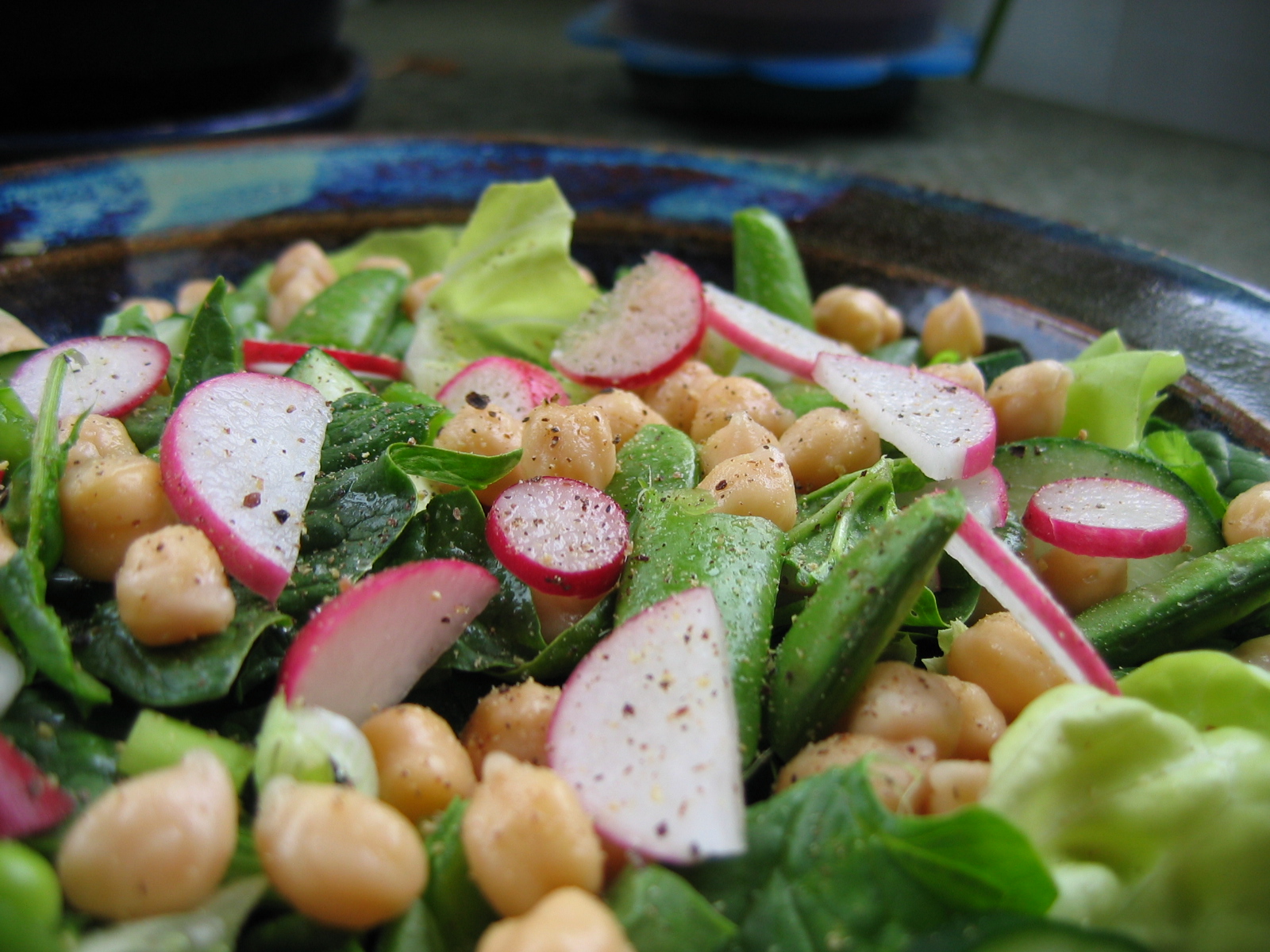
Mixed greens with radishes, sugar snap peas, garbanzo beans, onions, cucumbers, homemade vinaigrette, and sunflower seeds

With all this heat, ’tis the season for low- or no-cook meals.  Great big garden-fresh salads rounded out with a side of no cook couscous.  Couscous is technically a pasta, wheat-based and cut into tiny pieces.  Because the pieces are so small, you can “cook” couscous by simply adding the appropriate amount of water and waiting for it to absorb.  The golden ratio for couscous is 1 cup of grain to 1 1/2 cups of water.  I prepared a single serving: 1/4 cup dry grain + 3/8 cup water.  The couscous absorbed the water in about 15 minutes.  When the water was absorbed, I simply added a bit of olive oil and salt — one side of couscous, ready to go!

Notes:

  • Look for whole wheat couscous in bulk bins.
  • Couscous tastes great simply prepared, as suggested above.  Try adding chopped fresh herbs (parsley comes to mind) to spice it up a bit.
  • Couscous also works well as a grain base for vegetable stir fries.
  • I would never prepare a single serving of a grain that requires boiling (as most do), because it is much more efficient to cook multiple portions at once.  However, with the no-cook method, it doesn’t really matter, since it requires no energy.

Go, Iowa!

No, I’m not cheering for the Hawkeyes, I’m cheering for Iowa’s 7th place finish in the Bike Friendly State rankings.  My current state of Missouri didn’t fare so well, coming in 28th.  Lots of good things happening all around, but a lot more work to do!

Backpacks, racks, and panniers, oh my!

Recent question from reader Rebecca: “At the moment I’m using a backback, but it has limited capacity. So I’m wondering what you do… baskets? panniers? racks? I’d love any advice on that subject.”

Great question.  I used to be a backpack gal, too.

At first, I carried a regular back pack, plus a small gym bag.  I found that carrying two bags was awkward (and sometimes unsafe), so I switched to the internal frame backpack pictured above (yes, I’m in the picture too, hiding behind the pack).  With a volume of 50.5 L (3082 cubic inches), this pack easily handled everything I needed most days, and, with the waist belt and suspension system, felt pretty comfortable, even fully loaded, when riding my hybrid.

Once I switched to a road-style bike, with the bent-over riding position, the huge pack was a) more awkward and less comfortable and b) somewhat dangerous — when I turned to look over my shoulder, I couldn’t really see the road behind me — not good!

I took the plunge and bought a rear rack and panniers.

With a total volume (for the pair) of 20 L (1220 cubic inches), the panniers (Cartier by Axiom) provide much less space than my pack.  Although they come with a detachable over-the-shoulder carrying strap, it is not very comfortable, making these panniers great while on the bike, but not so good when you want to take them off and carry them around.  I hesitate to leave them on the bike, even when empty, because they’re not cheap.    For some errands, I need more volume (or a different configuration) than these provide.

I experimented with adding a milk crate (which is what my husband uses).

I like the milk crate because I can use whatever bag I want — just toss it in the crate.  With the milk crate and panniers, I have lots of carrying capacity, although the panniers are a bit difficult to access and pretty much impossible to remove while the crate is attached (which is good from a theft perspective, not so good when I want to remove them quickly).  For now, I just use bungee cords to secure the crate when I want extra space, but my hubby uses zip ties for a more permanent attachment (just make sure to carry a couple extra, as zip ties eventually wear out and snap).

Cool green tip: Over the weekend, I heard about people using cat litter buckets as make-your-own panniers (see here and here).  I wish I knew about this innovative reuse solution before I sunk $100 into my panniers.

Eating beetles

I love eating beetles!

And by beetles, I mean beets, of course.  I’m not sure why I’ve taken to calling them that, but I find it amusing.

Matthew bought these at the farmers’ market on Saturday — our first of the season.  The beets in our garden aren’t this big yet.

Roasted Beets

Wash beets thoroughly.  If they’re fairly small (and sometimes even if they’re big) you can skip peeling them.  (My sister taught me this.)  Cut them into small chunks.  Toss with a bit of olive oil and salt.  Spread in a single layer on a baking dish.  Roast for 45-60 minutes at 325-400 degrees F, stirring occasionally.

Delicious on salad with poppy seed dressing (recipe here), onions, toasted pecans, and goat cheese.  Other serving suggestions: serve the roasted beets as a side dish or toss with pasta.

Who knew . . .

. . . that you should use your front brakes when biking?  And here I thought they were just there for decoration — to balance things out.

But no, the front brakes, when applied with the rear brakes, can help you stop faster than applying the rear brakes alone, which might be useful in an emergency situation! As I consider myself a rather experienced cyclist, I make this admission with a bit of embarrassment.  I just bought a new pair of rear brake pads, while the front pads look almost brand new — time to conquer my front brake fear.

Apparently my fear of touching the front brakes on my bike is irrational, and you can, in fact, use the front brakes without causing your bike to flip over the front tire.  The strange thing?  The situation I so fear has never happened to me.

There WAS a close call a couple of years ago.  My eyes exceeded the size of my backpack at the farmers’ market, so I foolishly biked home with a bag of produce hanging from my right handle bar.  The bag started to slip, so I reached my right hand out to adjust it.  Next thing I knew, I braked hard with the only hand available, my left hand (front brake), and my bike and I came THIS close to taking a little flip.

I’m not sure what, if anything, I did to prevent it, though if you find yourself in this situation and have the presence of mind, all you have do is release the front brake and the back of your bicycle will return to the ground.

After yesterday’s enlightenment (at a bike course, which I found to be very useful, even after 5 years as a bike commuter), I’m forcing myself to use both my front and rear brake.  I feel my left hand cramping up already from all of the unaccustomed exercise 😉