Making soy milk — Part 1

Looking back, we’ve been talking about making our own soy milk for over two years now, when a friend first offered to let us try her soy milk maker.  For one reason or another, it took me quite awhile to actually take her up on the offer.  (You can make soy milk without a special machine, but, to a newbie, those recipes seemed complicated and labor intensive.  I bought soy beans, intending to try, but it never happened.)

Why make your own

  • Save money???
  • Reduce packaging waste (soy milk packaging is recyclable, but reducing >> recycling!)
  • Avoid additives in store-bought soy milk, particularly carrageenan
  • Better taste than carrageenan-free, store-bought options???

I could write an entire post on that last bullet point, but we’ll try the brief version.  Carrageenan is a “natural” additive,  derived from a type of seaweed, used in food as a thickener and/or emulsifier to improve flavor and mouth feel.  It’s found in many processed foods, not just soy milk.

WebMD says carrageenan is, “safe for most people in food amounts,” but the Center for Science in the Public Interest (CSPI) gives carrageenan a “Caution” rating, stating “May pose a risk and needs to be better tested. Try to avoid.”  (For a full report on carrageenan and human health, with links to peer-reviewed research, see this publication from the Cornucopia Institute.)  There is evidence that it may be especially prudent for individuals with Inflammatory Bowel Syndrome or other GI disorders to avoid consuming carrageenan.

I am not affected by any GI disorders, but the CSPI’s “Caution” rating was enough to make me want to investigate alternatives, and store-bought soy milk is the main source of carrageenan in my diet.

Soy milk consumption
When it comes down to it, I don’t consume all that much soy milk.  I’m not drinking three 8-ounce glasses per day.  In fact, I rarely drink soy milk at all.  I consume 1/3 to 1/2 cup a day in my oatmeal.  Some days, that’s it.  Other days, I have a bit more, either in hot chocolate, with cold cereal, or, very rarely as something I sip with a cookie.  A bit more slips into my diet some days via our homemade pancakes and waffles, but I think it’s safe to say that I average less than one cup of soy milk a day, total.

My other concern, of course, is Gabriel.  I would estimate his soy milk consumption at about 1/2 cup most days.  While he likely consumes a bit less than me, his body is smaller than mine, and perhaps more vulnerable to questionable ingredients.  As far as I know, Gabriel does not suffer from any GI disorders — he doesn’t complain of stomach pain, and his bowel movements are regular.

Store-bought options
A few years ago, I decided it was important to eat organic soy as much as possible.  This decision was not necessarily for health reasons, but rather to avoid GMO soybeans (avoiding the GMOs is also not necessarily for health reasons; for me, it’s about avoiding big agribusiness that threatens small-scale, local growers and food systems).

Based on availability and price, my go-to, store-bought soy milk is Silk Organic Unsweetened, which is readily available at most grocery stores, sold refrigerated in a half-gallon carton.  Sometimes I’d mix things up and buy the equivalent store-brand product at Whole Foods or Trader Joe’s.  The ingredient lists on these products were pretty similar: water, organic soybeans, carrageenan, sea salt, and “natural flavor.”

For carrageenan-free options, I tried Trader Joe’s Unsweetened Organic and WestSoy organic unsweetened.  Both of these come in aseptic quart cartons and do not require refrigeration until after opening.  Ingredients are simply water and organic soybeans.

To me, the carrageenan-free options were missing something in the taste department.  They were fine for my oatmeal and for cooking (e.g., making pancakes), and okay for hot chocolate, but not particularly appealing on cold cereal or for sipping.

Making my own
Part of my motivation for making my own was to see if I could make something that tasted good, without carrageenan and other “natural flavor” additives.

The other motivation was the waste factor: the store-bought options without carrageenan only come in quarts (vs. the half-gallons size of Silk and similar products).  Smaller quantities mean a higher packaging to product ratio, so by switching to the [quart-sized] carrageenan-free option, I was going to be generating proportionally more trash.  Uck.
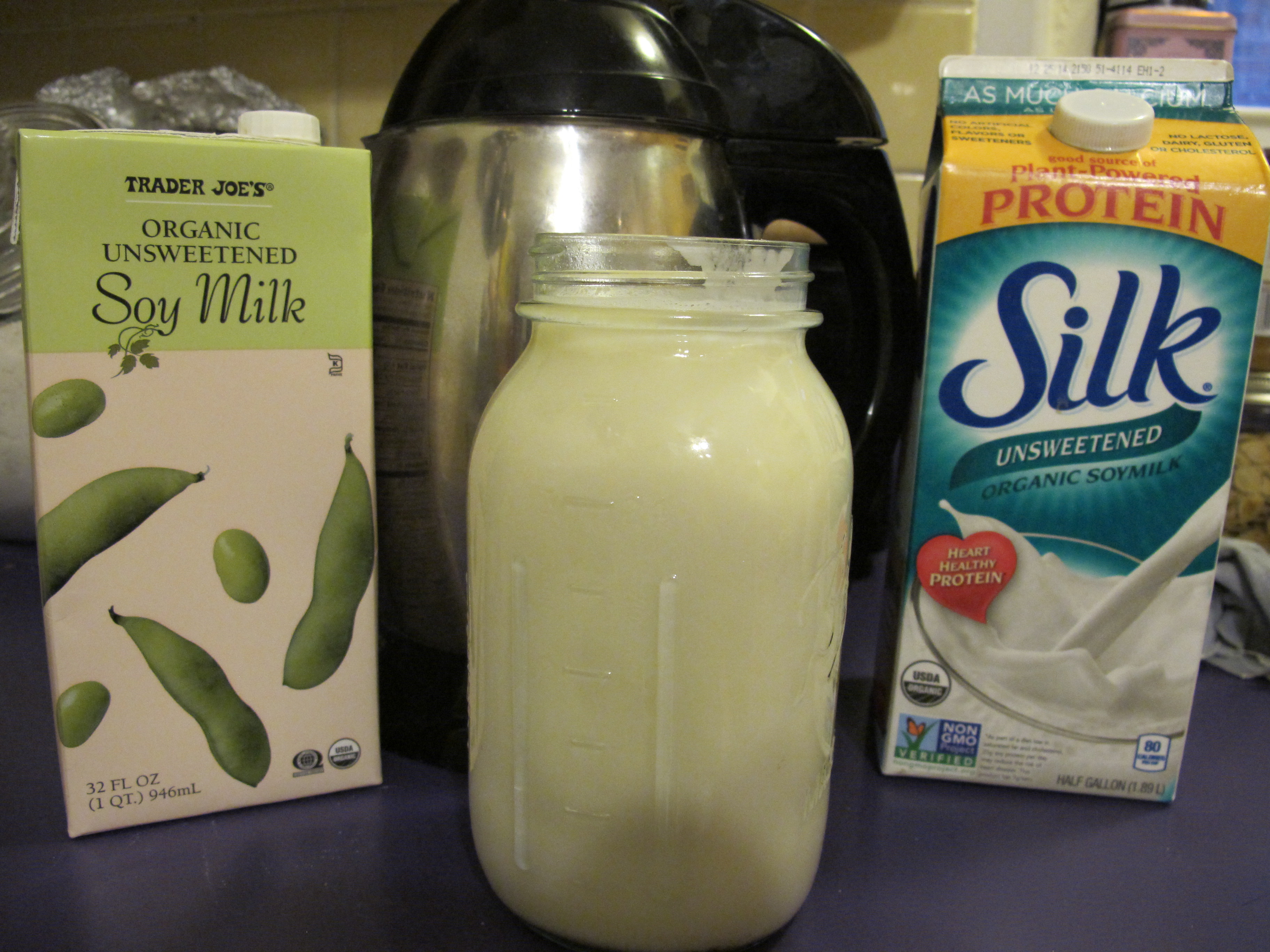
IMG_6053
L to R: Trader Joe’s (sans carrageenan), homemade (with soy milk maker in background), and my beloved, tasty (but maybe not good for me?) Silk

Plus, what exactly is in the lining of those aseptic containers?  Nothing beats a good, old-fashioned glass jar!

When I started questioning carrageenan, my friend again offered to let me borrow her soy milk maker.  The timing was particularly good, because her family had taken a break from using it.  It’s been great getting to try the machine, and the resulting product, before committing to buying an appliance just for making soy milk.

I’ve been experimenting with it for three weeks now.  I’ve tried straight-up soy milk, plus a number of variations: adding coconut cream, a peanut soy blend, a cashew soy blend, and even a version that used some black beans.  Tomorrow, I’ll report back on the results!

Still breathing

I feel like my last post needs some kind of follow-up.  I have a back-log of “regular” posts (at least in my head), but jumping right into, “and here was my experience making soy milk,” doesn’t quite seem right.  So, here we go . . . .

Colorblind
Claiming that one “doesn’t see color” is a cop-out.  First, unless you actually have some type of visual impairment, it’s total B.S.  Claiming that I walk down the street and don’t notice the color of a person’s skin would be like claiming that I don’t notice whether that person is male or female.  Our brains automatically take in and process this information.  Noticing skin color is not good or bad.  It just is.  It’s what we do with this information that is important.

Second, claiming to be color/race blind actually undermines progress in addressing racial disparities.  This article in Psychology Today breaks it down well:

Colorblindness creates a society that denies [minorities’] negative racial experiences, rejects their cultural heritage, and invalidates their unique perspectives . . . . And if you can’t talk about it, you can’t understand it, much less fix the racial problems that plague our society.

Claiming to be “colorblind” insulates us from wrestling with difficult topics like white privilege; disparate police practices, like racial profiling and unequal use of force; and a broken justice system.

White Privilege
Back in September, I requested a copy of Shelly Tochluk’s Witnessing Whiteness.  I was not able to be part of the YWCA-led group that was reading the book.  I started reading the book, but I just couldn’t get through it.  Not because I disagreed with Tochluk or struggled with the concepts, but more due to the writing style.  I think having a group would have helped a lot, in large part because the book just felt so academic.  I wasn’t expecting a “fun” book, but I just couldn’t get into it.  I’m wondering if Tim Wise’s White Like Me, would be a better starting point.

That said, I think one of the better analogies for thinking about white privilege is running a marathon (would like to give credit, but don’t remember where I heard this).  We’re all running the same marathon, but white privilege means that you get to start the race at mile 10, while someone else, just because his/her skin is a different color, starts at mile 0.  And then maybe your course looks a little different as a white person: fewer hills, or at mile 20, you get a “skip to mile 22” card.  Or maybe you’re white and born into poverty, so you don’t quite start at mile 10, but perhaps you start at mile 5 and experience some of the other benefits along the course.

Police practices
Objecting and speaking out against minority deaths at the hands of police officers doesn’t make one “anti-law enforcement.”  The reality is, we have serious problems.  This is not one “bad” officer, in one city.  This is a systemic problem throughout the United States.  The expectation that law enforcement exist to “serve and protect” should not depend on the color of one’s skin, but it does — here are the names and faces.  And it’s enough of an issue that it’s caught the attention of the United Nations.  We have a problem.

In our current “justice” system, police officers are often treated as if they are above the law.  There is little incentive for trying to diffuse situations rather than immediately resorting to force.  If you follow one link here, please read this article, written by a former St. Louis police officer.  It speaks volumes about the issues we face.

If you want to take action, sign this petition to reform how we investigate police misconduct, so police officers are held accountable for their actions.  There are legitimate alternatives to using lethal force (including avoiding escalating things to the point where it’s even considered), but it is becoming clear that without real disincentives to using lethal force, police have little reason to discontinue business as usual.

It would be nice to live in a cozy little world where “police aren’t the bad guys.”  Have I benefited or received help from police officers?  Absolutely!  But your experiences, and the degree to which you agree or disagree with the statement that “police are the good guys,” probably depends in large extent on the color of your skin.  That’s white privilege.  That’s racial injustice.  And it needs to change.


I can’t breathe

As I read the news from New York City yesterday, about a grand jury’s decision not to indict the police officer who choked Eric Garner to death, after the coroner ruled Garner’s death a homicide, my chest was tight.  I recognized my body’s reaction and reminded myself to breathe.  Because I could.  Because no one’s hands were around my neck, cutting off the oxygen that these human bodies require to live.  And with that thought in mind, it was pretty hard to get rid of the tightness in my chest, the rock in my stomach.  As well it should have been.

I don’t know where to start, so I’ll share some words from my friend Dan:

‘To all you people who think of Mike Brown and say, “just don’t assault a police officer and you won’t die,” I give you Eric Garner.

To all you people who think of Eric Garner and say, “just do what the officer tells you and you won’t die,” I give you John Crawford.

To all you people who think of John Crawford and say, “he should not have picked up that gun that was for sale at Wal-Mart and he would not have died…”

To all you people who think of [12-year-old] Tamir Rice and say, “he should not have played with a toy gun…”

I am tired of you waiting for the “perfect” case to understand that this is real. The people that you see protesting are not making this shit up. It is racism. It is real. We have a problem.’

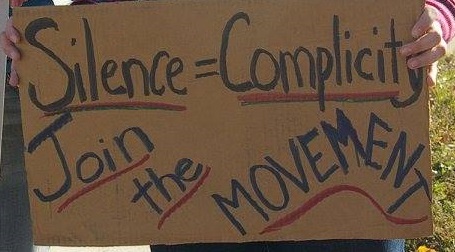
SilenceComplicity
Photo credit: D. Stout

On Saturday, I participated in a small demonstration at a busy intersection in South St. Louis City.  This peaceful action, organized by a local Unitarian church’s “Standing on the Side of Love” group, took place in the same ZIP code where I live: the whitest, wealthiest ZIP code within city limits.  At midday on the Saturday following Thanksgiving, this intersection, near a Target, Schnucks, and other retail locations, was hopping.

Within minutes of gathering, a woman stopped at a red light told us that we needed to “go back to Ferguson.”  She continued to try to engage those in our group, blocking traffic in the right travel lane through at least two light cycles.  How dare we bring this issue to her nice, quiet, monochromatic neighborhood?!?  How dare we stand there quietly on the sidewalk making her feel uncomfortable?

Not long after that, the police swarm began.  My friends who were walking to join us saw ten police SUVs speeding down the street with their lights on.  Before long, our group of 30 or so demonstrators had attracted an equal number of police vehicles, each vehicle carrying multiple officers, for a likely ratio of 3 [fully armed, riot-gear equipped, zip-tie handcuffs at the ready] police officer to every 1 demonstrator.  Oh, and some National Guard thrown in the mix, just for fun.

Two officers came over to talk to one of the organizers.  I don’t know exactly what was said, but I guess they decided to “let” us stay (on the public sidewalk, where we were breaking no laws), though they had no intention to de-escalate the police presence.

It was an interesting ninety minutes.  We received a number of friendly honks (as a bicyclist, you get good at discerning these) and waves, but there were certainly nasty looks and comments (shouted from the safety of cars) as well.  These, to me, showed that the organizers had picked a good location for this action.

We had a single incident of a very riled-up man (red sweatshirt guy) jumping out of his car to confront us.  The following minutes were tense.  Most of the group wisely chose to not engage, leaving the discussion to a well-prepared organizer.  Red sweatshirt guy finally calmed down, and before he left, I overheard a fellow demonstrator sharing his story, his experiences, of being a middle-aged black man, harassed by the police (on multiple occasions) for no reason.  Red sweatshirt guy actually seemed to be listening.  I have hope that, just maybe, a tiny seed was planted.  Face-to-face encounters, where we actually listen are SO important.

As planned, the demonstration ended after ninety minutes.  As Matthew and I walked back to the library, where we’d left our bikes locked up, I couldn’t help feeling a bit like one of the disciples, waiting for someone to say, “Were you with [them]?  I think I saw you with [them].”

I’d naively assumed that most of the police that responded had quietly slunk away, but no, they were just one parking lot over.  We had to walk right by them.

1129141252-00

This photo probably shows about half of the police vehicles that responded.  The rest were staged across the street in another parking lot, with the National Guard.

At the time, I had not yet read about police response to demonstrations after the no indictment decision, including injudicious use of tear gas (a chemical weapon).  Amnesty International has sited some specific concerns about police use of force against protestors here, based on reports from their trained, on-the-ground observers.

These first-hand accounts are also important:

____________

At best, the system is broken.  At worst, it’s working as designed.  Militarized police acting on decades of inherent racism, wielding weapons against unarmed people with impunity. My chest is tight.  But I can still breathe.  Unlike Mike Brown, unlike Eric Garner, unlike Tamir Rice, I can still breathe.  And so I will continue listening to stories that are hard to hear, will continue to feel uncomfortable with the privilege my skin color confers, will continue to feel sick at the injustices that just. keep. coming.

Mindfulness: Changing my brain

Last week, I was excited to see a link to a study which found that mindfulness practice (specifically the 8-week Mindfulness-Based Stress Reduction (MBSR) Program) actually changes the brain.  Turns out that the study is old news (from 2011), but it was the first I had read about these specific findings, which used before and after MRIs to look for changes in specific regions of the brain.

The analysis of MR images, which focused on areas where meditation-associated differences were seen in earlier studies, found increased grey-matter density in the hippocampus, known to be important for learning and memory, and in structures associated with self-awareness, compassion and introspection. Participant-reported reductions in stress also were correlated with decreased grey-matter density in the amygdala, which is known to play an important role in anxiety and stress.

The use of imaging just adds to the already large body of evidence that supports mindfulness practice for both mental and physical health.

My Practice
I can’t believe it’s been over a month since my last mindfulness class!  At that class, the instructor invited us to set short- and long-term goals related to our practice.  My short term goal was to make/find a journal to record my ongoing practice, since I suspected the accountability of recording my practice would be important.  I went with functional over fancy: a two-pocket folder with prongs and some lined notebook paper.

With my short-term goal accomplished, it was time to tackle my long-term goal:

For the next three months, I will engage in formal mindfulness practice for at least 25 minutes per day, 5 days per week.

I finished the class having logged six weeks of regular mindfulness practice.  It was important for me to set a goal that would keep that momentum going and increase the chances that this would be a lifestyle change and not simply a phase.

Five weeks into that three month goal-period, I am happy to report that I’ve been sticking sticking with it, which included maintaining the practice over the holiday weekend (so important!).   I am averaging 25-30 minutes per day, six days per week (I almost used six days per week as my goal, but in the interest of making sure the goal was realistic and achievable, and increasing my chances at feeling successful, I stuck with five days).

I rotate between simple seated meditations (just focusing on the breath), with or without guidance; the body scan; and mindful [guided] yoga.  I’ve also branched out a bit, incorporating some of Tara Brach’s guided meditations in some of my sitting practices.

Even on the days when making time to practice is a challenge, it is always worth it.  Some days, I feel fairly calm and centered throughout the practice.  Other days, those 25-minutes feel like a constant effort of bringing my mind “to heel.”  Such is mindfulness practice.

While not one of my official, written goals, I would very much like to build on my half-day mindfulness retreat experience (and my practice, overall) by participating in a longer retreat.  To that end, I am investigating nearby weekend-long mindfulness retreat options.

While a bit belated, I would like to give thanks [again] for discovering mindfulness, for my mom’s gentle encouragement, for Matthew’s support, and for the resources (money, time, transportation) to participate in Masterpeace Studios’ Mind-Body Stress Reduction Program.


Happy cold weather biker

I’m feeling a lot more optimistic after getting out on the bike two days in a row.  Gabriel came along for the ride both times.  Despite the title of the post, yesterday morning’s trip was actually made in balmy, 42°F temps, but today really was cold.

I had originally planned to use the bike for our afternoon outing yesterday, and the car for our morning outing (which included returning some large-ish items to the store), but when I stepped outside in the morning and realized how warm it was, combined with the fact that temperatures were supposed to drop during the day, I flip-flopped those plans: bike in the morning, car in the afternoon.

Someone had to deal with some disappointment at the change in plans: “But I want to go in the caaaarrrrr!”

Tough luck, kid!  He perked up when he realized that the bike was taking us to the same destination as the car would have (Rise Coffeehouse).  G loves this space for the second floor play area.  On the third Wednesday of the month, there is also music time with Celia.  We arrived early and had the play area to ourselves for a bit, but come music hour (10-11am), the place was PACKED!  Celia won my heart with a song about bicycles, written by a young friend of hers ❤

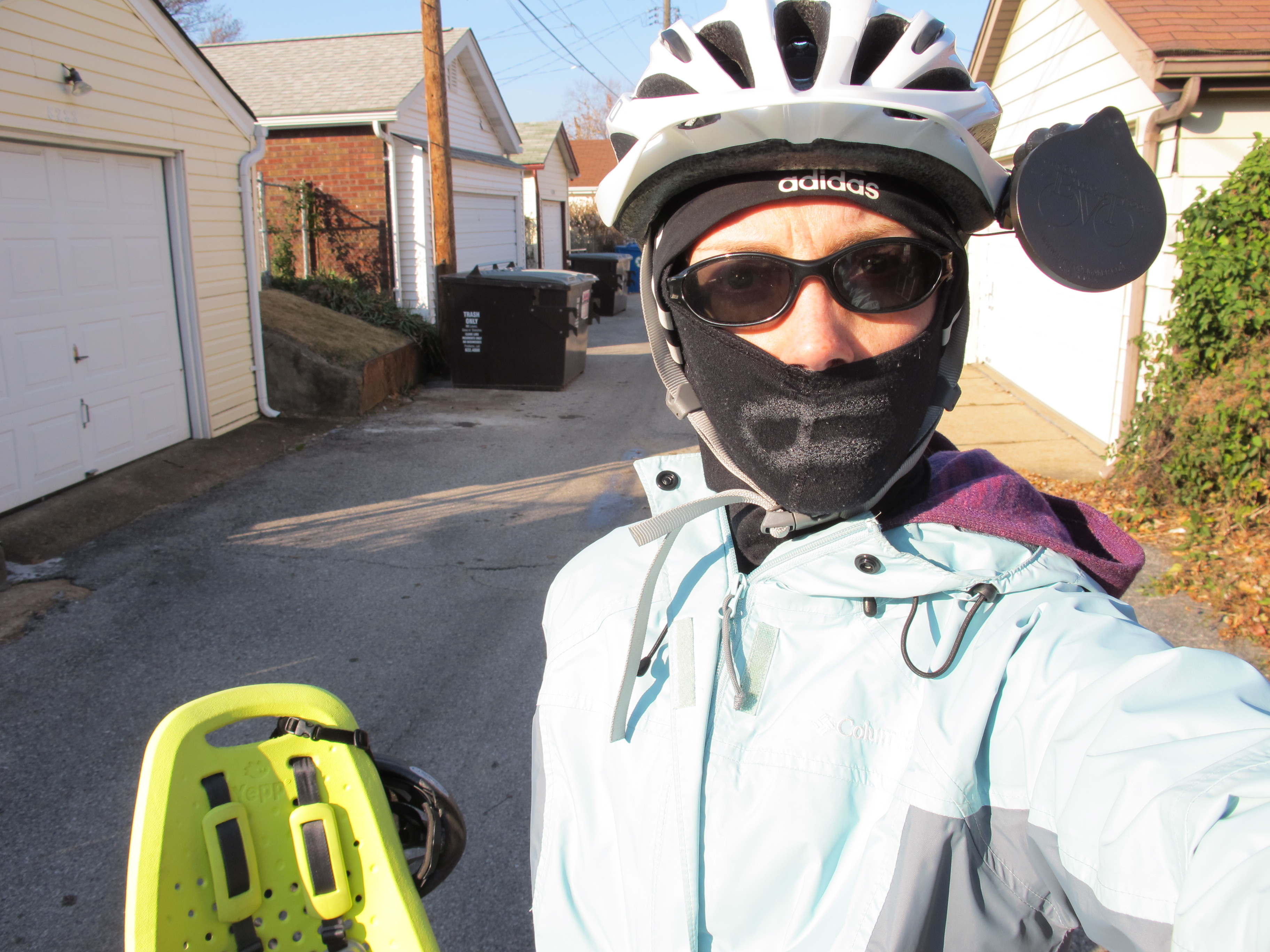
Today’s outing definitely counted as cold-weather biking (~20°F, with a slightly cooler wind chill).  We bundled into our layers.

IMG_6025

I’ll have to update with a photo of G later.  For now, you’ll just have to look at my [frosty] face.*

Gabriel’s Cold Weather Bike Layers:

  • socks
  • long underwear (just fitted cotton pajama pants and top)
  • leg warmers (to make sure there’s no gap b/w socks and pants)
  • regular pants
  • sweat shirt or sweater
  • down jacket (warm, but not super puffy)
  • balaclava
  • hat
  • insulated mittens
  • rain boots
  • scarf (covering most of his face)
  • sunglasses

We might upgrade to snow boots (his pair from last year are too small), but I also think we could stick with the rain boots, especially if we add a pair of thick, wool socks.

We use the sunglasses to keep the cold wind out of his eyes, and protect that part of his face a bit.  My MIL bought him a pair of ski goggles, which he likes to wear . . . around his neck.  He refused to have them anywhere near his eyes this morning, so we stuck with the sunglasses (choose your battles, right?).

IMG_6026

I’m still just wearing a light jacket (over layers), instead of my winter coat, but I did pull out the snow boots today.  They come up high enough on my legs that I can just tuck my pants into them instead of worrying about wearing leg bands to keep my pants away from the bike.  The combination of the boots and a double layer on the bottom made me feel rather slow and clunky when riding, but when it’s cold, staying warm is what matters.

Finally, I noticed over the last few days that the few remaining patches of ice on the streets are located . . . can anyone guess?

If you guessed, “near the edge of the road,” you’re spot on!  While black ice can happen anywhere, this observation is yet another reason (on a looooonnnggg list) to NOT ride far to the right!

*That’s my new helmet-mounted mirror, which I’m not really crazy about.  We’ll see if I warm up to it . . . .