How I ride: Summer footwear

In the fall of 2010, after I enjoyed biking around Chattanooga in sandals, I relaxed my “only bike in closed-toe shoes” policy, and started biking in sandals.  Sturdy sandals with backstraps (my Birks and Tevas), but still, sandals.  It felt great in the summer, and it was convenient.  Sandals looked better with skirts or capri pants, and, if I was headed to a destination where I wanted to wear sandals, I didn’t have to worry about wearing tennis shoes, changing into sandals, and lugging my shoes around.

This practice lasted for about two years, then came to a screeching halt when Matthew had a bike crash (a solo fall, due to a structural failure in his bike) in the fall of 2012.  He was wearing his Teva sandals at the time, and, other than a few scrapes, his sole injury was a sprained big toe.  Sounds like a little thing, but it was a fairly bad sprain, and it turns out it’s rather difficult to walk when one of your toes is out of commission.

Since wearing closed-toe shoes almost certainly would have prevented this injury, I reluctantly reverted back to my former policy.  But I wasn’t satisfied — there had to be some middle ground, something closed-toe (and comfortable) that looked halfway decent with skirts and dresses.  I tried [close-toed] Keen sandals, but I didn’t like the way the foot bed felt with bare feet, and I wasn’t crazy about the appearance.

At the end of last summer, I purchased a pair of Mary Jane-style Crocs.  They were comfy and decently attractive, but after a few rides, I decided they weren’t quite what I was looking for.  They met the letter of my closed-toe policy, but with thin, very flexible soles, they didn’t feel terribly protective.

I wore them a few more times this summer, but the hunt continued.  (The purchase was not a total waste — I like walking in the Crocs.)

After researching and considering, I narrowed my selections to Keen and Chaco Mary Janes.  When I went to order various styles and sizes to try, I saw a third brand, Jambu, that looked interesting.

CuteBikeyShoes2
REI order

The Jambu’s from REI were cute, and also on sale for half off.

IMG_5804

Alas, the toe box was just a bit narrow (on the big-toe side).  You know, more of a “traditional” shoe shape, and less of a foot shape.

IMG_5802

I put on the Keen Siennas, and they seriously felt like slippers.  I was nearly sold, but I was still awaiting a Zappos order with some other options.

CuteBikeyShoes

When this order arrived, I tried on the Jambu shoes, knowing that they were likely already out, due to the toe box fit, and that was indeed the case.  The Keens in my Zappos order were VERY similar to the Siennas, despite being a different model.  Then there were the Chacos.

IMG_5812

The Chacos had the same, immediately comfortable feeling that I’d loved in the Keen Mary Janes and similarly good toe box shape.IMG_5814

From left to right: Keen Sienna, Chaco Petaluma, and my Crocs.  The Chacos seemed wide not just in the toe box (where I wanted the room), but throughout the rest of the shoe (where I didn’t want the room), so the Keen Siennas won.

I wore them on the bike for the first time on Sunday.  The foot bed didn’t feel quite as great once my feet were sweaty, but it wasn’t bad, either.  They have a thick, firm sole, and the extra bit of rubber covering the toe, and the strap keeps them on securely.  Something about them (perhaps the open top?) makes these feel less protective than a tennis shoe, but I’m not sure I’m going to find anything better (that also fits the look I’m going for).

When it comes to bike apparel, I think it’s about finding a happy medium.  Could I be wearing more protective shoes?  Absolutely!  I could, for example, wear nothing but steel-toed boots when I ride my bike.  My feet would be really, really safe, but I would probably be pretty uncomfortable.  I also know plenty of people who enjoy biking in sandals (or dress shoes), but that’s just not me, at least not right now.


Stuffed peppers

One for my foodie readers (I know it’s been a lot of bike stuff lately, but that’s life!).  Anyhow, I was beginning to despair of ever having peppers, and then, voila!  Grocery bags full of gorgeous sweet peppers!

We also had a few large green bell peppers, which Matthew suggested stuffing.  I made these based on [a vegetarian adaptation of] his grandmother’s recipe.*

In the interest of not reinventing the wheel, the recipe here is adapted from the stuffed zucchini recipe I shared earlier this summer.  To make this recipe similar to Matthew’s grandmother’s recipe, simply use tomatoes for most of the veggies to make a nice amount of tomato sauce.  Thicken the sauce with a couple tablespoons of flour, which you mix in with the sauteing onions and other veg before adding the tomatoes. IMG_5805

Stuffed Peppers

Recipe by Melissa
Serves 4-6

INGREDIENTS

4-6 large bell peppers, any color
1 onion
6 cloves garlic
1.5 c. uncooked grain (brown rice, quinoa, millet, farro)
1 c. cooked lentils or 1 8oz package of tempeh
4-8 c. vegetables of choice (tomatoes, peppers, eggplant, kale or spinach, fennel)
fresh or dried herbs (thyme, oregano, parsley)
4-6 oz. cheese, cut into small cubes (I used Havarti and Gruyere)
olive oil and/or butter
salt and pepper

Directions

1. Prep the peppers: cut off the tops, and scoop out the seeds.  Bring a large pot of water to a boil.  Parboil the squash for 1-2 minutes (it doesn’t take long with these guys), until slightly tender.  Drain well.

2. Prep the grain.  To up the flavor, add a bit of salt, plus some onion powder and a pinch of tumeric to this step.  If you want to conserve water and energy, use some of the already-heated water from step 1 to cook the grain.

3. Prep the veggies: You want everything fairly tender and ready to eat.  Chop everything into bite-sized pieces.  Sauté onions, then add other veggies to sauté.  I used a mix of butter and olive oil, plus about 1/2 t. of salt.  If you’re using tomatoes, you can just throw the chopped, uncooked tomatoes into the filling, or cook them down into more of a sauce.

4. Prep the tempeh, if using: I basically followed the method I use to prep tempeh for vegetarian reubens, except I crumbled it up first, instead of leaving it in a slab.

5. Combine it all: In one large pan or bowl (one of the ones that’s already dirty is fine, if it’s big enough), combine everything from steps 1-4.  Toss in any herbs.  Taste for overall salt and flavor level, and adjust as needed.

6. Stuff it and bake it: Preheat [toaster oven] to 400F.  Arrange peppers, open side up, in a baking pan (for four peppers, a bread pan worked well, and allowed me to use the toaster oven).  Sprinkle halves with salt.  Add the stuffing.  Bake for 15-20 minutes — long enough for cheese to get melty and flavors to meld a bit.

*The original recipe uses ground beef in place of the cheese and tempeh.  My MIL’s veg adaptation uses all cheese.  This version lightens it up a bit by replacing some of the cheese with lentils or tempeh.  Matthew said it was good, but he still wants the cheesy version sometime.

Tired tires

Last week, I concluded my “Crazy Days” post with, “. . . and I’m hoping that’s the end of the excitement for the week!”  Apparently I tempted fate just a bit too much with that statement, as Friday brought more “adventures.”

Car tires
After the flat brought our attention to the fact that the 8-year-old tires (with ~55k miles on them) on our car were no longer road worthy, we did our research, selecting both a new tire and a local place for installation.

On Thursday morning, I made the appointment for nine on Friday morning, planning to bring work and a book and just wait there (for about 90 minutes) while they worked on the car.  I arrived at nine, handed over the key, and headed to the waiting area.

About thirty minutes later, one of the front office guys came in and told me that the new tires were still on a truck on their way to the shop, but that they should arrive in about forty minutes.  Thinking I’d still be out of there by 11am, I opted to wait.

Around 10:30am, with a dead laptop battery and no power cord (I didn’t think I’d be there long enough to need it), I went in search of an update.  Still no tires.  With lunch looming, and no definite end time, I accepted a shuttle ride home, after they agreed to deliver my car to me [at home] when the work was complete (which they don’t usually do).

Three-thirty rolls around and still no car.  At this point, it made more sense for Matthew to bike to the tire place on his way home from work and grab the car rather then them delivering it.  I called the shop to relay this change in plans; to make sure that we would, in fact, be getting new tires before the day ended; and to see if there was anything they could do for the inconvenience.  I mean, why do you SCHEDULE someone for an appointment without having the parts?

On the phone, they offered to give me their “tire protection plan” ($30 value) for free, as well as knocking $20 off the cost of the alignment.  Not quite what I’d been hoping for, but better than nothing.

Sometime between that phone call and Matthew arriving to pick up the car, someone must have had a change of heart, because they also ended up essentially giving us one of the tires, including installation, for free ($120 value).  Now that’s good service!  (With a 90k mile lifespan, these tires will probably outlast our car.)

In the meantime . . .

Bike tires
With Baby Jake permanently out of commission, I’m reduced to 1.5 bikes — BUB (my back-up bike) and Big Blue, which I consider half a bike because Matthew and I share it.

BUB has been sitting in the basement, unridden, since the end of April, when I loaned out the IBert seat in anticipation of Big Blue’s arrival.  I’m not exactly sure when I’ll get around to deciding on and acquiring Baby Jake’s replacement, so on Friday, I pulled BUB out of the basement.

Matthew and I were planning to meet for a yoga class on Friday evening, so I aired up BUB’s tires, did a quick check of the bike, and headed out.

I was about a mile into the two mile trip, when I heard a funny sound from the rear of the bike.  I had a split second to prepare to pull over and see what was causing the noise, when, BOOM!  The rear tire had a complete blow-out (I’ve had flats before on my bike, but never a blow-out like this).

Fortunately, I was traveling slowly when it happened and I was able to maintain control of my bike (may have also helped that it was the rear tire, rather than the front).  Unfortunately, I was a mile away from my destination (and from home) with a spare tube but no air pump, and a heavy hybrid bike.  Oops.

I called Matthew for a rescue ride (in the end, it worked out well that the car tires took forever, otherwise he wouldn’t have had the car at this point), and continued walking, lugging the bike, in the direction I’d been riding.  After awhile, I gave up attempting to carry the bike and wheeled it along, knowing that I was risking damaging the tire, but not really caring.

When I pulled the wheel off the next day, the tire showed signs of dry rot (I didn’t think the tires were that old, but I guess I was wrong), so instead of just patching or replacing a tube, I set out to buy replacement tires.  (I’m still not sure exactly what caused the flat — no signs of anything that punctured the tire and tube, nor anything obviously wrong with the rim.)

It’s been quite awhile since I’ve dealt with a flat (you get them much less frequently when you avoid riding on the edge of the roadway, which is where you find most of the debris that causes flats), so it took me awhile to put on the new tubes and tires.  I was starting to think I should have just paid someone at the bike shop to do it, but it’s a relatively easy task and a useful skill to have.

In the process, I couldn’t help but notice that BUB is due for a tune-up, and likely replacement brake and derailleur cables.  I’ll probably continue to use her for short trips, but limit rides to small streets and distances of no more than a mile until those issues are resolved.  This will limit my two-wheeled mobility on days when Matthew has Big Blue, adding some extra incentive to decide on Baby Jake’s replacement sooner rather than later!

Apathy, incompetence, and inattention on our roads — Part 2

It’s clear we have a problem.  What’s the solution?  In a word, complicated.

Part of the problem, of course, is that over the last 50-60 years, we built a massively car-dependent country and culture, and that wasn’t an accident:

Through the effective lobbying of a special interest group, the Automobile Association, our public roads were hijacked to serve the needs of the few. As this special interest group lobbied on, public transportation was effectively swept out of main stream use. All public roads, including the very ones in front of our residences have been made to feel unsafe and to be unsafe for anyone who wished to use them without the use of an automobile.*

Except for people living in urban centers with transit, and the small mode share of cyclists and pedestrians, most people cannot conceive of getting anywhere without a car.  And many of those people are right — they are in a car-dependent situation (whether it’s driving a car themselves or being driven).  If you take the keys away from grandpa or your teenage daughter, you/they now have to find another way of getting from Point A to Point B:

The minute you hold people accountable for being competent drivers, the percent of the population that will be ineligible to drive a car will be too large to ignore.

We can ignore [those] who have fallen on hard times and can’t afford to drive. [They] are easy to marginalize. But when we eliminate the high risk populations (teen-to-mid-twenties who lack maturity for good judgment; the elderly who no longer have the cognitive ability or reflexes; and the recidivist, irresponsible [people] who seem to retain a valid license even after proving time and again they don’t deserve it), then we’re looking at a population too large to marginalize. We’re not willing to do it because we’d have to rethink our lifestyles.”

In a way, we’ve driven and engineered ourselves into a literal dead end here.

DeadEnd

Are we willing to change?  Or do we just accept these lost lives — lives of pedestrians, bicyclists, and motor vehicle occupants — as [yet another] “cost” of our car culture?

Here’s one possible starting point:

If we had the political will to change one single thing that would cause a cascade of positive safety consequences (and probably policy consequences), it would be to increase the cost and rigor for obtaining a license and make it easier for the state to revoke a license from a recidivist offender.**

We can reform drivers’ education and licensing, both standardizing the process across all states (in Iowa, I completed a fairly decent drivers’ ed course to get my license in high school; across the border in Missouri, Matthew had no such requirements), and modeling it on rigorous programs in other countries — we don’t have to reinvent the wheel here.

At the same time, we need to continue the work that is being done to increase transportation options for those who would not have a drivers’ license in the new system (and those who have licenses but crave other options!) and [re]create communities and cities that are not car-dependent.  Fortunately, these changes have benefits that go far beyond making the roads safer: more vibrant communities and local economies, as well as the physical and mental health rewards of active transportation.

Let’s Make a Change!

  • Start at home.
    • Analyze your own driving habits.  Are distractions and/or bad habits endangering your life, those of your passengers, and everyone else you encounter on the road? It only takes a split second for a collision to occur. Reduced attention and reaction time costs lives. Pay attention!
    • Recognize bicyclists as fellow humans and equal road users.
    • Practice patience, whether it’s a slow motorist, a bus making frequent stops, a pedestrian crossing the street, or a woman biking to work. We all have places to go. If we’re aware and respectful, we will all get there.  Breathe.
    • Try an alternate way of getting from Point A to Point B (i.e., making a trip without your car), whether it’s walking, riding a bike, or using transit.
    • Are there people in your life who need to hang up the keys? Here are some good resources:
  • Support policies that call for stricter licensing requirements, better education, and stiffer penalties for offenders.
  • Support investments in public transportation and safe, well-engineered infrastructure improvements.

This is a complex problem.  Change will be neither fast nor easy, but it is possible.

*In addition to recent events, this post was inspired by a discussion in a Facebook group for female cyclists. All quotes here are from that discussion, used with permission.  Thanks, ladies!
** “But you have to have follow-through. A NHTSA page noted that 70% of California drivers with suspended licenses continued to drive. You either have to provide alternative transportation, or lock them up. We’re not willing to do either.”

Replacing Baby Jake — Suggestions, please!

A bike is a really personal thing.  It’s a machine, but because you’re using your body to power the machine, there’s a unique synergy and relationship (unlike driving a car).  It may not happen every ride, but that feeling of oneness between you and the bike is pretty amazing.

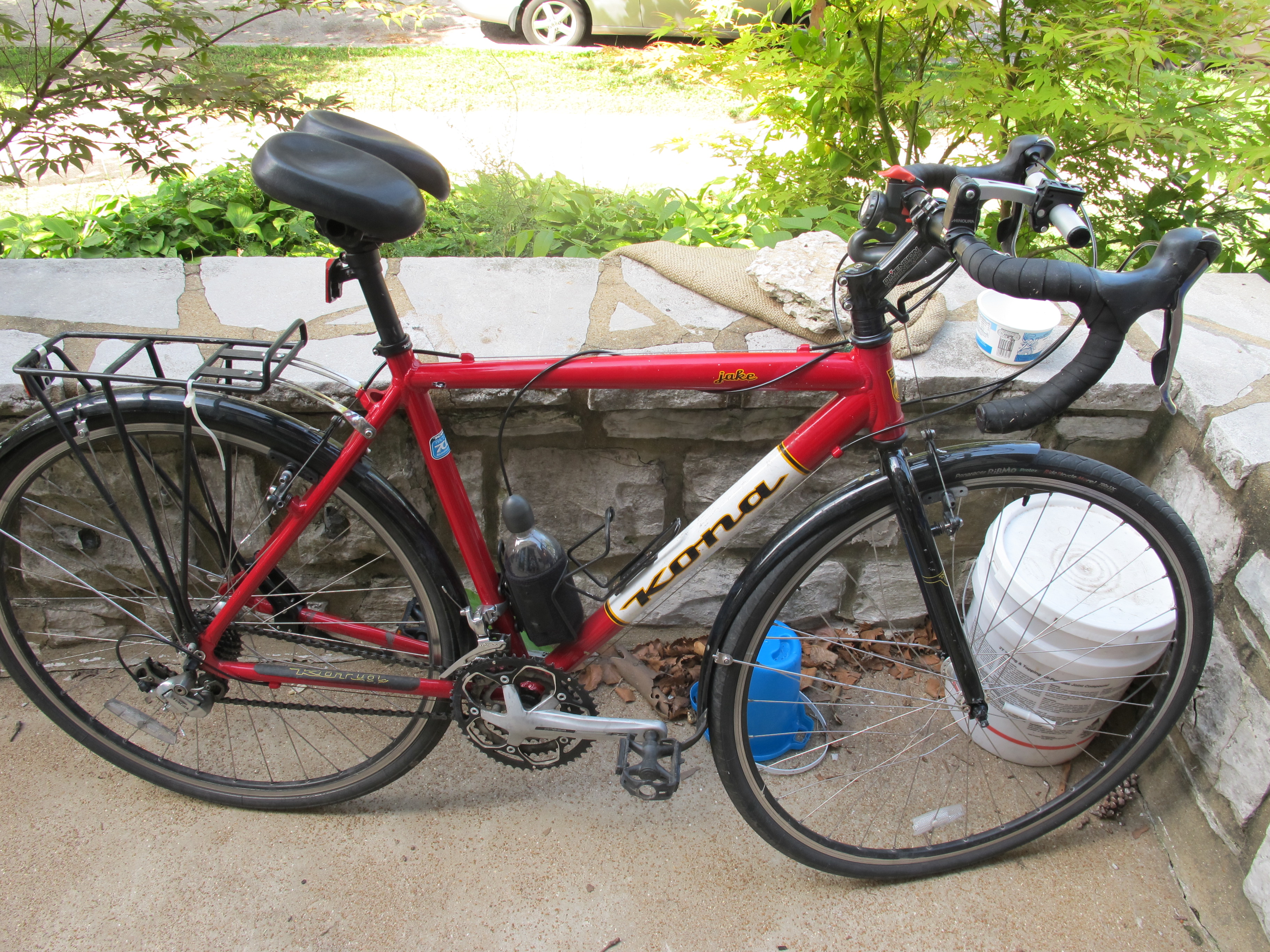
Baby Jake was the first new bike I ever bought (excluding my Wal-Mart bike in college, cringe; I won BUB), and I quickly turned the cyclocross bike into a great urban commuter.

For about a year, Baby Jake and I spent [almost] every work day together — six miles there, six miles back.  When I took my car commute job at the end of 2009, our time together was relegated to errands on the weekends and some evening outings.

Once Gabriel came along, Baby Jake became my trailer puller, but once I got the IBert front seat (which didn’t work on Jake’s frame), I returned to BUB for many rides.

Last Monday, the bike shop declared Baby Jake totaled, due to a bent frame.  It was really hard to photograph the damage, but with the naked eye, it was clear that, at the very least, I would be replacing the fork, front chain ring, bottom bracket and crank, front wheel and tire (and fender), and possibly the rear shifter.  These parts may have added up to the cost of a new bike, in and of themselves, but the bent frame sealed the deal.

IMG_5774

Today, I received the check from the insurance company [of the driver who hit us] for Baby Jake’s replacement.  So now the question is, what to buy???

The 2014 and 2015 Kona Jakes are a bit different than my 2009 version; most obviously, they have disc brakes rather than rim brakes.  They also lack the dual brake levers I enjoyed on Baby Jake (two sets of brake levers, one for a more upright riding position and one in the drops).

So, do I stick with the tried and true and buy another Kona Jake?  Or do I use this as an opportunity to try something a bit different?  Since I purchased Baby Jake, my eyes have been opened to the world of bikes out there, and I’m not 100% set on going with the exact same thing.

Other Options

  • A touring bike — like the Kona Sutra or Surly Long Haul Trucker
    • Pros: Drop bar (which I like in the Jake); should be a comfortable, reliable bike for commuting — maybe more comfortable than a ‘cross bike?
    • Cons: The Sutra is $300-$400 more than the Jake; not crazy about bar end shifters for urban riding (lots more shifting than you would do when “touring,” due to frequent stops and starts) — could I swap for STI shifters?
    • The Novara Safari at REI also caught my eye yesterday, though I’m not crazy about the twist-grip shifting.
  • A folding bike — for example, a Brompton or Bike Friday bike
    • Pros: I would have a folding bike, which has been on my eventually list; with the Brompton, I could add the IT Chair for transporting Gabriel; I should be able to get a model with a drop bar
    • Cons: I don’t really know much about folding bikes — would I really want this for my primary bike???  Also, once designed to my specs, this would probably end up costing significantly more than the Kona Jake.
  • Something else???
    • I do like having at least one “fast” bike with drop bars (but still sturdy for commuting), so I’m not sure what other options there are, but I’m open to suggestions . . . .