Raising a foodie toddler

In response to yesterday’s meal post, a friend asked, “Does your son eat all of these recipes?”  It was a great question, and I want to share (and elaborate on) my reply.

As a note, I conducted childhood obesity research in grad school, so I’m fairly familiar with (and perhaps take for granted) a lot of the basic tips for helping kids learn healthy eating habits.

[Sir] eats almost everything, though with varying degrees of enthusiasm.  Some nights he looks at his plate and announces, “Need mo’ food,” which translates to, “I want different food.”  We always encourage him to try what’s on his plate, and we rarely offer alternatives.

Finishing the meal with some frozen blueberries

When he’s less enthusiastic about something, I’ve found that simple things, like letting him serve himself, or making a slight modification to the dish (e.g., adding some chopped peanuts), can really help.

While we don’t force-feed him, or make him eat everything on his plate, we do sometimes help feed him the first few bites of something he’s uncertain about. If he takes to it, great, if not, that’s okay, too.

Nature or nurture?
All-in-all, he’s a pretty adventurous eater for a toddler. I don’t know how much of this is nature, and how much is nurture, which would include our use of the Baby Led Weaning approach.

We’ve basically offered him the same food he sees us eating, right from the start.  While there’s nothing intrinsically wrong with offering some pureed food, I dislike the new trend of the “squeeze pouches.”  It’s one thing to use one every once in awhile, for a snack on the go, but using them at the table, as a substitute for eating real meals, is a slippery slope.

As pointed out in this post on getting kids to eat vegetables, constantly offering alternatives at mealtime is also a slippery slope.  If given a choice, most kids (Gabriel included, I imagine), would choose grilled cheese or pasta over a quinoa dish.  Offering alternatives is tempting, to make meal time “easier” in the short term, but it can quickly become a cycle that creates the so-called “picky” eater that most parents hope to avoid.

Finally, involving Sir in as many aspects of “food to table” as possible seems to really help.  During the growing season, he spends almost every Saturday at the garden with Daddy and Baba, getting a hands-on lesson in where his food comes from, harvesting and nibbling fresh green beans, broccoli, and cherry tomatoes.  You don’t have to have 3000 square feet of garden to get your kids involved.  A small raised bed is a great place to start!

He loves to help me get his oatmeal ready every morning, and I involve him in other meal prep and kitchen work, time (and my sanity) permitting.  Recently, he’s enjoyed helping tear arugula for salads, though he was eating about as much as he was prepping — just raw arugula, no salad dressing required!  While I’m careful about not snacking close to meal times, I’m always happy when he wants to nibble on the vegetables I’m chopping.

Recent recipe round-up

It seems like it’s been quite awhile since I wrote about food here.  Here’s a look at the last four week’s worth of eats, along with some recipe links.  The table below chronicles what we had for dinner each night.  Lunch = dinner leftovers.

I don’t plan out the week’s dinners at the beginning of the week, but I do sketch out which leftovers we’ll have for lunch on which day.  (On a good week, I start the week with lunches covered through Wednesday).  Then, I base the dinner plans on what we had for lunch, i.e., if we didn’t have beans for lunch, I want to incorporate them into dinner, or, if we had a wheat-based lunch (e.g., bread or pasta), I want a different, non-wheat starch/grain (e.g., millet, rice, potatoes, corn, quinoa, etc.) for dinner.

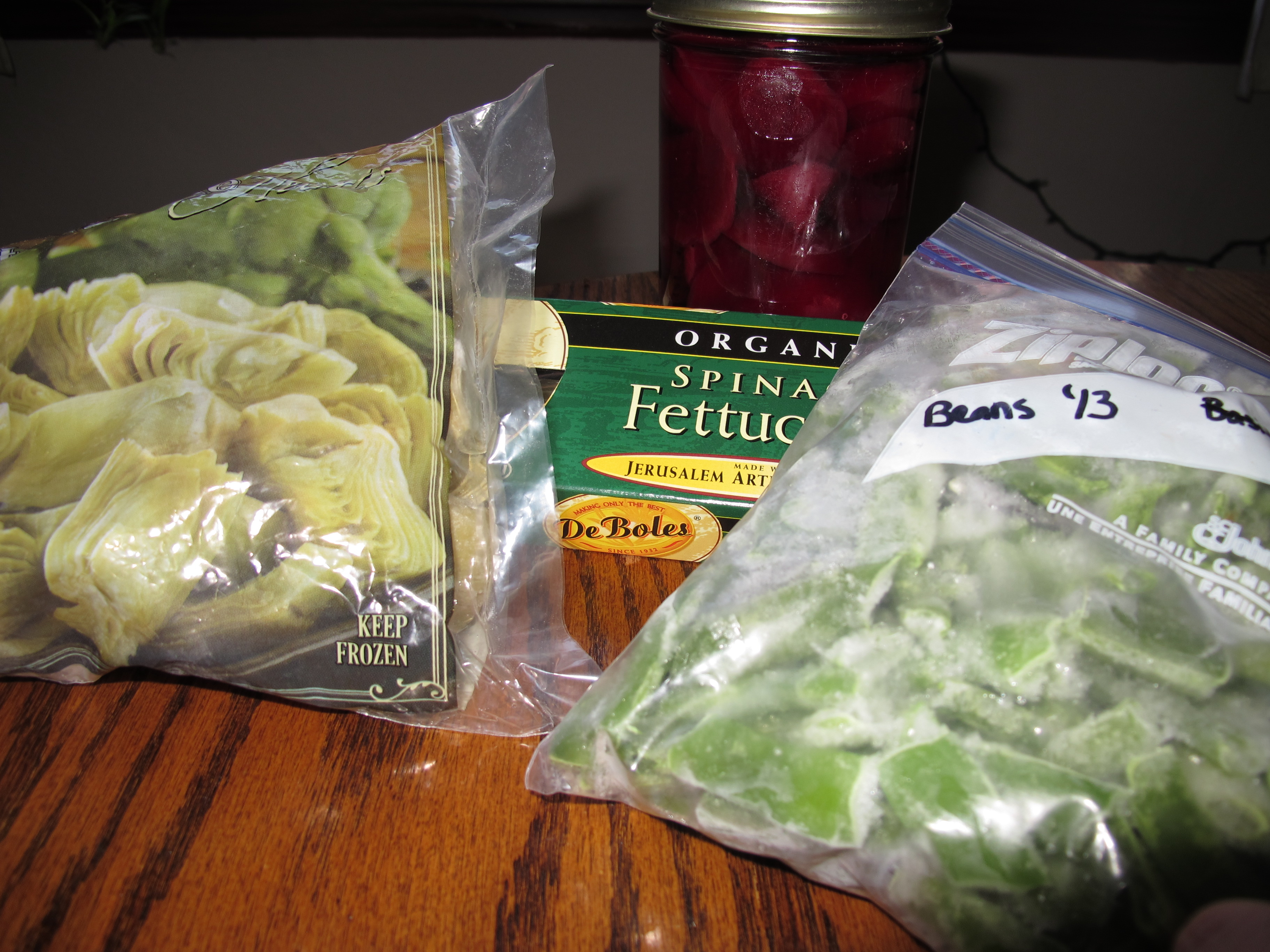
Frozen green beans and canned pickled beets

I’m enjoying the fruits of our labor, using frozen and canned garden produce as a component in many meals, which makes meal prep a bit easier, as well as stored potatoes, sweet potatoes, garlic, and winter squash.  This menu also includes our foray into eating sardines.

MenuTable

Recipe links and sources:

  • Black bean soup
  • Kugel (kind-of a shredded potato casserole-type thing): recipe modified from “Tante Malka’s Potato Kugel Deluxe” in Mollie Katzen’s Enchanted Broccoli Forest cookbook
  • Slaw
  • Fritatta (ours had potatoes and asparagus in it)
  • Snobby Joe’s
  • Spanakopita
Fritatta
Fritatta

Many of those dishes are just things I made up, with no official recipes, so if you’re curious about something, please ask, and I’ll be happy to reply with details and/or work on a recipe post.

Big things from the garden

Exhibit #1: A ridiculously large sweet potato

IMG_3565

Shown with a grapefruit and my hand for some sense of scale, what this guy lacks in beauty, he makes up for in size, weighing in at just over 12 pounds.  He suffered some damage from voles during the growing season, and his growth outpaced their eating.

I made a huge, way-too-thick batch of this sweet potato peanut bisque, which I originally read about over on Spatoola, with half of it.  I roasted the other half in big chunks, and stuck them in the freezer for a future batch of mashed sweet potatoes.

Exhibit #2: Lunga di Napoli winter squash

IMG_3628

Unlike the sweet potato, which was abnormally large, this lunga is rather par for the course for this variety.  It’s just a big ol’ squash.

We sliced and roasted about a fifth of it as a dinner side earlier in the week.  For the remainder, I roasted big chunks to puree into a simple soup consisting of squash, coconut milk, grated ginger, and a bit of salt.  This very simple soup perked up significantly with the addition of some carmelized onions, plus Paul’s beans.

I actually thought this big guy would go further, perhaps yielding some extra puree for pumpkin bread or pumpkin butter.  I guess that will wait for the next squash.

After a failed attempt at pumpkin butter last year, I finally figured it out several weeks ago.  Turns out that it’s pretty simple — you just have to let it simmer for. ev. er.  That’s the trick.  Anyhow, we’re about finished with my first batch, and I’m looking forward to making more.

Food philosophy: Eat your beans

Wow, I feel like I wrote my first “Food Philosophy” post (on fad diets) yesterday, not two months ago — time really does fly!  In that post, I mentioned beans as an innocent victim of low-carb diets.

Beans (as in legumes, dried or canned) are a fabulous food: high in fiber, good source of vegetarian protein,  and easy to store and transport.  Despite being vilified by some diets because of their high carbohydrate levels, they are a low Glycemic Index (GI) food, another factor in their favor, since low-GI diets are associated with reduced risk of a number of chronic diseases (including heart disease and type 2 diabetes).  In short, a food’s GI is a measure of how a particular food impacts blood sugar levels when consumed (you can read more about GI here).

The variety of beans is almost endless, and they can be prepared in many ways.  I try to incorporate a serving of beans (1/2 cup cooked beans) into at least one meal a day, which is relatively easy, with a bit of planning.

In grad school, I ate some variation on beans and rice for lunch almost every day.  I prepared a big batch at the beginning of the week, and had a cheap, nutritious, portable lunch easily at hand.  These days, the recipes are often a bit more complicated, but I enjoy going back to that staple, as in this oven-baked twist.

IMG_3313[1]

Something about sitting in a hot oven for 45-minutes really elevated the flavor, making it almost creamy and cheesy (though no cream or cheese were involved).

Dry vs. Canned
Canned beans are convenient, but because of the BPA in can linings, I almost exclusively buy dry beans.  I can also buy dry beans in bulk, reusing my own bags, with little to no packaging waste.  You can read my full list of advantages of dry over canned in this post.

I rarely use the brining method for preparing dried beans mentioned in that post anymore.  First, it requires a quick soak, which uses more energy than an overnight soak.  Second, it wastes salt.  Sure, salt it cheap, but I realized I could get nearly the same effect (nicely salted beans) by doing a regular soak (either quick or overnight), cooking and draining and beans, and then adding salt directly to the hot, cooked beans and letting it soak in a bit before using the beans.

Quick tip: prepare twice as many dried beans as you need for a recipe/meal.  Freeze the extra cooked, cooled beans in a quart-sized freezer bag, and they’re ready when you need them, almost as fast as opening a can of beans!

Eat your beans
Until recently, if asked, I probably would have said that chickpeas (AKA garbanzo beans) were my favorite legume.  They still rank high, but over the last year, two other legumes stole my heart: lentils and cowpeas.

Lentils (or dal, in Indian cooking) rank high for their versatility.  I love blending well-cooked lentils into a variety of soups to make a hearty base.  They are also fabulous in chili (recipe post languishing in draft form).  Lentils also star in Snobby Joe’s, a vegetarian take on Sloppy Joe’s.  Unlike other legumes, many types of lentils don’t need to be soaked before cooking, so they’re great in a pinch, when you realize you forgot to soak beans for dinner.

Cowpeas come in an amazing number of forms.  If you’ve eaten black-eyed peas before, then you’ve had one type of cowpea.  Matthew grew one variety last summer (and Gabriel helped shell them).  Our harvest was enough for just a few meals, but they were delicious.

IMG_3610

For the past few years, we’ve been fortunate to have a local source for some of our beans.  Paul at Bellews Creek Farm grows two types of [dried] beans every year, usually black beans and something else.  This year, the “something else” was a type of cowpea: a pink-eyed cowpea.

Both varieties of cowpea — what we grew in our garden, and the pink-eyed peas from Bellews Creek — rank among the most flavorful beans I’ve ever had.  While I’ve incorporated them into a number of dishes, I also enjoy then straight-up, with just a bit of salt.  If you’re in StL, look for Bellews Creek beans in the bulk bins at Local Harvest Grocery.  Seriously, try some!

I hope to have that lentil chili recipe ready soon, but in the meantime, check out the other bean-y recipes on my recipe page.

Smells fishy . . . and I’m eating it

I’ve been toying with the idea of adding sardines to my diet for a few years now.  While I was pregnant, I took a fish oil supplement for omega-3s.  I decided I wanted to try some kind of fish-based source of omega-3s again.  A bit of research showed that you get more benefits from eating actual fish than from taking fish oil supplements – not surprising, as this is true of many nutrients: better from real food than from a pill.  So I decided to take the plunge.

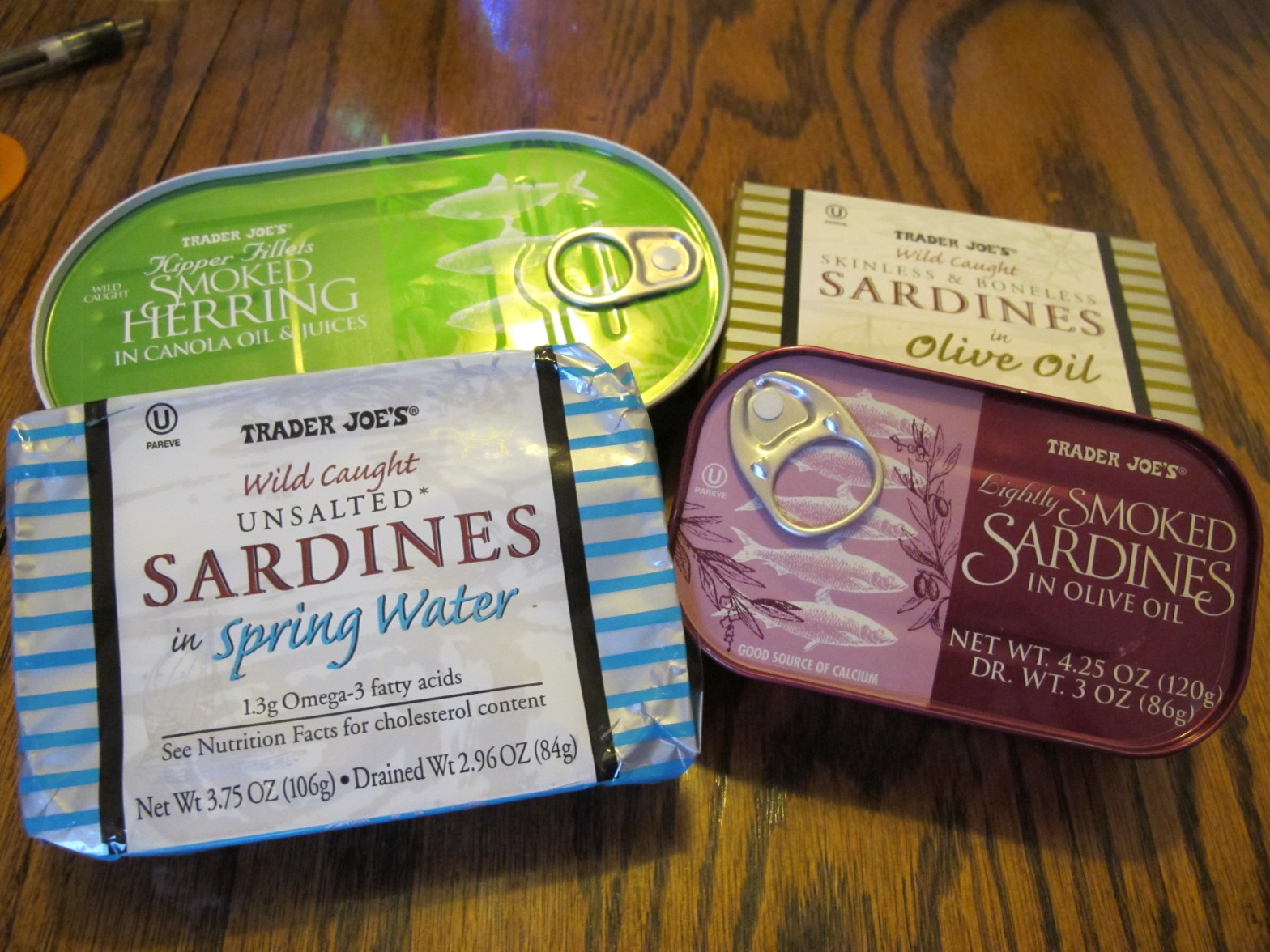
Two weeks ago, Matthew picked up a few tins of sardines for me.  I rather thought he would come home with one or two cans, but when he pulled out four (different varieties), I figured that would force me to try them enough to make a fair judgment and get over any initial uncertainty.

Sardine Trial (all from Trader Joe’s):

  • Wild Caught, Unsalted in Spring Water, 1 serving (2.96 oz.), 1.3g omega-3/serving
  • Wild Caught, Skinless, Boneless in Olive Oil, 1.5 servings (~2 oz/serving), 1.2g omega-3/serving
  • Lightly Smoked in Olive Oil, 1.5 servings (2 oz/serving)
  • Smoked Herring in Canola Oil 2.5 servings (~2 oz/serving)

IMG_3590[1]

I started with the Wild Caught, Unsalted.  As soon as I opened the tin, I was met with a very strong fishy smell.  The fish oil supplements were looking better and better.  Despite the claim that a single serving was the entire tin, I started with about 1/3 of the contents, mashed up with some dill potatoes.  It was awful.  I thought this wouldn’t be a big deal, because I used to eat canned tuna, but blech!

In the interest of giving it a fair shake, and giving myself the chance to get used to a new taste, I turned the rest of the tin into sardine salad by adding some mayo, mustard, plain yogurt, celery, onion and garlic powder, lemon juice, and salt.  Still awful, really, but over the next two days I managed to choke it all down on crackers.

At this point, I debated donating the three remaining cans to a food pantry.  I knew once I opened another tin, I would feel obligated to finish it, and did I really want that?

Not ready to call it quits, I decided to try an actual recipe, using the Wild Caught in Olive Oil to recreate this sardine pasta recipe (I used just one tin — half the amount of sardines the recipe calls for).  As soon as I opened this second tin of sardines, I realized it is true that not all sardines are created equal.  While this variety still smelled fishy, the scent was distinctly less strong than the first variety (reminded me of canned tuna) – a good sign.

I actually really enjoyed the pasta dish.  Gabriel gobbled it right up, too.  Matthew ate it, though he was a bit dubious (both of them missed out on that first awful tin of sardines).

I have yet to try either the smoked sardines or smoked herring, but I’m optimistic that the smoky flavor will make them seem less fishy.  I will probably try another round of sardine salad with at least one of these tins.

Environmental and health considerations
Tiny fish lower on the food chain (like sardine and herring) have less chance to accumulate toxins, like mercury, so they are one of the healthiest choices if you want to eat fish.

Both sardines and herring are on the Marine Stewardship Council’s list of best seafood to consume.  But, again, not all sardines are created equal when it comes to environmental impact, and I’m afraid most of what we bought from TJs falls into the Mediterranean, “avoid due to overfishing category.”  Apparently, I need to be looking for the Marine Stewardship Council’s blue label when I shop.

The packaging is a major down side of sardines.  First there is the obligatory tin (recyclable, yes, but still using resources).  Then, for two out of the four varieties I tried, the tin alone wasn’t enough.  One had a plastic outer wrapping and another was in a cardboard box – excessive packaging to be sure.

Real food vs. supplement
Not sure where I come down on this one.  If the omega-3 fats are truly better absorbed from the fish, that is a big plus, assuming you can stomach the fish.  On a per serving basis, the fish oil supplements generate much less waste.  It would probably take more than 30 tins of sardines to get the same number of servings as in a bottle of supplements.  This also makes the real food version more expensive, dollar-wise, than even a high quality supplement.

Practically, I don’t see myself eating sardines every day, while taking a supplement every day is relatively easy.  For now, I plan to combine the two, perhaps trying to eat some sardines once or twice a week, and take a low-dose fish oil supplement most days (still need to buy the supplement.

While not a realistic expectation, I’m a little bummed that my first “dose” of sardines didn’t make me feel like superwoman.  Ultimately, to maintain the added cost of either sardines or supplements, I would like to see some kind of results.  While not necessarily linked, there is some chance that the additional omega-3s will help my psoriasis (since the condition involves inflammation and omega-3 fats are supposed to reduce inflammation in the body) and they may also help my mental health.

If I keep this up, I guess I will technically be a “pescatarian” though I’ll probably continue to identify as a vegetarian.