Irrigation system

Another gardening guest post courtesy of Matthew, AKA Farmer Brown.  For all things garden-related, check out the new Browns’ Green Garden page.

Background
I’ve been gardening for a while now, and I’ve watered by hand, from rain barrels, with a sprinkler, and with soaker hoses.  By hand can be very precise, and allows use of rain barrels, but takes a lot of time once you have a larger garden.

Watering with a sprinkler saves a lot of time, but is relatively wasteful of water.  You lose some of the water to evaporation (depends on relative humidity, wind speed, and time of day), but all that wet foliage also increases the risk of a number of plant diseases.

Watering with soaker hoses is more water efficient than the sprinkler, but one soaker hose costs a decent bit, and then you must leave it in place and move the connector hose between soaker hoses, or laboriously move the soaker all around (soakers are easier to use with row gardens, but row gardens do not use precious garden space very efficiently, so I use 4’ wide beds, which require soakers to be snaked among the plants.

I’ll still use my rain barrels, both by hand watering and watering with a hose.  I’m also still pondering setting up a siphon system to increase the storage and move the water closer to the destination, but this system promises to dramatically decrease the time watering (my mom was moving the sprinkler to four locations to water the whole garden), decrease water use, and decrease plant diseases in my garden.  Here’s hoping it delivers.

Switching to drip irrigation
Drip systems take significant money and time to set up (and to learn enough about them to order one), but they allow a gardener to deploy the system and leave it in place, deeply watering the whole garden by timer without getting foliage wet.  While they cost a lot, they cost less than enough soaker hoses to water a garden, and entail much less effort than moving a hose about, and much less risk of damaging plants with hoses.  They do require the gardener (and anyone else in the garden) to be careful not to damage the system.

Thanks to a biodiversity grant from Slow Food St. Louis, I’ve taken the leap and invested in a drip system.  It took me about eight hours, spread out over a number of days, to understand the parts of the drip system, how the parts go together, the different flow rates of different components, costs and benefits of high vs. low flow, and the various calculations you need to make.

I knew I was just doing garden beds, so I simplified matters by only investigating emitter tubing and drip tape.  Using the Dripworks’ T-Tape estimator, I determined that with low flow T-Tape I could do my main garden on one zone.  Later I learned, luckily in time, that to do such a large zone I’d need to use 3/4” mainline tubing to allow sufficient flow rate to support such a large zone (most kits include the more standard 1/2” mainline tubing which can only handle 240 gallons per hour, but 3/4” supports up to 480 gallons per hour).

I debated drip tubing vs. drip tape, but the tape costs about a quarter as much and was available as lower flow with more emitters per linear foot and theoretically lasts pretty well.   I decided that the tape was worth a try, especially since the price of doing the whole garden with tubing would have been a much larger expense, and the benefits of the system are greatest with as much of the garden covered by it as possible.

I also realized I could save money, time, and water by doing each 4’ bed as a valved barb (so the water supply to the bed can be turned off), a run of drip tape, a T shaped connector, two short bits of drip tape, a 90 degree connector, and two more runs of drip tape.

It took about sixteen hours to install, and I learned that while most instructions say to tighten drip locs for drip tape by hand and fold ends of drip tape once or twice, if you want them not to leak you should tighten with pliers and fold ends of drip tape twice.

There are many drip irrigation suppliers and companies out there; these are the two I used.  I purchased most of my supplies from Irrigation Direct with their competitive prices and free shipping, but they don’t make or carry low flow drip tape, so I got low flow drip tape (T-Tape) from Dripworks.

A greener move

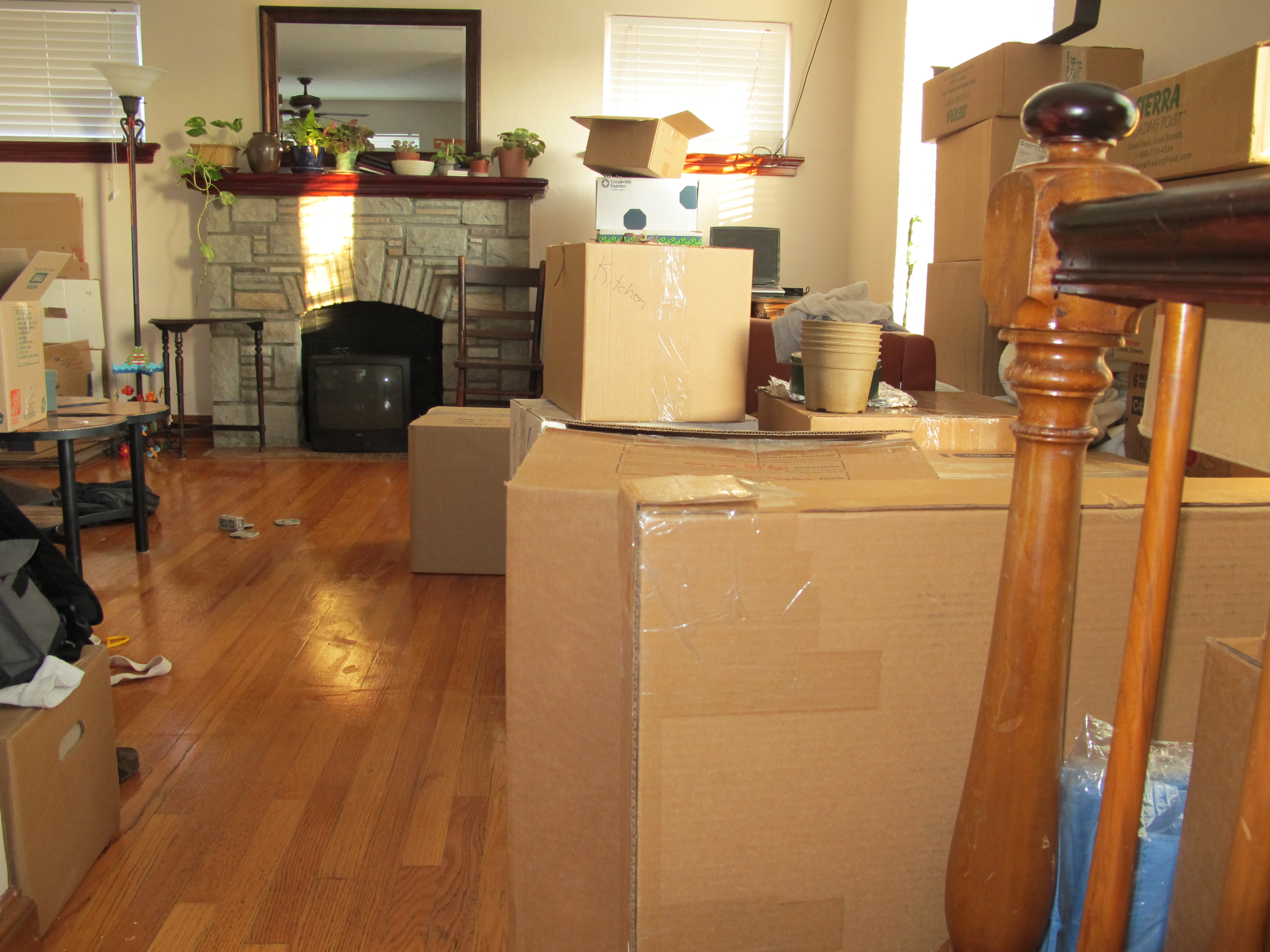
Despite our original plans for one of us to bike to the new apartment with the trailer (since we only have room for two of our three bikes on the trunk rack), I didn’t bike at all on moving day.  I certainly didn’t move by bicycle (while I think this is a cool idea, it was never in the game plan for us).

Don’t have a contingent of friends lined up with cargo bikes and trailers to help move you?  Fear not, there are many ways you can make your next move a little lighter on the planet!

Lighten your load
Know you’ll be moving sometime in the next few weeks or months (or even years, if you like to plan ahead)?  Now’s the time to embrace minimalism and overcome your hoarding tendencies. Attack any drawers, closets, sheds, or other storage-type spaces.  Depending on your time frame, this can be an ongoing project, not something you do all at once.

Sort items into four boxes/bags: 1) Donate/sell, 2) Recycle, 3) Trash, 4) Keep.  If you’re questioning whether or not you need something, you can probably just ditch it, but you could add a fifth “think about it” box.  Follow through on actually getting the items in boxes 1-3 out of the house.  It will feel good!

When it comes to moving, less stuff means less packing, fewer boxes for you or the movers, a smaller truck, and a faster, cheaper move.

Even with using this method, I was horrified by how many boxes we packed.  I would have liked to make more serious cuts before the move, but time ran out.  While I am eagerly opening the boxes that contain functional items that we use frequently (mostly kitchen boxes), there are others that I open and slam shut again, wishing I could just toss the contents into a big bonfire.  Moving on . . .

Rent reusable moving boxes
Several weeks ago, I read about reusable moving boxes over on Daily Garnish.  Emily rented her plastic boxes from a company in Seattle called karmaboxx.  I excitedly searched for plastic moving box rentals in St. Louis, only to find nothing.

While more expensive than reusing cardboard, renting plastic may cost less than buying new boxes, and, while I’m a bit skeptical about how many moves the plastic can handle before wearing out, you can check out this explanation and comparison between plastic and cardboard and decide for yourself.

If they had been available here, I would have been willing to pay a bit for the convenience of not having to deal with packing tape and breaking down boxes on the other end.

Collect used boxes
Ask friends, family members, and coworkers to save any moving boxes that are in good condition.  True, heavy-duty cardboard moving boxes definitely have more than one use if broken down carefully and stored in a clean, dry space.

We already had a good start on collecting used cardboard moving boxes, both some saved from the last move and many more from Matthew’s mom.  I was quite confident we had plenty of boxes, and then, in the eleventh hour, we had to run to Home Depot for a few more (thank goodness we found someplace open on a Sunday evening).  Lesson learned: You’ll probably need more boxes than you think you will, so collect extra.

Ditto for packing materials
If you don’t get a newspaper, ask others to save them for you.  Newspaper that’s headed for the recycling bin makes great packing material — reuse first, then recycle on the other end.  Towels, sheets, and other soft items that you have to move anyway can be useful packing material as well.

Get the right vehicle for the job
We made a few car and [borrowed] minivan runs for items we wanted to move ourselves, including our potted plants and framed pictures, plus a few last minute moving-day items.  Everything else fit on the truck — although it was close in the end (see earlier section on excessive boxes).

Unless you’re moving by bicycle, having a larger moving truck that can fit everything in one load will be more efficient than a smaller vehicle making multiple trips.

We are sloooooowly making progress on the unpacking front.  If we’re lucky, perhaps we’ll finish before finding a house we love and moving all over again!

Your turn!
What are your tips or tricks for more sustainable moves?


How to buy a used freezer

A few months before I started this blog (which is almost three!), we bought a deep freeze.  I’ve written about the freezer and its energy use a few times, and mentioned various frozen food more than a few times, but some recent reader questions prompted this post with more details.

Are you thinking about buying a freezer?  Here are a few things to consider.

How to you plan to use the freezer?
The answer to this question will determine what size freezer you need (or if you really need a freezer at all).

We use our freezer for three primary things: 1) Frozen produce (from the garden and farmers’ market). 2) baked goods — we bake all of our bread, and the freezer space allows us to make 4-6 loaves at a time, and 3) bulk dry goods — various flours, nuts, and seeds — the freezer protects against rancidity and various pest invasions.

Regarding size of freezer, you want enough capacity, without having excess space.  A full freezer is more efficient than one with a lot of extra space.  We have a 15 or 16 cubic foot chest freezer.  There are times when we could use a bit more space, but for us, this is a decent balance between too small and excess capacity.

Freezer or second fridge?
Your answer to the first question will also provide a partial answer to the question of freezer vs. second refrigerator.  As long as you’re using them fairly regularly,  bulk dry goods should keep equally well at refrigerator temps.  However, long-term storage of items in categories one and two in my list requires freezing.  Ditto for meat, if that’s part of your diet.

A second refrigerator will give you SOME extra freezer space, but that freezer is not the same as a deep freezer (either chest or upright).  A deep freezer maintains a colder temperature than the freezer compartment of a refrigerator, which means that frozen foods (produce, meat, baked goods) stay better, longer in a deep freezer.*

Chest or upright?
Volume for volume, chest freezers are hands-down more energy efficient than upright freezers.  Here’s a little snapshot from the Energy Star freezer comparison chart:

These are all for the same brand of freezer.  If you compare the two larger models, the 22 cu. ft. chest uses about 2/3 the energy of the 20 cu. ft. upright.

So a chest freezer is the obvious winner, right?  Well, they have two main drawbacks: 1) finding things in a chest freezer can be trickier than an upright and 2) chest freezers are not frost-free, which means every now and then (once a year or less, unless you have the freezer somewhere really warm, like a garage), you have to take everything out of the freezer and remove the ice that builds up on the sides.

For us, the energy savings of the chest is worth the drawbacks (more on how we deal with those in an upcoming post).

Used or new?
Used is the way to go, especially for a chest freezer.  Unless it’s truly ancient, most run-of-the-mill chest freezers will be more efficient than new upright freezers, even if the chest freezer does not have an “Energy Star” rating.

After just a bit of searching, we found our 15 cu. ft. chest freezer on Craigslist.  It was less than five years old, and they accepted our offer of $75 ($100 asking price).  Over three years later, it’s still going strong.

Tips on buying used
If you’re going with used, make sure the unit is plugged in before you arrive.  Bringing a thermometer to check the temperature wouldn’t be a bad idea, but we didn’t think about it when we bought ours.

Also, if getting the freezer from its original home to its new home requires tilting it or turning it on its side, there IS a risk of ruining the compressor.  To reduce the risk, minimize the time that the unit spends in a compromised position, and, once it’s settled in its new home, wait for six to twenty-four hours before plugging it in to give the coolant time to resettle.

*A deep freezer maintains a temperature of less than  0° F (actual temp varies by model and setting), while the freezer compartment of a refrigerator usually hovers right around 0° F.

Related posts:
Deep freeze
Energy Hog

Active transportation tastes better

Our housing hunt continues, and, the day after my birthday, we both took the day off and spent the morning running around (in a car unfortunately) with a realtor looking at houses.

We planned to wrap things up by late morning and follow the house tour whirlwind by treating ourselves to lunch.  Due to excellent efficiency (and a few houses that we weren’t able to see), we were finished before eleven — too early for lunch — so we headed home.  After being in and out of the car all morning, a separate car trip just for lunch was the last thing I wanted.

Bicycles were an option, of course, but I really wanted to WALK somewhere.  Unfortunately, we don’t have many options within walking distance (if you discount a few fast food joints, which are not even on our radar).  My criteria for a walkable non-fast food restaurant led us to La Tropicana, a restaurant we’ve been talking about trying for quite some time now.

After a bit of back and forth with the waiter and chef, we ordered some vegetized versions of a couple of their standard menu items.  While I enjoyed the meal, getting to and from the restaurant on my own two feet was truly my favorite part of the outing. It felt both novel and right at the same time, and reminded me of our time in Italy last year.

I’m a little bummed that we’ve lived here for four years and just now ventured into La Tropicana — within weeks of a move that will most likely take us to a different neighborhood.  We don’t eat out often, but having a good choice within walking distance is worth a lot.  I hope we’ll have some walk & dine options in our new neighborhood (location TBD), because walking to a meal is the best seasoning.

Green baby strategies

While I’m far from having everything figured out on the “green parenting” front, I have learned a few things over the last ten plus months.  So, in no particular order, here are eight strategies to help you and your baby go green.

1. Buy Used
Okay, this one is rather obvious, but it bears repeating.  The million (or billion?) dollar baby industry spends a lot of time and effort telling us (especially first-time moms) that we need a big, custom nursery with shiny new furniture, a dresser AND closet full of brand-new baby clothes (that will acquire stains and be outgrown in the blink of an eye), and a whole array of toys and entertainment devices that a newborn could care less about.  Their strategies prey on our insecurities as new parents, trying to convince us that we can make up for perceived deficits in our parenting knowledge and skills by spending money.

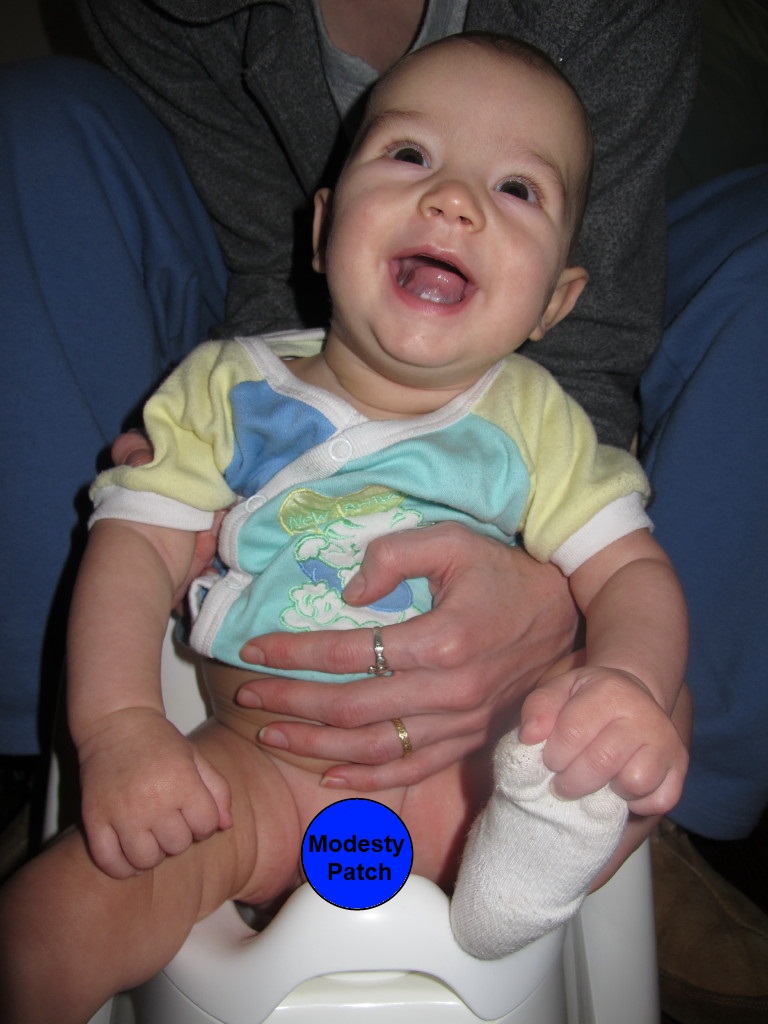
Baby Bjorn potty, like-new condition, $8 on CL ($30 new)

Since most baby stuff is used for a relatively short period of time, you can find many items in pretty good condition at regular thrift stores, baby/kid-specific consignment shops, Craigslist, and/or garage sales.  Make a specific list (but be flexible on things like color), and then ask family and friends to keep an eye out for things as well.

2. Something Borrowed
Even better than buying used, check with friends and family about borrowing items.  Your cousin may not want to SELL that baby swing or bouncy seat, preferring to keep it for a future baby, but she may be willing to loan it to you for the few months that it will be useful.

3. Skimp on Laundry
A new addition does not have to mean tons of extra laundry.  Sure, there will be some additional laundry in the form of diapers if you use cloth, but there’s no reason you should be averaging over a load a day!  A shirt or blanket with a bit of drool, or pants that are slightly damp at the waist from a minor diaper leak, can be removed, aired-out, and re-worn.  Comfortable shirts and pants can transition from daytime to bedtime, with no need for an extra change of clothes.

Basket case

4. Be Flexible
Sir graduated from the [second-hand] Moses basket to a Pack ‘n Play that my sister picked up for us at a garage sale.  Our initial assumption was that it would be a temporary solution while we worked on finding a crib and making room for said crib in our small, one-bedroom apartment.  He slept well in the playpen, so we decided to forgo the crib. 

5. Think Outside the Box
Instead of a big, bulky high chair that separates baby from the table and keeps him from really being part of the meal, we started with a small, portable seat that clamped on the table.  It seemed safe enough, but I was a bit worried, especially as Sir often demonstrates  his enthusiasm for food by kicking and bouncing in his seat.

Who, me?

I was all ready to visit a local baby consignment store to look for a booster seat that we could use with a chair at the table, when Matthew came up with the solution in the above photo: phone books stacked on a chair underneath the clamp-on seat.  His idea transfers the weight to the chair instead of the table, allowing us to continue to use the clamp-on seat, but making it safer and more stable, no purchase necessary.

6. Seek suggestions
When I wrote about our crunchy diaper problem and my search for used cloth diapers, several readers responded with helpful suggestions.  Based on your ideas, I contacted a local diaper service and purchased thirty of their “seconds” for twenty dollars.  Despite some signs of wear, these are good quality, thick prefolds that are more than adequate for our needs.

7. Wait on It
Sometimes not having the time or energy to do the research for a purchase, or actually get to a store [or online] to make the purchase, can be a good thing.  Babies’ needs change very quickly, and something that might seem absolutely essential today may well be old news in a week or two.  Waiting gives you time to find a more long-term solution and avoid an unnecessary impulse buy, but you may also discover you can live without a what’s-it or thing-a-ma-jig.

8. But Don’t Drive Yourself Crazy
I’m NOT so good at following my own advice on this one, but I’ll toss it in anyway.  If you’re spending lots of time and energy trying to hunt down a particular item, or burning gallons of gas driving to far-flung garage sales, you’ve probably hit a point of diminishing returns.

The bottom line is that having a baby is WAY less green than not having a baby, and, as I continue to discover, parenting is all about compromises (my friend writes a blog devoted to that subject).  Sometimes buying new does make sense — in these cases, try to keep the item in good condition to loan, sell, or donate once you’ve finished using it.

Your Turn
I’m sure there are lots of other ideas out there — what are YOUR tips and tricks for minimizing your little one’s carbon footprint?


Related post: A basket for baby (my pre-baby thoughts on baby stuff)