Pumpkin time!

Matthew grows a lot of delicious winter squash this year, but he’s never grown a “jack o’ lantern pumpkin.”  He plans to correct that next year (especially after dropping twenty dollars on “squash we can’t even eat”), but this year, we visited the pumpkin patch.

This slideshow requires JavaScript.

We visited Braeutigam Orchards two Sundays ago.  I posted these photos on Facebook that evening, and I felt like a bit of a fraud, because this perfectly illustrates the Facebook effect: the pictures people share often give an unrealistic view of events (and if you compare your own REAL life with what everyone is sharing on Facebook, you’re likely to not feel too great).

So, in the interest of full disclosure, while there were some good moments, this happy little family outing was anything but.  It started with stress about keeping someone halfway quiet on a Sunday morning while we tried to get out the door, my own anxiety about returning in time to avoid the dreaded car nap, and getting lost on the way to our destination, to the constant chorus of, “Are we at the pumpkin patch yet?”  (“Yes, kid, why don’t you get out of the car and wander around East St. Louis looking for a pumpkin.  Knock yourself out!)

Anyhow, I don’t want to dwell on the bad, but it was what it was.  I went into yesterday with a plan to have a better Sunday.  I started with some mindfulness practice (while Matthew and Gabriel made pancakes), followed by a quick jaunt outdoors with Gabriel, to run and shake off some energy.  After a quick Skype chat with my mom, we headed outdoors to carve the big pumpkin (an 11 pounder).

IMG_5921

Matthew and I handled the knife work.  Gabriel helped scoop out the seeds and goop, and drew on a second pumpkin.

IMG_5923

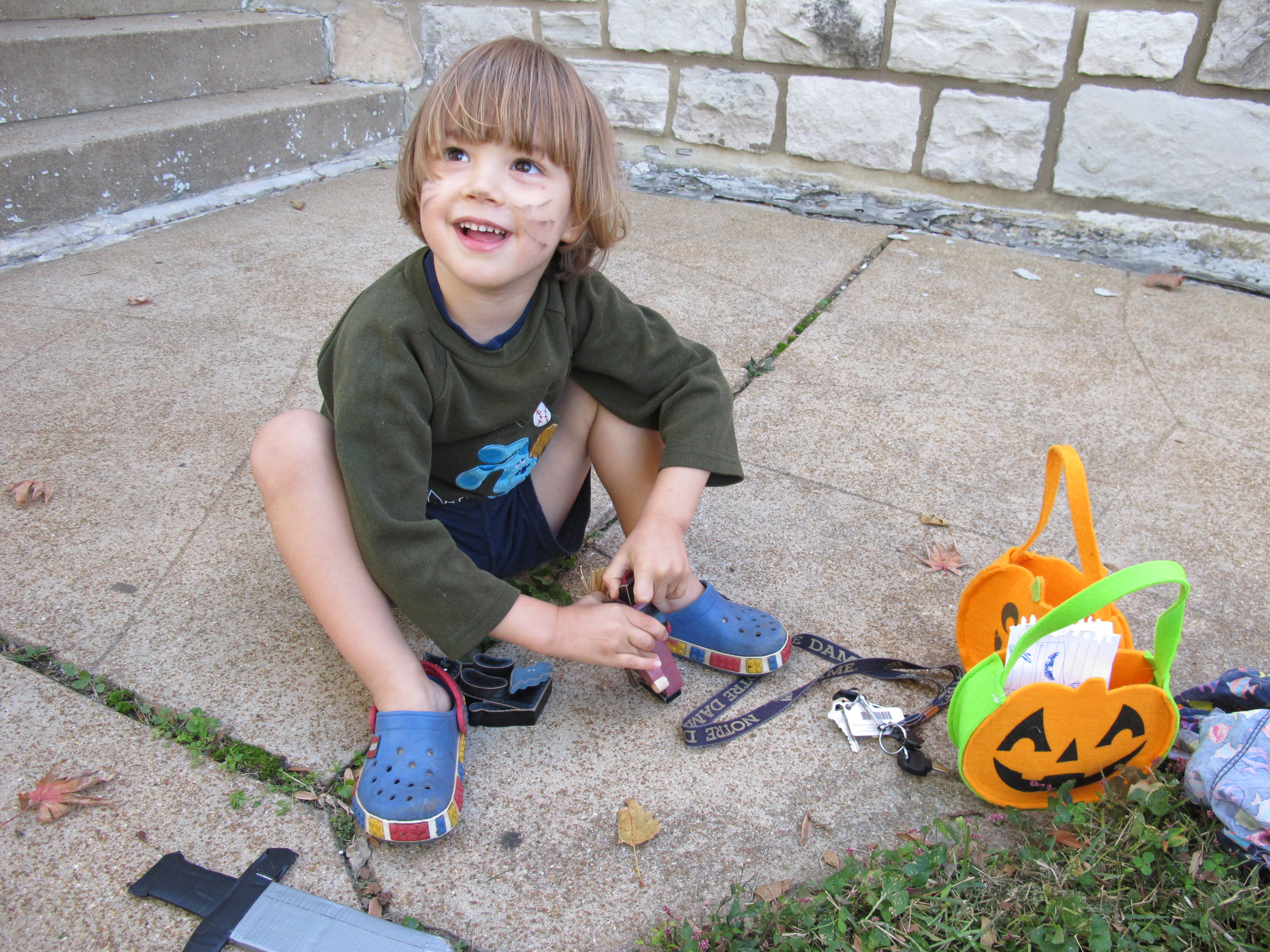
He also enjoyed running around with the sword from his Peter Pan costume and playing with some Halloween figurines (while sporting tiger whiskers).

IMG_5927

In the end, we had a lovely Sunday morning, and we have a pretty great jack o’ lantern (to be revealed on Friday, along with some costume pics).

Raising a child in an apartment

There must be thousands (millions?) of people raising kids in apartments, but among my friends and acquaintances, we’re somewhat of an anomaly.  I can think of exactly one other apartment-dwelling family-with-kids that we know in St. Louis.  Other than that, it seems that by the time children enter the picture, there’s a house involved.  While in many ways, I’m in no hurry to buy a house, raising a kid in a multi-family building presents some challenges, mainly involving noise.

We live in a two-family duplex/flat with wood floors.  We intentionally chose a second-floor space, in part because it tends to be quieter on top, compared to living on lower levels with people walking around above you.  That said, there is very little up-down sound insulation, and sounds carry both ways.

In the beginning, when Gabriel was younger, the challenge mainly came from noises below, and my concern that they would wake him.  As he’s gotten older, the noise he makes being an energetic little person — walking, marching, running, jumping, dancing, knocking down blocks — has become an increasing issue.  The sounds don’t bother me at all, and would be a complete non-issue in a house, but I totally get that, for our neighbor downstairs, they are loud, unpleasant, and annoying.

The question is what to do about it.  We ARE actively looking to buy a house, but given our land and location requirements (and the fact that we’ve already been looking for years, since before G was born), it doesn’t seem that that will happen anytime soon.

We could look at rental houses, but I imagine that a rental house that is similar size and quality as our apartment would be out of our budget (and the cost and hassle of an extra move — oof!).

If the noise downstairs is really as bad as I imagine it to be, I’m somewhat surprised that our neighbor hasn’t moved, but that would not solve anything for us, because there would just be another tenant.

Measures to minimize noise

  • Using area rugs might help somewhat, but they’re not going to cover everything, and I don’t want the hassle of keeping them clean (cleaning wood floors is soooo easy).  So we probably won’t go this route.
  • We’ve been trying to keep Gabriel out of the bedrooms (which are above our neighbor’s bedroom) in the morning, especially on weekends.
  • Now that it’s cooler, we’re encouraging Gabriel to wear his slippers, which might offer some sound dampening.

Kids will be kids? 

While we discourage blatantly loud, unnecessary activities, like repeatedly banging his wooden blocks on the floor or shouting inside the house, we’re not willing to suppress or discourage the normal sounds that come with being an exuberant, happy, active child.

Focusing overly on the noise, e.g., asking Gabriel to walk quietly, is stressful for us, and it often seems to produce the opposite behavior.  We try to explain that we’re doing this “to be respectful of our neighbor,” but at three, he just doesn’t quite get it.

Still stressed

Overall, our neighbor has been patient and understanding (and we try to respond in kind to sounds that travel up to us).  We’ve talked with her about the accommodations we’re trying to make.  Still, the ongoing worry about the noise we’re generating makes me feel stressed and “yuck.”  The fact that our neighbor is being bothered by sounds that we can’t totally eliminate also creates a dynamic where it’s very hard for us to bring up reverse concerns.

Having a little person means that we are not ideal neighbors.  I wish I could magically create a sound barrier between the first and second floor units, but short of that, I guess I’ll just have to make my peace, as best as I can, with the situation.

I’d love to hear from others who have been in similar situations, whether you were the one with kids or the one living with sounds from other kids in the building.


Mindfulness training

So, back in June, I wrote this post about stress and health.  I know what I can do to reduce stress and support mental (and physical) health: eat well, get enough sleep, exercise . . . .  I’m pretty good at all of those things (except for when the stress is interfering with sleep).

But what about the mind-body connection, and practices such as meditation and yoga?  I know there’s research backing it’s importance, but this is a weak link for me.

A year-and-a-half ago, when I was struggling with depression (a follow-up to my post-partum depression), my mom (who’s a licensed clinical social worker) sent me Jon Kabat-Zinn’s The Mindful Way through Depression.  She has quite a bit of experience with mindfulness practice and recommends it highly.  I’d like to say it changed my life, but that wasn’t quite what happened.

The book lays out an 8-week program, with readings and suggested practice for every day of the eight weeks.*  I had good intentions, and I stuck with it for two or three weeks (practicing most days), and then, I don’t know, life happened, and I put mindfulness practice on the back burner.

While talking with my mom last month, she once again encouraged me to look into mindfulness practices, specifically Mindfulness-Based Stress Reduction (MBSR) workshops.*

A quick internet search turned up two main options in St. Louis.  The first local MBSR course that came up is one offered at UMSL.  It is primarily for UMSL employees (and their spouses/partners), but the site says they have a limited number of seats for the “general public.”  However, the next session doesn’t start until January, and driving out to UMSL once a week in [possible] winter weather didn’t sound that appealing.

The second option was the Mind-Body Stress Reduction program offered by Masterpeace Studios.  Held in Webster, the location of these classes was much more appealing, and there was a fall session about to start.  Convenient location, reasonable cost, and workable dates.  (The course offered at Masterpeace is a condensed 6-week version of what is normally an 8-week program.)

I went to their free intro class/info session on September 8th.  I turned in my registration paperwork that night, for the session to start the following week, but held off on writing a check.  Once I wrote that check, I would be committed, and I was still on the fence.  Did I really want to do this?  Could I make the commitment to practice every day for six weeks?

Even though it meant I would be out one night a week for the next six weeks (leaving Matthew solo with G at bedtime), Matthew was very supportive, and really encouraged me to go through with it.

I went into it unsure if mindfulness would “work” for me.  What if my brain just couldn’t do it?

Bridget, the instructor, told us from the beginning that the mind is a muscle.  If you want to be reap the benefits of mindfulness you have to practice.  When practicing, your mind will wander, and you just have to keep bringing it back, over and over again.  (Bridget uses the analogy of training a puppy to heel.)

With those things in mind, and with the motivation of being part of a class (that I paid good money to take) plus a log to record our daily practice sessions, I’m now into the third week of the course, and I’ve devoted time to practicing every day.

It’s not always easy, and I’m not “good” at it, but I’m doing the work, building that brain muscle.  I have to bring my mind “to heel” constantly — thoughts of decisions I’m trying to make are particularly intrusive.  Mindfulness practice won’t make the hard things go away, but it can lessen their negative effects.  No matter what was happening prior to practicing, I almost always feel calm and centered after practicing, ready to take another stab at life’s challenges.

I’ll check in again here in a couple of weeks with an update on my practice, challenges, observations, etc.

If you’re struggling with stress (and who isn’t?), anxiety, chronic pain, and/or depression, I’d highly recommend looking into Mindfulness-Based Stress Reduction.  If you’re not lucky enough to have a nearby program, you can try it on your own, using the book I mention below.  The University of Missouri Mindfulness Practice Center has some guided mindfulness meditations that you can listen to or download to help you get started.


*The original 8-week program, as practiced in Kabat-Zinn’s Stress Reduction and Relaxation Program at the University of Massachusetts Medical Center, is described in his earlier book, Full Catastrophe Living: Using the Wisdom of the Body and Mind to Face Stress, Pain, and Illness.  There is very strong scientific evidence for the benefits of mindfulness practice, and specifically the 8-week, which is explained well in the book.

Partner bicycling conundrums

When we met, our interest in, and commitment to, biking for transportation was one of the things that Matthew and I shared (along with a love of cooking and eating delicious vegetarian food).  Perhaps because of this shared history, it’s particularly frustrating when bicycling becomes a point of contention in our relationship.  I’m not talking about, “You spend all your free time riding your bike,” kind of contention, though.

In general, we don’t ride our bikes together all that much.  Bike trips to work, or to run errands, are usually solo ventures.  Duo trips are limited to weekend (or rare weeknight) outings, so it took a while for us to notice the problems.

Prior to April 2011, the primary point of contention was that I was riding too close to parked cars.  I understood Matthew’s concern, but I felt uncomfortable riding farther left in the traffic lane.

Enter CyclingSavvy.  We took the basic course together in April 2011, and went on to become instructors two months later.  This course gave me the knowledge, confidence, and skills I needed to get out of the door zone and away from the edge of the roadway for good.

It seemed this would be just what we needed for partner cycling bliss.

We do great on multi-lane roads, usually riding two abreast in the right travel lane, then singling up in spots with on-street parking (or other features that narrow the effective lane).  But we don’t want to always ride on arterial roads, since there are lower-speed, less-trafficked options, nor do these big roads always serve our destinations.

And here’s the thing.  We agree on all the basic principles: 1) follow the rules of movement, 2) practice good communication, 3) never ride within 5 feet of a parked car and you won’t get doored (or startled), 4) never, ever ride up along the right side of a tractor-trailer (or bus, garbage truck, etc.).  Those are just a few examples, but suffice it to say, we agree on most things when it comes to how/where we ride.

But then are the “gray areas,” the judgement calls.  Where, exactly, on a given roadway do I need to be to encourage safe motorist behavior (i.e., discourage unsafe passing)?  When should I actively (or passively) encourage someone to pass me?  When should I passively (or actively) discourage passing?

The answer to all these questions is, “It depends.”  It depends on road design, traffic conditions, weather, and a number of other dynamics.

The main north-south route we ride is a tricky one for these questions.  It’s a street with two-way traffic, and on-street parking on both sides.  Portions of it are too narrow for a center stripe (perhaps just barely wide enough for two cars to eek by each other if there are also parked cars on both sides at a given spot).  Other portions do have a center stripe, creating a narrow lane of travel in each direction.  The blocks are short, with a stop sign at almost every intersection, so it’s difficult for anyone (motorists or bicyclists) to work up much speed.  There are also alleys that exit onto the street in between every intersection, so LOTS of potential turning conflicts.

But it’s a neighborhood street, with low speed limits and relatively little traffic, and it offers an alternative to a traffic sewer (Kingshighway, which we do ride portions of).

We’ve ridden this route for years, and when we’re riding solo, we each navigate this stretch as we see fit.

In general, I move a bit slower on my bicycle (especially when I’m hauling a kiddo), and I tend to look for opportunities to “release” a motorist who ends up behind me, even if it means I need to slow down a bit more to facilitate the pass.

Matthew also practices control and release, but, when on his own, is usually moving a bit faster, meaning less opportunity to release (and perhaps less real need, though there’s still the “Must Pass Bicyclist Syndrome” to deal with).  He also tends to ride MORE than five feet from the parked cars, to discourage unsafe passing by both overtaking and oncoming (because the passable street width is so minimal with on-street parking) motorists.*

I prefer to stay closer to the right as a default position on this stretch (though still at least 5 feet from the parked cars, not riding the edge, not weaving in and out of parked cars, etc.), and use active encouragement/discouragement to communicate with motorists about when it is or is not safe to pass.  (In truth, I may be cheating in a bit on that 5 feet from parked cars along some of these stretches — we may need to bring out the tape measure on this one, to double check both of our perceived vs. actual distances.)*

Yet what we do almost effortlessly alone, with one bicycle, becomes REALLY difficult when we add the other person and that second bicycle.

  • The dynamic changes for Matthew because, in order for us to actually ride together, he’s traveling slower than normal.
  • Instead of time and space to pass one bicyclist (it’s too narrow for us to ride two abreast on the streets in question), overtaking motorists need time to pass two bicyclists.
  • The front rider (usually me, setting the [slow] pace) needs to decide if it’s safe to encourage a pass, but the rear rider needs to communicate with the motorist.
  • On these short blocks, by the time I see a gap, make a decision, and communicate with Matthew, the gap is gone, or we’re at the next stop sign — too late for him to signal the motorist to pass.

So our shared bicycle outings, times where we should be enjoying our common love of bicycle transportation, become fraught with tension, disagreements, and stress.  Instead of feeling good, we arrive at our destinations feeling “yuck,” and, for me, at least, wanting to give Matthew a five minute lead on the way home, just so we don’t have to deal with it.  And wanting to never ride our bikes anywhere together again.

So we’re taking advice.  Do any of you cyclist pairs have suggestions for harmonious partner bicycle travel on roads/in situations like what I describe?  Any tricks for clearly communicating with each other on the road?

*Regarding our roadway position, and where we need to be to get safe passes — in our small sample, it seems there may be some motorist bias based on bicyclist’s sex, i.e., motorists behave better around female cyclists than around male cyclists, so Matthew has to ride differently (i.e., farther left) to get the same passing distance I get when riding a bit farther to the right.


PA school — Full steam ahead?

I started this post last week with a working title of “PA school — An unreachable goal?”

I spent five months considering options, including getting a med tech or CNA certificate, and hunting for jobs (ideally ones that I could get without any additional education) that would give me more “patient care experience” for my physician assistant school application.  Five months with very few jobs to apply for, and zero interest in the few applications I did submit.

I was feeling like this whole PA school thing might never happen, when I looked at my work history and decided that, technically, I have [barely] enough hours to go ahead and apply now (for a fall 2015 start date).

Of course, it would have been much better to come to this conclusion in June, at the beginning of the application cycle, than in mid-September, just several weeks from the application deadline.  Better in terms of time, and better in terms of my odds of acceptance (the school I’m looking at considers applicants on a rolling basis — at this point, some of the spots for next fall’s cohort are probably already taken, so by applying late[r], I’m competing against a bigger pool for a smaller number of seats).  Sigh.

I went ahead and started completing the online application, which is ridiculous.  You have to enter, one at a time, each and every college level class you’ve ever taken: course title, course prefix and number, grade received, credit hours . . . talk about painstaking!  (I made it through undergrad, and I’m waiting on my grad school transcript to tackle those classes.)  This is in addition to sending them your official transcripts, which, of course, obtain all the info they’re making you enter.

With the exception of medical terminology, I have all the academic prerequisites (though some of them are a bit dated).  My overall GPA will be quite high, and my science GPA will be decent.

The fact that I have a degree in public health, and 7+ years experience in the field, should work in my favor.

Still, while my patient care hours meet the minimum requirement, they’re nothing impressive.  More clinical/patient care experience would be a plus, but it’s not clear that that is going to happen, certainly not quickly or easily.

The idea of applying now, and starting next fall (2015), as opposed to applying in the summer of 2015 and waiting until the fall of 2016 to start (two whole years away), is appealing (and frightening).  I feel like I’m just cooling my heals otherwise and giving myself too much time to second-guess and question this whole crazy plan (you know, juggling an intense 27-months of full-time school and studying with having a family,  going into debt for the privilege, watching school bills eat up all the money we’ve saved to buy a house, questioning why the heck I have to do this, and whether “this” is the right/best option — should I be seriously considering opening a bike shop instead?).

I was all set to go for it, full speed ahead, and then I considered the application fee.  Two hundred twenty-five dollars.  Not that much money, but I’m not a gambler, and that’s what it feels like I’d be doing if I go for this now, instead of waiting for the next application cycle.

The thing is, I’m not sure I’d be anywhere different in nine months, experience-wise, but I would at least have the advantage of applying really early, and being in that first pool of applicants they consider.  I feel like I may need that advantage.

So, cards on the table, or bide my time???  What would you do?