Black-eyed peas

So, back on the first of the year, I wrote a post about a new soup I planned to make.  I said I would post the recipe here if it turned out well, and, nudged by the fact that I made it again last night, I’m finally getting around to it.   Black-eyed peas and kale form the base for this simple, delicious, and healthy soup.

Click here for the recipe for “Southern New Year’s Day Soup” from Vegetarian Times.  A few notes on my adaptations:

  • I used onions instead of leeks both times.  I’m sure leeks would be good, but they’re not something we keep around.
  • I used a liberal amount of garlic (shocker, I know!).
  • The recipe calls for dried black-eyed peas and never tells you to cook them.  If you start with dry peas, you need to soak and cook them just like you would any dried bean (although I think they cook faster than other types of dried beans).  Otherwise, if you can find them, you can start with canned black-eyed peas.
  • I used water and the cooking liquid from the peas, along with a bit of extra poultry seasoning, instead of the quart of vegetable broth.
  • The soup is good both with or without the pasta.  If you add pasta, cook it separately and add it to just the portion that you will be eating at that meal, otherwise it will get soggy.
  • As before, both the peas and the kale were locally grown 🙂

The first and the last

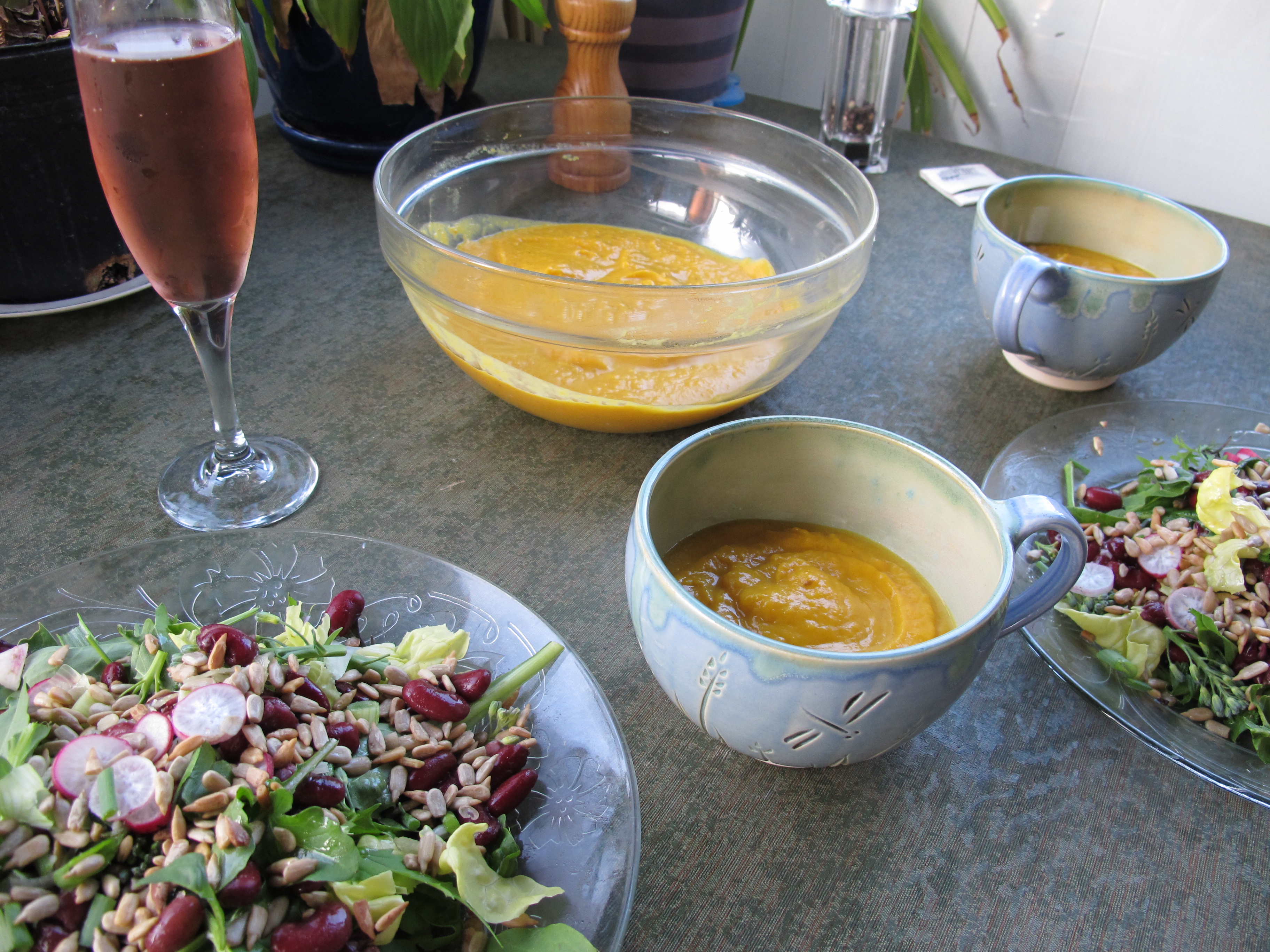
I love it when we sit down to a meal and realize it’s almost all local food!  We made this salad with our first garden harvest of greens (although we’ve been buying local lettuce for a few weeks now), radishes, green onion, and locally grown kidney beans.  The sunflower seeds and dressing (homemade with a base of olive oil, vinegar, and minced garlic) prevent this salad from being 100% local.

Second component of the meal: butternut squash soup.  We bought 15 butternut squash in the fall; for this meal, we ate the last squash.  They kept beautifully for over six months with minimal effort.  We put them in mesh bags (the bags that onion come in, for example) and hung the bags from nails in our basement.  Simple!

For this soup, we roasted the whole squash, then added sauteed onions, butter, milk, cumin, turmeric, and salt.  I blended it all with my stick blender for easy clean-up.

It all came together for a simple, delicious, local dinner.

Grandma’s baked beans

My grandma’s original baked bean recipe included some type of meat, but we discovered that it’s just as delicious without the meat.

Grandma’s Baked Beans

1 lb. dry navy beans, soaked 8 hours
4-5 c. water
2 t. dried  mustard
2-3 onions, quartered
bit of cloves or cinnamon
2 t. salt
1/4 c. brown sugar
1/4 c. molasses
2 T. vinegar

Add soaked beans, water, mustard, onions, and cloves or cinnamon to a Crock Pot set on high.  Cook ~4 hours (beans should be slightly tender), then add remaining ingredients, turn down to low, and cook ~4 hours more, or until desired tenderness.

Notes:

The beauty of making your own baked beans is that you can control the amount of salt and sugar.  Start with the amounts in the recipe, and add more to taste.

As written above, I add the sugar, salt, and vinegar later in the cooking process because these ingredients slow the beans’ cooking and can lead to tough beans.

Sometimes I add a bit of bulgar wheat (AKA cracked wheat) if the sauce seems too watery.

The original recipe calls for baking these in the oven, instead of using a Crock Pot.  I avoid this method because it requires that the oven be on for 6-8 hours.  If you want to try it in the oven, combine the first 5 ingredients in a pot and boil on the stove top for one hour.  Then add remaining ingredients, transfer to a baking dish, and bake at 250° for 6-8 hours.

Poppy seed dressing

A few days ago, when I posted this recipe, I decided to add a “Recipes” category to this blog.  Despite the fact that I have plenty of “Food” posts, recipes are lacking because I rarely use them.  Most dinners are a little of this, a touch of that, add lots of garlic, and voilà — dinner (and leftovers for lunch)!

However, we follow recipes from time to time.  Using a little magic math, I reconstructed the recipe for our favorite store-bought poppy seed dressing.  I’m sure the make would not give me the recipe, but all I needed was the ingredient list and nutrition information.  Yes, I do feel rather clever!

Poppy Seed Dressing

6 oz. canola or olive oil (I use a combination)
3 oz. water
2 oz. white vinegar
1 oz. apple cider vinegar
7 T. sugar
1 t. salt
1 T. finely chopped onion
1/2 t. mustard powder
1/4 t. xanthan gum
1 T. poppy seeds

Place all ingredients EXCEPT for oil and poppy seeds in a blender.  While the blender is running, slowly add the oil.  When thoroughly mixed, turn off the blender and stir in the poppy seeds by hand.

Notes: Xanthan gum is a thickener — you can find it in health food stores.  If you omit it, the dressing will still taste fine, but it will be thinner.  If you don’t have a blender, you can still make this dressing.  Just place all of the ingredients in a jar and shake thoroughly (will work best if you put the lid on first).

Serving suggestion: Our favorite salad with this dressing consists of arugula (or mixed greens that contain arugula), roasted beets, thinly sliced onions, toasted pecans, and goat cheese.

Rumor has it that eating poppy seeds can produce positive results on drug tests, so I may try to avoid them before my drug test for the new job.


Wedding recipe

In honor of our recently celebrated 1-year wedding anniversary, I am sharing the recipe for the main dish that we served at our reception.  In order to green the event, we served a completely vegetarian dinner.  Many of our guests were not thrilled with the absence of meat.

We carefully chose one of our favorite vegetarian recipes for the event.  Unfortunately, the version made by the caterer did not taste nearly as good as what we make a home.  We invite any of our wedding guests to come visit us, and we will make you the real deal.

_____________________________________________________________________________
Vegetable Upside-Down Cake
Adapted from The Enchanted Broccoli Forest by Mollie Katzen

The Vegetable Part
5 T. oil or butter
2 c. chopped onion
1 bulb of garlic, minced
3 c. broccoli florets
3 c. cauliflower florets
2-3 medium carrots, diced
1 c. diced red bell pepper
1 c. peas
1 c. corn
Large handful of chopped garlic chives
Salt, pepper, and cayenne to taste
1 c. cashew butter, mixed with 3/4 c. hot water until smooth

In a large pan, saute the onion in 4 T. oil for about 8 minutes, then add garlic and saute 30 seconds more.  Turn off heat.

Boil a pot of water, and blanch the broccoli, cauliflower, and carrots for 30 seconds.  Drain immediately and rinse with cool water or place in an ice bath.

Add blanched vegetables, along with bell pepper, peas, corn, and garlic chives to the pan with the onion and garlic.  Add salt, pepper, cayenne, and cashew butter mixture.  Stir to combine well.  Spread into greased 9×13 pan.

The Cake Part
1 1/2  c. whole wheat pastry flour
3/4 c. fine corn meal
1 1/2 t. baking powder
3/4 t. baking soda
1/2 t. salt
3 T. sugar
1 t. dried oregano
1 t. dried thyme
2 T. fresh dill
2 eggs
1 1/2 c. buttermilk
3 T. oil

Mix all dry ingredients, including herbs and fresh dill.  In separate bowl, beat eggs, buttermilk, and oil.  Combine wet and dry — do not over mix!

Spread the cake batter over the vegetables in the baking pan.  Bake at 350°F for 40-45 minutes, or until a toothpick inserted in the center comes out clean.  Let cool in pan for 10-15 minutes, then cut into squares and serve, inverted (i.e., with the veggies on top).