Earth Day, every day

What kind of “green” blogger doesn’t post on Earth Day?  This one, apparently (though that has not been true every year: 2011, 2012, 2013).

While “Earth Day, every day” sounds cliché, it really is something that we need all people, corporations, governments, etc. to embrace, rather than simply creating hype for one day and then returning to familiar unsustainable practices.

For me, this year’s business-as-usual Earth Day involved biking to the library (sharing books instead of buying) and a yoga class, lunching on our potatoes and asparagus (plus some non-local beans and broccoli), and biking to a school tour (the school is now near the bottom of my list due to the pick-up time madness that results when every child is transported in a separate motor vehicle).

That said, Earth Day can be a good time to check-in and look for areas of improvement, whether that’s catching little lapses that have become habits, or looking for new ways to further lighten our footprints on this planet.

With the severe drought in California, it’s a good time to visit water conservation ideas.  One of our small, but regular, practices is capturing the water that runs while waiting for hot water.  In our second story apartment, we usually capture a gallon of [cold] water while waiting for the pipes to warm (a bit more in the winter) in the shower or in the kitchen for washing dishes.  We reuse plastic 1-gallon milk and apple cider jugs (of which we don’t generate a lot) for this purpose.

After sitting to dechlorinate, this captured water, which would otherwise just go down the drain, is perfect for our potted plants.  In the summer, when the plants are using a lot of water, we sometimes go through more than we can capture.

If you don’t have plants to water, you could use this captured water when doing laundry –just add it to the machine as it’s filling — or perhaps to wash the floors or some such.

While I’m not planning on participating in the local Earth Day festival activities (on Sunday 4/26 here in StL), I do want to make it to the recycling extravaganza.  Over the past couple of years, we’ve accumulated a broken toaster oven (we let G use it as a toy for a bit, but I’m ready to get it out of here), electric mixer, humidifier, grow light fixture, and a few dead AA and AAA batteries.  While I wish these items (particularly the humidifier and grow light) had had longer lifespans, at least we can keep some of this out of the landfill.  Being able to get all of this to the right place for recycling at one convenient drop-off point sounds pretty good!

So, let’s share inspiration — what’s one “Earth Day, every day” tip that you have, that others could adopt?


The seven year house hunt

Sometime in April of 2009, Matthew and I made our first offer on a house.  It was a low offer (but one we felt was fair, for an amount we were comfortable paying for the house in question), and it went nowhere.  It was by no means our “dream property,” and we didn’t want a starter home, so we shrugged it off.

Our house hunt it now entering its seventh year.  In that time, we’ve made a handful of offers, usually low offers on something that might have worked, but that we weren’t too sad to pass on.

It feels like we’re looking for a needle in a haystack (I thought there was a previous post outlining what we’re looking for, but I guess I need to work on that).  In the past six plus years, we’ve viewed hundreds (perhaps even thousands) of online listings.  The listings are first filtered through some of our criteria for price, lot square footage, location, and number of bedrooms.

If something looks interesting, the next step is to pull up a satellite view.  Sure, it may have a BIG yard, but is it a big, SUNNY yard?  Or does it have the potential to be a big sunny yard, i.e., are there trees we can remove, or is the shade coming from neighboring buildings and/or trees on neighboring lots?

On the maps, we also look at proximity to highways, train tracks, and other NIMBY factors, as well as looking at transportation options.  We’ve already limited our search to locations that would be bikeable [to current/potential work sites], distance-wise, but what would it actually be like to bike from Y to Z?  Is it at all convenient for public transit?  What about walkability?

The map test significantly reduces the number of properties that are actually worth seeing in person, but every now and then it happens.  Yesterday was one of those days, and the property in question even had an open house.

I like attending open houses because it means we don’t have to waste our realtor’s time with an official showing.  (I like the realtor we’re currently working with, and after over six years and at least as many realtors, I’d like to hang on to this one.)  With an open house, you just show up, pop in, and you’re on your way.

Of course, the last few years of house hunting have been with a little one in tow.  The hardest part of this by far is scheduling viewings around his sleep times; compared to that, the actual house tours are a piece of cake!  When he was little, we would just stick G in the Ergo and wear him while we toured houses.

Things are a little trickier now, but fortunately G is pretty flexible and low-key.  If we’re viewing a clean, safe property, we’ll sometimes bring a favorite toy or two and give him the option of walking around with us or plopping down somewhere with his toys.  (Dirty properties, or those with hazards, are a bit trickier, but we don’t encounter too many of those.)

Anyhow, I brought a couple of toys to yesterday’s open house, but G was content to walk around with us.  We had finished viewing the main floor, and Matthew opened the door to the basement.  In addition to an immediate view of some rather creative plumbing (I don’t think you ever really want to hear the word “creative” applied to plumbing), we were met with a special stench, which Matthew identified as cat pee (the owners had already moved out, so there are neither humans nor cats living in the house at the moment).

All in all, the basement was less than inviting, and Gabriel said he didn’t want to go downstairs.  I was also fine passing on that experience, so I suggested the two of us check out the second floor.  Now, Gabriel really likes cats, and I could tell that he was curious about Matthew’s comment.  In a quiet voice (so the realtor showing the house couldn’t hear), I tried to explain why we thought there had been a cat (or cats) in the house.  So we’re climbing the stairs up to the second floor, and Gabriel gets this really serious look on his face and says, “But what color was the cat?”

His non sequitur totally cracked me up, and now I feel inspired to use that line at random in conversations.  “Yes, I see your point, but what color was the cat?”

Unfortunately, after our quick walk through, we deemed yesterday’s house yet another non-starter — the location would have been great for both biking and walking, and decent for transit, and the house itself had some nice features, but the actual usable garden space wasn’t as big as we’d hoped, it was overpriced for the updates it needed, and we’re not sold on the school district.  It all added up to a big N-O.  And so the search continues . . . .


Previous house hunting posts:


Avoiding pitfalls in raising a healthy eater: Part 2

We left Part 1 with my struggles handing over the Whether and How Much reigns of meal time to Gabriel.  There are times we do a decent job of this, but there is certainly room for improvement.  The information in Fearless Feeding helped me see that G doesn’t need as much food as we do (by this age, growth slows dramatically, so it’s natural for appetite to decrease and choosiness to increase).  If he passes on the beans one day, it’s not the end of the world.

Little changes
Most nights, I plate meals in the kitchen.  We all get a bit of everything, with G getting slightly scaled-down amounts. But part of letting G take an active role is letting him serve himself.

I am a bit hesitant to do this for a couple of reasons: 1) it would mean he could take tons of, say, noodles, while ignoring the rest of the meal and 2) since we use dinner leftovers for lunch, this could lead to disproportionate amounts of things for those future lunches.  For now, I’m taking a scaled approach, plating some meals (or parts of some meals) and doing others as self-serve.  It’s fun to see him serving himself, and so far he does seem to take a bit of everything, even when it’s something he’s not crazy about, like lentil sloppy joes.

While it takes a bit of self-discipline, Matthew and I are both trying to refrain from encouraging G to eat “one more bite” of this or that, but rather to tune in to how he’s feeling.  If his stomach is telling him it’s full, then it’s fine to stop, even if it means leaving some food on his plate.

If we had already planned to offer a bit of dessert, and communicated those plans to G, we’ll go ahead with it, but make it a very small portion if he did not each much of his dinner (I know, that’s not letting him serve himself, but little changes, right?  Not to mention modeling that those foods are part of a normal, health diet in moderation).

Tummy troubles
Our new way of approaching meals and food may have other timely benefits.  A couple of weeks ago, I wrote about our stomach weirdness.  While Matthew and I seemed to get back in balance, Gabriel continued burping A LOT, and started asking why he was having “throw-up burps.”  Not good.

I got pretty freaked out about GERD and possible esophageal damage.  We started looking into possible causes (food allergies, high stomach acid, low stomach acid), tests (not fun to contemplate most of the tests on a 3-year-old), etc.  I wondered if the re-introduction of carrageenan-containing soy milk was to blame (though it had never seemed to be a problem for him before, the time-frame matched).  We started tracking symptom-timing and what he was eating.

At some point, we realized it might not be WHAT he was eating, per se, but how much and how fast.  He’s always had a big appetite, and, while it seemed a little crazy that he ate almost as much as me at some meals, I didn’t think much of it.

But it seems he somehow got into a habit of eating way TOO FAST, which led to him eating TOO MUCH (when you eat fast, you’re more likely to miss the “full” signals).  So, in addition to letting him serve himself and not pushing extra bites, we’re really focusing on eating slooooooooowly: taking small bites, noticing the flavors and textures in our mouths, chewing thoroughly, waiting until our mouths are empty before taking another bite — basically mindful eating.

This takes a good bit of effort, especially when he’s sooooo hunnnngry, but it seems to be paying off in terms of his stomach troubles.  The burping still surfaces after some meals, but not all, and usually to a much lesser degree.  We’re hoping that this is indeed a relatively simple solution, and we’re all benefiting from bringing more mindfulness to our eating.

Bicycles, egg hunts, and garden time!

‘Twas a full, fun weekend in these parts!  The usual Saturday gardening was on hold due to the ground being much too wet, but Matthew headed out anyway to pick up G after his overnight at Baba’s house.  While there, Matthew picked the first asparagus of the season (if you don’t count the single spear from last week) and supervised the delivery of a dump truck full of compost (20 cubic yards).  Gabriel was very excited about both the asparagus and the dump truck!

That afternoon, we headed to the local school playground with G’s new bike in tow.  As you’ll see in the picture below, we went ahead and put on training wheels.  Even with that addition, getting him to ride the darn thing turned into quite a saga (later post), so this was huge progress!

IMG_7160
Bicycle Boy

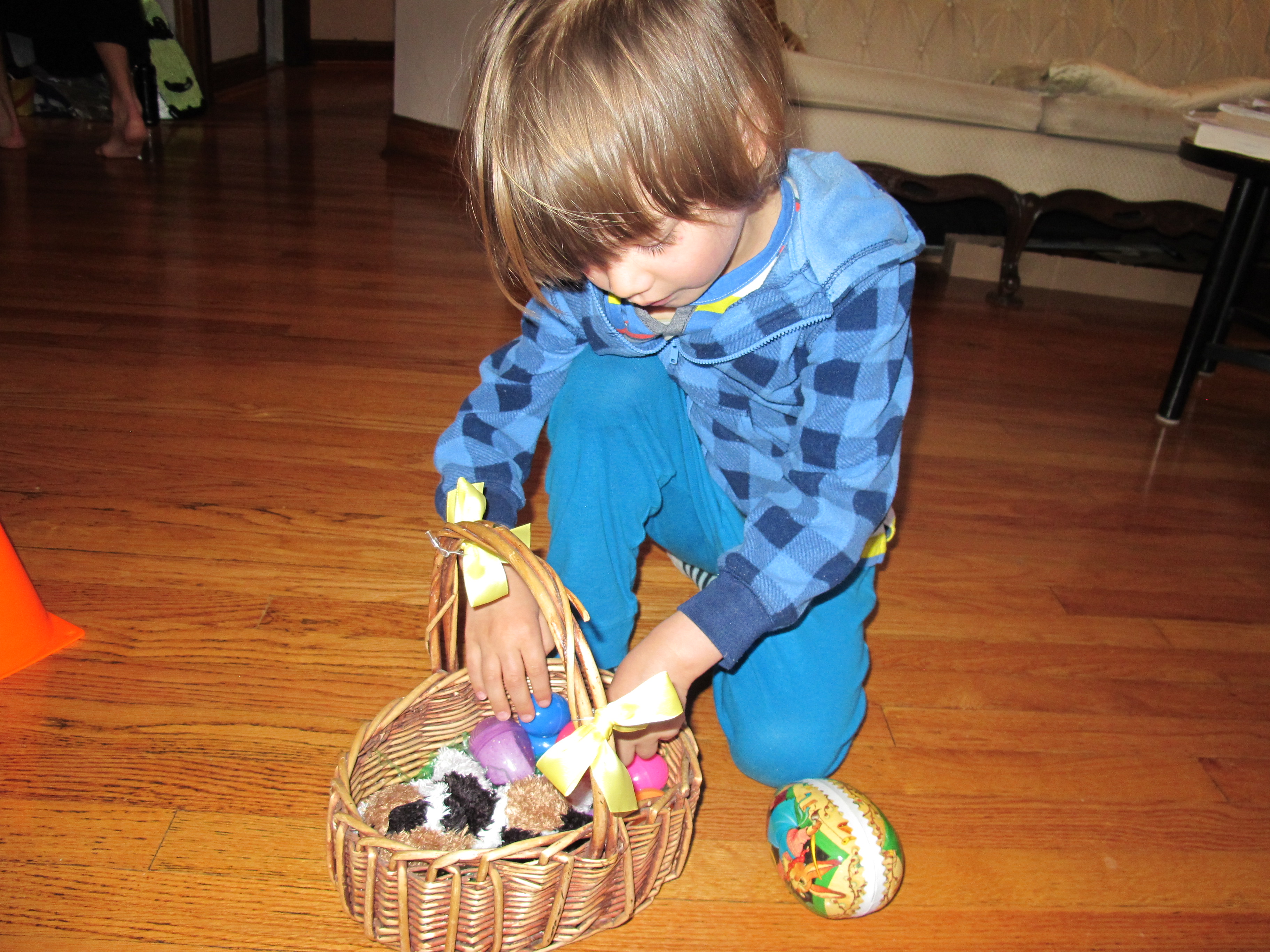
We kicked off Sunday with an indoor Easter egg hunt (Gabriel had been having “practice” Easter egg hunts for two weeks).

IMG_7167

Nothing fancy — just a few eggs with stickers, chocolate covered raisins, pistachios, and a few jelly beans.  He picked out one jelly bean to eat before breakfast.

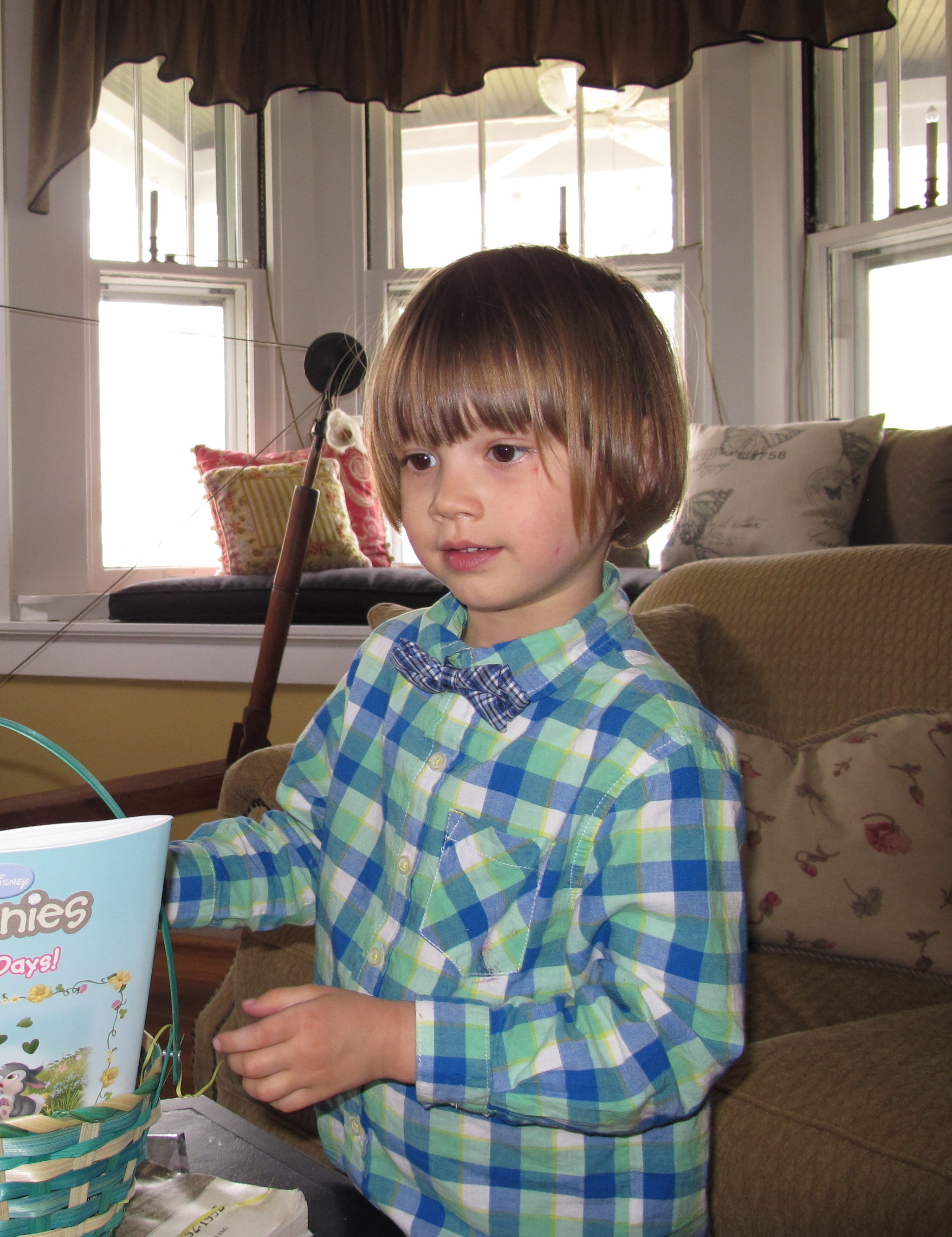
After breakfast, we put on our Easter best, packed our bags with a change of clothes for garden work, and headed to church, then a very nice brunch (my FIL went all out!) . . .

???????????????????????????????

. . . and egg hunt number two!

This marked the first day ever (I think) that I have planned on Gabriel not napping.  I’m not going to make a habit of it, as most days he could really use that extra bit of sleep, but it worked fine.

Eggs were found, pictures were taken, and we were off to the garden!

IMG_7212

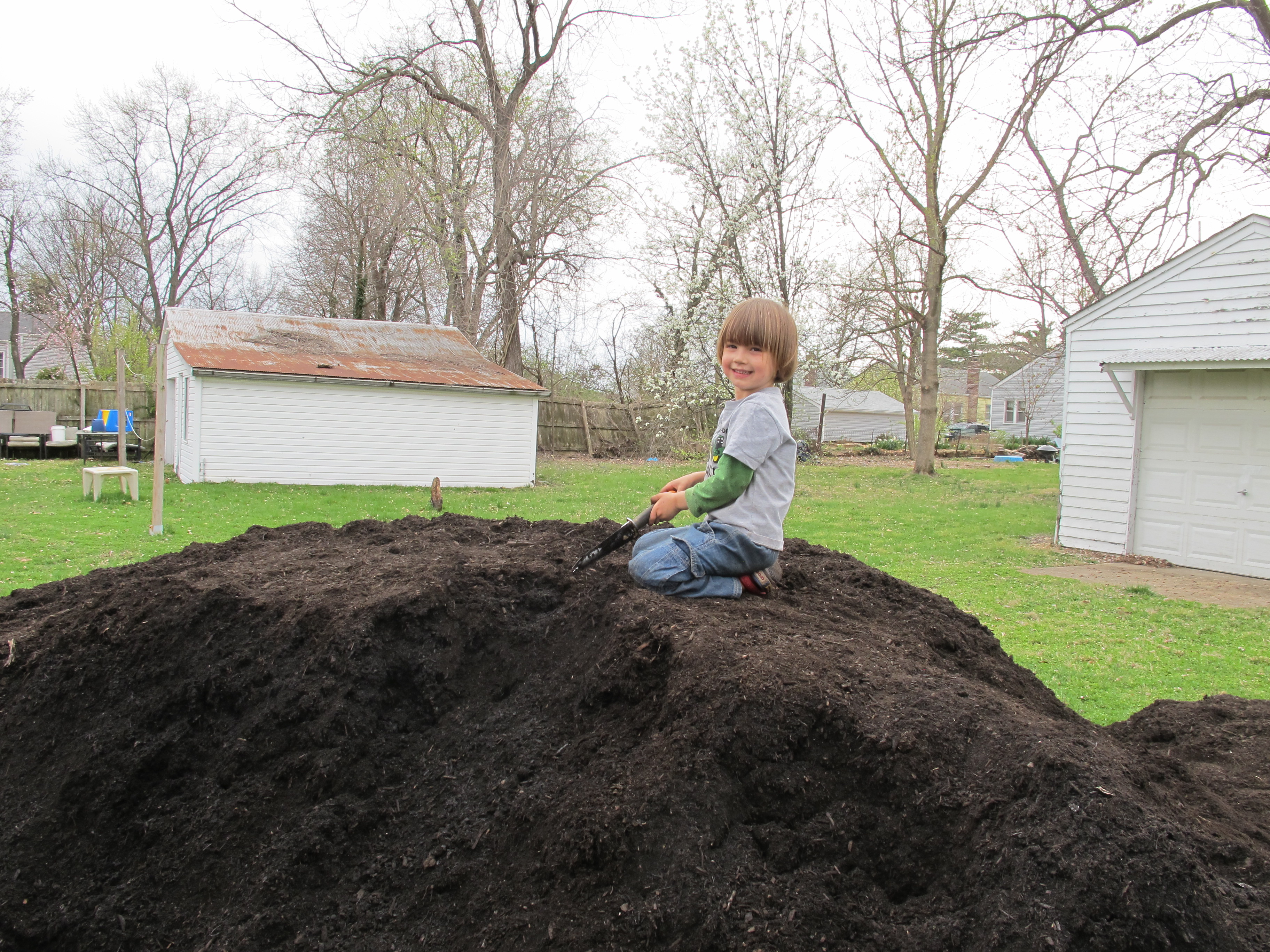
While we loaded and hauled 5-gallon buckets full of beautiful compost, Gabriel played king of the hill (and also “compost pile slide” and various other activities that would ensure he was thoroughly coated in the stuff).  Unfortunately, it wasn’t warm enough to strip him and hose him off outside, so we settled for the bathtub at my MIL’s.

IMG_7211

The compost is still hot, so for now we’re just using it to line the paths in the garden (the dark rows in the above photo).  Eventually we’ll add some to the beds.

Matthew planted parsnip seeds and a few more potatoes.  My MIL transplanted celeriac seedlings.  I just pulled weeds and hauled compost.  Despite the cool, wet weather, they’ve now finished almost all of the spring planting.

The tired gardeners returned home to a simple dinner of black-eyed peas, rice, just-harvested Swiss chard, and sweet potatoes.  It was just what I wanted after the rich brunch!

Avoiding pitfalls in raising a healthy eater: Part 1

Over the past year, our foodie toddler has grown into a preschooler, and, while I don’t want to label him as picky (and by most standards, he isn’t!), he has been making his preferences known a bit more.

These days . . .
Legumes, which are an important part of our animal-product-light diet, are often a tough sell, unless we’re talking chickpeas or black-eyed peas.  Now, I love both chickpeas and black-eyed peas, but I don’t want to eat them every day.  Variety is important — each type of legume has a unique flavor, texture, and nutrient profile.

While he’ll eat 100% whole wheat pasta and bread (homemade, with lots of crunchy things in it!) until the cows come home, during meals where we serve non-wheat grains, like rice or millet, you’d think the kid was on the Paleo diet.

On the plus side, he’s pretty into almost any and all vegetables, and he is usually willing to try new things (and sometimes he surprises me by being into new things that I’m not-so-into, like the okonomiyaki).

Little by little, we’ve started allowing a few small sweets into his diet, but figuring out the balance is tricky.  We don’t have dessert every night, but we do like to bake, and sometimes it’s fun to share a bit of something special.  While I don’t want dessert to be a reward or bribe for eating a “good” meal, I’m also disinclined to offer him a cookie when he’s barely touched his dinner.

Avoiding food fights
In many ways, I felt like we were doing all the right things.  Offering a wide variety of nutrient-dense, wholesome foods — check.  Making one meal / he eats what we eat (no short-order cooking) — check.  Not using food as a reward or bribe — check.

But I also felt myself sliding into some not-so-great patterns, such as encouraging “just one more bite,” as well as my own overly-concerned response and frustration to what he was or wasn’t eating.

I sought some expert help, and found this post on the Raise Healthy Eaters blog, written by Maryann Jacobsen, RD.  While numbers 8 and 10 on Jacobsen’s “10 Things You Should Never Say to Your Child About Food” list are not issues around here, I recognized some form of most of the other comments as things I’d said (and often regretted as it was coming out of my mouth), not often, but more often than I liked.

A bit more digging led me to the book Fearless Feeding, co-authored by Jacobsen and Jill Castle (also a registered dietician).  Fearless Feeding is based on pediatric dietician Ellyn Satter’s Division of Responsibility.  In this system, it’s up to the parents to decide What, When, and Where.  But it’s up to the child to decide Whether and How Much.

After reviewing the chapter on toddlers and preschoolers, I realized that I’ve pretty much got the What, When, and Where.  The trick is trusting Gabriel to the Whether and How Much — that’s where I struggle.  More on that tomorrow, in Part 2 . . . .