Making travel plans? Consider getting there without flying. If you have to fly, balance out the carbon impact by buying offsets. Fund a project that prevents one ton of greenhouse gases for each ton that your trip will cause (more info here).
This is a tough one, and something that I’ve never done. I don’t fly much, but it can be hard to think about spending more money when you’ve already paid for expensive plane tickets and other trip-related expenses.
So how much does it cost to offset your trip? I’ll be taking my first (but I’m afraid not my only) flight of 2010 this coming Tuesday. I used the calculator at TerraPass to check on the carbon emissions of my flight from StL to DC. I found the calculator easy to use and surprisingly informative.

My round trip flight will produce 644 pounds of CO2. That’s just for me; the flight’s total CO2 emissions will be 644 x the number of seats on the flight. How does this compare to other ways of getting to DC? When I click details, I see this comparison:
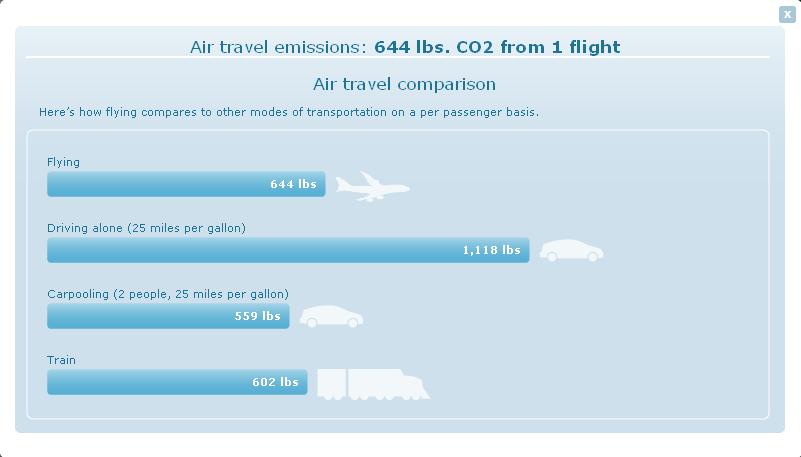 Conclusion: whatever way you do it, travel greatly increases your carbon footprint. This chart answers one of the things that I’ve wondered about for awhile now: “If flying is SO bad, is it worse than each person on the plane getting in a car alone and driving instead?” Now I have an answer!
So, how much does it cost me to offset the flight? I clicked, “Or skip to results,” in the first image, and was surprised to find that I could purchase offsets for 1000 pounds of CO2 (more than I was emitting) for only $5.95.
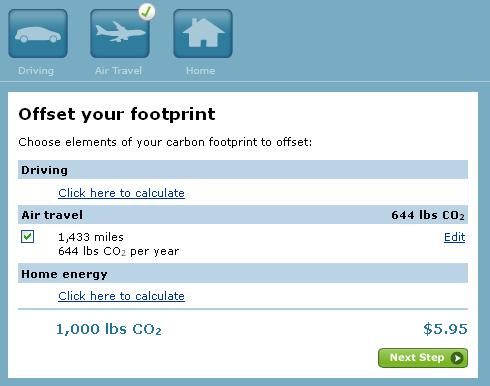 Now that’s something that I can do!
Still, given the environmental impacts of traveling, I prefer traveling less to just throwing more money at carbon offsets. However, given the reality that most of us will travel, purchasing carbon offsets can help us be more mindful of our impact on the earth.
—
Daily tip from http://www.lcwr.org/lcwrsocialjustice/eoclentcalendar2010.pdf


 Daily action from



 Her Green Life