Optimizing garlic growing in the Midwest

Guest post by Matthew, in which he geeks out on growing garlic in St. Louis, complete with a crazy-detailed spreadsheet 🙂

One of the challenges of gardening is that things that work well in one place, with one soil and climate, don’t work the same way in another climate.  While it isn’t perfect, the best data comes from places that are near where we’re wanting to garden.  I haven’t found a lot of detailed information and recommendations for my Midwestern climate with hot, humid summers, cold winters, and fast weather changes.  (If you have suggestions, I’d love to add to my reference library.)  Because of this, I do quite a bit of experimenting with different techniques, spacings, varieties, etc.  We’ve posted some of my results about carrots before, but today is all about garlic.  Onions will come in another post.

We did one garlic tasting last year.  We were unimpressed with the practical differences in taste when used as we normally use it, or really even in the roasted product.  Granted, my roasting protocol could use some work.  If you have a foolproof recipe for all different kinds of garlic, please let us know.  Normally we just add a bulb to a dish of other food, and I think as long as it’s pretty garlicky, it’ll do.  I do plan to try tasting again this year, but unless something impresses me, I think I’ll be weeding out a lot of my lower performers, or at least cutting them way back and trying to grow them from bulbils to see if they grow better with a fresh start free from soil disease.

That said, I grew 24 or 25 different kinds of garlic last year, and eliminated those that were most diseased or unsuited to my climate.  This year I grew 17 kinds, plus elephant garlic, and took data for comparison.  This is not a great study, as the sample sizes vary, and the growing conditions vary some, but it’s a decent set of data to start from, and much better than the information I’ve been able to find.

I asked myself what I’d need to compare garlic…

First I thought number of bulbs, total weight, and average weights for each variety.

But wait.  My “Main Crop” tends to have only 4-6 huge cloves, while Inchilium Red has 8-10 plantable cloves per bulb.*  For a fair comparison, I needed to know the number of bulbs, and the weight, that had to be devoted to replanting the same amount for next year.  I needed more data.

My, that’s a lot of data (see PDF linked below for full data table).  But hmm, this still doesn’t take into account the planting density.  I mostly used 6″ spacing between plants, but planted a few sub-plots at 4” spacing, and the elephant garlic had 12” spacing.

I realized the productivity was probably my best measure, and that I could capture that with lbs of eaters per square foot total needed to grow the variety, including the footage for replants.  To get that I added the sq feet total for variety including replant, lbs of eaters, and productivity (shaded in gray in the PDF linked below).

Garlic for blog Planning 9.15.2014

When I added that in, I also adjusted the elephant garlic for space, and it’s productivity came out as low middle of the pack.  The Broadleaf Czech at 4” was essentially just as productive as Broadleaf Czech at 6”, but no better.  I’ll repeat the experiment on a small scale, but it certainly suggests that for Broadleaf Czech, and possibly other softneck varieties, the 4” spacing is just too tight.  Why have smaller cloves if you can have the same total weight and larger cloves?

On the other hand, Main Crop at 4” was significantly more productive than Main Crop at 6”:  7.48 oz/sq foot vs. 4.85 oz/sq foot (possibly contaminated with Music or Russ Giant) or 3.86.  4” was between 1.5 and 2x as productive.  Since it only has 4-6 cloves generally, I’ll probably continue trying significant amounts of 4” Main Crop, and possibly other high yielding hardnecks too.

So, for St. Louis, from my data, German White (a.k.a. German Extra Hardy or many other names), Russian Giant, Silver Rose, Inchilium Red, Broadleaf Czech, Asian Tempest, Siberian, and Shantung Purple, Kettleriver Giant, and Elephant Garlic (in order of productivity).  I’ll grow a little of the others to check my data next year, and I may start growing some from bulbils to see if that increases the yield of the other cultivars . . . IF my taste test reveals that it makes a difference for our uses.  If not, I’ll just focus on the top ten producers, and once I have results from a few years, drop it down to the top three to five.

Other garlic resources:

*Our best guess is that our “Main Crop” is German White/Extra Hardy, but we’re not quite sure.


Informal traffic stop leads to good discussion

Great story from Matthew’s bike commute this morning . . .

So, this morning I was cajoling fun out of Gabriel, who really wanted to take the car because it’s “not so fast.” (He’s decided that he doesn’t care for the faster downhills on the bike.  We keep taking them a bit slower, but he was pretty upset when we didn’t capitulate on his car request this morning.)

The houses decorated for Halloween helped; the bucket truck did too, but the jackhammer he didn’t get to see almost touched off world war three.  Anyway, we were doing fine again when I entered Brannon northbound after Fyler.  This is always a slightly tricky stretch as there is a very wide lane that is intended for parking and driving.  In the absence of parked cars, riding to the right is still unsafe due to the debris that collects there (particularly bad on that segment), and a too far right position, when I can’t be all the way over, typically gets very bad (i.e., too close, very unsafe) split lane or in-lane passes.

I actually did move right at one point and allowed one vehicle to pass, but after that there was a full-size black pickup.  Given the truck’s size, and the room required for a safe pass, encouraging lane sharing, even in a wide lane, just wasn’t smart.  To avoid a bad pass, I kept lane control position.  Since the oncoming travel lane was empty, I was actively encouraging the driver of the truck to change lanes to pass, but he remained behind me.

After the next stop sign, the driver finally did pass, but he slowed down and parked right before the next intersection.  I debated waiting or going by him as he completed his stop, but when he started opening his door I was thinking, “Oh boy, here we go.”  I prepared to steer wide of him with a friendly wave (as friendly as I can) and get us the heck out of there, when I noticed the driver had blues on.

He asked me to pull over for a moment, and I, of course, did so.  At that point, I was apprehensive, because I know how wrong things went in the Cherokee Schill case.  The officer expressed his concern that I was too far left and that me waving people around instead of getting right might make other drivers mad and create a bad situation.  He told me he was especially versed in bicycle law because he’d had extra training recently to deal with mopeds (and they’re to follow bicycle regulations), and he talked about as far to the right as is safe.

I told him I really appreciated his concern for our safety.  Then I talked a bit about getting safer passes when not too far right.  The officer talked about his appreciation for my hand signals and stopping at the stop sign.  Eventually, I talked about the passing distances study, and we kept getting less uncomfortable and more friendly as we communicated with each other for a while.

I talked about my wish that there were more police available to enforce traffic rules for everyone, and he agreed.   Gabriel was awesome in all of this, mostly being quiet, occasionally asking to get to school, and giving me the opportunity to tell him that we’d be going soon, but that it was important for us to stop and talk to the officer who was concerned about our safety.  I think that may have helped a lot.

I expressed my sincere appreciation for the difficult job our officers do day in and day out.  Toward the end he told me that with the new information about the study, and with our discussion, he agreed that I was within the law riding further left if I believed it to be the safest place.

After that, I owned up to being a CyclingSavvy instructor and invited him to come to our classes.  He seemed pretty interested in coming to one sometime.

On the extra awesome side, this police “officer” was actually a sergeant, and he said he likes to learn more so he has answers when he’s asked for information in the scope of his duties either from above or below in the chain of command.  I truly hope to see this friendly sergeant at a future CyclingSavvy class.

It’s a complicated and challenging world, but discussions like the one we had this morning keeps my optimism regarding the good hearts and good work of our law enforcement officials alive.

Mindfulness training

So, back in June, I wrote this post about stress and health.  I know what I can do to reduce stress and support mental (and physical) health: eat well, get enough sleep, exercise . . . .  I’m pretty good at all of those things (except for when the stress is interfering with sleep).

But what about the mind-body connection, and practices such as meditation and yoga?  I know there’s research backing it’s importance, but this is a weak link for me.

A year-and-a-half ago, when I was struggling with depression (a follow-up to my post-partum depression), my mom (who’s a licensed clinical social worker) sent me Jon Kabat-Zinn’s The Mindful Way through Depression.  She has quite a bit of experience with mindfulness practice and recommends it highly.  I’d like to say it changed my life, but that wasn’t quite what happened.

The book lays out an 8-week program, with readings and suggested practice for every day of the eight weeks.*  I had good intentions, and I stuck with it for two or three weeks (practicing most days), and then, I don’t know, life happened, and I put mindfulness practice on the back burner.

While talking with my mom last month, she once again encouraged me to look into mindfulness practices, specifically Mindfulness-Based Stress Reduction (MBSR) workshops.*

A quick internet search turned up two main options in St. Louis.  The first local MBSR course that came up is one offered at UMSL.  It is primarily for UMSL employees (and their spouses/partners), but the site says they have a limited number of seats for the “general public.”  However, the next session doesn’t start until January, and driving out to UMSL once a week in [possible] winter weather didn’t sound that appealing.

The second option was the Mind-Body Stress Reduction program offered by Masterpeace Studios.  Held in Webster, the location of these classes was much more appealing, and there was a fall session about to start.  Convenient location, reasonable cost, and workable dates.  (The course offered at Masterpeace is a condensed 6-week version of what is normally an 8-week program.)

I went to their free intro class/info session on September 8th.  I turned in my registration paperwork that night, for the session to start the following week, but held off on writing a check.  Once I wrote that check, I would be committed, and I was still on the fence.  Did I really want to do this?  Could I make the commitment to practice every day for six weeks?

Even though it meant I would be out one night a week for the next six weeks (leaving Matthew solo with G at bedtime), Matthew was very supportive, and really encouraged me to go through with it.

I went into it unsure if mindfulness would “work” for me.  What if my brain just couldn’t do it?

Bridget, the instructor, told us from the beginning that the mind is a muscle.  If you want to be reap the benefits of mindfulness you have to practice.  When practicing, your mind will wander, and you just have to keep bringing it back, over and over again.  (Bridget uses the analogy of training a puppy to heel.)

With those things in mind, and with the motivation of being part of a class (that I paid good money to take) plus a log to record our daily practice sessions, I’m now into the third week of the course, and I’ve devoted time to practicing every day.

It’s not always easy, and I’m not “good” at it, but I’m doing the work, building that brain muscle.  I have to bring my mind “to heel” constantly — thoughts of decisions I’m trying to make are particularly intrusive.  Mindfulness practice won’t make the hard things go away, but it can lessen their negative effects.  No matter what was happening prior to practicing, I almost always feel calm and centered after practicing, ready to take another stab at life’s challenges.

I’ll check in again here in a couple of weeks with an update on my practice, challenges, observations, etc.

If you’re struggling with stress (and who isn’t?), anxiety, chronic pain, and/or depression, I’d highly recommend looking into Mindfulness-Based Stress Reduction.  If you’re not lucky enough to have a nearby program, you can try it on your own, using the book I mention below.  The University of Missouri Mindfulness Practice Center has some guided mindfulness meditations that you can listen to or download to help you get started.


*The original 8-week program, as practiced in Kabat-Zinn’s Stress Reduction and Relaxation Program at the University of Massachusetts Medical Center, is described in his earlier book, Full Catastrophe Living: Using the Wisdom of the Body and Mind to Face Stress, Pain, and Illness.  There is very strong scientific evidence for the benefits of mindfulness practice, and specifically the 8-week, which is explained well in the book.

And the great bike hunt continues

Are you tired of reading about this?  If you said, “Yes,” I completely understand, because I’m tired of thinking and writing about it.  But maybe writing will help clear my thoughts (or help someone else who’s bike shopping), so here goes.

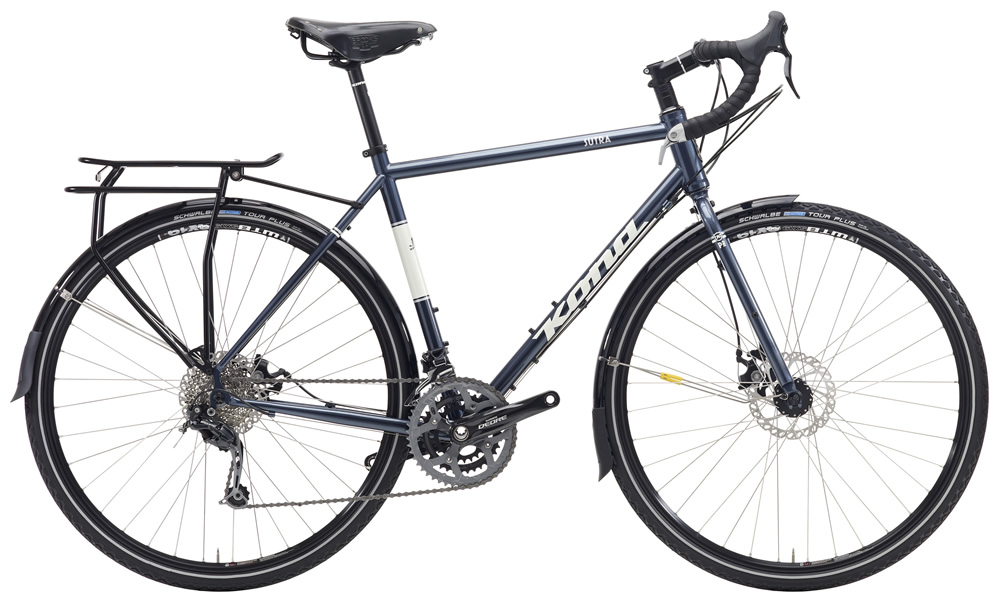
On Friday, I visited The Hub and rode two Kona touring bikes, the Sutra and the Rove.  They both have steel frames and disc brakes.  The Rove has SRAM integrated shifters, and the Sutra has bar end shifters.  They felt fairly similar, ride-wise (their geometries are basically identical).  When I lifted each bike, the Sutra felt heavier, due to some heavier-duty, touring components (the Sutra also comes stock with fenders and a rear rack, which contribute some to the weight).

If I was choosing between the two, I’d lean slightly toward the Sutra.  If I buy a bike with bar end shifters (the Sutra or the Surly LHT), I’m going to have the shop swap out the bar end shifters for the Shimano integrated shifters (planning to use those currently on my Kona Jake, assuming they are undamaged, which they appear to be).

I spent a decent bit of time on both Konas on Friday, and, while I have not made an overall bike decision, the time on drop handlebars clarified a feature of the 2010 Kona Jake that I really liked — a second set of brake levers for the “top” position (for a tutorial on possible drop bar hand positions, see Lovely Bicycle’s overview).

It may be mostly the fact that I got used to having those brake levers there on the Jake, but I really, really like having that option.  I feel like I have more stopping power using the brakes on the tops (though, technically, adding the second set of brake levers to the system reduces overall braking power slightly).

So, I’ll also be asking the bike shop to move the bar top brake levers from my old Kona Jake to whatever the heck I finally decide on.

At this point, my gut and/or make-a-decision-and-get-this-over-with feeling is to order a non-disc [brake] Surly Long Haul Trucker from The Hub.  They don’t stock Surly bikes, but, unlike Salsa, they can order Surly bikes.  (But part of me says the LHT is similar enough to the Kona Sutra, and I’m being silly and should just go with the Sutra they have in stock.)

Surly LHT (photo from surlybikes.com)

But there’s still a little piece of me leaning toward the Salsa Vaya (from non-preferred bike shop), in part because of this review over at The Path Less Pedaled, which talks about it being more responsive and less sluggish than the Surly LHT.  The other feature I like is the sloped top tube.  I’m not sure it will make that much of a difference for most rides, but it would be nice when riding in a skirt or a dress (though I could use BUB or Big Blue for that).  On the other hand, I’m not really sure that I want disc brakes (which come stock on the Vaya, vs. the option for a non-disc LHT).

I should probably revisit the bike shop and ride both the Surly LHT and the Salsa Vaya again, but I’m feeling worn out, and the trip across town, just to do that, again, is not exciting.

If money were no object (and I lived in the U.K. and could go to the shop in person), Thorn bicycles seem pretty interesting.  In the U.S., Rivendell Bicycle Works has some interesting options (again, not realistic on my current bike buying budget).

It’s frustrating because I don’t feel excited about anything.  I realized over the weekend that this point in our longtail search, the trying to make a decision, wasn’t particularly fun or exciting either.  The excitement and anticipation came after we’d made a decision, while we were waiting for the bike to arrive.  Then, once Big Blue arrived, riding was fun.  I’m just ready for the fun part here.

————-

Update: A friend shared this very appropriate TED Talk link.  “Paralysis” very accurately describes what I’m feeling right now regarding this issue.

Bicycle shopping woes

It’s been a month since Baby Jake’s demise, and I have yet to settle on a replacement.  After seeking a bit of input, I decided that some kind of touring bike might make a pretty decent commuter.  I was considering the Surly Long Haul Trucker or the Kona Sutra, when I wrote this post, and Rebecca brought the Salsa Vaya to my attention.

On September 3rd, I visited a couple of bike shops and returned home to post the following:

Gah — my frustration with inventory at StL bike shops continues! Visited The Hub and Maplewood Bicycles this morning. Both shops were very happy to ORDER a Surly LHT (or a Kona Sutra) for me, but neither stocked any touring bikes, so I left without test riding anything 😦

It’s a a chicken and egg problem: the shops don’t want to stock bikes that might not sell, but it’s pretty darn hard to sell a bike that you don’t stock!

Two days later, after a phone call to confirm inventory, I visited Big Shark:

Rode a Salsa Vaya [2] and a Surly LHT, and saw a Kona Sutra (two in stock, one too little, one too big for me to ride), at Big Shark this morning.

I felt a little guilty, knowing I would likely order my new bike through my preferred bike shop, and not Big Shark, but I needed to get my hands on these bikes somewhere.  I left with the information that if I wanted the Vaya, I’d have to wait until late September/early October, when the 2015 models came in.

Stock image from salsacycles.com
2015 Salsa Vaya 3 (stock image from salsacycles.com)

I was rather decided on the Salsa Vaya 3, when a local bikey contact mentioned that he was interested in selling his year-old Novara Randonee touring bike, fully outfitted with fenders and rear rack.

It just happened to be my size, so we met for me to test ride it on a Saturday morning (9/6).  I liked how it rode and even felt fairly comfortable with the bar-end shifters.  While a used bike would not have the advantage of life-time free tune-ups that come with a new LBS purchase, the savings over new ($800-$900, in this case) were substantial and attractive.

I told the seller that I would get back to him with a decision in 24 hours.  At that point, he’d had no other contacts about the bike (it was posted on CL).  I also thought I communicated that if he received an offer before I contacted him, and I needed to decide sooner, to please let me know.

I’d pretty much made up my mind that I was going to take the “pre-loved” Novara, and I was already picturing my new ride, and really looking forward to it, especially since I’d discovered that riding BUB was a literal pain in the neck (and upper back and shoulders).

Six hours later, the bike was sold.  To another buyer.  Whomp, whomp, whomp.

So, back to the Salsa Vaya.  My next step was checking to see if The Hub could order the Salsa Vaya.  I was fairly confident they could, since I already knew they could order a Surly LHT (even though they don’t stock Surly bicycles).

After waiting for a week, I got the bad news — Salsa bicycle sales are restricted to official Salsa dealers.  That meant I could either get my first choice bike OR a [different] bike from my first choice bike shop (The Hub), but not both.  I’ve basically been sitting on this information for ten days, trying to figure out what I’m going to do.

In the meantime, The Hub got a 2015 Kona Sutra in my size, and the co-owner pointed out that they also have a [my size] 2014 Kona Rove in stock (very similar specs and geometry to the Sutra, but with integrated brakes and shifters as opposed to bar-end shifters, which was part of the appeal of the Vaya).  I’m hoping to ride both tomorrow.

2015 Kona Sutra (stock image from konaworld.com)

Both of these Kona bikes are a bit more like a cyclocross bike than a touring bike (comparing geometries to the Vaya and the Surly LHT), and, since I’d kind of settled on a touring bike, I’m not sure how I feel about that.  On the other hand, I was pretty happy and comfortable on a ‘cross bike (Baby Jake) for quite awhile, so maybe it’s not a big deal.

In the meantime, I’m minimizing time on BUB (despite new tires, a tune-up, and a new chain, cassette, and rear derailleur cable), due to comfort issues, which means I’m riding Big Blue (the longtail), whenever Matthew doesn’t need her to transport G.  But I’m ready for a new primary bike already!!!