Partner bicycling conundrums

When we met, our interest in, and commitment to, biking for transportation was one of the things that Matthew and I shared (along with a love of cooking and eating delicious vegetarian food).  Perhaps because of this shared history, it’s particularly frustrating when bicycling becomes a point of contention in our relationship.  I’m not talking about, “You spend all your free time riding your bike,” kind of contention, though.

In general, we don’t ride our bikes together all that much.  Bike trips to work, or to run errands, are usually solo ventures.  Duo trips are limited to weekend (or rare weeknight) outings, so it took a while for us to notice the problems.

Prior to April 2011, the primary point of contention was that I was riding too close to parked cars.  I understood Matthew’s concern, but I felt uncomfortable riding farther left in the traffic lane.

Enter CyclingSavvy.  We took the basic course together in April 2011, and went on to become instructors two months later.  This course gave me the knowledge, confidence, and skills I needed to get out of the door zone and away from the edge of the roadway for good.

It seemed this would be just what we needed for partner cycling bliss.

We do great on multi-lane roads, usually riding two abreast in the right travel lane, then singling up in spots with on-street parking (or other features that narrow the effective lane).  But we don’t want to always ride on arterial roads, since there are lower-speed, less-trafficked options, nor do these big roads always serve our destinations.

And here’s the thing.  We agree on all the basic principles: 1) follow the rules of movement, 2) practice good communication, 3) never ride within 5 feet of a parked car and you won’t get doored (or startled), 4) never, ever ride up along the right side of a tractor-trailer (or bus, garbage truck, etc.).  Those are just a few examples, but suffice it to say, we agree on most things when it comes to how/where we ride.

But then are the “gray areas,” the judgement calls.  Where, exactly, on a given roadway do I need to be to encourage safe motorist behavior (i.e., discourage unsafe passing)?  When should I actively (or passively) encourage someone to pass me?  When should I passively (or actively) discourage passing?

The answer to all these questions is, “It depends.”  It depends on road design, traffic conditions, weather, and a number of other dynamics.

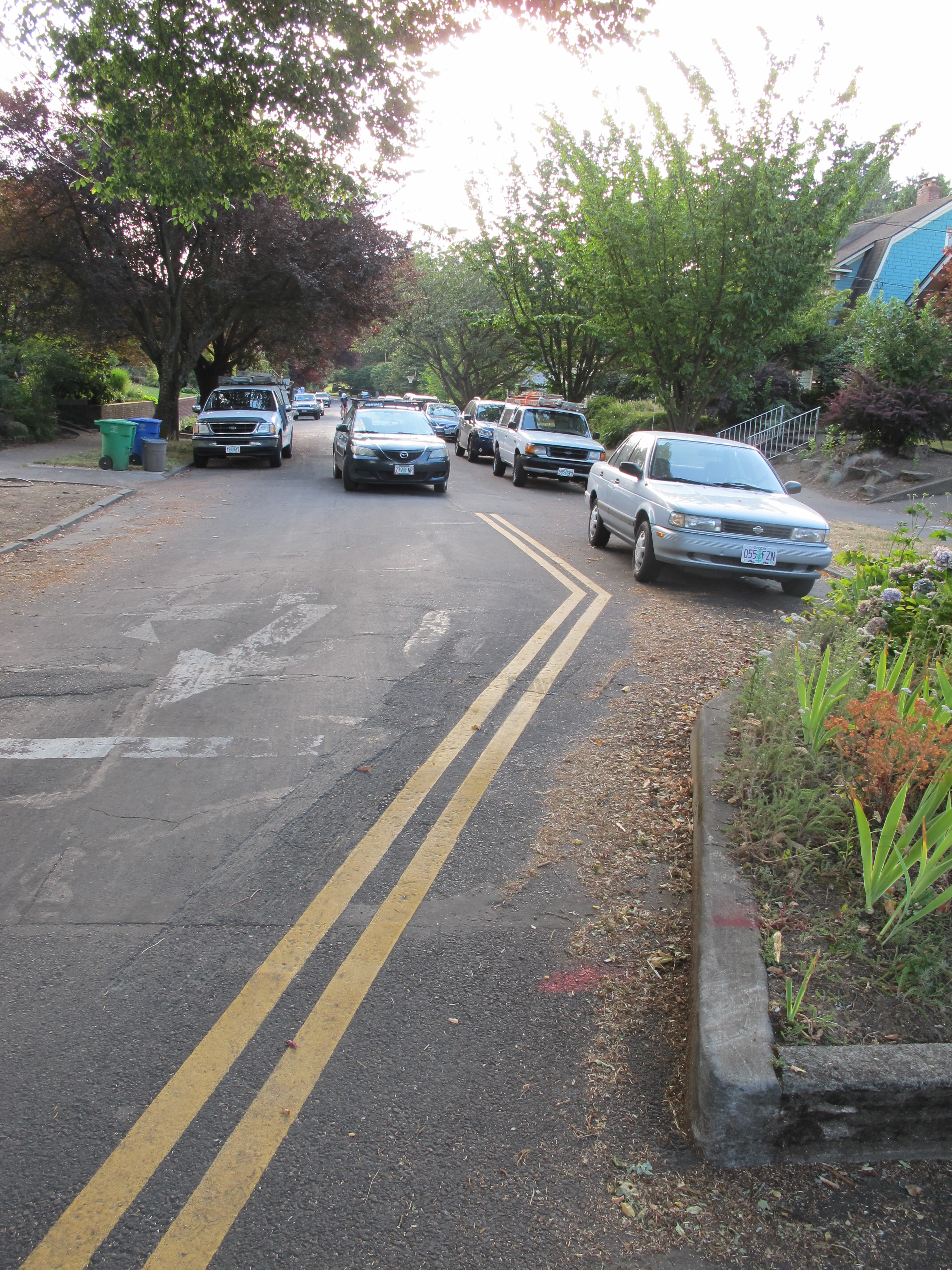
The main north-south route we ride is a tricky one for these questions.  It’s a street with two-way traffic, and on-street parking on both sides.  Portions of it are too narrow for a center stripe (perhaps just barely wide enough for two cars to eek by each other if there are also parked cars on both sides at a given spot).  Other portions do have a center stripe, creating a narrow lane of travel in each direction.  The blocks are short, with a stop sign at almost every intersection, so it’s difficult for anyone (motorists or bicyclists) to work up much speed.  There are also alleys that exit onto the street in between every intersection, so LOTS of potential turning conflicts.

But it’s a neighborhood street, with low speed limits and relatively little traffic, and it offers an alternative to a traffic sewer (Kingshighway, which we do ride portions of).

We’ve ridden this route for years, and when we’re riding solo, we each navigate this stretch as we see fit.

In general, I move a bit slower on my bicycle (especially when I’m hauling a kiddo), and I tend to look for opportunities to “release” a motorist who ends up behind me, even if it means I need to slow down a bit more to facilitate the pass.

Matthew also practices control and release, but, when on his own, is usually moving a bit faster, meaning less opportunity to release (and perhaps less real need, though there’s still the “Must Pass Bicyclist Syndrome” to deal with).  He also tends to ride MORE than five feet from the parked cars, to discourage unsafe passing by both overtaking and oncoming (because the passable street width is so minimal with on-street parking) motorists.*

I prefer to stay closer to the right as a default position on this stretch (though still at least 5 feet from the parked cars, not riding the edge, not weaving in and out of parked cars, etc.), and use active encouragement/discouragement to communicate with motorists about when it is or is not safe to pass.  (In truth, I may be cheating in a bit on that 5 feet from parked cars along some of these stretches — we may need to bring out the tape measure on this one, to double check both of our perceived vs. actual distances.)*

Yet what we do almost effortlessly alone, with one bicycle, becomes REALLY difficult when we add the other person and that second bicycle.

  • The dynamic changes for Matthew because, in order for us to actually ride together, he’s traveling slower than normal.
  • Instead of time and space to pass one bicyclist (it’s too narrow for us to ride two abreast on the streets in question), overtaking motorists need time to pass two bicyclists.
  • The front rider (usually me, setting the [slow] pace) needs to decide if it’s safe to encourage a pass, but the rear rider needs to communicate with the motorist.
  • On these short blocks, by the time I see a gap, make a decision, and communicate with Matthew, the gap is gone, or we’re at the next stop sign — too late for him to signal the motorist to pass.

So our shared bicycle outings, times where we should be enjoying our common love of bicycle transportation, become fraught with tension, disagreements, and stress.  Instead of feeling good, we arrive at our destinations feeling “yuck,” and, for me, at least, wanting to give Matthew a five minute lead on the way home, just so we don’t have to deal with it.  And wanting to never ride our bikes anywhere together again.

So we’re taking advice.  Do any of you cyclist pairs have suggestions for harmonious partner bicycle travel on roads/in situations like what I describe?  Any tricks for clearly communicating with each other on the road?

*Regarding our roadway position, and where we need to be to get safe passes — in our small sample, it seems there may be some motorist bias based on bicyclist’s sex, i.e., motorists behave better around female cyclists than around male cyclists, so Matthew has to ride differently (i.e., farther left) to get the same passing distance I get when riding a bit farther to the right.


Balloons and bicycles, times two

This past weekend was all about hot air balloons.  We kicked things off with a bikey outing on Friday night.  Bikes are the way to access this event.  No getting stuck in traffic; no parking and walking from far away.  We biked from The Hill to Forest Park, through the VIP parking barricades (with a wave and a nod from the guard), and right up to the edge of the balloon field.  We had a rather impressive number of bikes locked together, as you can see in the top photo in Rebecca’s post.

We enjoyed a lovely potluck picnic spread as the sun set and the balloons started to glow behind us.  We forgot our camera, so I’ll let you enjoy Rebecca (linked above) and Mike’s photos.

On Saturday, Matthew finished up at the garden early so we could take Gabriel to the park for the balloon launch.  Similar to last year, we packed a picnic dinner.  Unfortunately, I forgot to pack any toys, a lapse which someone lamented greatly.

Also similar to last year, Sir seemed as interested in the bounce houses as the balloons.  (Sigh.  Three year olds!)

We brought the camera, but I only caught one thing flying this year:

IMG_5821[1]

On the way home, we stopped for gelato.  Gabriel had his very own cone — blueberry and chocolate chip — which he thoroughly enjoyed.

We couldn’t have asked for better weather over the weekend!  Friday’s biking was lovely.  Saturday’s trip was a bit stressful; we’re struggling a bit with the dynamics of riding together (vs. solo riding).  Not a new problem, but one we’re hoping to solve (I may say more about this later), so future bike outings are more enjoyable.

Privilege and rights in our communities and on our roads

A couple of weeks ago, I finally got around to reading Jeremy Dowsett’s post, “What My Bike has Taught Me about White Privilege.”  I’d been seeing links to the post on FB for a week or two, and I resisted clicking.  I had a pretty good idea what his argument would be, and, while I thought he had a point, I also thought the argument was a bit of a stretch.

When I finally got around to reading it, I found a thoughtful, well-written piece.  I particularly enjoyed the way Dowsett looked at the idea of white privilege (emphasis mine):

But privilege talk is not intended to make a moral assessment or a moral claim about the privileged at all. It is about systemic imbalance. It is about injustices that have arisen because of the history of racism that birthed the way things are now. It’s not saying, “You’re a bad person because you’re white.” It’s saying, “The system is skewed in ways that you maybe haven’t realized or had to think about precisely because it’s skewed in YOUR favor.”

As a bicyclist, Dorsett explores this imbalance from a number of angles: access; road conditions; the often unintentional, but potentially quite damaging behavior of “privileged” motorists; and unjust laws.  In the interest of not recapping his entire post here, I’ll let you read it for yourself.

This is not the first time I’ve read or heard bicyclists’ rights being compared to civil rights.  I get the analogy.  Bicyclists are often treated as second class citizens.  Even motorists who don’t have bad intentions don’t really get it, and often behave in ways that endanger us.  (I don’t agree with everything he says — while I share some of his experience, and frustrations, my experience on the bicycle, the story I tell, is often different because of the way I ride.)

Part of where this argument/analogy breaks down for me is that skin color is not something you choose.  It’s something you’re born with.  And everyday, people in this country, people in my city, are treated differently because their skin is darker than mine.

On the other hand, most people who ride bikes are choosing to do so.  Even if you eliminate the recreational riders from that equation, and just look at people who are using bicycles for transportation, for most of them, most of the time, it is still a choice.  They can afford to own and operate a motor vehicle (though the cost of this is not negligible).  For whatever reasons (health, money savings, environmental reasons, etc.), they are choosing to ride a bike.

And it’s not okay to be discriminated against, harassed, or endangered for your transportation choices, but it is also not the same as facing those same challenges and built-in biases because of a physical characteristic you can’t control.  (Also, for bicyclists, these experiences happen when they are on the bicycle; people of color can’t just “get off the bicycle.”)

But what about the people who don’t have much choice about being on a bike?  What about people like Cherokee Schill, a single mother who rides her bike to work every day?  A woman who was first dragged to court, and has now been arrested, because she is using her bike to get to work and support her family?  A person who’s riding her bike so she can save her money for groceries and housing rather than gas and car maintenance?

Schill, 41, said if there were an easier way to get to work, she would take it. Her [car] is not dependable. To be able to afford housing and food for herself and two teenagers, the divorced mother said commuting by bike keeps her household afloat.

“I’m not putting myself here because I think it’s fun or exciting,” Schill said of the commute. “I’m here because I’ve got two kids to feed and a roof to put over their head. … I’ve got to pay rent, pay bills and buy groceries.”

The only route between Ms. Schill’s home and her workplace is a U.S. highway (the article I linked to above makes it clear that she explored other options for getting to work; none of them get her to work in time for her 6am shift).  This is not an interstate, with posted minimum speeds.  The shoulders on the highway are filled with debris (as are most shoulders), not to mention rife with turning conflicts that make “far to the right” a very dangerous place to be.  So Ms. Schill rides in the right traffic lane and practices defensive bicycle driving.

This is a 4-lane road, so when Ms. Schill is operating her bicycle in the right lane, motorists can freely change lanes to pass her in the left lane.  It is that simple.  Might they have to take their foot off the gas pedal and slow down a bit when they approach her?  Yes, just as you would for any slower moving vehicle.  The “delay” this would cause any single person is minimal.

The county prosecutor and law enforcement have chosen to challenge Ms. Schill’s right to operate her bicycle on this road.  Through all the citations and press, Ms. Schill had continued riding, continued going to work and supporting her family, despite harassment from [a select few] motorists and local law enforcement.  Instead of focusing on the people who were threatening and harassing Ms. Schill, with their vehicles, they chose to focus on the “danger” she posed to motorists.  To focus on how she doesn’t belong on that road, because she is slower and smaller.

After reading about Ms. Schill’s conviction last week, and her arrest yesterday, the parallels between the different struggles for rights ring more true than ever.  I will not claim they are identical (nor does Mr. Dowsett, as explained in his follow-up post).  But the similarities, and possible implications, are frightening.

———–

To learn more, and show your support for Cherokee Schill (and the rights of all bicyclists), check out the “I Support Cherokee Shill” page on FB, as well as the fundraising effort to cover Ms. Schill’s legal costs (she is planning to appeal the initial court ruling against her).


PA school — Full steam ahead?

I started this post last week with a working title of “PA school — An unreachable goal?”

I spent five months considering options, including getting a med tech or CNA certificate, and hunting for jobs (ideally ones that I could get without any additional education) that would give me more “patient care experience” for my physician assistant school application.  Five months with very few jobs to apply for, and zero interest in the few applications I did submit.

I was feeling like this whole PA school thing might never happen, when I looked at my work history and decided that, technically, I have [barely] enough hours to go ahead and apply now (for a fall 2015 start date).

Of course, it would have been much better to come to this conclusion in June, at the beginning of the application cycle, than in mid-September, just several weeks from the application deadline.  Better in terms of time, and better in terms of my odds of acceptance (the school I’m looking at considers applicants on a rolling basis — at this point, some of the spots for next fall’s cohort are probably already taken, so by applying late[r], I’m competing against a bigger pool for a smaller number of seats).  Sigh.

I went ahead and started completing the online application, which is ridiculous.  You have to enter, one at a time, each and every college level class you’ve ever taken: course title, course prefix and number, grade received, credit hours . . . talk about painstaking!  (I made it through undergrad, and I’m waiting on my grad school transcript to tackle those classes.)  This is in addition to sending them your official transcripts, which, of course, obtain all the info they’re making you enter.

With the exception of medical terminology, I have all the academic prerequisites (though some of them are a bit dated).  My overall GPA will be quite high, and my science GPA will be decent.

The fact that I have a degree in public health, and 7+ years experience in the field, should work in my favor.

Still, while my patient care hours meet the minimum requirement, they’re nothing impressive.  More clinical/patient care experience would be a plus, but it’s not clear that that is going to happen, certainly not quickly or easily.

The idea of applying now, and starting next fall (2015), as opposed to applying in the summer of 2015 and waiting until the fall of 2016 to start (two whole years away), is appealing (and frightening).  I feel like I’m just cooling my heals otherwise and giving myself too much time to second-guess and question this whole crazy plan (you know, juggling an intense 27-months of full-time school and studying with having a family,  going into debt for the privilege, watching school bills eat up all the money we’ve saved to buy a house, questioning why the heck I have to do this, and whether “this” is the right/best option — should I be seriously considering opening a bike shop instead?).

I was all set to go for it, full speed ahead, and then I considered the application fee.  Two hundred twenty-five dollars.  Not that much money, but I’m not a gambler, and that’s what it feels like I’d be doing if I go for this now, instead of waiting for the next application cycle.

The thing is, I’m not sure I’d be anywhere different in nine months, experience-wise, but I would at least have the advantage of applying really early, and being in that first pool of applicants they consider.  I feel like I may need that advantage.

So, cards on the table, or bide my time???  What would you do?

Portland bike infrastructure: The good, the bad, and the ugly

Well, it’s been a month since our Portland trip, so I guess it’s about time I got around to writing this post.  As I mentioned in this post, we spent a good bit of time on bikes while we were there, averaging about ten miles a day, all around the town.

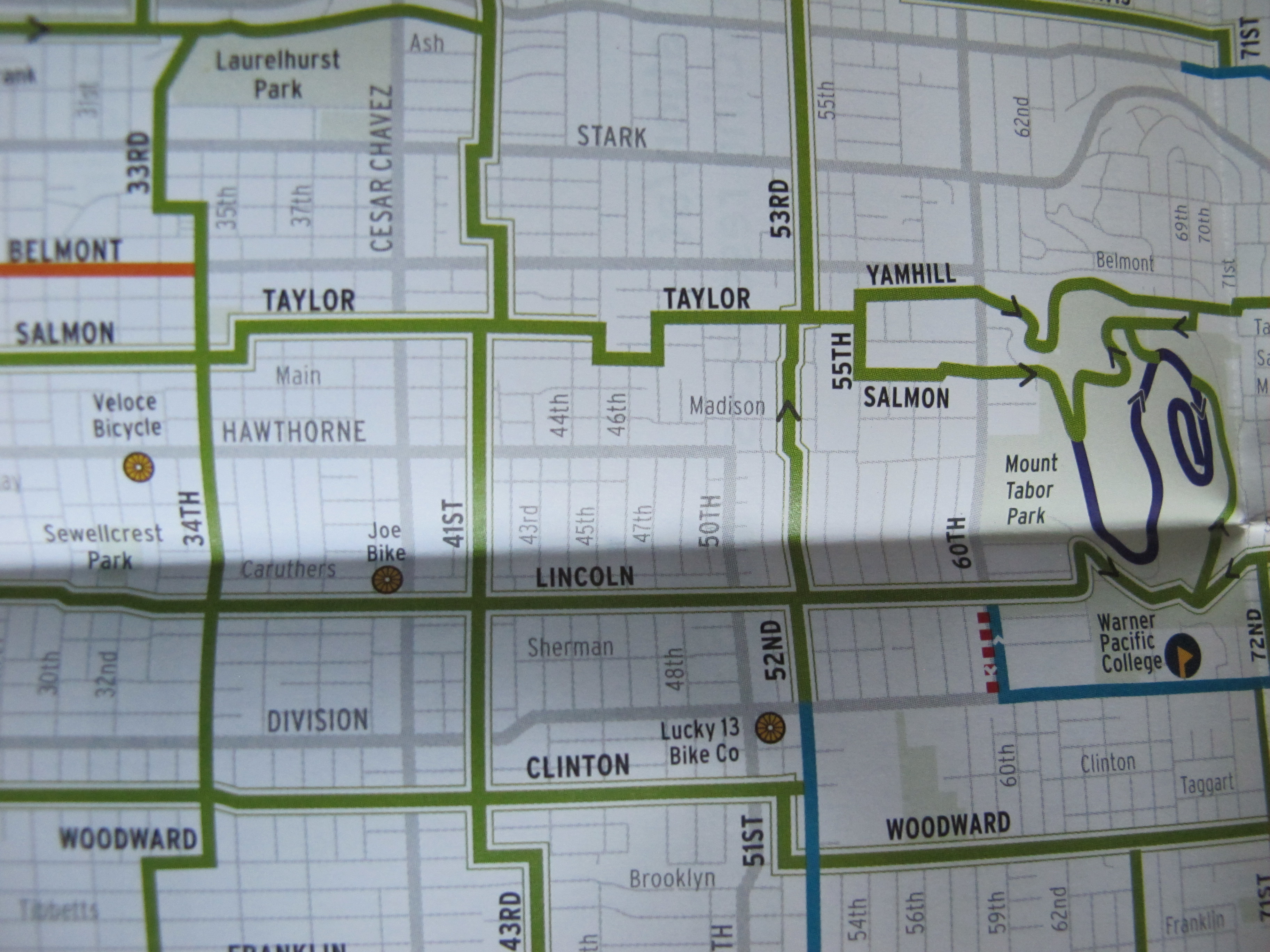
Similar to our last visit, the Portland Citywide Bike Map was our best friend.*

IMG_5271
Our well-loved map

The bike map was useful for telling us where to ride, and, just as importantly, where NOT to ride (i.e., we planned our routes to avoid streets with bike lanes).

The Good
The green routes in the above photo indicate bike boulevards (AKA neighborhood greenways), defined here as:

. . . residential streets with low volumes of auto traffic and low speeds where bicycle and pedestrians are given priority.

So, how do they achieve “low volumes of auto traffic” and give priority to people on bicycles?

IMG_5187
Sharrow and “Bumps” ahead sign

These routes are marked with well-placed sharrows (above) and low, broad speed bumps (below — also, mini horses 🙂 ).

IMG_5201
Traffic calming bumps

These speed bumps aren’t a big deal at bicycle speeds, but they do get motorists’ attention.  My friend drove down from Seattle to visit us in Portland, and while driving her car on some of these streets, she mentioned that the bumps were annoying.  I responded with, “That’s the point.” Yes, motorists can use these streets, but the frequent bumps make them less attractive, thus encouraging motorists to do most of their travel on arterial roads (the bumps also encourage travel at slower speeds — they weren’t too bad if you hit them at ≤20mph).**

IMG_5198
Awwwwe, a baby traffic circle

Another design feature is intentionally minimizing stop signs, which are a bigger bother to pedal-powered travelers than to motorists.  Instead of four way stops at every. single. intersection (ahem, StL, I’m looking at you), most intersections along these routes used 2-way stops at the cross streets, allowing traffic on the bike boulevards to flow smoothly.  Some intersections used a “mini traffic circle” (for lack of a more official term), pictured above, in conjunction with the 2-way stops, for traffic calming.

So, the bike boulevards in general get a thumbs up.  Throughout our stay, we sought out these routes, combining them as needed with “regular” streets (i.e., streets with no bike infrastructure).

The Bad
The bike boulevards did have some design quirks.  If you look at the map pictured at the top of this post, you’ll see that you often have to do some little “jogs” to stay with the green routes.  Sometimes these were marked well, sometimes not.  If you lived in Portland and rode these routes every day, it wouldn’t be a big deal.  As visitors, it was a bit confusing and frustrating at times.

IMG_5167
Say what?

So here we were, traveling eastbound on a two-way street, and we cross an intersection, and all the sudden, we’re moving against the flow of traffic on a one-way [westbound] street, per the paint’s instructions!  Granted, this took place on a small, residential street, and the one-way bit only lasted for a short block, but still, talk about breaking the rules of movement!  (The sign says, “Do Not Enter | Except Bicycles.”)

IMG_5169
Same place as above, with a car approaching. This might belong in “The Ugly.”

I understand this is another technique for reducing/discouraging non-local motor vehicle traffic, but in addition to being dangerous in this location, it potentially encourages wrong-way riding on OTHER streets.

If they really want to do this, I would suggest at least eliminating parking on the right side of the street, to create more space for movement, as well as adding some sharrows to make people more alert to the anomaly.

In some places where this occurred, the offense wasn’t quite as egregious, as the street immediately reverted to two-way traffic,  and, you know, actually had enough space to operate a bicycle.

IMG_5194
Do Not Enter | Except Bicycles

Of course, the intersection above commits the additional offense of having “bike boxes,” that special green paint that encourages queue jumping by bicyclists.  “Here, please ride up along the right side of potentially right-turning motor vehicles instead of just waiting your turn like everybody else.”

Here is another intersection feature along some of the bike boulevards: “Right Turn Only | Except Bicycles.”

IMG_5328
Median to prevent thru motor vehicle traffic.

These medians, with cut-outs for bicycle pass-throughs, were usually found where the bike boulevards intersected with a larger street.  Again, this discourages motorists from using these routes for long distances, as they are only thru-routes if you’re on a bike.

IMG_5330
Median cut-outs for cyclists

This is perhaps a decent idea, but, as implemented, the cut-outs are clearly designed for edge-riding cyclists.  This design becomes particularly problematic if the cyclist wishes to make a left turn at one of these intersections, as you first have to cut right, then back left to make the turn.  Not impossible, but it does require extra communication to make your intentions clear to both motorists and fellow cyclists.

The Ugly
For the most part, we used the bike route map to successfully avoid “the ugly.”  We did find ourselves on a couple of short stretches of roads with bike lanes.  These were invariably door zone bike lanes, that sandwiched you nicely between parked cars to the right and moving motor vehicles on the left.  No thanks!

However, in Oregon, you don’t really have the choice to NOT ride in these lanes, given the state-wide mandatory bike lane law.  Granted, those laws have exceptions which would basically invalidate over 90% of travel in the bike lanes, but I didn’t want to take chances with a police officer not knowing/understanding those exceptions, especially when “everyone else was doing it (i.e., riding in the bike lane like good little sheeples).”

I should note that, on this trip, we were always pulling a trailer (or riding a box bike like the Bullitt) which should be a valid excuse for not ever using a bike lane — these things are just too wide for bike lanes, period!

I don’t have any photos of Portland’s bike lanes, since we avoided them so successfully, but for a deeper look, check out Andy’s excellent series on the topic of Portland bike lanes at Carbon Trace: Part 1, Part 2 , Part 3.

Finally, this:

IMG_5183
Bi-directional bike lane on one-way street

Where to begin?  On this street, what had been a two-direction road divided into two, separate one way chunks.  But that didn’t stop the Portland traffic engineers from installing a bi-directional bike lane.  What you see above, from left to right: a sidewalk, a north-bound bike lane, an against-traffic [south-bound] bike lane a buffer zone (the lane with the chevrons in it — UPDATE: I was incorrect in my original identification of this space; see comments for details), two north-bound travel lanes, and another sidewalk.  The presence of multiple rail tracks just south of this intersection adds to the general confusion.  There is a “Do Not Enter” sign, but we were confused as to whom that sign was addressed.

On our very first encounter with this intersection, Matthew accidentally ended up in one of the [regular] travel lanes, going the wrong direction.  I was still waiting at the stop sign, trying to figure out exactly what was going on and how best to respond, and I watched in horror as I realized his mistake — he was headed right toward a car in the same lane.  Fortunately, he was able to divert onto the sidewalk on the far side.  In the end, much as I avoid sidewalk riding, the sidewalk is also what I chose for this small stretch.

No Substitute for Quality Education
In the end, even “good” bike infrastructure, such as the bike boulevards, is no replacement for comprehensive bicycling education.  The majority of the bicyclists I saw riding on the bike boulevards in Portland were operating in either the door zone or the startle zone, despite the presence of properly placed sharrows directing them elsewhere.

At one point, while traveling along a bike boulevard, Matthew was almost the victim of a drive-out collision.  It was a two-way stop — so the motorist had a stop sign and we did not.  The motorist stopped at the stop sign, but was already on his way, with his front bumper out beyond the curb, when he saw Matthew and stopped again.  If Matthew had been practicing edge-behavior, rather than driver behavior, he quite possibly would have been hit (being away from the edge makes you more visible).

I’ll close with a couple of great quotes that I came across recently:

Merely believing and hoping that Protected Bike Lanes are safe is not good enough. We are not practicing a religion here, we are trying to keep people alive.  (source)

And, from a thread on the “Supporters of Full Lane Rights for Cyclists” FB page:

In other kinds of transportation facilities, we do not have the most inexperienced users decide out of fear which are the best designs.

*If you’re headed to Portland, you can order a bike map ahead of time here, or just visit most any bicycle shop once you arrive.
**Not sure of the full details, but a local (StL) traffic engineer told me those speed bumps (and/or the mini traffic circles, I don’t remember which) don’t work so well in places where snow plows are needed.