One for the now

This is a post that has been on my mind for a long time.  I’m finally writing after reading some other posts this week by Kim Simon (AKA Mama by the Bay): first, this beautiful tribute to doulas and fighting PPD, then the story of becoming a family of four, and finally, this.  Talk about tugging my heart strings!

Kim’s story with her first child seemed so like mine, in many ways, and it was SO easy to get caught up in the healing she found with her second child.  Her writing had me in tears; it was, in many ways, beautiful and uplifting, but it sent me on a downward spiral, because, in my heart of hearts, I don’t think her story will be my story, and that was depressing.

THIS is my story.  Maybe it is your story, too.

My little boy will turn three in just over a month.  In the past ten months, it seems like everyone I know with a similar-age first child has either had a baby or announced a pregnancy — both real-life and virtual friends.  So now it’s just me.

I guess because I made it clear fairly early on that G would most likely not have a sibling, I’ve avoided a lot of the, “So, when are you guys going to have another one?” questions, but that doesn’t mean it’s not on my mind.

Most of the time, I’m over 90% sure that one is a really good number.  But sometimes I get caught up in wondering: the chance to grow and nurture another life; a re-do of our first year; a shot at another (different?) birth story.

It’s tempting to look at my peers and think, “Everyone’s doing it, so I should, too.”

But my story is my own, and when I really think about it, I can’t think of any really good reasons to have a second child.  At least nothing that overrides my looooong list of reasons why, for me, for our family, one is a really good number.

My one child is awesome (and exhausting and sometimes frustrating).  Could I handle another one?  Could we make it work?  Yes.  Maybe.  Probably . . . . but why?  (No, I don’t really want answers to that last question.)

It’s hard to find closure on this when I wonder if I’ll regret it later.  And these are still “early days,” in many respects — will I feel differently when G is 4?  Or 5?  Or 10?

As he gets older — more independent; less needy; more fun, new stages — I’m afraid the temptation toward a second child will only grow, especially when couple with increasing time and distance from those challenging first months and years.

The best answer I can come up with is to live in the present, challenging though that may be for this “have it all planned out” gal.  For NOW, one is a really good number (except those times when it still feels like too much — I’m a mommy wimp!).  For NOW, I have a sweet, healthy, smart, adorable little boy, and I love seeing the world through is eyes.  For now (and, yes, quite possible forever), one is enough.

If I am still living in the present when I am 40, 50, 60 . . ., I won’t look back and regret.  The real tragedy would be getting so caught up in the worry and what-if that I miss the amazing, wonderful NOW.
IMG_4124


Garden lite

A couple of weeks ago, I was on garden duty while Matthew and my MIL were on vacation.  While there was a ton of work I could have done, if gardening had been the only thing on my to-do list for the week (the weeds were thriving!), my efforts focused mainly on picking (and processing) strawberries, along with a couple of other crops.

The strawberries needed to be picked every other day (at least), which meant multiple, short trips.  Because of the distance to the garden, this is just the thing we usually try to avoid (and why this garden set-up depends heavily on my MIL’s involvement), but it did give me a chance to experience what it would be like to put in a few hours at the garden, here and there throughout the week, instead of Matthew’s current all day Saturday set-up.

I discovered (not for the first time) that gardening in 1-3 hour chunks, in the earlier morning hours, is quite pleasant.  This is what I envision having a garden at our house would be like (with perhaps a few long, intense days here and there).

We debated putting in a single, small raised bed at our apartment, but we’re not sure it’s worth the time and cost for materials to build.  There’s a small community garden within easy walking distance that has a couple of seemingly abandoned beds, so we’re looking into adopting one of those . . .

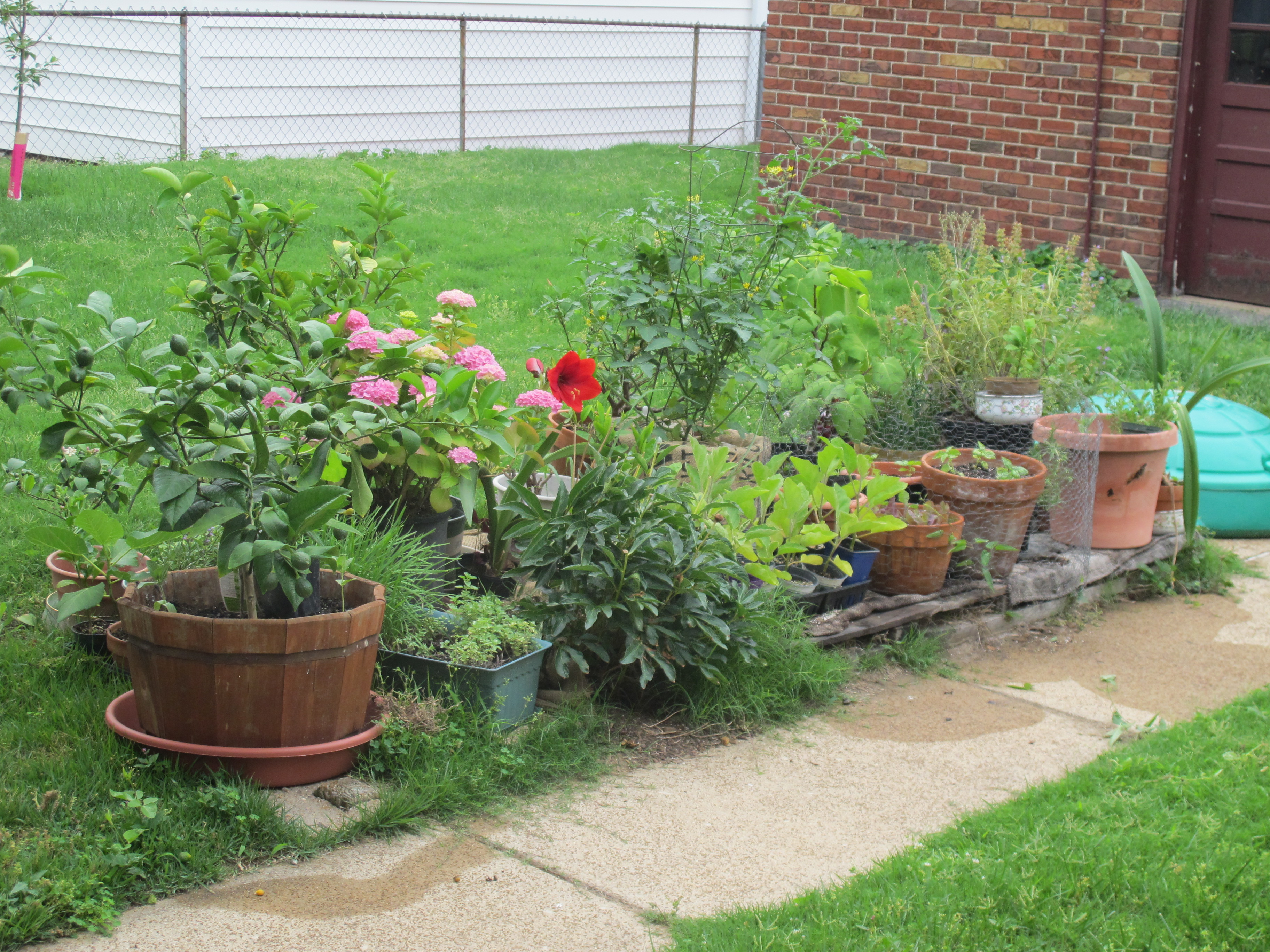
. . . but in the meantime, we have our little backyard container garden.

IMG_4429

Most of these are perennials that come inside (on our sun porch) in the winter.

IMG_4424

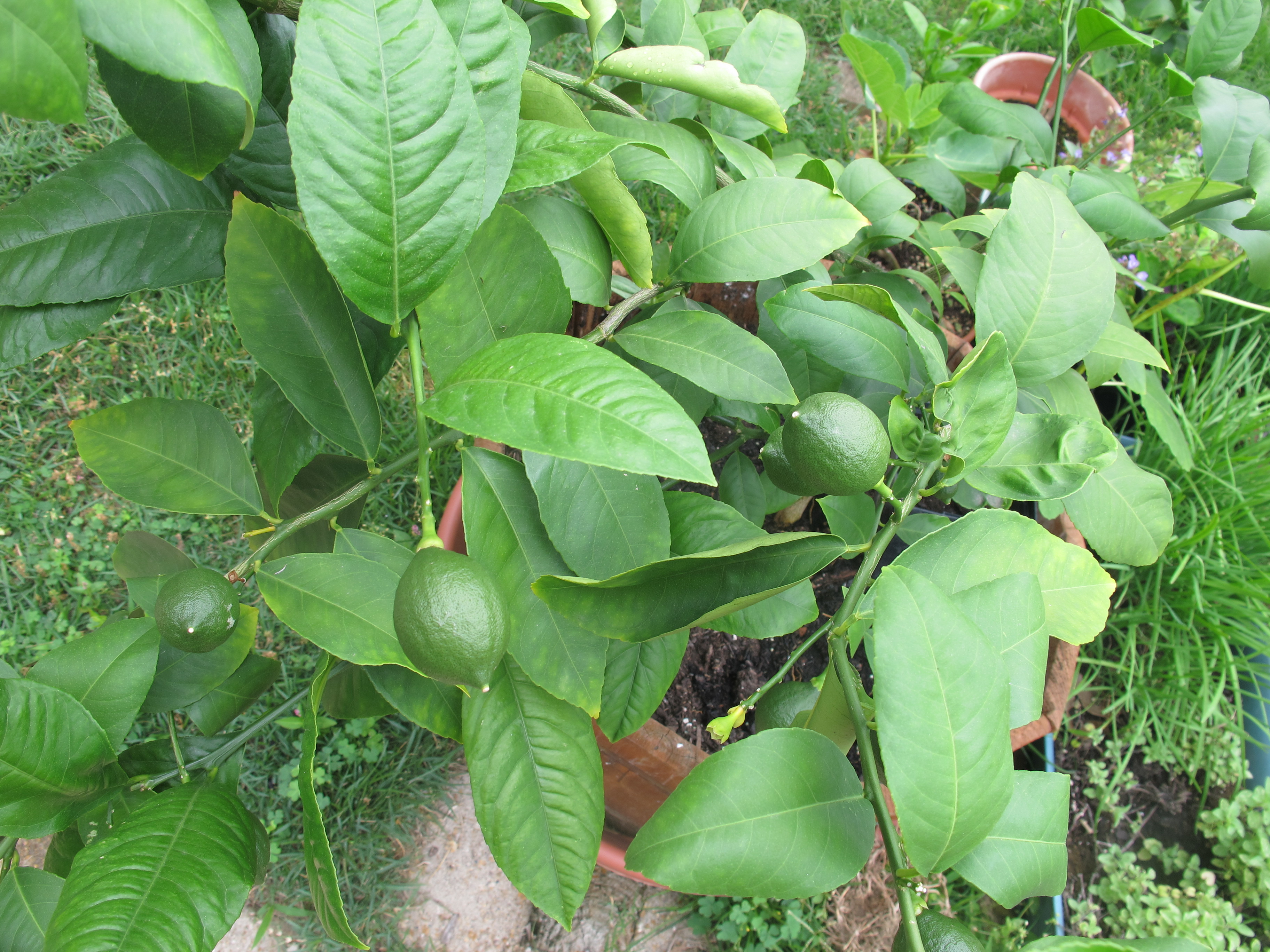
We rescued this large, potted Meyer lemon tree from the dumpster last fall (fortunately, it was next to, not in, the dumpster).  It looks like our efforts will be rewarded — the tree is LOADED with ripening lemons.

IMG_4423

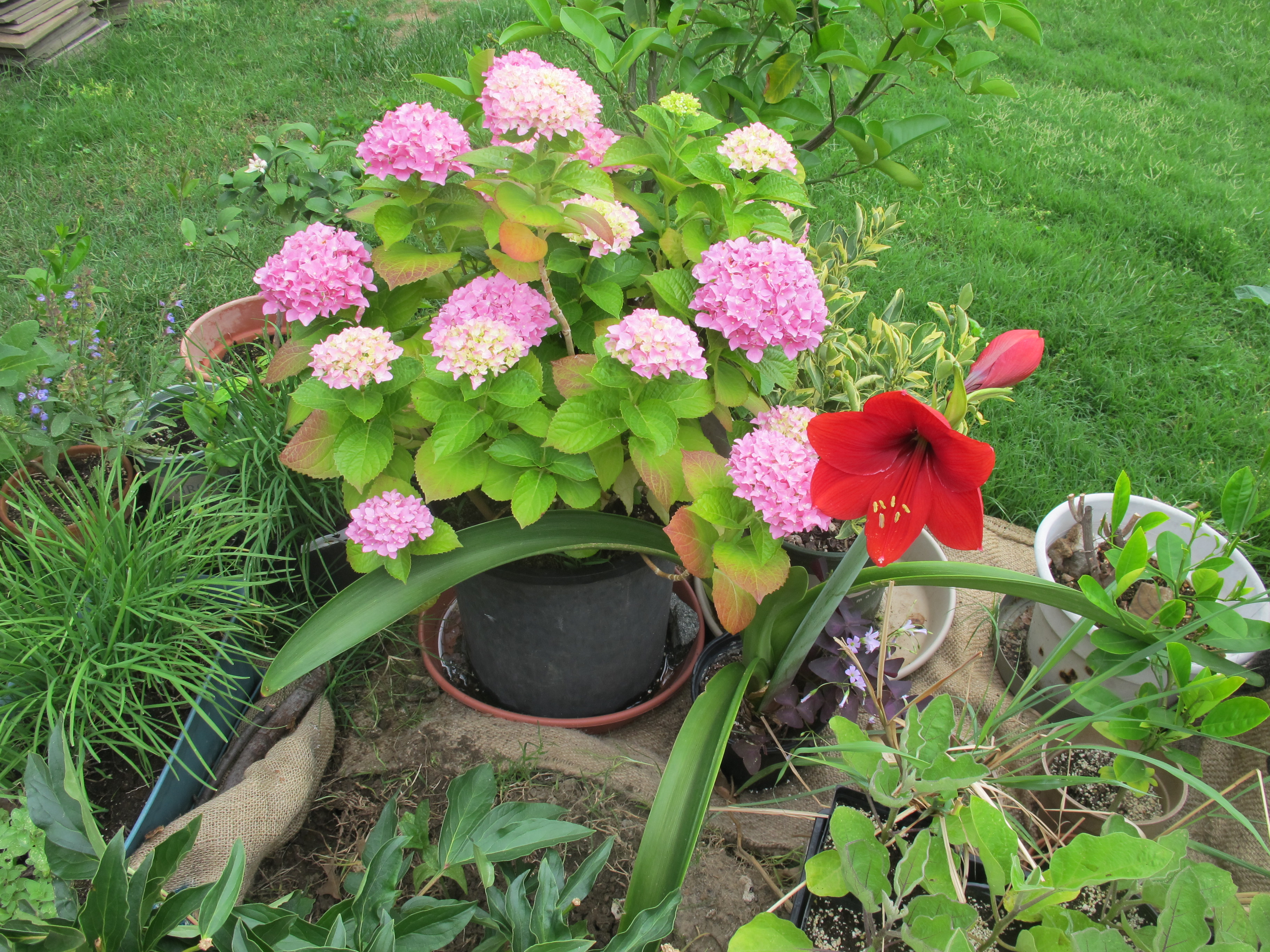
Flowers!  We received the hydrangea as a gift from my aunt and uncle when Gabriel was born.  We don’t want to put it in the ground until we’re somewhere permanent — fortunately, it seems happy enough in it’s pot.  Amaryllis photo bomb — this guy already bloomed once this year (a quadruple blossom!), but apparently that was not enough; it decided to send up another flower shoot.

IMG_4427

Figs!  This tree was Gabriel’s buddy on the way back from Florida last year.  If all goes well, we should have a few tasty figs to enjoy.

IMG_4425

Remember my curry tree project?  Well, it failed.  None of the little branches I tried to root ever grew, although they did take up enough water to stay alive all winter.  I admitted defeat, and Matthew ordered this little guy [pictured above] for my birthday!

We also have a couple of annuals in pots.

IMG_4428

Center back is a sungold tomato plant — fruit is set but not yet ripening.  Center front are some small basil seedlings.  I also have some potted zinnia seedlings, grown from seeds that Gabriel gave me for Mother’s Day.

The eggplant (on the left in the above photo) will be transplanted to the garden next weekend (trying to get the plants big enough to outlast the flea beetles).

Not pictured are potted herbs: rosemary, sage, oregano, thyme, marjoram, and garlic chives.

While large gardens are great for producing large quantities of food, small container gardens (or raised beds) are so manageable and tidy!

First big grocery haul by longtail

Today, I set out to test the Roadrunner’s cargo capacity, seeing if she was up to a grocery run.  We have a grocery store just over a mile away that I use for small, weekly needs, but I keep a running list of bulk items, as well as other groceries that are a particularly good buy at either Whole Foods or Trader Joe’s.

The two stores are near each other, and, if possible, I make the trip (which happens about every 1.5 months), when I’m already planning to be in that neck of the woods with the car.  I usually return with six (or more) very loaded grocery bags, something my regular bike was not up to, at least not without the trailer (and the trailer wouldn’t fit on MetroLink (our light rail system)).

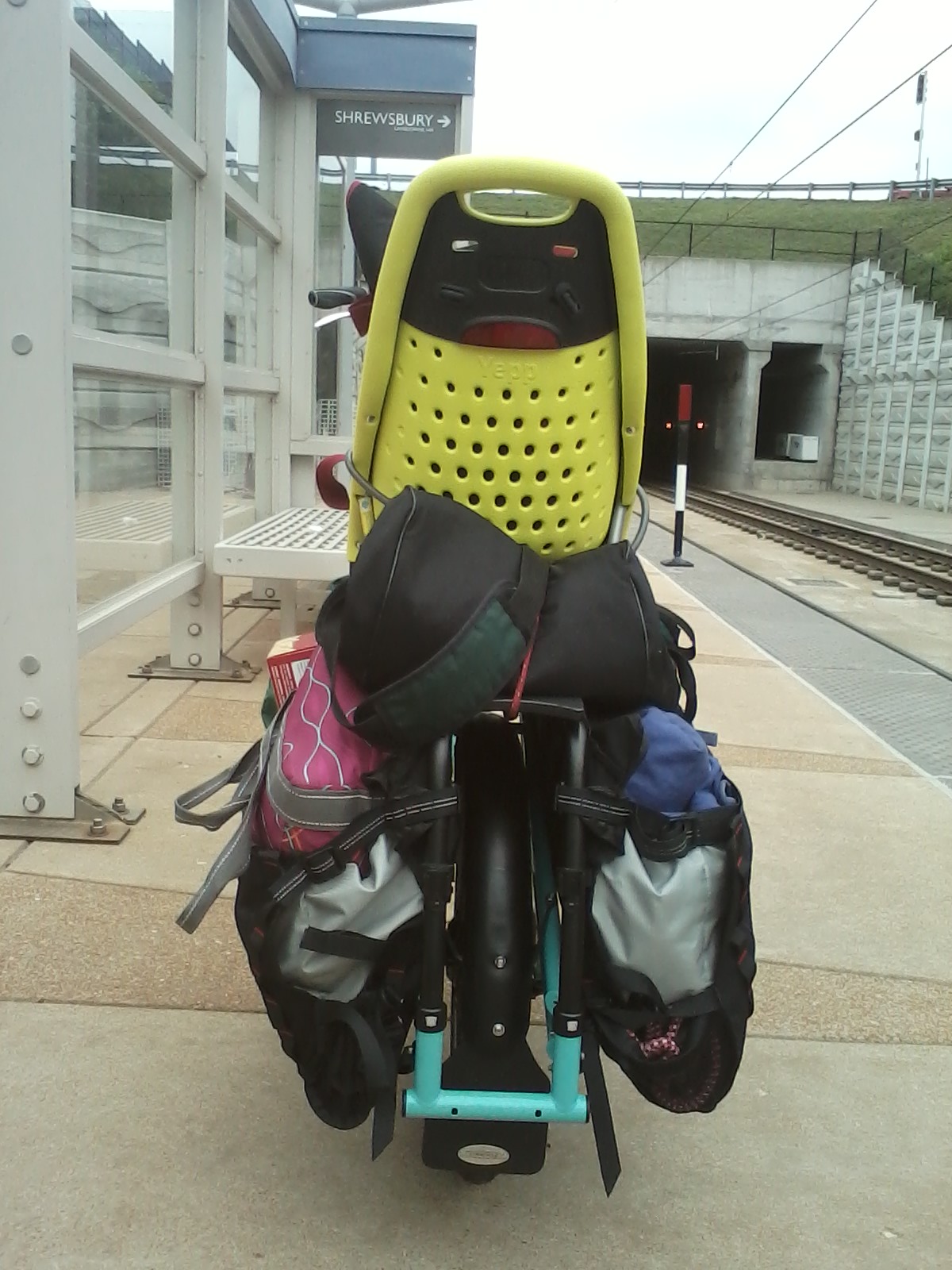
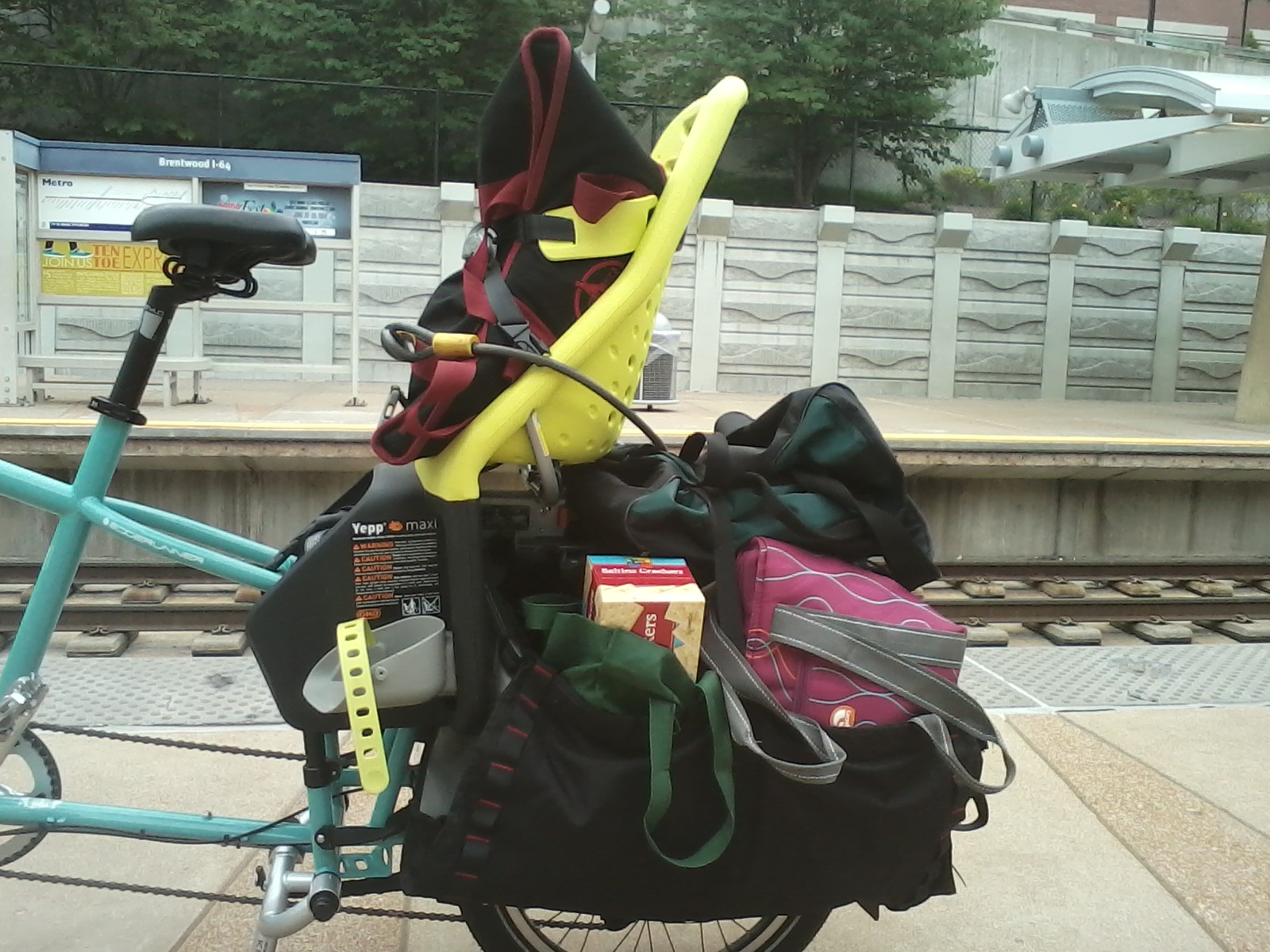
With the reduced cargo capacity of our side-loader bags, due to the Yepp childseat, I wasn’t sure how Roadrunner would do on this trip, but it was time for a test.

The trip started with a nice 2.5 mile ride to the MetroLink station.  I wheeled Roadrunner up the ramp and onto the train . . .

0605140905-00

. . . and it was a perfect fit!  With the center kickstand deployed, the front wheel was hanging out over the stairwell, and she was pretty darn stable.

0605140905-01

I almost thought I could sit down and leave her there, but the movement of the train meant that she need a little bracing every now and then.  Ten minutes and four stops later, we de-trained at the Richmond Heights stop and cruised down Brentwood Blvd. to WF.

My biggest hurdle this trip was time, as I had under 2.5 hours for both transit and shopping.  Well, that, and not letting my eyes get bigger than my cargo space.  The need for speed forced me to stick to my shopping list, which minimized the size of my load.

0605141028-00
All appearances to the contrary, that trash can is not part of my cargo.

The WF haul consisted of bulk bin items and a couple of dairy products (those are in the insulated bag strapped into the child seat).  The bill (under $100!) confirmed that it was a rather light shopping trip, but I bought everything on my list.

Next stop, Trader Joe’s.  Next dilemma — leave my WF groceries on the bike, or carry everything in with me to TJ?  I compromised by bringing the insulated bag in with me, but leaving the two bags of dry goods in the side-loader bags with the bike.  Happily, they were there waiting for me when I returned with two more bags from TJ’s.

0605141028-01

I thought I would have more strapped onto the rack behind the Yepp seat, but my duffle bag was mostly empty.

0605141029-00

Verdict: Roadrunner hauled everything on my list, and had room for more, but perhaps not ALL that much more, with our current set-up.  A milk crate on the back would be convenient for grocery trips, but I would want a way to take it on and off easily, because the rack is convenient for some items.  The Yepp seat could be removed, but I really don’t want to take it on and off all of the time, and I can make use of the space in the seat.

The ride home, fully loaded, was not really all that different from an empty bike, and once again, everything went smoothly on MetroLink.  To be fair, my groceries probably weighed in under 50 pounds (or not much over), making the total cargo not that much more than carrying Sir on the bike, but there’s nothing wrong with starting small.  I also managed to make the trip in just under my 2.5 hour time limit, so success on all fronts!

Linguini with rhubarb and carmelized onions

I visited my family in Iowa over Memorial Day weekend, and, upon arrival, I discovered a treasure trove of magazines.  I’m a closet magazine junkie — I love reading books, but there’s just something about sitting and flipping through a magazine that feels fun and indulgent.

I don’t subscribe to any magazines myself, between the environmental and monetary costs.  I could get more magazines from the library, but I don’t.  Anyhow, I indulged in magazine fest while at home: Self, Health, Parents, and Better Homes and Gardens.  (My mom sent some back to StL with me, so the mag-fest continues!)

The May issue of BHG had a whole section of rhubarb recipes, including several savory dishes, and the rhubarb linguini caught my eye.  Once back in StL, I was on garden duty while my boys and MIL were in Florida, and, lo and behold, we had rhubarb to harvest.

I started out by more or less following the recipe as printed.  My garden harvest also included a ton of greens, so I made a side of sauteed spinach with carmelized onions to go with my pasta.  Turns out that was an good move, as the sweetness of the carmelized onions was just what this recipe needed to balance out the tart rhubarb!

It’s been for. ev. er. since I’ve posted a recipe.  Sorry about that, and here you go!

IMG_4407

LINGUINI WITH RHUBARB AND CARMELIZED ONIONS

Recipe by Melissa, adapted from BHG May 2014
Serves 6-8

Ingredients
12 oz. whole wheat linguini
2 c. thinly sliced onion
4 c. loosely packed spinach or kale
3 c. 1/4-inch thick slices rhubarb
4 cloves garlic, finely chopped
1/3 cup olive oil
4-6 oz. freshly grated Parmesean cheese
1 T. dried parsley
chopped fresh parsley

Directions
Carmelize the onions.  While the onions cook, start working on the other steps.

Wash and chop the spinach.  If you haven’t already chopped the rhubarb, chop the rhubarb.

Bring a large pot of salted water to a boil.  While waiting for the water to boil, grate the cheese and chop the garlic.

Cook the pasta according to package directions for al dente noodles.  One minute before the pasta is finished, remove one cup of pasta cooking water and reserve.  Toss the chopped rhubarb in the pot with the pasta, cook one more minute, and drain.

Sauté the garlic in olive oil in the hot, now-empty pasta pan.  Add spinach and carmelized onions.  Add the pasta and rhubarb.

Lower the heat, and add the cheese, dried parsley, and reserved pasta water.  Mix until well combined.  Turn heat to medium, and cook, stirring constantly, for two minutes.

Garnish with fresh parsley and freshly ground black pepper to serve.

 ———–

This was tasty the first night, but I think it tasted better the second time around, after the rhubarb mellowed a bit and the flavors had a chance to mingle.


Call it global warming

Back in the day when this blog was in it’s infancy (5 years ago!), I was working in health communication research (how to tailor and target messages to make them relevant and effective for a given audience).  That work, combined with my interest in sustainability and “climate change” led me to do some literature searches into the subject of climate change communication.  How could we have all this information that was just not getting through to people?

Turns out, Yale has a whole center devoted to the topic, the Center on Climate Change Communication, and the group just released a report saying that we’ve been getting it all wrong with by using the term “climate change,” when, in fact, the term “global warming” is both more relatable and more likely to cause concern.

So, how did this switch come about?  “Climate change” more accurately describes the range of changes that we are seeing, but this terminology change, at least in the U.S., did not necessarily come from the scientific community.

As reported in this article from The Guardian:

George W Bush swapped the term climate change for global warming in 2002, on the advice of the Republican political consultant, Frank Luntz.

In a secret memo before the mid-term elections, Luntz warned Republicans – and Bush in particular – were singularly weak on the environment. He advised a strategy of disputing climate science, and of avoiding the term “global warming’ because of its highly negative connotations.

“It’s time for us to start talking about ‘climate change’ instead of global warming … ‘climate change’ is less frightening than ‘global warming’,” said the memo obtained by the Environmental Working Group.

Gah — suddenly “climate change” feels so dirty!  Twelve years of word trickery and misinformation!  Twelve years (and more) that we’ve been sitting around debating while global warming continued, unabated.

Since April, I’ve been collecting global warming-related articles, trying to reconnect to this important topic:

  • From Climate Change Study Finds U.S. Is Already Widely Affected
      • In the Southwest, the water shortages seen to date are likely just a foretaste of the changes to come, the report found. In that region, the report warned, “severe and sustained drought will stress water sources, already overutilized in many areas . . .”
      • . . . the effects of global warming that had been long foreseen by climate scientists are already affecting the planet.  [The report’s] documentation of changes occurring in the United States, and of future risks, makes clear that few places will be unscathed — and some, like northerly areas, are feeling the effects at a swifter pace than had been expected.
      • One of the report’s most striking findings concerned the rising frequency of torrential rains.
  • A picture is worth a thousand words, so check out these images.
  • From Let This Earth Day Be the Last

Any discussion of the situation must begin by acknowledging the science and the sheer lateness of the hour—that the chance for any smooth, gradual transition has passed, that without radical change the kind of livable and just future we all want is simply inconceivable . . . . there’s good reason to believe that a rise of two degrees will lead to catastrophic consequences. And of course, what’s “catastrophic” depends on where you live, and how poor you are, and more often than not the color of your skin. If you’re one of the billions of people who live in the poorest and most vulnerable places—from Bangladesh to Louisiana—even 1 degree can mean catastrophe.

  • Finally, in Climate Change: The Bigger Picture, Charles Eisenstein offers some food for thought:
      • If advocates of fracking or nuclear power can argue plausibly that their technology will reduce greenhouse emissions, then by our own logic we must support those too. This is already happening: witness the “Think about it” campaign touting the climate change benefits of natural gas.
      • What would happen if we revalued the local, the immediate, the qualitative, the living, and the beautiful? We would still oppose most of what climate change activists oppose, but for different reasons: tar sands oil extraction because it kills the forests and mars the landscape; mountaintop removal because it obliterates sacred mountains; fracking because it insults and degrades the water; offshore oil drilling because oil spills poison wildlife; road building because it carves up the land, creates roadkill, contributes to suburbanisation and habitat destruction, and accelerates the loss of community.

This is hard for me to explore, because I know my own modest efforts are a tiny little drop in a great big ocean, when what we need is widespread, sweeping change in how we interact with our environment and natural resources.  (It also makes it difficult to continue to blog, when many of my posts seem frivolous, by comparison.)

Realistically, at this point, we will be forced to adapt to many of the changes already underway, while doing our best to mitigate damage.