Bicycle beginnings — Part 2, in The Lou

College degree in hand, with my parents’ minivan and my compact car both bursting at the seams, my left-out-in-the-elements-for-four-years bicycle did not make the cut come moving day.  I removed my lock and left it at the bicycle rack outside my dorm for some lucky user.  In retrospect, I should have made a bit of an effort to find it a new home, but that didn’t happen.

I arrived in my hometown with five weeks to figure out my move to St. Louis (the biggest city by far that I’d ever lived in), including where the heck I was going to live.  For some reason, living close to school/work appealed to me even at that time, perhaps primarily for the savings on gas money.  At any rate, knowing relatively little about the St. Louis area, I discarded any apartments that were in the suburbs, and focused my hunt for housing within a mile or two of the Salus Center (which houses Saint Louis University’s School of Public Health), which served as the hub of my life for the next two years as a full-time grad student and part-time research assistant.

I settled on a room in a house (shared with three med students) almost exactly a mile east of Salus.  Prior to the move, my dad found a nice, sturdy 80s or 90s era Schwinn mountain bike for fifteen dollars at a garage sale.  My initial plan was that I would walk to school most days, but over two those two years, I can count the number of times I walked on one hand.  Biking was faster, and, while I felt relatively safe in my neighborhood, there were places and times where being able to move at speeds greater than those I could attain on foot enhanced my perceived safety.

I’m really not sure of my ratio of biking to driving in those early days, but it was certainly skewed in favor of biking.  I absolutely refused to pay for a parking pass, and, while there was some [free] street parking available, that served as a disincentive to driving.  I was mostly a fair weather biker, and I certainly didn’t have any fancy gear.  No fenders, cargo racks, or lights, I rode with my books and lunch in a simple backpack, often with the addition of a small duffle slung across my body on the days I hit the gym (fortunately, there was a small, but completely functional fitness center in the basement of the Salus Center).

Seven months after the move, I met a fellow student and bike commuter.  Hearing that he had three miles to ride after class on a chilly, rainy night in January, I offered him a ride home (bike and all, since I’d purchased a truck rack for my car).  He declined, but that was not that last I’d see of the man who I’d later marry.

Matthew’s longer commute encouraged me to push the limits as far as where I could travel on my bike, and, in addition to school/work, I was soon making many of my weekly Soulard Farmers’ Market trips by bike, returning home on Saturday morning with my backpack full to overflowing, with the overflow hanging in bags from my handlebars (classy, I know).  Eventually, I followed Matthew’s lead and upgraded to an internal frame backpack, which eliminated the need for me to carry two bags on “gym days,” and, with the hip belt, helped take some of the weight off of my shoulders and back.

Fast forward a bit (May 2007), and, with a Master of Public Health degree in hand, I was planning my next move.  My housing had served me well for two years, but I was ready for a change.  With job status uncertain, I hedged my bets on finding employment in St. Louis (and ideally near SLU), and found a new rental house (this time with only one roommate).  My new digs in the Tower Grove South neighborhood were closer to Matthew, but a bit farther from the Salus Center (where I did end up taking a full-time position two months after graduation).

Shortly after graduating, I won a bicycle in Trailnet’s Bike Month commuting promotion, so I had a new ride to go with my new, longer commute (around two miles instead of the previous one mile), the hybrid Schwinn Voyager.  By this time, I had added front and rear lights to my set-up (Matthew insisted when I was biking to and from a night class), and, after seeing the benefits of fenders for wet-weather riding, I added those to my set-up as well.  We continued to push each other to “go by bike” rather than car.

Summer of 2008 – another year, another move, or, rather, two moves, back to back.  First, I moved to yet another rental house, a move that changed my commute route, but only slightly increased the distance, to about 2.5 miles one-way.  However, immediately on the heels of that move, my employer moved from Saint Louis University to Washington University (specifically, WashU’s North Campus near Skinker and Delmar).

This made my commute nearly six miles each way.    I adjusted to the new distance rather quickly, and I felt a sense of pride every afternoon when I made it up the never-ending hill that, for local readers, is southbound Macklind coming from Manchester.  It only took me one day of my new route to realize why they called my then-neighborhood The Hill.

However, if you’d suggested two years prior that I use a bike to cover that distance and those hills, I probably would have looked at you like you were crazy.  But with over three years of bike commuting experience under my belt, I was up for the challenge.

Justifying the purchase by looking at what I was saving in gas and parking by biking instead of driving, I upgraded to a lighter, faster bike (Baby Jake) after five months of the new commute. With this upgrade, I also ditched the backpack for a rear cargo rack and panniers (milk crate added later).

I rode that route for almost a year-and-a-half, until I traded my bike commute for a car commute and a job encouraging other people to ride bikes more.  This was a tough transition.  Over the two-and-a-half years that I worked in Jefferson County and commuted by car, I continued to use my bike as much as possible for other trips – grocery, library, events in Forest Park, music at the Botanical Garden, and, on a couple occasions, to our commuter garden.  In the meantime, I became a much more educated cyclist, increasing my already-substantial comfort and knowledge operating my bicycle on the road.

That more or less brings us up to the present, minus the whole “adding a tiny, loud, fussy human-ish thing” to the picture, and figuring out how to transport said thing by bike.  You can read more about that here.

The point is, I didn’t just wake up one morning and start biking instead of driving.  Whether you’re in a dense urban core, a less dense urban area (like St. Louis), a suburb, or a smaller city/town, there’s a good chance that you can turn at least one car trip into a bike trip.

Sit down and make a map with your home as the center.  Now map destinations you visit on a weekly basis – how many are within two to three miles?  That’s a relatively easy distance to cover on bike.  At a moderate pace, you can bike three miles in twenty minutes (or less).  You’ll have saved money on gas, enjoyed the health benefits of physical activity, and helped to lessen your impact on the planet.  Just like that.

Out of garlic

Send in the vampires because the sad day has arrived, my friends.  We are out of garlic.

Back in July, around the time he harvested many big, beautiful bulbs of garlic, Matthew also came across a guy selling his own locally grown garlic for a decent price at the farmers’ market.  Knowing how much we love garlic — I start most dishes with the assumption of a nice-sized bulb — and knowing that he would be saving the best of our bulbs for planting this year’s crop, he bought thirty bulbs to supplement our harvest.

Over the last several months, we made the most of that garlic — garlic in almost every dish, roasted garlic here and there, and a nice batch of bagna couda later, our stockpile dwindled.

Unfortunately, the bought garlic was not nearly as high quality as what we grew — it did not store as well and had smaller cloves which are less fun (read: more work) in the kitchen.  Whether it was garlic variety, growing conditions, and/or harvesting conditions, it just didn’t measure up.  Still, I made the most of it, salvaging what I could toward the end and dealing with the small cloves.

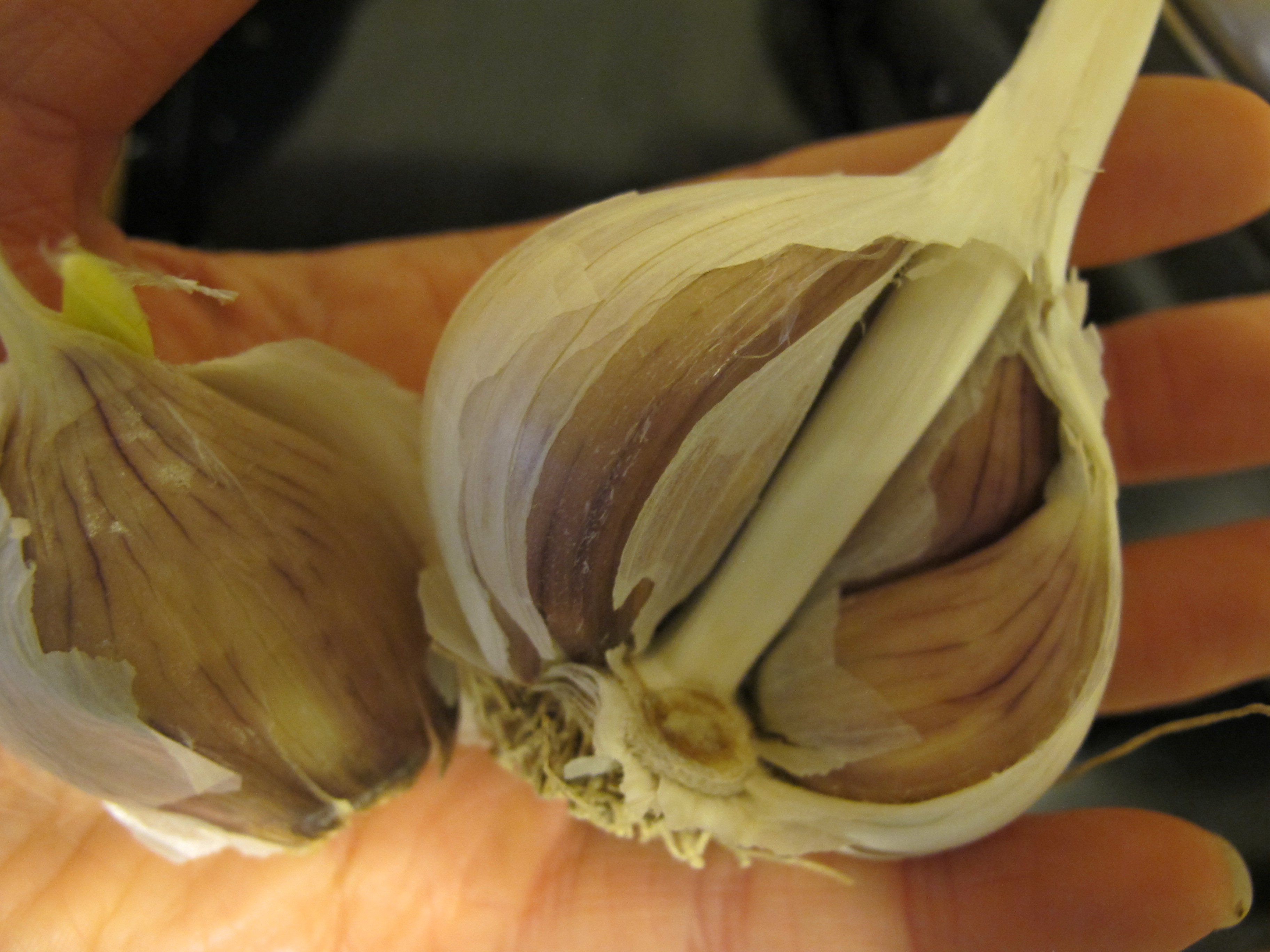
So, here we are in early March, with our last bulb of garlic (yes, our kitchen counter tops are, in fact, purple).

IMG_1524

A bulb in the hand . . .

IMG_1526

This guy started to sprout, but with four or five nice, still-firm cloves, I had no complaints.

After stretching things out as long as possible with a jar of minced garlic we received as a gift, it was time.

I used our last bulb of garlic in veggie fajitas on Thursday night.  In my effort to not overcook the garlic, it ended up a bit on the raw side — not ideal, but what can you do?

We currently have over 400 bulbs of garlic in the ground, waiting for harvest in June.  Though we’ll be saving some for planting next year, we may have enough to get to this point next year without supplementing.  Until then, I guess it’s back to the store for garlic.

Bicycle beginnings — Part 1

We start every session of “Truth and Techniques,” the classroom portion of CyclingSavvy, with brief introductions that include participants’ history with bikes.*  As part of my effort to get back to more bike-related posts here, I thought I would share a bit of my own story.

While I probably had some kind of tricycle in my early years, I remember the pink banana seat bicycle my parents gave me for my fifth birthday as my first bike.  It looked something like this:

Image from another bicycle beginnings type post, click for link

It was probably a bit big for me, but I had long legs, and, most importantly, determination to ride my beautiful new bike!  I remember my dad doing the classic running-and-holding-on-to-the-back, then letting go, as I learned to ride without training wheels.

My other main memory of that bike is riding down our alley one day, and noticing my shoelace getting caught in the pedal.  Instead of stopping to untangle it, I chose to continue riding, with the shoelace getting wound ever more tightly, until finally there was no more lace, the pedal wouldn’t turn, and I went down.  It was a slow-motion crash, reminiscent of a couple of falls that I would take years down the road, as I adjusted to clipless pedals.

I didn’t ride a bike to school since we lived only three houses from my elementary school, easily walkable.

I don’t know if my first ten-speed was a new, discount-store bike or a nice garage-sale find, but, at some point, probably when I was around ten or eleven, I graduated to a “grown up” bike, something with gears that made that cool whirring sound while coasting like my parents’ bikes did.

I should note that while my parents rode some recreationally, they didn’t really use bikes for transportation (to my knowledge).  I should also note that, while we had to wear helmets, my parents did not wear helmets, so I looked forward to the day when I would be grown up enough to not have to wear a helmet.  I believe this occurred sometime in middle school, when my parents finally gave up the battle.  Not judging or trying to turn this into a helmet manifesto, but I always shake my head now when I see a helmetless parent riding with his/her helmeted child.

My new bike and advanced age brought new freedoms.  I have fond memories of summers spent riding downtown to the library (ah, being able to go to the library anytime I wanted!) and to Mosquito Park, a small park on a bluff overlooking the Mississippi, where my friends and I would sit for hours, eating snacks we bought from the gas station and talking of all that is of import to middle school girls.

For whatever reason, I didn’t ride my bike to middle school.  At just under a mile away, and in an area that I rode regularly anyway, it would have been convenient, but instead I walked (uphill both ways, in the snow, of course).  My load of a heavy backpack and a violin may have served as the main deterrents to biking.

Once high school hit, the bike began to lose its shine, especially when I reached the magical age of sixteen and got a drivers’ license.  While they didn’t officially buy me a car, my parents very generously bought a car for me to use (and later share with my younger sister).  The bike rarely saw the outside of the garage.

And then came college.  Though I hadn’t done much biking in the past few years, I decided that having a bicycle would be a convenient way to get around campus.  I remember going to Wal-Mart with my dad and picking out a pretty purple and bright blue ten-speed, along with a basic cable lock.

When heading to on-campus destinations with friends, I often walked, but when traveling solo, especially to more distant destinations like the bookstore, the bike was quite helpful.

Senior year I moved off campus and bought a car.  The parking lot I used was a good distance from the heart of campus, so I took to leaving my bike locked in the parking lot at the end of the day, and using it as a shuttle of sorts.

One night, I locked my bike up, perhaps in a slightly different location than previous times, and headed home as usual.  When I returned in the morning, the bike was nowhere to be found.  I scratched my head as I looked at the empty post where I’d locked my bike, and then realized that my lock-up of choice was a free-standing waist high post, that, while quite sturdy and nicely cemented, could quite easily be overcome simply by lifting the bike, lock and all, up over the top of the post.  Not my most brilliant moment.

I didn’t bother with a new bike, but a couple of months later, as I was walking by a campus bike rack, I spotted my bike.  Ever since it disappeared, I couldn’t pass a bike on campus without scrutinizing it closely.  Given that it was a basic model from a local discount store, there were actually several of “my bikes” on campus, but this one actually was MY bike.

The lock was still hanging on the frame, and my key fit.  Since the new “owner” had not bothered to secure the bicycle in any way, I glanced around, shrugged, and reclaimed my bike.  I did a better job of locking it up after that!

Well, this is obviously a much longer spiel than I give during class, and we’re only halfway there.  Stay tuned for Part Two, which starts after college graduation, when I moved to St. Louis for grad school, and rediscovered bicycles as a a means of transportation (as they had been for me in middle school).

Until then, do you have any vivid memories from your own bicycle history?  First bike?  Places you liked to ride?

*For all you local folks, there’s a “Truth & Techniques” session tomorrow, March 9th, at Cafe Ventana in Midtown.  Through continued support from Great Rivers Greenway, we’re offering the class at no cost to you, but please click here to register.

Lunches for the week

As I put away our leftover honey beans on Monday night, I happily realized that the fridge held enough leftovers to provide lunches for the rest of the week.  That knowledge removes the pressure to continue making big, leftover-yielding dinners, buying me an easy night or two of sandwiches, pasta, or leftovers for dinner instead of just for lunch.

In order to keep track of all the leftover goodness and avoid food waste, I grabbed a piece of scratch paper and sketched out our lunches for the week.

IMG_1558

The full lunch menu — most of the veggies in the dishes are locally grown:

Monday: Kale quinoa quiche with a side of squash
Tuesday: Black bean soup w/avocado and tortilla chips; side of collard greens
Wednesday: Rotini w/red sauce and sauteed eggplant, ‘shrooms, and squash
Thursday: Polenta topped with black-eyed peas, collards, and sundried tomatoes w/a side of roasted sweet potatoes
Friday: Honey beans, whole wheat bread w/olive oil, sides of squash and kale

On the top half of the page, I brainstormed dinner ideas based on what we had to use and what types of food (i.e., rice, lentils, tofu) we haven’t eaten in awhile.

IMG_1559

Our fridge full of leftover goodness (and a huge hunk of rising Danish pastry dough, second shelf from top, on the right).  A bit crazy, but I have a pretty good mental map of what is where, and this is nothing compared to high gardening season when we’re truly overflowing with fresh produce.

In case you were wondering, I have yet to use my “coasting” dinner (many weeks I don’t — it’s just nice knowing I have a cushion, if necessary).  Tuesday night I made risotto (recipe coming soon) and Wednesday night I made a variation of my Persian stew, with lentils instead of chickpeas and [garden!] cabbage instead of cauliflower.

African honey beans

A couple of years ago, we ran into some friends at the Festival of Nations.  They had already eaten, so we asked if they had any favorites, and they quickly recommended the African honey beans from the Nigerian food stand.

We took their suggestion, thoroughly enjoyed our honey beans, and started counting down the days until the next year’s festival so we could get our fix.  In the meantime, of course, we played with the idea of making our own, but neither of our go-to international grocers (Jay’s and Global) carried the beans, a variety of black eyed peas that are inherently sweet.

IMG_0020
Gabriel’s first taste of honey beans — yum!

This year, we visited the Nigerian stand again and asked the proprietor where we could purchase the dried beans.  She directed us to Worldwide International Foods and African Grocery, a small store on Olive (just east of I-170) in UCity.  The store in question is decidedly outside our normal walkable/bikeable radius, and it’s also not an area we frequent in the car (unlike the suburbs where my in-laws live and the TJ’s/WF shopping area).

Anyway, I attempted a bean pick-up back in early November, when I visited a friend who lived not too far away, but they weren’t open.  Still no honey beans.

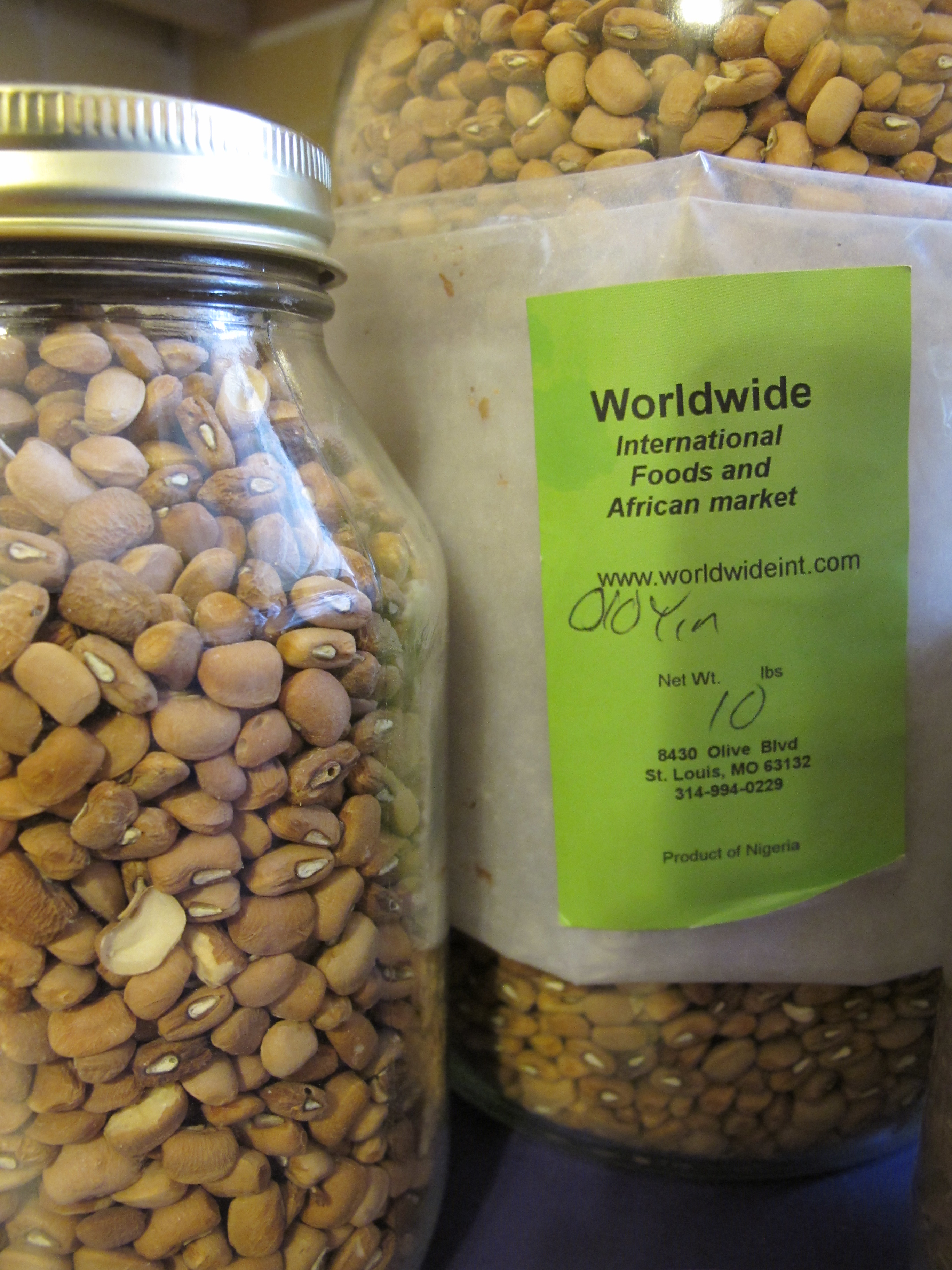
They fell of my radar until then I saw the article on honey beans in last month’s Sauce Magazine.  Interest renewed.  I wrote down the store address, called to check the hours, and jotted down the Yoruban name for the beans, “ewa oloyin,” in case that would make my quest easier.

Yesterday, with plans to look at a few houses just off of Olive, I made a second attempt, this time successful (well, sort-of).  They were down to two bags of “oloyin” on the shelf, a two-pounder and a ten-pounder.  We eat a lot of beans, and it had taken me FOREVER to actually get to the store and buy the beans, so I opted for the ten-pounder.  When I checked out, I confirmed with the store clerk that the beans in the bag were, in fact, honey beans, since the label just said “oloyin.”  He assured me they were.

IMG_1551

With limited time until dinner, I used the quick soak method on the beans and worked on my rendition of the sauce while they cooked.  When I tested the beans for doneness, they surprised me with their lack of sweetness — not a good sign.

Either a) the beans I purchased were, in fact, NOT honey beans, or b) they prepare the dish sold as honey beans at the Nigerian food stand with significant added sugar.  (The annoying part is I don’t know how to find out if I bought the wrong beans.)

Anyway, I try to keep sugar consumption fairly minimal, especially for Gabriel, so the last thing I wanted was to dump a ton of sugar into the bean pot.  I compromised by adding some dates (sugared, not what I usually buy, but this seemed like a good place to use them) to the sauce.  The resulting dish, while not identical to what we had at Festival of Nations, was mildly sweet and quite flavorful.

IMG_1555

AFRican honey beans

Recipe by Melissa, adapted from recipe in Sauce Magazine

Ingredients
3 c. dry honey beans*
1 c. bean cooking liquid (for the sauce)
1/3 c. chopped sundried tomatoes
1 c. chopped red bell pepper
1 t. onion powder
1/4 c. dates
1 vegetable bouillon cube
1 T. butter
2 t. peanut oil
1 T. coconut oil

Directions
Soak beans, either overnight or using a quick soak.  Drain, rinse, return to pan, add water just to cover, and simmer until tender but not mushy (about 45 minutes for this batch).

When beans are cooked, pour off most of the cooking liquid into a measuring cup and salt the beans.  Combine one cup of the liquid with the sundried tomatoes, bell peppers, onion powder, and dates.  Blend to a smooth, thick sauce using a hand or regular blender.

Combine all three oils in a small saucepan over gentle heat.**  Add bouillon cube, cook for a few minutes, then add the sauce from above.  Stir to combine well, then pour over the beans in the pan.

*The beans I was using may or may not have been actual honey beans — I may never know.  The good news, if you, too, have trouble locating honey beans, is that you can probably replicate this dish with other beans (perhaps black eyed peas or a small white bean, like navy beans).

**Palm oil would be traditional in this recipe, but the labor and environmental practices around farming palm oil are pretty atrocious.  The blend of oils/fats I used here was quite flavorful and worked well in the dish.