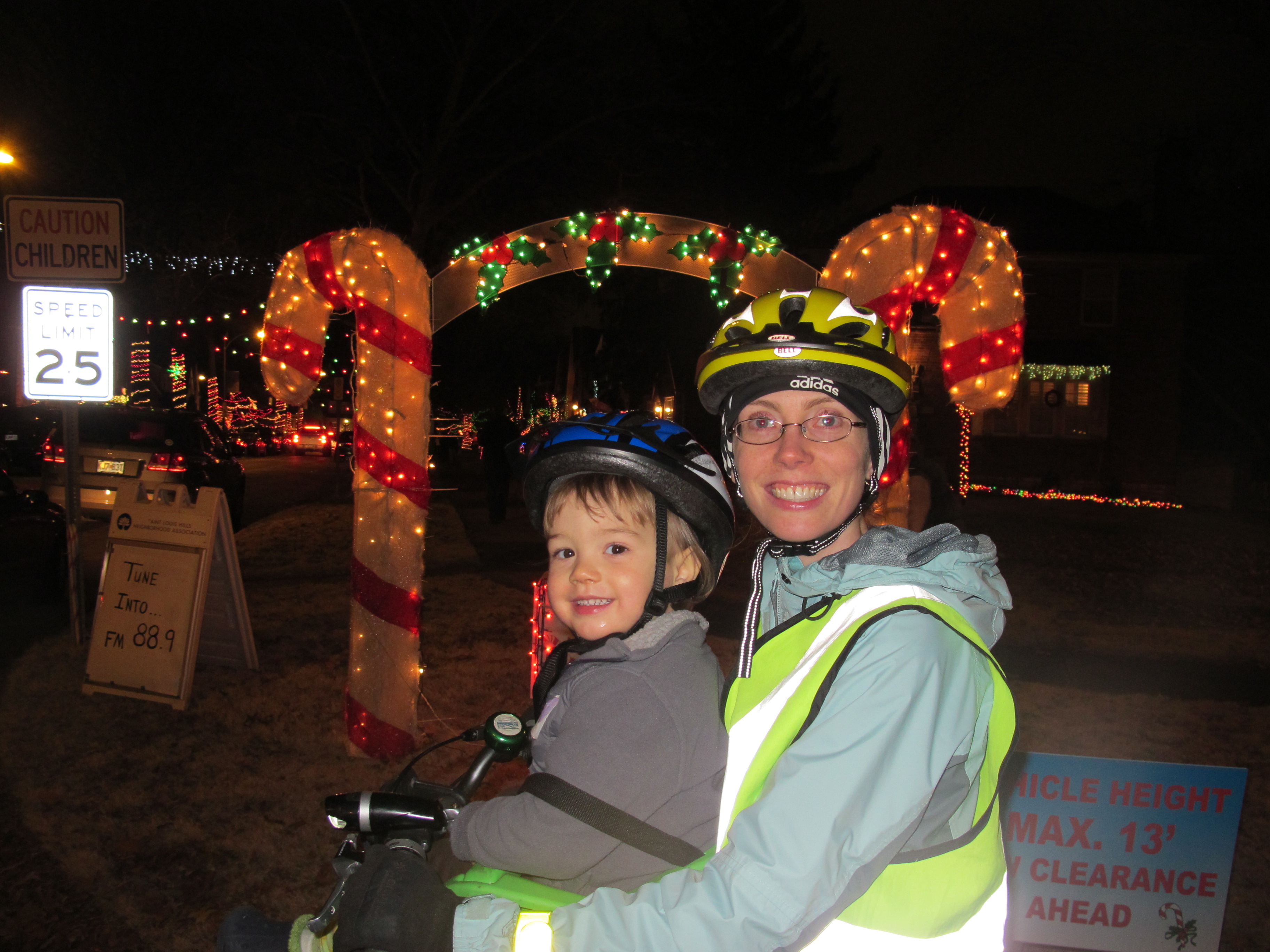
Biking down Candy Cane Lane

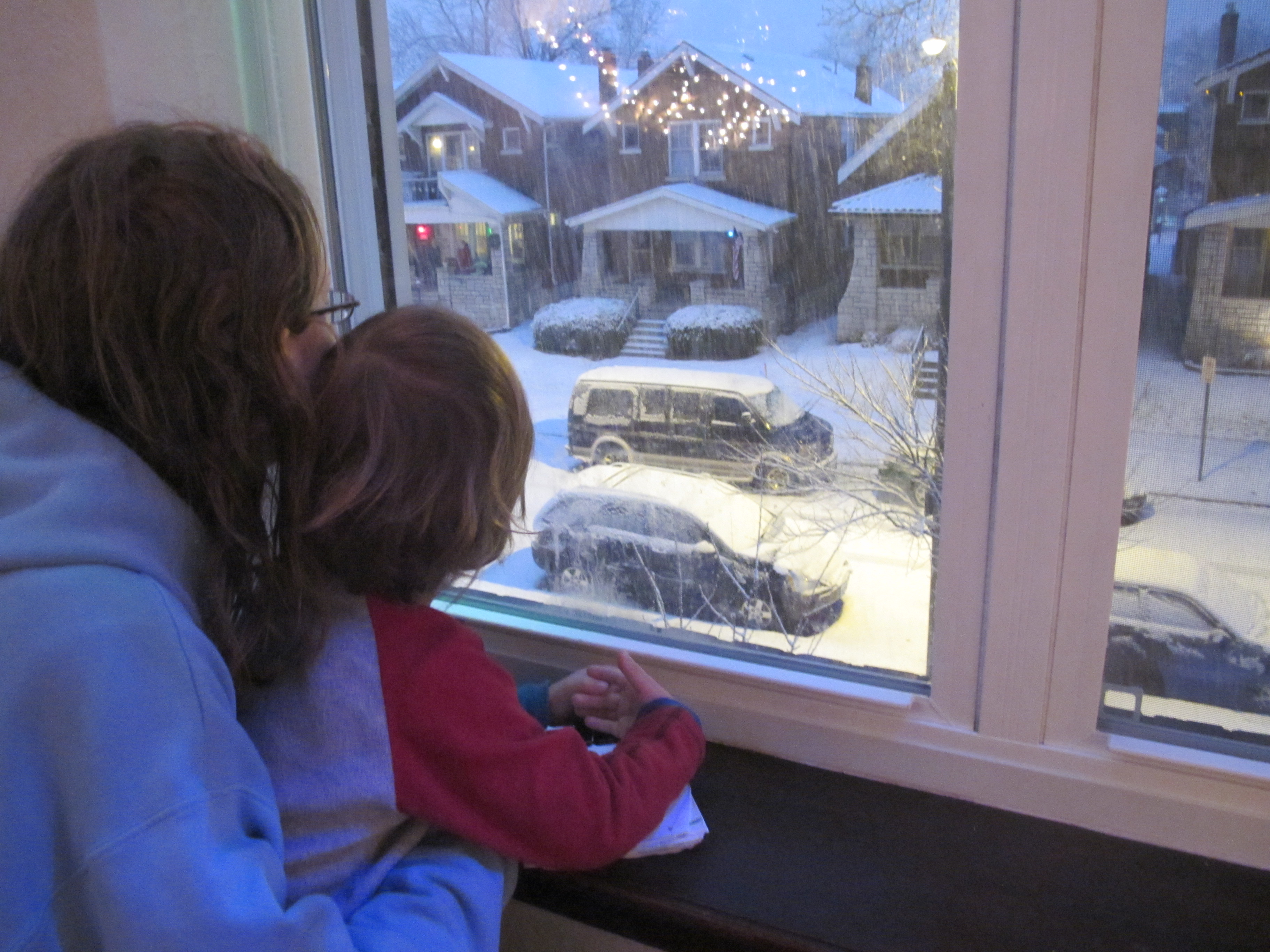
Tomorrow we will wake to rain, rain, rain, but last Saturday, we woke to this:

IMG_3352

A magical snow.  After breakfast, we bundled up and headed outside . . .

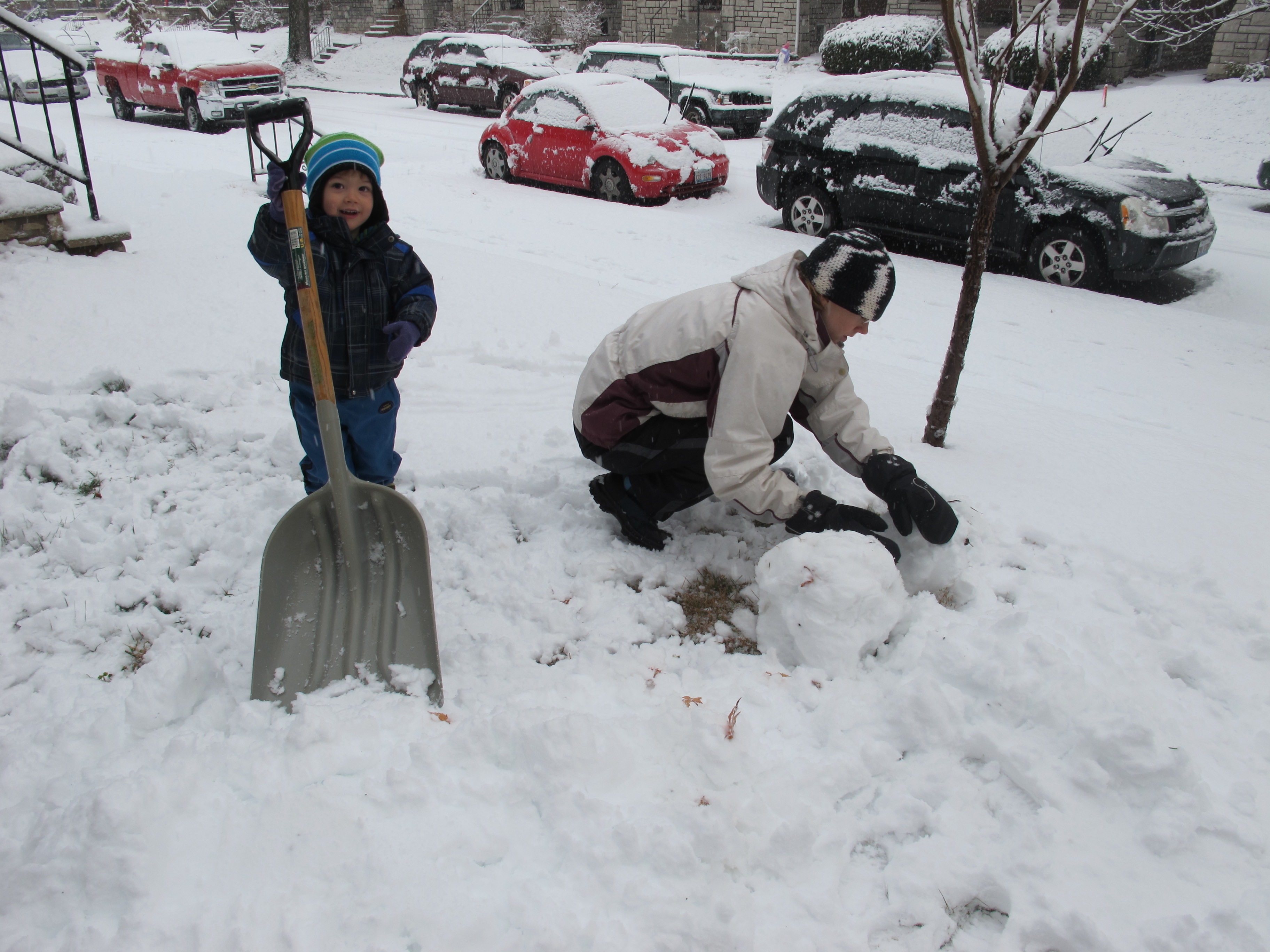
IMG_3358

. . . to shovel and make a snowman.  Our shoveling efforts paid off.  The people on our side of the block (the side that’s in shadow all day this time of year, with no sun to aid melting) who didn’t shovel had snow- and ice-covered sidewalks as late as yesterday morning, but our walk stayed clear.

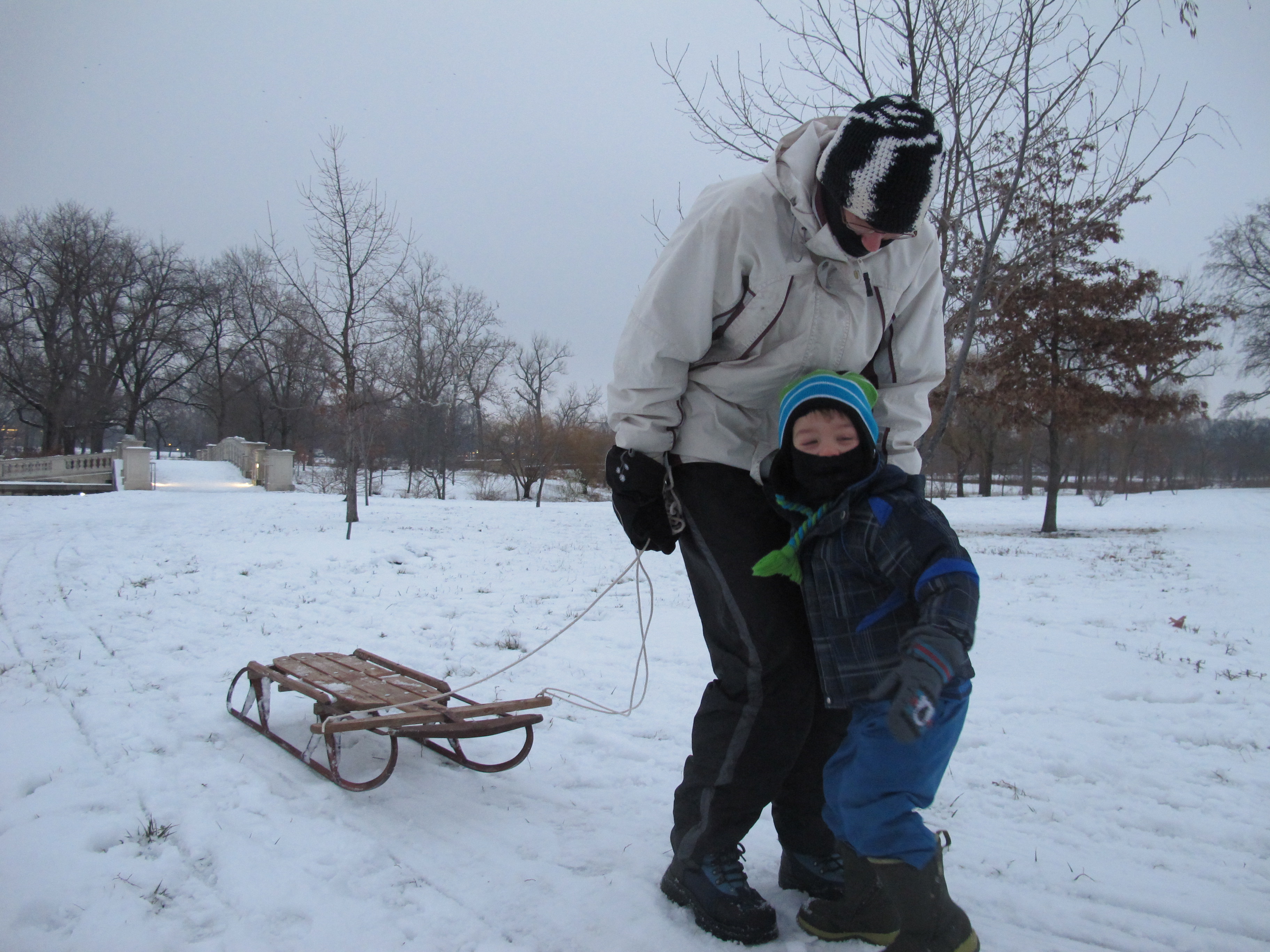
Matthew had been itching to go sledding all day, so after Gabriel’s nap, we climbed into the car and headed to Art Hill.  (If it had been up to me, we would have taken the easy, no driving on questionable roads required, approach and hit the nice little hill at the end of our street, but I knew that wouldn’t fly.)

IMG_3385

Gabriel’s first time sledding on Art Hill was a success.  The three of us managed to pile onto our old school runner sled, and Matthew safely steered us away from the hay bales and water at the bottom of the hill.

As I mentioned last week, they don’t clear the side streets, and this snow stuck around for quite awhile, even with somewhat warmer temps, melting a bit during the day, then freezing back into ice overnight.

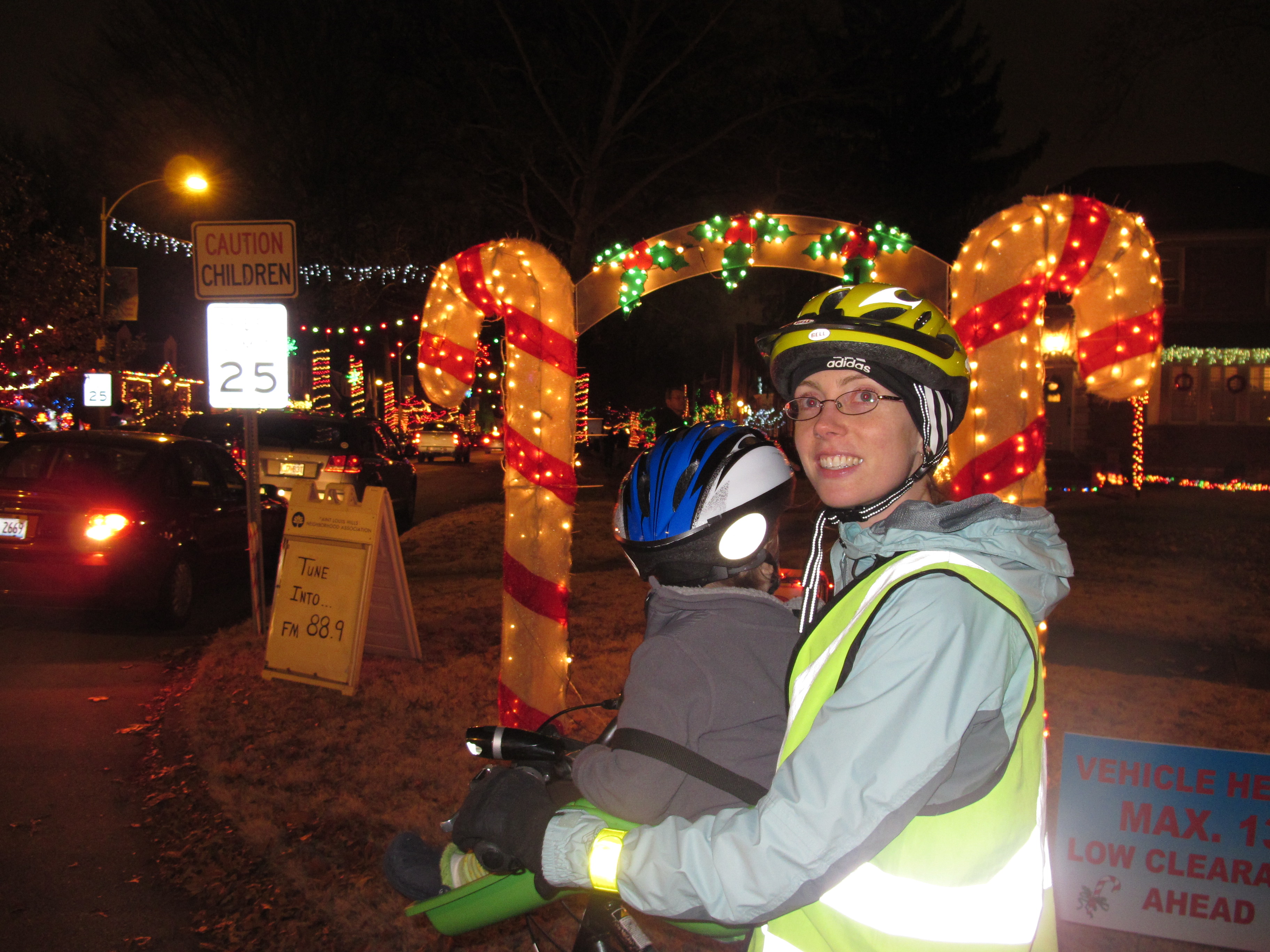
I waited all week for the streets to clear so we could bike down “Candy Cane Lane,” a street not to far from us where all of the residents on the block go CRAZY with Christmas lights and decorations.  It’s a bit of a Christmas destination, and I knew the best way to enjoy it would be on bike (or foot).

All of the stars finally aligned last night: streets almost 100% clear, fifty degree temps even after the sun was down, and time to make it happen.  We chose a route that had a number of nicely lit blocks, so really the whole ride was one big light show.

IMG_3386

We snapped a few pictures (which of course don’t do it justice, though they show off my blinding reflective vest) and joined the queue of slowly moving vehicles on Candy Cane Lane.  I felt like I was doing a “slow bicycle race” for most of the block.

IMG_3388

I’m so glad we were able to make this happen (we snuck it in just before it gets cold again), and it’s certainly a Christmas tradition I hope to continue in future years.

Getting out on still-icy streets

Between Thanksgiving travel and the fact that I work from home and walk Gabriel to childcare a half-block away, trips by bike have been pretty minimal.  I rode to my [final?] PT appointment last Wednesday in fifty degree temps, and by Friday our streets were covered with a fun mix of ice and snow.

Not much ice and snow by most standards, but enough to make things interesting in a city that doesn’t plow or salt the side streets.  I don’t mean that these streets don’t get priority, I mean that these streets, including the street we live on and many of the surrounding east-west streets, don’t get plowed or salted EVER.  If it stayed below freezing until April, snow and ice that fell in December would STILL be there.  Fortunately, St. Louis winters tend to be pretty mild, current unseasonably cold December temps notwithstanding (ahem), and the ice usually melts in a somewhat reasonable amount of time.

Six-days post-precipitation most of the streets are clear, but, as of this morning, our street still had significant ice.  Matthew’s been busing to work since last Friday, and I’d been delaying errands, hoping for just a bit more thawing so I could get around by bike instead of resorting to the car.  We’ve both been missing the regular dose of physical activity!

This morning, I finally decided that enough was enough — it was time to venture out on the bike.  The view of our alley from my handlebars looked a bit dicey.

1211130927-00

This was by far the worst I encountered, and, despite a couple of deceptive clear patches, I didn’t even attempt to ride in the alley.  Instead, I walked my bike to the street, where I found [almost] nothing but clear pavement.

The risk, of course, is that a small patch of ice that would be completely inconsequential in a car can be a big deal on a bicycle.  I rode a total of two blocks that had a decent bit of ice on the roadway, and I rode very slowly and cautiously, sticking to the clear pavement in the tire tracks.  Other than those blocks, I stuck to larger, completely clear roads.

Given the roads I was using, and my flexible schedule, I realized later that I could have waited until after morning rush hour to run my errands, but the timing/heavy traffic thing didn’t occur to me in my haste to get out the door and on my bike.

It looks like our roads will be mostly clear just in time for some more wintry mix this weekend (boo, hiss).  I consider myself an [almost] all-weather cyclist, but I have a long way to go before I join the ranks of Miss Sarah.  On the other hand, it’s hard to feel like going to great lengths to prep for winter-weather riding in St. Louis, where we have relatively little snow.  Perhaps I just need to move somewhere with no winter weather!

Attending the St. Louis Regional Bike Plan workshop

Last Wednesday, I attended Moving to the Next Level: Lessons from Three Model Bicycle Friendly Communities, a workshop designed for regional planners and engineers and co-hosted by Great Rivers Greenway and Trailnet with speakers from Indianapolis, Minneapolis, and Memphis (Trailnet’s recap of the event here).

To be clear, I am neither a planner nor an engineer, and thus was not a member of their target audience.  Regardless, I decided it would be worth rearranging my schedule to hear about what was in the works and to know what messages those who control the destiny of our streets are getting.

The result?  I spent nearly five frustrating hours feeling like my brain might explode — not due to a headache (physically, I just felt exhausted), but rather due to the presentation of information in a format/venue in which alternate voices could not be heard.

Instead of reinventing the wheel, I’m going to share the text of an email I sent as a follow-up to summarize my concerns about the event.

——————–

I did my best to approach the event with an open mind,but as I sat there, I was truly bewildered and horrified by much of what I heard, and what our region’s planners and engineers were hearing.

The event was clearly not designed to allow discussion about the pros and cons of the various bike facilities that were highlighted, and I do not think commenting in that venue would have been welcome or productive.  However, I am concerned that the attendees departed with a rather one-sided view of what bicyclists want, not to mention having some dangerous myths reinforced.

  • The presentation of statistics on the “types” of cyclists was biased.  Are the 1% “strong and fearless” or are they educated and confident?  Instead of pandering to the myth of bicycling being dangerous and always requiring separate facilities, why don’t we work to make the, “interested but concerned,” educated and confident?
  • I’m guessing the majority of the attendees were not transportational cyclists, and no one mentioned processes for getting feedback and input from the people that are currently using our roads for cycling.  It’s easy to focus on what the “interested but concerned” believe would help them cycle more, but it might be more effective to focus on what the “educated and confident” feel is helpful.  The first is a theoretical proposition, while the second approach is informed by experience.  Most of the “educated and confident” were once “interested but concerned” — what helped them make the transition?
  • One recurring theme was “No matter what you do, you’re going to make somebody mad,” or “You can’t have happy cyclists AND happy motorists.”  Why not?  Education, along with facility enhancement such as sharrows and BMUFL signage, allows us to keep the road space we have accessible for everyone.
  • Andy Lutz (Deputy Directory/Chief Engineer for the City of Indianapolis) and David Peterson (Bicycle and Pedestrian Planner with the City of Minneapolis) both seemed very opposed to sharrows.  This was particularly disturbing, as the growing number of properly-placed shared lane markings in St. Louis are something that I appreciate as a cyclist.  Reducing or eliminating their use would be a step backwards, yet that’s certainly the message that was delivered to workshop participants.
  • Todd Waeltermann (Director of Streets, City of St. Louis) mentioned early in his report that when he started with the Street Department in the 90s, they “didn’t know what they were doing” when it came to bicycle accommodations.  That comment, combined with David’s photos and comments about old [dangerous] left-side and center bike lanes in Minneapolis made me wonder, do most planners and engineers really know what they’re doing now?  Right-side bike lanes (buffered or not) carry many of the same dangers as the left-side bike lanes, yet they are heralded as a step forward, as a way to make bicyclists “safer.”
  • While both Andy and David gave lip service to the importance of predictability, they both advocated practices, such as having [straight] sharrows for cyclists in the right-turn only lane, that are anything but predictable.
  • Both Andy and David talked about the cost of keeping bike lanes clear of debris and snow.  Integrating bicycle traffic onto existing roadways eliminates this challenge/cost.
  • Andy made multiple comments indicating his mindset was “if it’s up to [NACTO] standards, it’s safe.”  The fact that planners and engineers are not bothering to question these standards is disturbing.
  • When talking about “advisory” bike lanes (which I’d never heard of before the workshop, and which seem like a particularly poor idea), David said they, “help bicyclists stay where they’re supposed to be” (emphasis mine).  This statement, which undermines cyclists’ full rights to the road, also, at its core, supports the dangerous myth that our roads are first and foremost for motor vehicles.
  • Re. “advisory” bike lanes: The lack of center lines on the “advisory” bike lane streets is problematic.  Center lines facilitate lane control, which increases visibility and decreases conflict on the road.

While education was not the focus of the meeting, I was disappointed that none of the guest speakers mentioned his/her city’s efforts in this regard beyond an offhanded, “oh, and bicycle education,” type comment.  It seems that cities and communities want to replicate the infrastructure component of Denmark’s cycling scene while ignoring the fact that cyclist and motorist education is of huge import in that country.

As a cyclist and an active-living advocate I have a vested interest in how things play out in the region.  I am not sure where to go with these concerns, but I would be remiss if I didn’t try to find a way to connect with the other workshop attendees and offer an alternate perspective.

Over the weekend and in the works

I have a decent bit to share, but there’s that whole “time to write” thing.  My time promises to be even more crunched this week (physical therapy, no Mrs. L on Tuesday = one extra day with Gabriel, then spending over half of Wednesday at the Gateway Bike Plan Workshop), so here’s quick recap and preview of coming events!

Over the weekend
Matthew and I celebrated our 5th anniversary with a dinner date at Pastaria, followed by dancing at Casa Loma Ballroom.

It was our first visit to Pastaria — it lacked the ambiance for a romantic anniversary dinner, but we enjoyed our meal, nonetheless.  We ordered a ridiculous quantity of food: risotto ball appetizer, large kale salad, pistachio ravioli, butternut squash and sage pizza, and a side of roasted brussels.  We could have easily fed a third adult and maybe Gabriel, too!

The food was good, but too salty (Matthew’s currently reading Salt Sugar Fat: How the Food Giants Hooked Us).  Though I could have done with less salt, I really liked the kale salad.  I’ve made raw kale salads before, but theirs was special.  I particularly enjoyed the crunch of the toasted breadcrumbs in their version.

Afterward, we headed to Casa Loma, where we did not dance nearly enough to make up for our huge dinner!  Casa Loma was a first for me.  It’s a special place because it’s where Matthew’s grandparents (married for over sixty years now!) first met.  I imagine we’ll return, though we may to brush up on our ballroom dance steps at home first.

Saturday was a typical Matthew and G at the garden, me getting stuff done around the apartment, day, though that won’t be the case for much longer, with the garden mostly put to bed for the winter.

Sunday morning, Matthew and Gabriel headed out to Cedar Hill, near where Matthew grew up, to visit a family friend and buy some dried beans and other assorted goodies from his friend’s farm.

In the afternoon, we attended our first local CyclingSavvy “Advanced” session in St. Louis, an informal gathering for CyclingSavvy StL grads to share experiences and trouble-shoot challenges as a group.  It was great to see familiar faces and meet some new people, and we had some good discussions.

In the works

  • Milling corn — trying a friend’s grain mill
  • Skillet cornbread
  • Vole trouble — pestilence in the garden
  • Third cup’s a charm?

Hope to get these written sooner rather than later, but we’ll see!

Indicator species follow-up thoughts

I appreciated each and every one of the thoughtful comments that I received on my “female cyclist’s manifesto” post.  I want to explore some of these views in a more organized manner than comment replies allow.

Like any cyclist, male or female, it takes time to become comfortable riding as regular traffic, but not that much time.  – Stacy

This one little sentence really got me thinking.  When we fail to view cyclists as drivers, as equal road users, we set ourselves up for trouble.  Imagine that you had never driven an automobile before, and someone hands you the keys and expects you to be able to operate that vehicle safely and competently on the streets.  Pretty overwhelming, huh?

In effect, that is how many people view bicycling in the U.S.  Most states have comprehensive, rigorous (and expensive) training programs for young [automobile] drivers.  Here is an example of the requirements in my home state (Iowa):

Typically, the course includes 30 hours of classroom instruction and six hours of lab time. At least three of these “lab” hours must be behind the wheel of a car; the other three may be either behind the wheel or using a simulator.  According to Iowa law, driver education courses must be offered or made available by your local school district.

I (by which I mean my parents — thanks, Mom and Dad!) paid well over three hundred dollars to take that drivers’ ed class in high school, yet I balked (as many do) at paying just $75 for a comprehensive cycling course.  Definitely something wrong with that picture!

We have no comparable requirements for cycling education.  Instead, it is left to individual cyclists to seek out training, and many cycling education programs are not nearly comprehensive enough to prepare cyclists to feel truly comfortable on the roadways.

Imagine if all schools incorporated age-appropriate cycling education and skill training in their curriculum.  We would eventually have a population of road users (both motorists and cyclists) who knew how to safely and respectfully interact with one another on the road.

There is also the simple fact that, similar to learning how to drive a car, learning how to operate your bicycle as part of the traffic system takes time and practice, above and beyond what you learn in even the best class.

——————————

I used to be very much a “take the lane” type of person, and I still am. I am an LCI and have taken similar classes to [CyclingSavvy]. I didn’t ever understand the “need” for cycle tracks or buffeted bike lanes UNTIL I took my 4-year-old on a ride that I do all the time and it terrified me. I realized that this is what it feels like for an inexperienced or less confident rider. There is no way that I would take my son on a road where we need to “take the lane.” We actually rode on the sidewalk for part of this little 3 mile stretch, a cardinal sin in my mind. I still ride with him on the street but we are limited in the areas we can go when he is on his own bike.  -Elle, Tiny Helmets Big Bikes

First, Elle’s adventures as a car-free, cycling mother of two little boys are a huge inspiration (and I am jealous of her cargo bike fleet!).  I’m happy she weighed in here, because, while Gabriel is still a few years away from cycling on his own bike with Matthew or I playing “wingman,” this is certainly something I’ve thought about.

At this point, I feel that there are certainly some (many?) roads where I would not feel comfortable with a preschooler or elementary-school-aged child riding his/her own bike, even with an accompanying parent, for many reasons.

First, while speed is NOT a requirement for using the roads, there are certainly places where maintaining some kind of reasonable minimum speed (say 8mph, excluding hills) can be useful.  Small children on small, gearless bikes may not be capable of this.

Speed aside, there is a lot of work we do while driving (whether a car or a bike), taking in visual cues both in front of us and in our peripheral vision, anticipating what other road users will do based on previous experience, responding to/avoiding hazards in the roadway, etc.  As adults, we do these things simultaneously and almost unthinkingly.  This level of processing and responding is beyond the capability of young children.

So, while it is imperative that we educate our children about cycling, and give them an opportunity to practice those skills, there is still an age-appropriate factor.  Though I’m not sure of an exact age, my plan is to let Gabriel ride his own bike on short trips and small streets, using a child seat on my bike (and eventually a trail-a-bike) for longer journeys and those that involve larger, higher-speed roads, gradually giving him both more freedom and more responsibility.

While I haven’t had the experience of cycling with my own child, I led a bike-to-school program for kids in sixth- through eighth-grades for two years.  We specifically targeted this age-group as having the developmental maturity to understand and follow the rules of the road and to ride our chosen routes with a relatively high (5:1) child to adult-leader ratio.  We also geared our education and training to give the students the skills they needed to ride these same routes on their own.

———————–

I am fortunate to live in a city with a great greenway/bike path system, and I pretty much stick to that these days, and also just ride for exercise and fun so my destination doesn’t matter much. Many people are able to use that system for commuting – and it works well if downtown is your destination. But the problem is that there’s really only one north/south route along the Platte river, so you end up having to go 10-12 miles out of the way if you want to go north or south in my part of town . . .  –EcoCatLady

Greenways can be great, especially if they are installed in locations where conflict points (i.e., intersections and driveways) are eliminated.  Unfortunately, they often have the limitations EcoCatLady points out — useful for transportation if you live and work very near one, otherwise, not so much.

Also, even a [would-be] cyclist who lives relatively near a greenway will be unable to use the route for transportation if he/she is not able to navigate the roads to get to the greenway in the first place (read this cyclist’s inspiring story of learning to use large roads to connect to the trail system near his house).

Because of the relatively high cost (in both money and land) of installing such infrastructure (a cost which still pales in comparison to the cost of installing urban freeways), it is unlikely that greenways will ever be able to serve the needs of all cyclists, so being able to use the existing public ways that were built for people to use (i.e., all of our roads!) is important.

——————————

I will agree that sharrows may be BS – the ones I saw in Baltimore ranged from the door zone to half way underneath parked cars.  -Angelo

Just like many things, sharrows can be done well or poorly.  In addition to the problem of poor placement, there is also the risk that road users will assume that cyclists can ONLY use lanes with sharrows, which are usually only found in the right-most lane, i.e., not where you would travel if preparing for a left turn.

Personally, I could take or leave them, but well-placed (i.e., in the center of the traffic lane/between the tire tracks and NOT in the door zone, parking lane, debris-filled edge of the road, etc.) sharrows can help cyclists, especially those new to the idea of lane control, feel more comfortable on the roads.  If it is a way to divert paint from dangerous-by-design bike lanes to something more safe and useful on our roadways, I’m okay with it.

While I have not addressed all of the comments in the original post, I will pause here for now.  Again, thanks to all who have read and commented (or just read and considered).  I’d love to keep this discussion going.