This morning was a good morning for fenders. While there was no rain on the way to or from my physical therapy appointment, the wet pavement would have made things messy. The fog also mandated lights and my reflective, high-vis vest (I temporarily ditched the vest to remove my jacket at a stop light, then shoved the vest in my crate when the light turned green before I had a chance to put it on again — thanks to the kind lady in the van who let me know that the vest fell out of my crate).
Given the combination of wet pavement and poor visibility, I took things a bit slower than usual, but still made it to my appointment in plenty of time. Even though it did not rain at all during the morning commute, the forecast seemed to have scared most other cyclists into other forms of transportation.
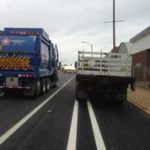
On the way home, I took a little detour to bike by a house-of-interest (we’ve been looking for the right place for, oh, four years now, and renting until “the one” comes along). My detour gave me the opportunity to ride along a stretch of the “new and improved” (ahem) Manchester road. I didn’t pause to snap my own picture, but, if I had, it would have looked very similar to this photo of the same stretch.
Replace the parked truck (on the right) with two or three different parked vehicles, all smaller, all theoretically capable of fitting within the parking lane so as not to encroach on the “buffer” zone, but yet all somehow not capable of actually parking that way, and replace the garbage truck with a tractor-trailer.
I made a right on red into this mess, with the tractor trailer approaching from the rear, still well behind me when I turned. I only needed to use Manchester for a block (before making a left turn), and no way was I going to be stuck in that bike lane between the parked cars and the 18-wheeler. Not happening.
This, of course, put me in the unenviable position of controlling a traffic lane next to a bike lane (which often leads to higher levels of motorist incivility). Fortunately, the truck driver was patient (as many motorists are), and I was soon to my left turn pocket, leaving him free to continue his trip.
He may very well have appreciated my lane positioning, as it left no chance of me being in his blind spot. No truck driver every WANTS to be in this position.
That little adventure over, I crossed some seriously whack train tracks (they were in such bad shape that I straddle-walked my bike across, rather than riding) and proceeded on my house-scouting trip. The result? Yet another one that probably isn’t the one for us (okay sized yard, but poor sunlight due to a tree on the property next door). And so it goes.
In biology, indicator species are used to determine the health of a given ecological region, with their presence (or absence) indicating either good or poor conditions.
In the world of bicycle advocacy and planning, women are often considered the indicator species, as described in this Scientific American article about getting more cyclists on the roads:
Women are considered an “indicator species” for bike-friendly cities for several reasons. First, studies across disciplines as disparate as criminology and child rearing have shown that women are more averse to risk than men. In the cycling arena, that risk aversion translates into increased demand for safe bike infrastructure as a prerequisite for riding. Women also do most of the child care and household shopping, which means these bike routes need to be organized around practical urban destinations to make a difference.
At present in the U.S., women are far less likely than men to use bikes for transportation, and thus a city’s percentage of female bicyclists is used as one measure of a city’s “bike friendliness.”
Here’s the thing. I am that indicator species, part of the demographic being catered to by bicycle advocacy groups. Not only am I a female cyclist, I am a parent.
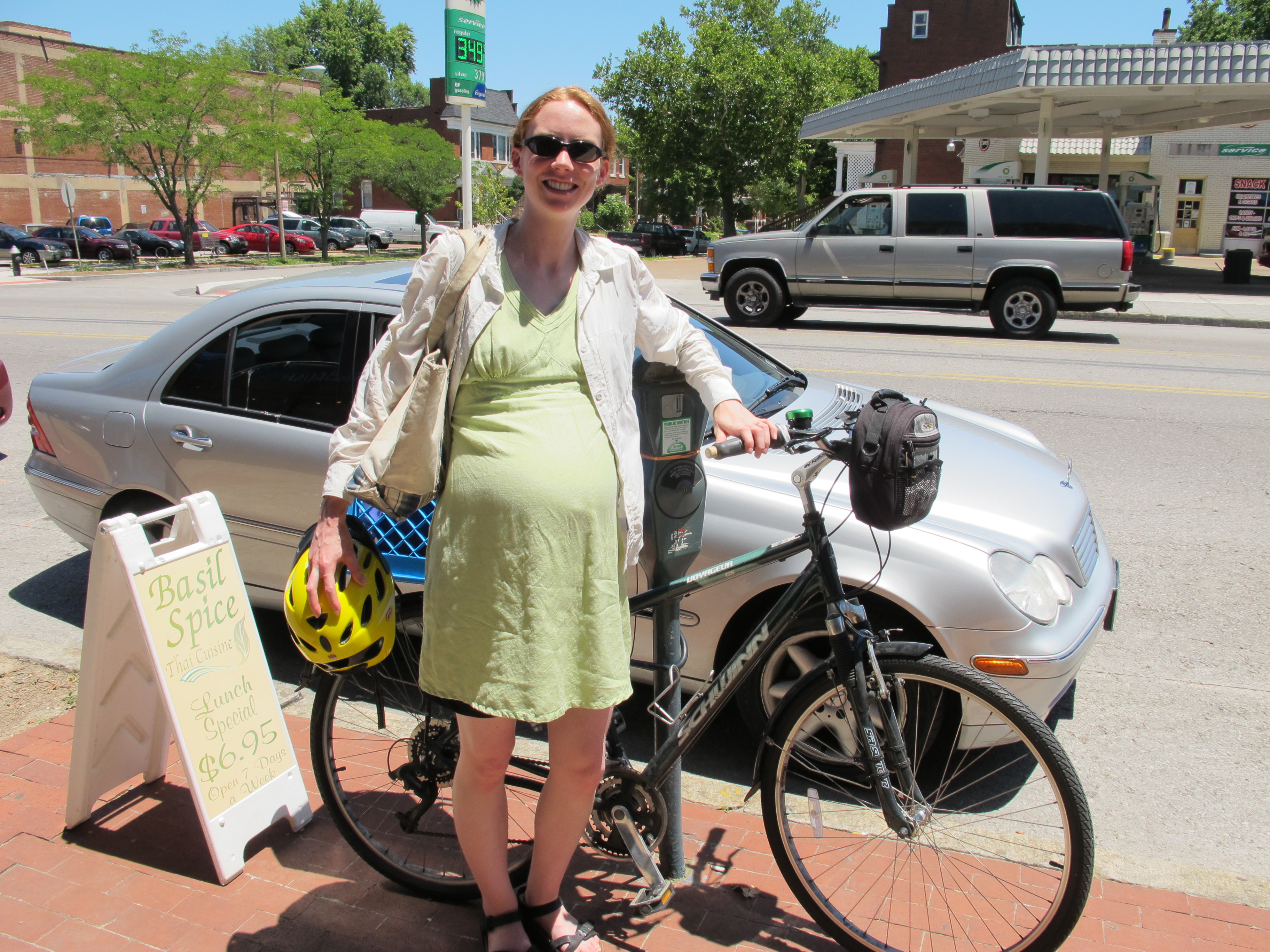
I cycled throughout my pregnancy . . .
Biking to lunch at 37 weeks
. . . and I regularly use a bicycle for trips with my son.
Ready to roll
Perhaps that qualifies me as not just an indicator, but as an über-indicator.
And this member of the indicator species is very frustrated. I’m frustrated with bike advocates and planners who continue to implement dangerous-by-design bicycle “improvements” that marginalize cyclists and contribute to the myth that cyclists and motorists belong in separate spaces, when the spaces for cyclists (be it bike lane, buffered bike lane, or cycle track) invariably increase crash risk at intersections — the place where cyclists are in the most danger of car-bike collisions.
I am a member of the indicator species, and I object!
Paint guide markings for the new buffered bike lanes on Arsenal, west of Grand
I’m tired of heading out on my bike to discover a formerly great route now made unfriendly and dangerous by the these roadway “improvements,” as I wrote in an unpublished post after encountering yet another tragedy of good intentions (above photo: street that formerly had a lane of traffic in each direction, plus a center turn lane, allowing cyclists to take the lane and motorists to pass in the turn lane — shown now with center turn lane eliminated and bike lanes added along a [narrow] buffer to between the bike lanes and parked cars):
Bike/ped organizations are assuming that the paint will lure new bicycle commuters, thus increasing their “counts,” while taking for granted that the cyclists who have already been riding, who are already committed to this form of transportation, who have been educated about how to safely coexist with traffic . . . that these cyclists will continue riding, despite roadway “solutions” that actually make things MORE dangerous for cyclists. Maybe we will, but maybe we won’t. Maybe you will make the roads so unpleasant, so littered with dangerous paint, that we will throw in our hats. We, who have been the face of cycling for years, we, who are even now encouraging others to try bike commuting for the first time, we, who support your bottom line goals of getting more people on bicycles, just not the way you are going about it.
I’m tired of those who choose to ignore the growing body of evidence showing the dangers of a variety of bicycle facilities.¹
The best-designed bike lanes and cycle tracks do not prevent tragedy:
These are but two examples (of far too many), both from supposed “meccas” of bicycling. All the special paint or buffers in the world cannot change the fact that the safest place for a cyclist to operate is in the lane as part of traffic.
Now, I understand that this is an uncomfortable place for many cyclists to ride (though hardly more uncomfortable than either of the bike lanes pictured below). I know the surveys and polls show that you will get more cyclists on the streets if you install bike lanes (or other facilities). This is great in terms of sheer numbers, and more cyclists on the roads makes everything safer for other cyclists, attracts more cyclists, etc.
However, bikes lanes (buffered or not) are basically a gauntlet of potential dangers, even for an experienced, educated cyclist. By installing more bike lanes to attract newbie/novice bicyclists, cities across the country are creating dangerous places (made more dangerous by the [false] perception of safety) for the most inexperienced riders out there.
Recent bike lane installation in St. Louis
And more . . . *
Somewhat ironically, I have been in the “bike lane advocate” camp. From 2009-2012, I managed a grant focused on increasing active transportation: I met with mayors, city administrators and city council members and worked to implement Complete Streets policies (we succeeded). The grant was geared toward policy change and community education and involvement (including starting a bike-to-school program). We had very limited funds for infrastructure improvements, so while we were not making changes, bike lanes, along with sidewalks for pedestrian access, were certainly something I frequently mentioned as an important part of creating a “complete street.”
I think it’s important to note where I come from, because I did not always hold my current views. I, like many other cycling advocates and city leaders and planners across the country, saw a compelling case for bike lanes in terms of increasing cycling numbers.
In April/June 2011, I took CyclingSavvy. Thankfully, I was open-minded enough to hear and process the information in the course and conclude that some of my previously held beliefs were simply incorrect. It is a shame that others refuse to attend the class outright, or attend with closed minds, going back to their jobs, or their soapboxes, and maintaining the status quo — directly or indirectly promoting a culture of fear, vulnerability, and separation.
So what’s the answer? Are all “bike facilities” bad? The short answer is “no.” The long answer?
I recently had an opportunity to respond to a Bike St. Louis survey about the next phase of their bicycle planning . Here is the feedback I provided:
Regarding the types of on-road bike facilities listed above [bike lanes, buffered bike lanes, and cycle tracks], I selected “I prefer no facility” because I feel/would feel very uncomfortable using any of the bike facilities (I have ridden in a cycle track in Washington, DC).
While cycle tracks offer some level of protection from being side-swiped, they present the same dangers at intersections and driveways as bike lanes, perhaps worse due to poor visibility caused by parked cars, less relevance to motorists, and the increased perception of safety that leaves cyclists exposed to the dangers of collisions at intersections, already the place where most car-bike collisions occur.
The most recent cyclist death in Copenhagen (not to mention quite a few right-hook deaths in U.S. cities over the past 2-3 years) clearly illustrates the problem with facilities such as bike lanes and cycle tracks.
I strongly encourage GRG and the City of St. Louis to focus on solutions that include sharrows and signage (including “Bikes May Use Full Lane and way-finding for cyclists), neighborhood greenways (i.e., convenient routes for cyclists that minimize stop signs and utilize other traffic-calming measures including speed humps and streets that are limited-access for motorists), as well as supporting and promoting high-quality, comprehensive bicycle education programs. In my experience, many roadways have plenty of capacity for motorists and cyclists to co-exist, IF the cyclists are well-educated in operating their bicycle as part of traffic.
The good news is that there are ways we can spend money, there are improvements we can make, on both infrastructure and education, that will encourage more people (including other members of the indicator species) to use bicycles without compromising safety.
Where to start when one has been away for multiple days?
Recovery
After nine very blah days, I returned to [almost] full health in time to teach CyclingSavvy the first weekend in October. For better or worse (perhaps better because my energy levels were still a bit low), the weather had other plans.
We made it through most of the “parking lot drill” portion of the class, including some low-speed drills on a freshly blacktopped parking lot that was quite slippery after a brief rain shower. However, after two wet-pavement-related crashes (and with more storm clouds looming on the radar), we cancelled the afternoon road tour portion of the class. I biked home, ate lunch, and passed out on the couch for two hours.
Found fruit
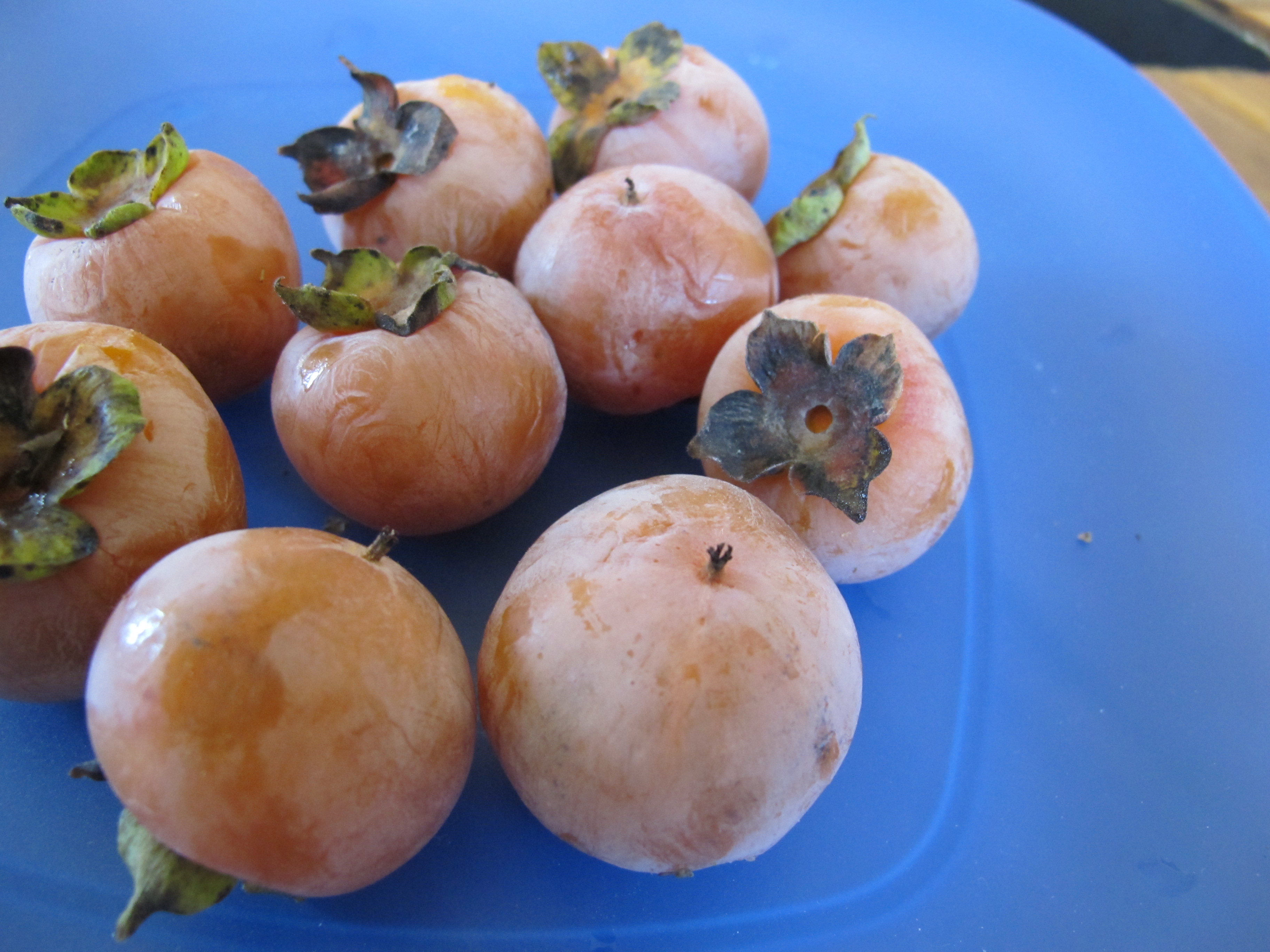
The following Monday, Gabriel and I visited a county park, where I just happened to come across some fresh persimmons.
We snacked on some in the park (Sir is a fan), and I gathered a small bag for later consumption. After painstakingly processing many of them into pulp, which later became persimmon custard, I’ve concluded that persimmons are best in small quantities, enjoyed raw, unless you have some sort of awesome way to separate the flesh from the seeds.
I originally thought our Foley food mill would serve well, but some places advised against it due to risk of scraping bits of seed into the final product. So I removed hundreds of seeds by hand. The custard is okay, “interesting” is a decent description — not bad, but probably not worth the trouble in the future.
By the time we encountered a persimmon tree right next to our campsite during this past weekend’s camping adventure (more on that in an upcoming post), I had had my fill of the fruit.
Biking Having used the trailer recently and having decided that it’s workable, but not ideal, I’m back to having Gabriel in the front seat, trying to maximize the time we have to ride that way before he really and truly outgrows the thing (he’s still a few pounds under the 38-pound weight limit, but height-wise, his legs are already scrunched).
Last Friday morning, I turned what could have been tedious errands, if done by car, into a lovely 6-mile ride, stopping at a bakery, then making milk and [Schlafly pumpkin] beer runs.
This morning marked my first chilly weather ride. By the time I left the house shortly after ten, I assumed my gloves and under-helmet hat would be overkill, but I brought them along just in case and quite happily donned them before my ride. Nothing like some crisp, cool, fall riding!
After our recent longtail test rides, Matthew’s view was that we should just buy something — whatever choice we made would be good enough and we would most likely enjoy having the bike. Worst case scenario, we could probably sell the bike for a decent price.
Longtails revisited
I agreed, to some extent, so I pulled together some prices and basic information for three longtails: Yuba Mundo (specifically, the Mundo NuVinci Lux), Surly Big Dummy, and Xtracycle Edgerunner. I ruled out the Kona Ute, considered in my previous detailed comparison, due to the larger wheel size (bigger wheels equal higher center of gravity, meaning heavy loads are harder to balance).
I added the Big Dummy (previously ruled out due to price) back into the mix since it was one of only two longtails we were actually able to ride, and it seemed like it might have a slightly more aggressive geometry (i.e., be faster and more nimble, assets on longer rides and hills).
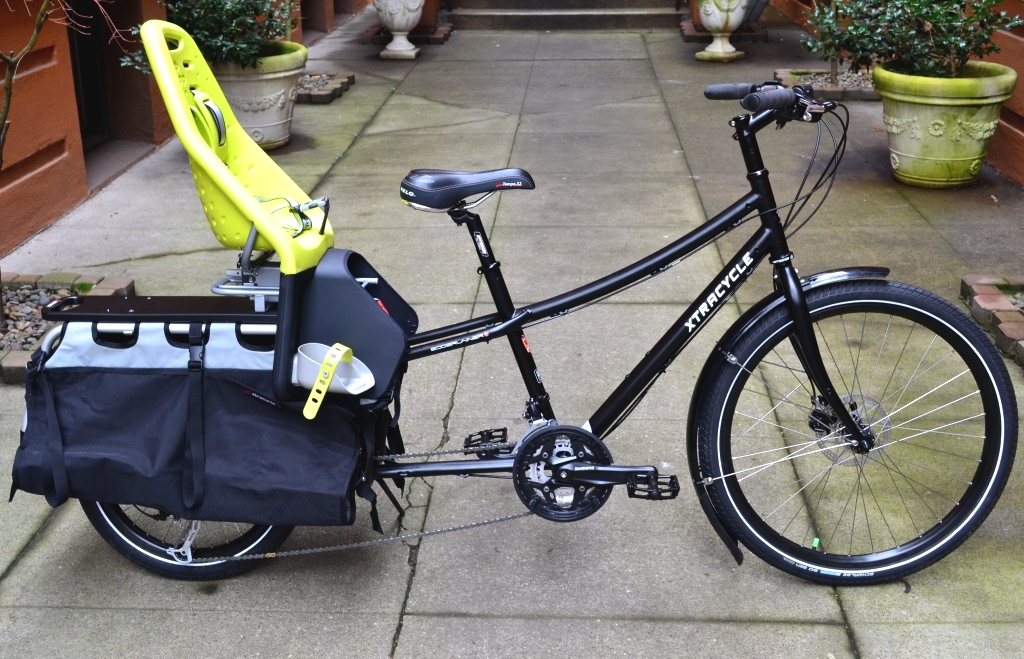
I’ve also read numerous good reports on Xtracycle’s new Edgerunner, which features a 20″ rear wheel, meaning the rear rack sits 6″ lower than the other longtails we’re considering. As explained in the above-linked article, this “lowers the bike’s center of gravity and makes the loaded bike feel less unwieldy and top-heavy.” As described, the Edgerunner seems to have many of the advantages (“a sportier, more nimble feel, which makes for a quicker-accelerating and more confidence-inspiring ride”) that made us reconsider the Big Dummy, but at a lower price point.
Edgerunner, photo from Splendid Cycles
So once again, we crossed the Big Dummy off the list, and we were left with the Yuba Mundo NuVinci Lux and the Xtracycle Edgerunner, both of which would cost about $2500 (before tax), fully outfitted for our needs (rear child seat, longtail cargo bags, lights, center kickstand, etc.). Gulp!
But what about midtails?
In the midst of these considerations, I read this post, singing the praises of the Kona MinUte, a midtail cargo bike. We actually test rode, and had an opportunity to get a good deal on, a 2012 MinUte back in April, but I was pretty set on a longtail at the time. The post on the MinUte, as well as this review of midtails in general, had me reconsidering.
While a longtail will fit on light rail cars (although getting it to/from the platform could be a challenge in some cases), it will NOT fit on bus racks, nor can it travel on Amtrak. While I don’t often take combined bus/bike trips, having the option is appealing. Also, a midtail really might be plenty of bike for our needs.
While the Kona MinUte may have been the one that got away, the midtail blog post had other inspiring rides, including this Workcycles Fr8. I love that it has the option of a front seat for older kids. I may have been sold on this bike, except that, with only eight speeds, I’m worried about how it will handle hills, of which we have our share.
Workcycles Fr8, fully decked out for passengers, photo from J.C. Lind Bike Co.
And yet more options . . .
In addition to reading [cargo] bike blogs, I am part of a cargo bike Facebook group, Revolutions per Minute. While it provides great inspiration, it’s really not helping me narrow my choices.
Someone recently posted information on the Circe Helios, a bike that can either be a tandem (with a rear seat that adjusts to fit riders as small a 3’6″, i.e., only four inches taller than Sir) or a longtail, depending on how you outfit it. Brilliant!
Decisions, decisions
Our [temporary?] decision is that we will stick with what we have for now, using the IBert front seat until he outgrows it (any day now) and then switching to the trailer. Since we haven’t used the trailer all that much, I made myself use it over the weekend, to see how I really felt about this option.
As far as general handling, speed, etc., pulling Sir in the trailer on my road bike felt pretty comparable to riding my hybrid (more upright, less-aggressive riding position) with Sir in the front seat (which is kind-of how I imagine riding one of the cargo bikes would be.
However, when it came to riding experience/fun factor, there was no comparison. In a way, I’ve been spoiled by all of these lovely rides I’ve had with my beautiful, smiling boy in front of me, right between my arms, continuously and effortlessly interacting with one another as we travel by bike and take in the sights (hence the appeal of that Fr8 with the front seat).
While a rear-mounted child seat on either a mid- or longtail would not allow quite the same level of interaction as the front seat, it would have to be better than having my little passenger WAY the heck back there in the trailer.
The limited rider-passenger interaction, combined with the fact that, with his helmet on, Sir’s head is already brushing the screen cover on the trailer, may mean that this budget-friendly option’s days are numbered, almost before they’ve begun.
The good news is that I am alive, though I’ve felt less-than-lively since being hit by a respiratory virus on Sunday. Illness plus a heavier work load on the part-time job front equals precious little time, energy, and brain functioning for this space.
I ended last week’s heavy biking log with a trip to Forest Park for the balloon race on Saturday afternoon. The ride was notable because it’s probably close to the highest single-trip mileage I’ve completed with Gabriel along in the front seat, and it’s the first time I’ve been up and down the Macklind hill with him along. I made it up on the return trip, thanks to my granny gear!
And then of course there were the balloons . . .
This slideshow requires JavaScript.
We enjoyed a picnic dinner as we watched the balloons inflate, rise, and fly swiftly south under a heavy breeze from the north. I thought the last few balloons might accompany us on our ride home, but they must have taken a slightly different route.
On the ride home we discussed Sunday plans to test ride some longtails, and Matthew, who’d put in over twenty miles on the bike on Saturday while leading CyclingSavvy, requested that we use the car to get to our Sunday destination since he was having some knee pain.
I reluctantly agreed, having liked the idea of showing up on our bikes to test ride the other bikes. Come Sunday afternoon (post cold-pocalypse), feeling like death-warmed-over, I lacked the energy to bike anyway. Only the fact that we’d been trying to set up these test rides for quite awhile (over a year, in one case!) persuaded me to abandon the couch and get in the car at all.
I perked up enough to ride the two longtails (a Surly Big Dummy and a Yuba Mundo) around the block. Once again I failed to photo-document the fact that I was on a longtail, but it happened. Gabriel also rode along on the Big Dummy.
Both bikes handled well, and Matthew and I agreed that either could potentially meet our needs. I slightly preferred the ride of the Mundo, while Matthew slightly preferred the Big Dummy.
Of course, just to make things complicated, some other options, including the Xtracycle EdgeRunner and the question of whether a longtail is really what we want at all (would we be better served by a midtail?) entered the picture recently. Enter the “too many choices” phenomenon! We’ll have made a decision by the time Gabriel’s twenty and the question of how we transport him by bike is completely moot.
Anyhow, a variety of factors (distance, cargo, sickness) conspired to make this week quite the opposite of last week: a number of car trips (will be up to four after tomorrow morning) and no bike trips.
So far, this virus is outwitting my usual weapons (i.e., lots of liquids; salt water gargles; neti pot; soup with lots of onion, garlic, and ginger). The only thing missing there is rest, which is hard to come by when the symptoms make it hard to sleep at night and there is too much on the to-do list during the day. Hoping at the very least to be back to normal by this time next week, when I’m on for a CyclingSavvy gig!
 Replace the parked truck (on the right) with two or three different parked vehicles, all smaller, all theoretically capable of fitting within the parking lane so as not to encroach on the “buffer” zone, but yet all somehow not capable of actually parking that way, and replace the garbage truck with a tractor-trailer.


![IMG_1495[1]](https://i0.wp.com/hergreenlife.com/wp-content/uploads/2013/02/img_14951.jpg?w=306&h=306&crop=1&ssl=1 "IMG_1495[1]")





 Her Green Life