Bloody onions!

A few weeks ago, Matthew started onions and leeks in flats, and they’ve been happily growing under the grow lights in the basement.  However, the lack of real sunlight and fresh air led to some mold growth on the top of the soil, so with outside temperatures in the 50s, he planned to get them outside for some good old-fashioned UV light.

I decided to help with this on Tuesday, so mid-morning, after Gabriel and I returned from the gym/kids’ room, we headed to the basement.  With no way to carry the seedling flat and a baby at the same time (well, there would have been a way, but it would have required going upstairs for the Ergo carrier), I opted for the “set Sir down in the basement with a toy, grab a seed tray, and dash outside and right back in before he could get into any trouble” option.

Now, while Sir’s usual stair method involves both hands and feet, he has recently started experimenting with standing up and holding a railing and/or adult’s hand.  With the hands and feet method, he navigates stairs pretty well over ninety percent of the time, but we [almost] always spot him from below, because he is given to slipping every now and then.

Anyway, when I opened the side door that leads to the stairs down to the basement, Sir was on the second or third step (from the bottom), coming to see me.  He had been using the original [safe(r)] method, but right about the time I entered, he stood up straight on the step, all, “Look, Ma, no hands.”

After that, I’m not quite sure what happened — either he just lost his balance on his own, or I may, in my slight alarm at his position, have made a sudden move that led to the tumble.  Either way, the final result was a two or three step fall, ending on the concrete basement floor.  Not good.

I picked him up and checked his head, which seemed fine, and then attempted to check for equal and reactive pupils, when I noticed a decent bit of blood on both of us.  For a minute, I couldn’t determine the source of the blood.  I ruled out mouth (which was the culprit in a previous fall), head, and ears before discovering a good sized gash on his chin, right along his jaw bone.

I called Matthew for a phone consult on the use of steri-strips, which I applied with little success, contending with a crying, upset baby and a chin soaked with blood and drool.  With lunch and nap time fast approaching, I cleaned things up a bit more and slapped a bandage over the steri-strips.

We suspected that, especially with the location, the injury would need more than our first aid attempts, so I called and left a message for our pediatrician’s phone nurse.  Since the bleeding was more or less under control and Gabriel calmed down and ate lunch as usual, I decided to go ahead with his nap while waiting for the nurse’s return call.

The nurse suggested coming in to the office to see if they could glue the gash, cautioning that if the doctor determined that glue wouldn’t work, we would have to head to the ER for stitches anyway.  With the possibility of avoiding a much higher copay and the ER gauntlet, I took their last available appointment for the afternoon.

Long story short (well, still fairly long, but a bit shorter), the doctor used the glue-bond stuff, covered with a big, waterproof bandage to protect it from drool (because the glue needs to stay dry for the first 48 hours).  I admit to being dubious that it would hold, but now, over 48 hours later, it looks like we got off easy.

Still, the $25 doctor visit copay, not to mention the pain, tears, and angst (and the risk of a more serious injury) added significantly to the cost of this onion crop.  Needless to say, I’ve learned my lesson about leaving a toddler unattended, even for “just a second” — the onions weren’t worth the blood!

Makeshift root cellar

A root cellar ranks high on our garden-related wish list.  A well-designed root cellar would maintain temperatures and humidity ideal for storing much of the food we harvest in the summer and early fall and eat throughout the winter, including potatoes, onions, sweet potatoes, cabbage, carrots, and squash.

Until we have a place of our own to garden and implement an “official” root cellar, we’re working with what we’ve got.  Until this year, that mainly involved basements — at Matthew’s mom’s house and at our apartment.  However, due to heat bleed-off from furnaces and duct work, most basements are actually warmer than ideal for root cellaring, and ours, with two (and in previous years, four) furnaces and duct work for two (or four) units is certainly no exception.

Once cold weather settled in for the season, we realized that the coldest place in our apartment was the front stairwell, just inside the front door.  We put a thermometer down there and discovered temperatures in the mid-50s (versus the 60-some-degree basement).

IMG_1367

While it’s not the most elegant storage solution, the space we’re using is more or less behind the door, so it’s out of the way.

The crate is full of potatoes, covered to prevent light damage.  It’s important to go through and de-eye the potatoes every couple of weeks.  We’ve had some that store better than others, but even the ones with rather shriveled skins taste good, they’re just a bit more work to clean.

The sweet potatoes at our place are a few steps up, in paper bags, though the bulk of our harvest of sweet potatoes and squash is still out at my MIL’s.

IMG_1366

We bought a bushel (about 50 pounds) of organic apples on our way to Iowa for Thanksgiving.  While they would keep better at cooler temps (like in the super-insulated straw bale building at the orchard), this was an okay compromise — there was no way we could fit them in the refrigerator.  Gabriel will often walk in the door, pick up an apple from the box, and take a bite, clearly indicating what he would like for a snack.

We’ve eaten or dried many of the apples.  The remaining apples have good flavor, but the texture is definitely best for cooking or drying at this point.

When we discovered our uninvited guests (of which we just found another a few days ago, argh!), I feared that they would be all too happy to invade our “root cellar,” but that hasn’t been the case (knock on wood).

Help, my baby ate my broccoli

And my cauliflower.  Oh, and my broccoli romanesco?  Yep, that’s gone, too.

I realized recently that while I’ve posted somewhat regularly on Elimination Communication (a method/practice that I seriously question, especially given some recent reading, but more on that in a later post), I’ve been a bit remiss in writing about something that has been much more rewarding, more straightforward, and less fraught with questions and stress: Baby Led Weaning.

Gabriel started slowly with self-feeding, which is normal and natural.  I definitely had questions in the beginning, but other than referring to the Baby Led Weaning book, I just kind-of went with it, offering a variety of solid foods, practicing patience with his developing appetite and pincer grip, and resting easy knowing that he was still meeting most of his nutritional needs with breastfeeding.

And then somewhere in the last year (maybe the nine or ten month mark?), he just really took off, and he’s never looked back.  He eats proficiently with fingers and a fork, and we’re working on the spoon.  Overall, he’s become a fairly neat eater, though of course some meals lend themselves to being messy at this age.

My biggest ongoing challenge is how to vary the grains in his diet.  Pasta and bread are easy go-to foods, but I’d prefer he eat something other than wheat, wheat, wheat (and I’d prefer to avoid buying expensive wheat-free pasta and bread).  Millet, quinoa, rice, and other small grains don’t make particularly great finger food, nor can they easily be speared with a fork.  When those grains are on the menu, we often spoon-feed him the grain portion of the meal.

While his interest in a particular food can vary meal to meal (sometimes he’ll shun something one  night, only to gobble up the leftovers at lunch two days later), overall, he eats what we eat for meals: lots of veggies, various beans and grains, nuts and nut butters, eggs in various forms, fruit, tofu, tempeh, some cheese . . . .

Given our passion for delicious, high quality food, we couldn’t be happier.  Well, except for those times when all three of us are eyeing the last two pieces of roasted cauliflower.  Then we would be happier if there were more cauliflower in the oven.

Holiday eats

Feels like just yesterday we were looking at ideas for Thanksgiving meals, right?  Despite the many lovely recipes in the NYTimes Vegetarian Thanksgiving compilations, my search for something featuring tempeh ultimately led me to the orange-maple tempeh at 101 Cookbooks.

The tempeh went perfectly with the wonderful array of traditional sides that my mom prepared, including mashed potatoes, dressing (AKA stuffing), mixed green salad, and whipped sweet potatoes (from my dad’s garden — candy sweet with no sugar added).  I doubled the recipe to insure we had enough for leftovers, which were delicious topped with the vegetarian gravy I made.

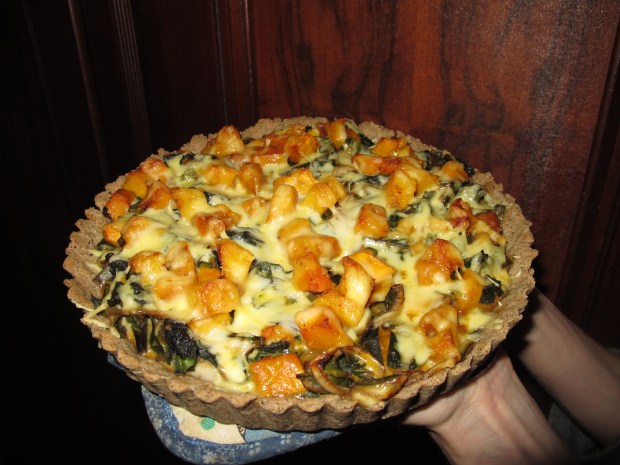
Still, our perusal of other holiday recipe ideas left us with a nice list of things to make later, including this Buckwheat Harvest Tart.  It looked labor- and time-intensive, so we kept postponing it, but I took advantage of my baby-free Monday last week and spent most of the afternoon in the kitchen, working with this guy. IMG_1019

Perhaps Matthew will share the real name in the comments, but I call it “the big warty squash.”  Less-than-attractive nickname aside, this is a delicious variety of winter squash, with lots of rich, flavorful flesh (and the seeds roast well, too).  I cubed some for the tart (along with some Silver Bell, another of our favorite squash varieties from this year), but I was left with quite a lot for roasting.  I followed my usual, fast and easy, slice and rub with coconut oil approach.

IMG_1023

Roasted squash perfection — yum!  But not to be outdone, here’s the star of the show, pre-cheese sprinkling step and before oven time.

IMG_1024

The various flavors came together so well here, showing the value of a good recipe.  Labor-intensive, but worth it!

IMG_1028

We’re brainstorming ways to use the flavors of the filling in dishes other than tarts.  For starters, you could certainly omit the eggs and serve the cooked veggies over pasta or another grain.

After making this on Monday, I settled down to simpler meals for the rest of the week, and Matthew focused his attention on baking cookies, old favorites and a new-to-us variety.  More on those later . . . .

Of mice and sweet potato wraps

Before we get to the food part, a little update: we did not just have a single mouse, we had mice, and the first mouse we caught was, in fact, not That, as evidenced by its lack of a kinky tail.

Within twenty-four hours, we caught a total of three mice, using my baiting method with the basic wooden spring traps.  When I told my mom, she asked if we were emptying and reusing the traps, and I was a bit taken aback, because the idea of not reusing them hadn’t occurred to me, but I guess some people treat them as a single-use item.

Oh, and she actually asked if Matthew was emptying the traps, and I might have been offended, but Matthew had, in fact, graciously taken on that grisly duty with no discussion, and I certainly wasn’t fighting him for it, making it hard to object to my mom’s assumption.

Anyway, we’ve had two baited traps out with no catches for six days now, and I have not seen or heard any signs of mice in that time, so it still seems we may have caught them early.

On to a delicious weekend lunch that came together quickly, thanks to leftover roasted  garlicky sweet potatoes and frozen [homemade] tortillas* — sweet potato wraps.

IMG_0988

The leftover sweet potatoes already had miso sauce on them, so I continued that theme to make a sauce for the wraps, whisking almond butter, miso, and water to create a nice, thick sauce.

Ingredients
Almond butter-miso sauce
Roasted sweet potatoes
Lettuce
Diced tomatoes or mild salsa
Cilantro
Tortillas

Directions
Spread sauce on a tortilla, then top with lettuce, warm sweet potatoes, tomatoes/salsa, and fresh cilantro.  Enjoy!

IMG_0985

Sometimes the meals where you just “coast,” enjoying the fruits of earlier kitchen labors, are the best.  I just wished we’d had enough roasted sweet potatoes for seconds!

*I’m still working on perfecting my 100% whole wheat tortilla recipe.  I used whole wheat pastry flour, which gave a nice, light result, but I think they suffered from the lower gluten content of said flour.  I plan to stick with the pastry flour and add some gluten for the next round.