Sold on squash

When all was said and done, this year’s [winter] squash harvest topped 800 pounds.  That’s a lot of squash.

This picture shows the portion that Matthew harvested fully ripe.  We have this much again that should ripen and be good for eating down the road (though perhaps a bit less flavorful than the fully vine-ripened).

We also sold a total of 250 pounds of the squash harvest to Local Harvest Grocery and Five Bistro, so if you want a taste . . . .

The [modest] profit helps cover some of the costs that go into the garden every year, including seeds, straw for mulch, and soil amendments.  (Though we’ve played around with the idea of growing food for a living, I can’t imagine how much you’d actually have to grow to support yourself.)

The remaining squash leaves us with a decent bit to use throughout the next several months.  Fortunately, we like squash, and it’s really quite versatile: roasted and served as a savory or sweet side dish; cooked and pureed to make soup, custard, or pumpkin bread; cubed or diced and used in place of carrots in soups, stews, and other one-dish meals.  And don’t forget chocolate pumpkin cake!

With the cooler temps, I’m really enjoying excuses to turn on the oven (a complete one-eighty from my summer behavior of avoiding it at all costs).  If the oven will be on anyway, roasting a squash is an easy way to make use of the heat, since they can cook at whatever temperature you’re using for other recipes, as long as it’s in the 350°-450°F range.  Coconut oil is the secret ingredient.

quick roasted squash side

Pseudo-recipe by Melissa

Grab a squash, slice it, rub the slices with coconut oil, and sprinkle with salt if desired.  Lay slices flat in a single layer on a rimmed baking tray.   Bake for 15-25 minutes (depending on thickness of slices) at 350°-450°F, then flip each slice and bake for 10-20 additional minutes, until they reach desired tenderness.  Serve as is, or dress up with spices and herbs of your choice.

Halloween trick or tart

Gabriel Bee

I lack the time or tools to be crafting/sewing costumes.  Fortunately, as I discovered last year, it’s easy to find nice, affordable used costumes — wear once and send back into the costume recycling circle.

Buzz, buzz

There will probably be no trick-or-treating this year, due to a conflict with bedtime, but we ventured out to the Botanical Garden’s event on Sunday afternoon.  Our little bee enjoyed buzzing around the garden on a gorgeous fall day.  He seemed nonplussed by all the other little ones in costumes, which (we discovered later) may have been due to discomfort from too tight pants (that I stuffed him into — sorry, Baby!).

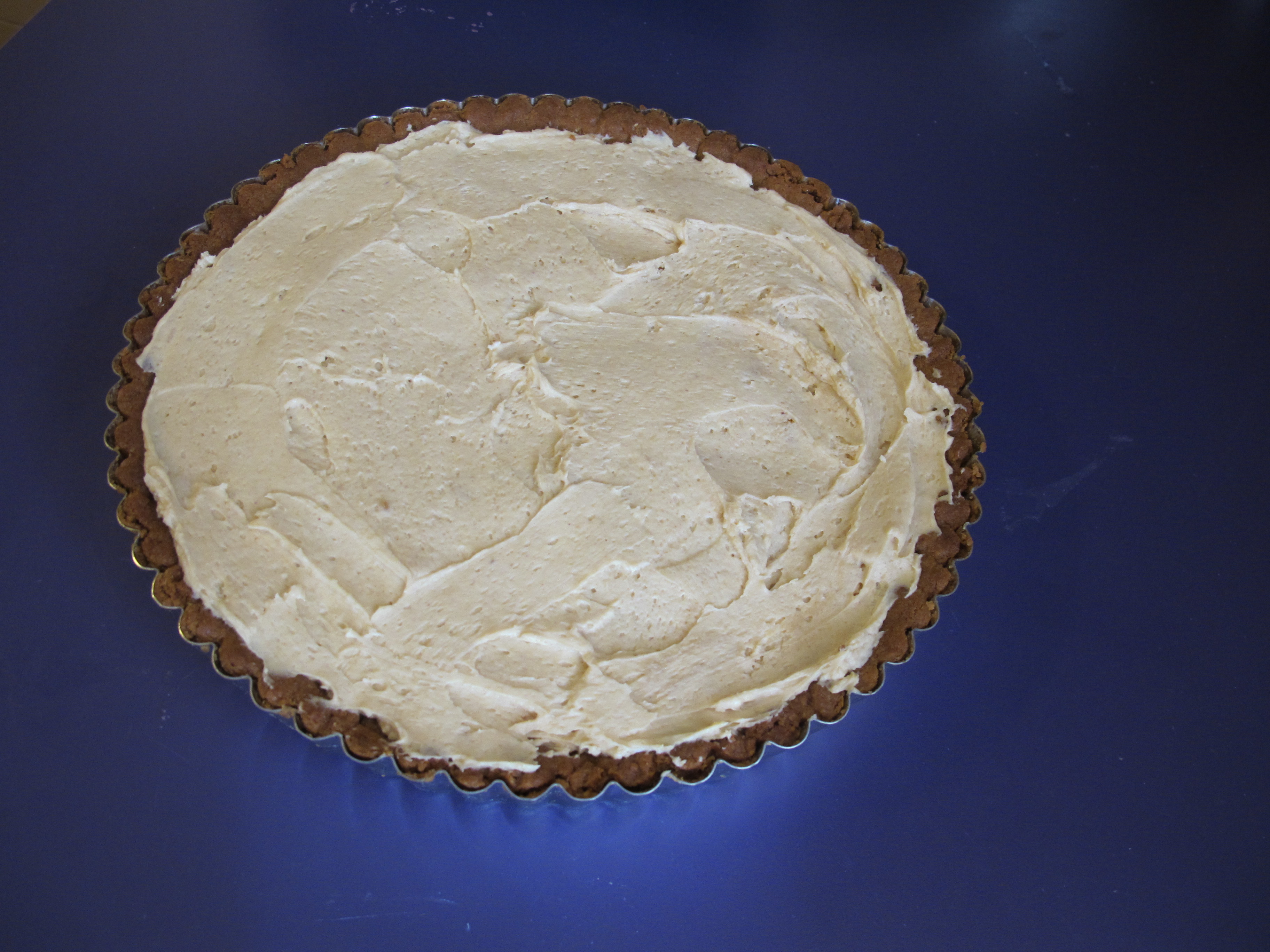
We also whipped up a little treat over the weekend — this chocolate peanut butter tart, a recipe I’ve been eyeing since I made my birthday cake request in May.  We assembled all the ingredients except for regular peanut butter.  We buy the natural kind that needs to be stirred, and I was nervous since the recipe was specific on that point.

Tart before the chocolate ganache layer

Fortunately, the peanut butter mousse whipped up beautifully with our peanut butter of choice, though perhaps a bit less sweet.  We didn’t mind too much.

Better than Halloween candy 🙂

It’s hard to mind much when you’re eating the equivalent of a very high quality peanut butter cup (and watching a great football game, as was the case Saturday night).

I’ll end with one more for the cuteness column — Baba found not one, but two Halloween costumes, so we had a bee and a cow this year.

Mooooo!

Who let the cow into the pumpkin squash patch?

Veggie potluck caught on camera (sort-of)

For the past few years, we’ve been part of a vegetarian potluck group that meets once a month.  Up until, oh, July of 2011 or so, we rarely missed one of the monthly gatherings, enjoying both the company and the food, which frequently served as a source of inspiration.

The group includes cooks of all levels (and omnivores as well as vegetarians), but many participants are epicures and foodies like us, and dished often feature local ingredients, either from gardens or CSAs.  Our attendance over the last year could be described as sporadic, at best, but we made it to the October gathering, which had an Asian them.

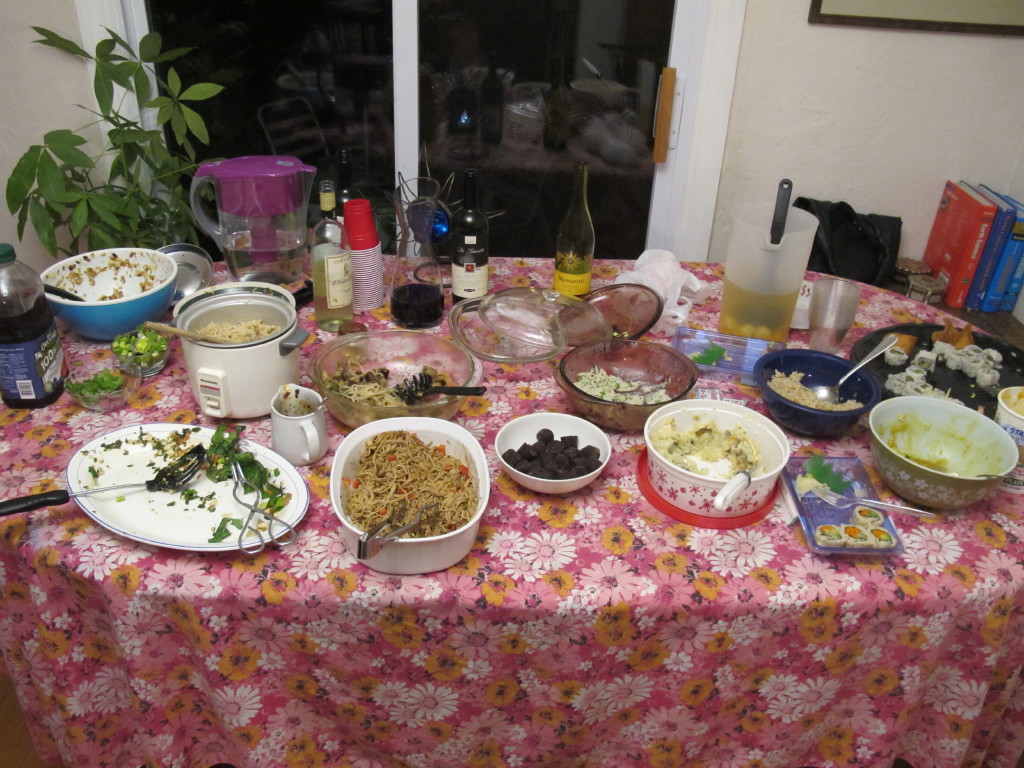
I remembered to bring the camera, but failed to get a “before” shot of the spread.  Fortunately, after going through the buffet line, Matthew got caught up in a conversation and loaned me his almost untouched plate for a nice photo op.

For our dish, I turned a large quantity of [garden] eggplant into garlic-ginger eggplant with sesame noodles, which seemed to go over well.  Here’s an “after” shot of the buffet, which featured a couple of noodle dishes, coconut rice, two sushi platters, an Asian cabbage salad (which I loved), and tofu-kale dumplings, made by our hostess.

I’ve missed our regular attendance at these gatherings.  We employed our first “real” (i.e., non-family member or friend) babysitter for the outing, which went well, so we hope to make the potlucks a regular occurrence once again.

Mouth on fire

Guest garden post from Farmer Brown . . .

Observation: Some varieties of peppers get hotter when bitten into and then sit in the fridge for a few days.

We’ve noticed this a few times this summer.  I grew a number of peppers that can range in heat levels (variety of heat levels from peppers on a single plant), so I started tasting a pepper from each plant as I picked, and sorting them into bags for hot and sweet (not hot).  But some of the peppers I’d tasted wound up being very hot, even though they were in the sweet bag.*

We decided that maybe since I was tasting the tips, it was that some of the tips were mild even though the tops were hot, so I started tasting both places, and I caught more, but still we’d get hot peppers in our sweet bag.

I then tried tasting all of the peppers at a picking, but still some wound up hot in the sweet bag.

I have a hypothesis that some of the peppers (that have potential to get hot) release more capsaicin (what makes them hot) when they’ve been bitten into.  This would make sense if capsaicin is a defense against being eaten (by mammals).

Has anyone else noticed this?  I keep meaning to get around to somewhat more formal experimenting, but I haven’t yet.  I’ll write more if/when I do.

*Melissa’s note: Since I’ve been doing most of the cooking lately, I’ve usually been the “lucky” one to encounter the surprise peppers in what should have been the sweet and mild bag.  I’ve had a enough unpleasant experiences — burning lips, mouth, and a random place on my face that I touched after handling a pepper — that I’m quite wary now.

Making seitan

About a year ago, the topic of seitan came up with a friend, and she mentioned a YouTube video on making seitan in a pressure cooker.  Our previous attempts used the basic simmer in broth on the stove top method, and, while the results were okay, we weren’t crazy about the texture.  Perhaps pressure cooking was the trick?

While rather over-sized for everyday cooking, pressure canners can double as pressure cookers (but not vice versa), so I already had the necessary equipment.  I just lacked the time and motivation to experiment.

Our vegan barbeque experience in Portland included “psstrami,” their take on pastrami, made from seitan and served with barbeque sauce.  The texture and very thin slices were great, but frankly, I thought I could do better flavor-wise in the barbeque department.

With that in mind, I pulled out the canner two weeks ago to take a stab at the seitan.  I more or less followed this recipe/method, except I brilliantly decided that a single recipe would not yield much, and as long as I was heating up the canner, I may as well go for a double.

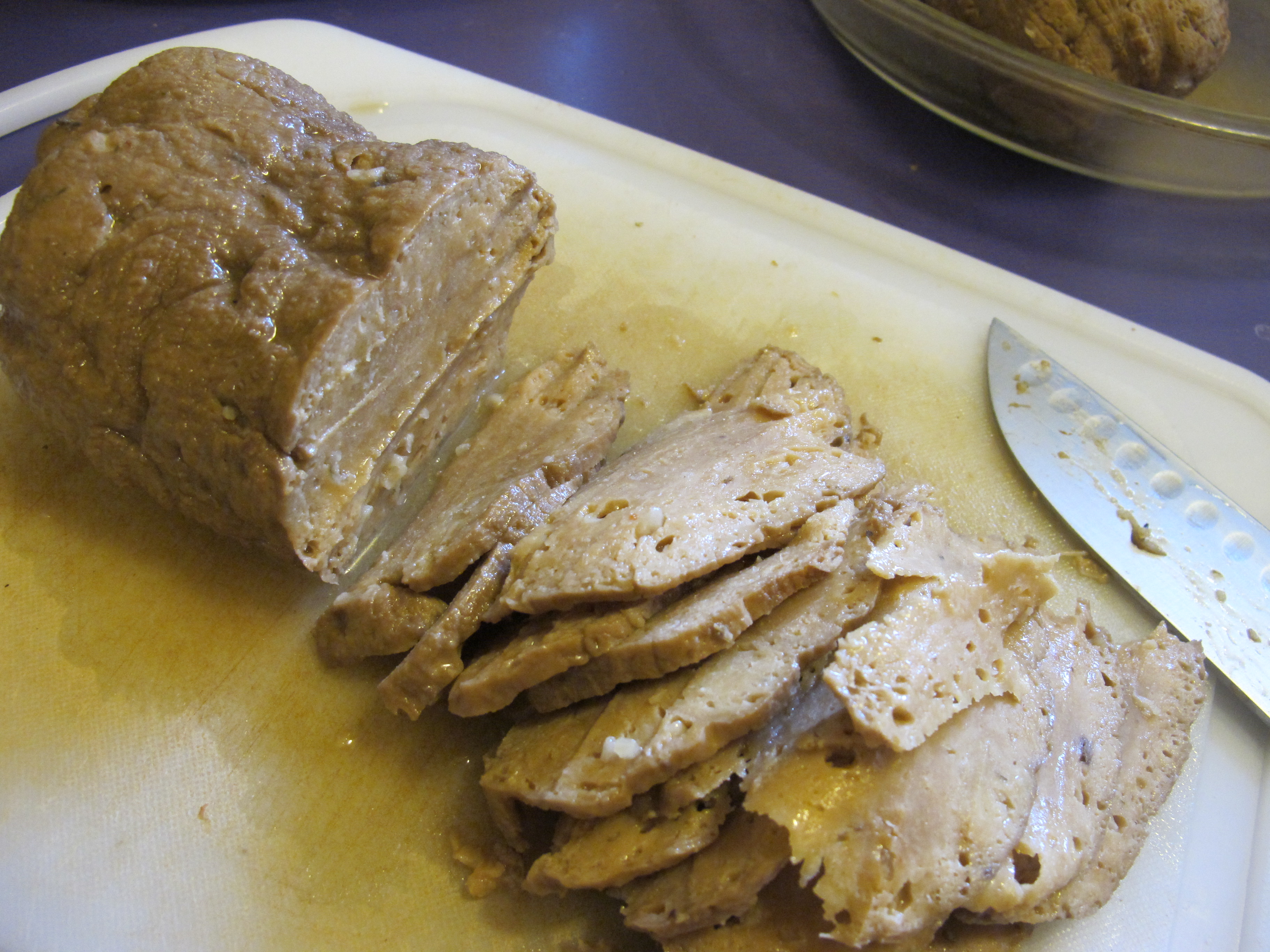
Though it seemed like extra trouble, I wrapped my uncooked dough in cheesecloth as suggested, locked the lid, brought it up to pressure and waited.  Once depressurized, I opened the canner to find two HUGE logs of a suspiciously meat-like substance.

Half pleased, half horrified, and a good dose of overwhelmed at the sheer quantity of seitan I had created, I set about the task of slicing it — some ultra-thin slices for sandwiches and some chunks for other dishes.

Over the past two weeks, we’ve had seitan reubens, gumbo, stir-fry, and, of course, the barbeque seitan sandwiches (which were better than the food truck version).  Gluten overload, anyone?

Anyway, I’m really not sure how long prepared seitan is supposed to keep, but we have just a bit left.  If it seems okay, it may make a final stand in tonight’s dinner, possibly as some kind of bbq/stir fry fusion dish.

Thoughts on pressure cooker method
I really liked the texture of the ends and outside part of the seitan logs — very similar to what you buy in the store (usually for $4-$5 for just a few ounces).  The center of the log was very dense, and while edible, was not my ideal. Perhaps smaller logs would help?

A double recipe was WAY too much.  Sure, I got to use it in fun, creative, and tasty ways, but we were eating seitan in some form almost every day for over a week — I really prefer more variety in protein sources, especially because beans and soy are healthier options than concentrated wheat gluten.

I’ll probably make pressure cooker seitan again as a single recipe with two or three smaller logs, but I’ve also seen a recipe that calls for baking the seitan in broth.  Now that we’re back to oven weather, that may come first.