Vegan again?

Although I’ve never officially been vegan, I was pretty darn close for a couple of years, including the time when I met Matthew.  On one of our first dates, we made vegan chocolate chip cookies.  He went out of his way to buy vegan chocolate chips and Earth Balance spread for the the recipe, knowing that I tried to avoid dairy products.

Though he had been vegetarian for much longer than I had, he liked cheese, butter, ice cream, and eggs, and my diet gradually came to incorporate more of those foods.

Over the summer, we started buying local milk regularly (one gallon every two or two-and-a-half weeks), some of which became yogurt and ice cream.  We’ve also been eating a decent bit of cheese, either local or non-local plastic-free.

Everything seemed fine and dandy until I suggested that Matthew visit my homeopathic health care provider (she has a doctorate, but cannot be considered a “doctor” in Missouri) about some ongoing health issues he’d been experiencing since August.  She ordered a simple food allergy blood test, and, lo and behold, the results came back with a Level 3 allergy to dairy.

While it is hard for him (and me too at this point, to be honest) to consider completely eliminating dairy from his diet, that is exactly what he (we?) will be doing for a month.  After his system has a month to recover, he will slowly reintroduce specific dairy products to see if there are some that he can tolerate.

We expect that straight up milk will be out of the picture altogether (which would not be a huge loss) but are hoping that butter, yogurt, ice cream, and cheese might not cause a reaction.

Since he has been eating them for years, this is clearly not a life-threatening allergy, but as the past few months have made clear, the allergy is most likely affecting his health on a day-to-day basis.  This may very well come down to a choice between optimum health and continuing to eat some favorite foods.

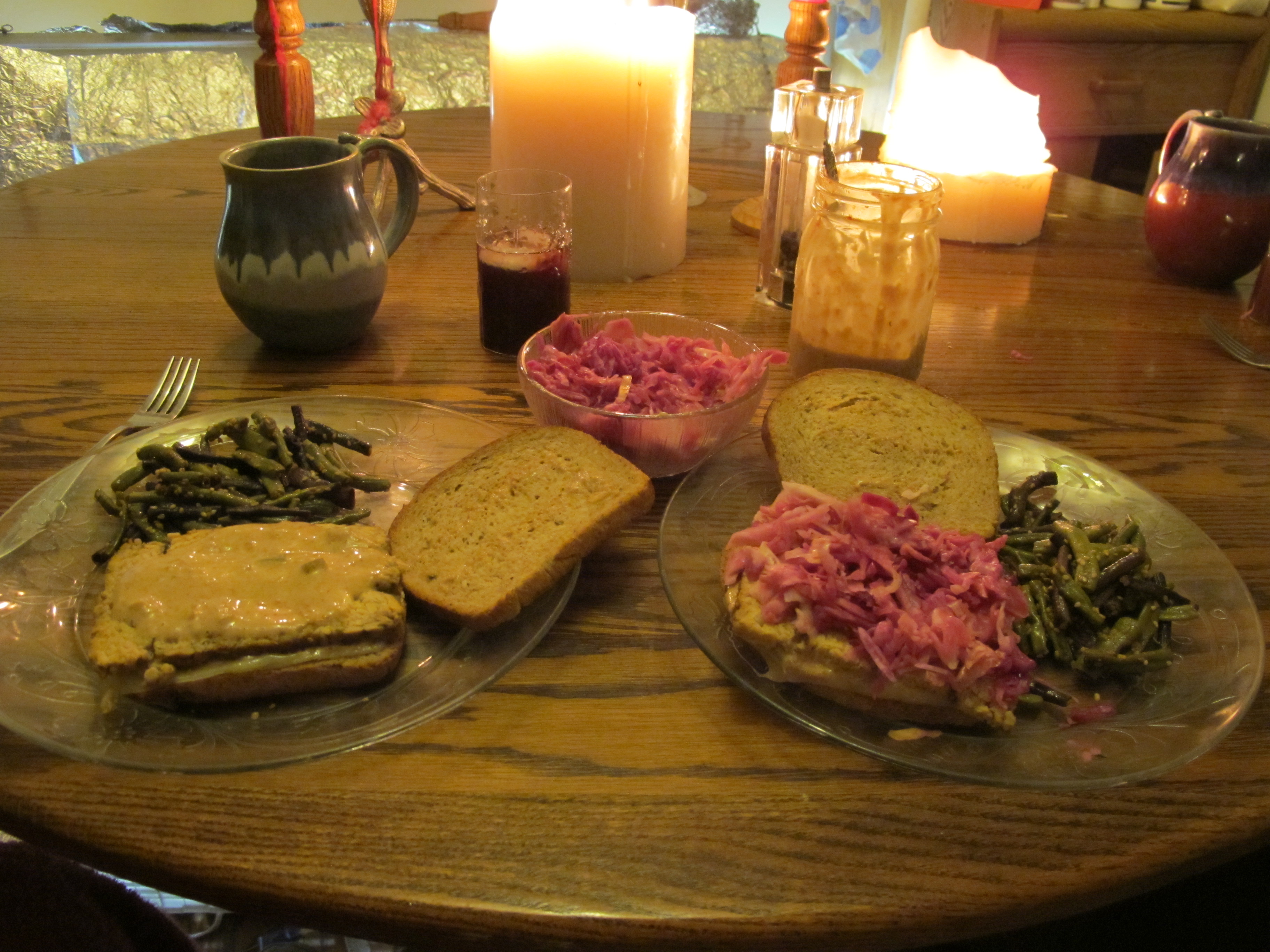
Finger-licking good vegetarian reubens

I’ve experimented with various ways to make vegetarian reuben sandwiches over the past few years.  The simplest: make as usual, just eliminate the corned beef.  The thousand island dressing and sauerkraut provide plenty of flavor (and salt!) — combine that with melty Swiss cheese and some good bread (rye or whole wheat), and you have a pretty delicious sandwich.

However, our new favorite version does include a corned beef substitute — tempeh.  This does not taste like corned beef, but it provides some nice additional texture, flavor, and protein to the sandwich.

Finger-licking good vegetarian reubens (Makes 4 sandwiches)

  • 1 package tempeh, prepared per the directions here
  • homemade Thousand Island dressing (see below for recipe)
  • 1-2 c. Sauerkraut (homemade or store bought)
  • 8 slices of Baby Swiss
  • 8 slices of whole wheat bread (or rye, if you like, but we enjoy these on our homemade wheat bread)
  • butter, softened (but not melted)

Butter outsides of bread, then assemble sandwiches with cheese, tempeh slices, and a small amount of dressing.  (Save the sauerkraut and more dressing for after the sandwiches grill, to prevent soggy bread.)  Grill the sandwiches in a large frying pan over medium-low heat until cheese is nice and melty, and bread is lightly toasted, flipping to grill both pieces of bread.  After grilling, and just before eating, add sauerkraut and more dressing.

Have your cloth napkins ready — a good reuben should be nice and juicy.

Extra points for color with purple cabbage sauerkraut

Thousand Island dressing

  • 1/2 c. mayonnaise or plain yogurt
  • 1/4 c. ketchup
  • 1 T. finely chopped onion
  • Dash of Worcestershire sauce
  • Finely chopped dill and/or sweet pickles

I definitely ad lib on this recipe — no measuring involved.  Start with the quantities above, add finely chopped pickles as desired, and then adjust until you have the flavor and consistency you want.  I am spoiled because I make this with our super-flavorful homemade ketchup, but it should work with the any variety.

Good sauerkraut — make your own

Yesterday, I wrote about my hunt for good sauerkraut and how, while I found a great store-bought product, we ultimately decided to make our own.

Fortunately, making sauerkraut is quite simple.  For this batch, we started with the following ingredients:

  • 2 1/2 heads purple cabbage
  • ~3 T. pickling salt

  1. Shred the cabbage — we took a shortcut with the food processor.
  2. Put a layer of shredded cabbage in a clean crock, sprinkle with salt, and repeat until you use all of the cabbage.
  3. Place a clean dish towel over the top layer of cabbage; top with a plate that’s about the diameter of the crock (and fits inside the crock).
  4. Place some kind of weight on top of the plate — we used two quart canning jars filled with water as our weights.
  5. After a couple of hours, the salt should pull enough water fro the cabbage so that the liquid completely covers all of the cabbage.  This is very important — if there is not enough liquid, boil 3-4 cups of water, add 1 t. salt (making a brine), let cool, and add to crock.  Repeat if necessary until all of the cabbage is completely submerged.
  6. Now you wait — every couple of days, remove the weights and clean the plate and towel.  Check the liquid level after reassembling — you may lose some liquid with the towel.  If this happens, simply make more of the brine and add as necessary.
  7. You can start tasting the cabbage after 1 week, but it will take 3-6 weeks (depending on the temperature) to really ferment and become sauerkraut.

I intended to include our fabulous veggie reuben recipe in this post, but figuring out how to make the photo collages took a bit longer than expected, so I’ll keep you in suspense on the reubens for now (the bottom left picture in the collage provides a sneak peak).

For a bit more info on the sauerkraut making process, try here or here.

The hunt for good sauerkraut

Though I’m not sure if I like the term, you could definitely classify Matthew and I as “food snobs.”  For reasons including taste, health, and the environment, we tend to be pretty selective about what we put in our bodies, but, until I met Matthew, I never thought about sauerkraut as a food that could be better or worse.

Sauerkraut was something that came in a metal can and was purchased mostly for the purpose of making reuben sandwiches with the corned beef left over from St. Patrick’s Day dinner (and maybe on brats, but I didn’t really eat those much).  Despite my limited sauerkraut consumption, I always enjoyed the salty, tangy cabbage, but I was perplexed when Matthew started talking about “good” sauerkraut, and needing to look for it in the refrigerated section of the grocery store.

For a long time, the closest I came was a glass jar of sauerkraut, still unrefrigerated, but perhaps a slight upgrade from the metal can version.  Then, while browsing the refrigerator case that holds tofu and tempeh at Whole Foods a few weeks ago, I spotted Bubbies Sauerkraut — the last one on the shelf.  Live cultures and must be kept refrigerated?  Maybe I’d finally found it!  Compared to the metal can stuff, this was a bit pricey, but I was curious.

The verdict?  If we weren’t trying to save it for reubens, we might have polished off the entire jar the first time we opened it for a taste.  Salty, tangy, crunchy, and cut in the most beautiful, long, almost noodle-like, shreds.

Finally convinced that there was such a thing as superior sauerkraut, and with our naturopath’s recommendation that we eat more fermented foods, but not excited about buying more of our semi-expensive new find, we set out to make our own kraut (something Matthew was somewhat familiar with from his childhood).

Here’s a sneak peek at the beginning of our little experiment — full post, along with our vegetarian reuben recipe, coming soon!

Spank it oh pita

Huh?  Oh, right, that’s supposed to be “spanakopita,” as in the delicious Greek spinach and phyllo concoction, but my mind tends to twist the word in a creative way.  I can’t see or say the word without “spank it oh pita” popping into my head, and now I’ve corrupted you, too.  (You can thank me later.)

Anyhow, with only a bit of help from yours truly, Matthew made spanakopita on Saturday night, using the Barefoot Contessa’s recipe.  This recipe yields a delicious spinach pie, which of course we double (after baking and cooling, we cut one pie into wedges and pop it in the freezer for future meals).  For a double recipe, we go a little light on the feta cheese (we used about 3/4 lb instead of 1 lb for the double), and the 1/4 lb (1 stick) of melted butter for the phyllo in a single recipe is plenty for a double recipe.

The finished product, golden & flaky

The directions say to “cool completely and serve at room temperature,” but we never wait that long.  We can always eat the leftovers at room temperature 😉

Steaming spanakopita

We enjoyed our distinctly not cool spanakopita with a side of the most delicious oranges ever.  Local Harvest had a limited quantity of citrus that someone brought directly from California after a trip — not at all local, but perhaps the freshest and most truly ripe oranges I’ve had the pleasure to eat.  They were also organic and unwaxed, so I zested each and every one before eating.