Seed starting: Make a functional, affordable heat box

Special guest post by Matthew

Functional, Affordable Seed starting heat source . . . I’ve used this one with great success and reliability for four sets of plants now.  We set our thermostat pretty low in the winter, so the heat box helps keep the seeds cozy (i.e., at an ideal temperature for sprouting).

The basics:

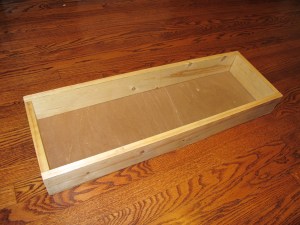
  1. Build a 5 sided wooden box to hold the heat, sized to fit your light source (or your tray size)
    1. Four 1”x4″ s (or whatever wood you want) for the sides
    2. Very thin plywood (or planks) for the top
    3. I left the bottom open, just set it on #3
    4. Nails or screws to join
    5. I made two boxes, each 10.5″ x 32″ x 3.5″
  2. A string of nightlight (4 watt) bulbs (or other incandescent lights) as a variable heat source (screw them in or unscrew some of them to get the soil temperature you want)
    1. Optional: Tack the wire of the nightlight string to the sides of the box to keep the bulbs out of direct contact with the box or radiant barrier –be careful to avoid damaging the wire’s insulation
    2. You may want to add a timer; I only use heat during the 16 hours of light I give my plants

    3. We have a string of lights that have a little metal cage around each bulb, so they sit directly on the reflective material
  3. A sheet of reflective radiant barrier insulation (see photo above) for below the box
    1. I used a scrap left over at the hardware store from someone’s home insulation project

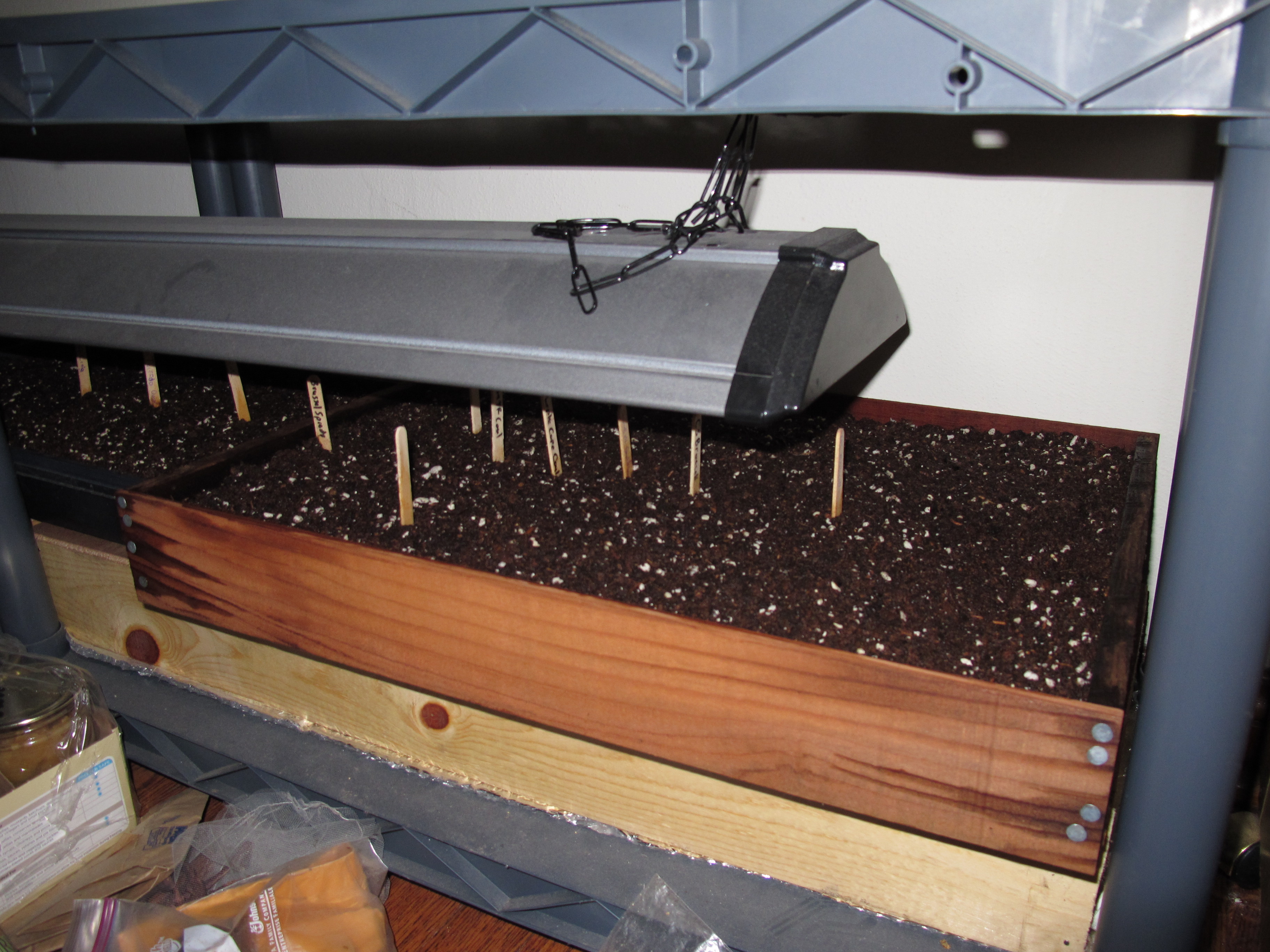
Set your seed starting trays directly on top of the heat box.  When starting with this, put a thermometer into the soil of your seed starting tray and adjust how many bulbs are on in your box until you get the right temperature for your seeds.

Sprouting

It's that time of year again

Matthew planted seeds for cruciferous veg, as well as onions and leeks last Monday.  With a bit of assistance from our homemade, super-frugal heating boxes, the first seeds sprouted within a few days.

Our average apartment temperature (especially during the day when we’re at work) is below ideal seed-sprouting temperature (~75° F), so the heat box provides a little extra help in a relatively efficient way.  We’re hoping to put together a  little post about making the heating boxes, so stay tuned!

Winter greens

Last night I made our first salad of the winter with some beautiful red leaf lettuce from our low tunnel.  We thought the low tunnel would provide spinach throughout the winter and expected the lettuce to bite the dust during the single digit temps in early December.

As it turns out, the spinach harvest has been pretty minimal (Matthew transplanted the spinach to the tunnel from its previous location in the garden, which may explain its lack of enthusiasm), and the lettuce, which is much less cold-tolerant than spinach, somehow survived.  While the low tunnel keeps things warm enough to prevent freezing, it’s still pretty chilly in there, which means that spinach, lettuce, or anything else, will grow veerrrryyy sllloooowwwlllyy.

Matthew harvested just enough lettuce leaves for a nice salad for two.  I dressed it up with some chopped cauliflower, red onion, toasted sunflower seeds, and this homemade dressing, which features nutritional yeast, and savored every bite of homegrown lettuce in the middle of January.

Retrospective menu

I fell off the cooking wagon for a couple of weeks, but I got back in the swing of things last Thursday night with — hmm, now I can’t quite remember.  Ah, right, lentil sloppy joes.  And I roasted some broccoli and cauliflower for a side dish — delicious fresh out of the oven, but not so great as leftovers.

I opened a jar of our canned tomatoes for the sloppy joes.  I saved some of the tomatoes and used them to make County Vegetable Soup with Pasta on Friday night.  This recipe comes pretty close to what I made — the main difference is that my recipe calls for pesto as a garnish.  Also, I used whole wheat shells for the pasta, which I cooked separately and added to the bowls when serving to keep them from getting mushy.

I love sitting down to dinner and doing a tally of all the garden and local produce in the meal.  The soup was a great one for this: the leeks, carrots, zucchini, green beans, tomatoes, and basil for the pesto came from our garden, and the cabbage was locally grown (we didn’t have much luck growing cabbage this fall).  This is a wonderful soup — really hearty and flavorful — perfect for these frigid days.

On Saturday night, I found my cheesy side with a baked macaroni and cheese dish (recipe from 1000 Vegetarian Recipes, our go-to cookbook).  On the side, a serving of steamed, grated beets with butter and salt, as well as a small roasted beet salad.

I finished my cooking spree with Swiss Chard risotto on Sunday night.  Instead of arborio rice, I used oat groats.  Instead of the normal time-intensive risotto procedure of adding small amounts of broth at a time while stirring almost continuously for an hour, I added the liquid in two installments and simmered it with minimal stirring.  The oat groats produced a creamy, hearty risotto, which I paired with roasted root vegetables (garden potatoes and beets, plus local sweet potatoes).  Risotto recipe coming soon, once I get it out of my head and into the computer — which I hope occurs before I forget what I did 😉

Bread & tomatoes, illness on the side

Sick + Writer’s block + Entertaining + Tiring week at work (last week) = not much blogging around this place.

While I have a relatively high pain tolerance, I don’t do sick well.  This has been the kind of mildly sick where I’m still able to function, albeit at a slightly reduced level.

Saturday night I passed out on the couch at some early hour, abandoning Matthew to start the bread making on his own.  This resulted in a new note on our whole wheat bread recipe: “Do not start at 9 o’clock at night.”  Even though he was only getting the dough together so it could have a long first rise on our cool back porch overnight, he didn’t make it to bed until after midnight.  (I moved from the couch to the bed sometime before then, pausing only to brush my teeth, no energy for flossing or neti-ing.)

Sadly, the bread did not turn out as well as it has in the past.  Still good, just not the “We should open a bakery and sell this for $5 a loaf” quality that we were expecting.  The bread served as the base for some very-late-season Caprese Salad Sandwiches last night.

We’re slowly working our way through the last of the garden tomatoes.  We (and by we, I pretty much mean Matthew’s mom) harvested a boatload of tomatoes a few weeks back and they’ve been slowly ripening (as well as slowly rotting, in a few unfortunate cases) in boxes in our living room ever since.

A few of the things that we’ve done with the tomatoes:

  • Roasted tomatoes
  • Tomato sauce (we need to make more)
  • Tomato tart (the crust has some serious butter)
  • Pizzas
  • And, of course, the Caprese Salad Sandwiches

My usual recourse for ripening tomatoes (and other unripe fruit) is a paper bag, but we had way too many tomatoes for that.  Instead, we set the tomatoes in single layers in cardboard boxes and covered them with newspaper — fast to arrange and easy to keep an eye on them.