Carrot taste test

This post has been in the works for quite awhile now.  If you’ve already ordered carrot seed for your spring garden, don’t despair — these results are from our fall grown crop.  Given our growing conditions, fall-sown carrots often do best here anyway, as the early heat of summer often limits the sweetness and growth of spring-sown carrots.

Carrot taste comparison (and far less rigorous growth comparison due to differential germination and thinning) – Grown Fall 2012, tasted January 2013, overwintered in low tunnels prior to harvest.

Taste comparison for carrots grown fall 2012 in St. Louis, MO in double dug clay soil after potatoes and prior to that lawn, probably a little on the acidic side.

Tasted sliced to ~1/8” or 3/16”, both raw and steamed for ~7 minutes, until soft but not mush.

We rated each carrot on a scale of one to four, one being best, with rating for how well that carrot grew (the number in parentheses) and how it tasted, with notes on taste both raw and cooked.

IMG_1405

Favorites

  • Danvers ½ Long – great germination and growth (1) fairly sweet & carroty; steamed – very sweet and flavorful 1
  • Cosmic Purple – (1) raw – mild sweet & spicy; steamed –sweet, spicy, flavorful 1
  • Dragon – (purple) (2) (raw) – carroty, mild sweet good flavor; steamed – mid-sweet, spicy, flavorful 1

Next best

  • St. Valery – great germination and growth and size (2) raw – good, not amazing, mild sweet, mild spicy; steamed – pretty good, not best 2
  • Yellow Carrots (j.o.d.d.) – (2) – raw – firm, crunchy, sweet gentle carrot flavor; steamed – mild, sweet, carroty 2
  • Chantenay Red Core –  (2) Smaller Carrots – Raw – Sweet full flavor, carroty; steamed –good flavor, but not amazing 3

Eh, don’t bother

  • Muskade – (4) poor germination – tasty to slugs  – Raw-not sweet, watery, not favorite; steamed – worst flavor, watery, not sweet, slightly carroty 3
  • Kuroda – very good germination and growth (3) Raw – carroty; steamed –decent flavor, but not amazing 4
  • Scarlet Nantes – beans ’11  (4) poor germination Raw – Carroty; steamed –poor flavor
  • Atomic Red – (4) – raw – a bit harsh, very carroty; steamed – carroty but not very sweet, still a bit harsh 4

Keeping the varieties separate while harvesting, cleaning, prepping, and cooking was truly a labor of love (i.e., huge pain in the butt), and something we don’t plan to repeat often.  Now that we have our results, we will focus our efforts on growing our favorites, allowing the purchase of a larger quantity of seed, which saves money.

Out of garlic

Send in the vampires because the sad day has arrived, my friends.  We are out of garlic.

Back in July, around the time he harvested many big, beautiful bulbs of garlic, Matthew also came across a guy selling his own locally grown garlic for a decent price at the farmers’ market.  Knowing how much we love garlic — I start most dishes with the assumption of a nice-sized bulb — and knowing that he would be saving the best of our bulbs for planting this year’s crop, he bought thirty bulbs to supplement our harvest.

Over the last several months, we made the most of that garlic — garlic in almost every dish, roasted garlic here and there, and a nice batch of bagna couda later, our stockpile dwindled.

Unfortunately, the bought garlic was not nearly as high quality as what we grew — it did not store as well and had smaller cloves which are less fun (read: more work) in the kitchen.  Whether it was garlic variety, growing conditions, and/or harvesting conditions, it just didn’t measure up.  Still, I made the most of it, salvaging what I could toward the end and dealing with the small cloves.

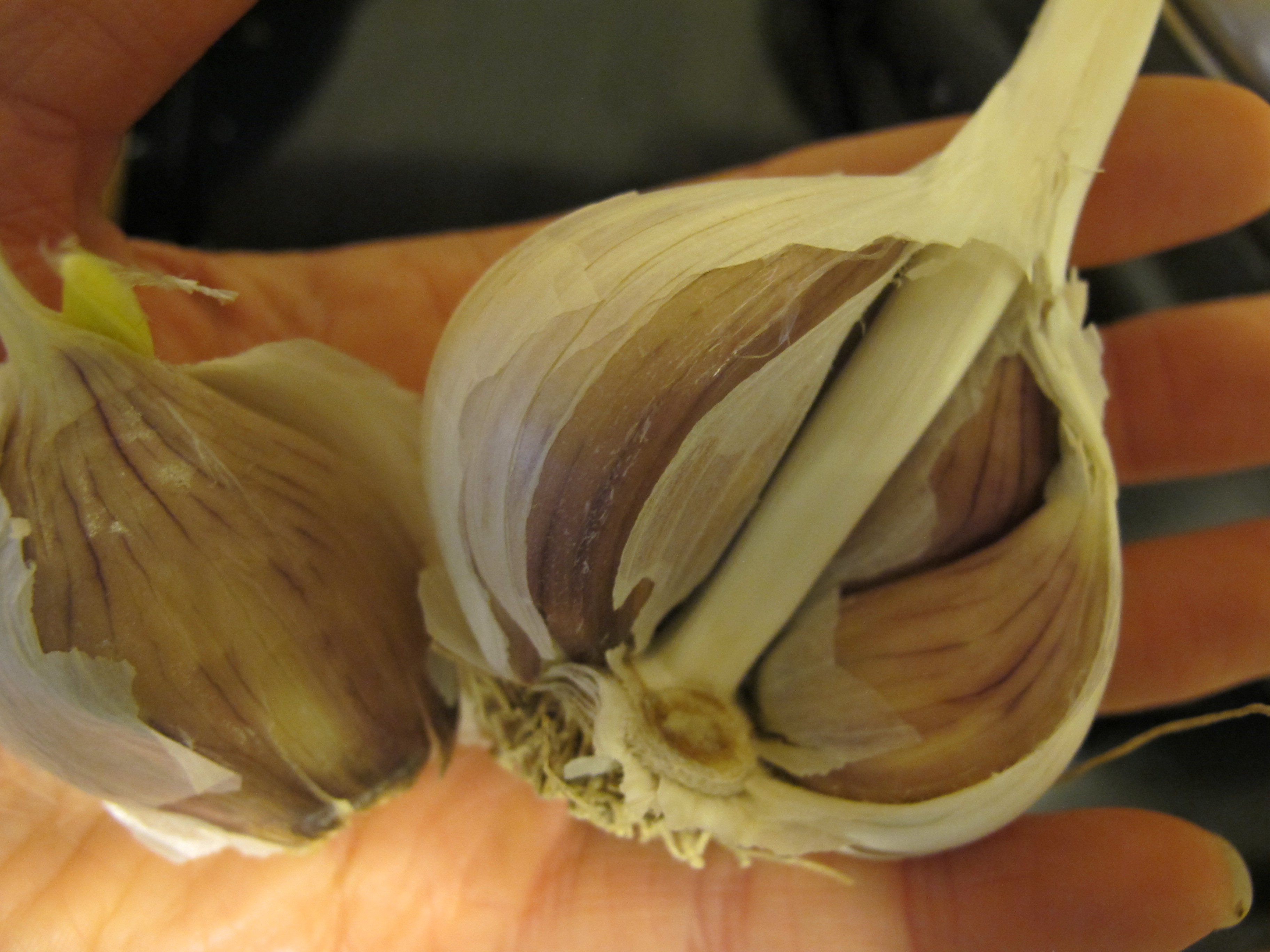
So, here we are in early March, with our last bulb of garlic (yes, our kitchen counter tops are, in fact, purple).

IMG_1524

A bulb in the hand . . .

IMG_1526

This guy started to sprout, but with four or five nice, still-firm cloves, I had no complaints.

After stretching things out as long as possible with a jar of minced garlic we received as a gift, it was time.

I used our last bulb of garlic in veggie fajitas on Thursday night.  In my effort to not overcook the garlic, it ended up a bit on the raw side — not ideal, but what can you do?

We currently have over 400 bulbs of garlic in the ground, waiting for harvest in June.  Though we’ll be saving some for planting next year, we may have enough to get to this point next year without supplementing.  Until then, I guess it’s back to the store for garlic.

Foodie Friday: Eating local in late winter

‘Tis the season for the annual, “What does a locavore eat in the winter?” post.  Quite a long list of things, actually.

We have our root cellared veggies: squash, sweet potatoes, and potatoes.  Then we have our canned tomatoes and tomato sauces, along with a small quantity of canned green beans.  Frozen garden goods include carrots, summer squash, eggplant, sweet (and hot!) peppers, beets, Swiss chard, kale, and sun dried tomatoes.  Oh, and let’s not forget the fresh carrots (from the low tunnels) and leeks (just out in the open) that we’re still harvesting!

We’ve supplemented our fresh and preserved produce with cruciferous veggies from farmers’ market: cabbage, broccoli, cauliflower, and some delicious Brussels’ sprouts.  Those items are on their way out though, so pickings will be a bit slim until spring.

We supplement the local food with onions and some store-bought frozen veggies, including peas and corn.

So, those are the raw ingredients in my kitchen.  Here are some recent creations:

  • Vegetable upside-down cake with our carrots, peppers, herbs, and garlic; local cauliflower; and frozen peas and corn
  • Farinata with carmelized onions and a side of roasted winter squash
  • Black bean soup with our sweet potatoes and peppers
  • Baked potatoes with tempeh and sides of canned green beans and roasted beets
  • Split pea soup with our carrots and potatoes
  • Masaman curry with local cauliflower, our carrots and potatoes, and frozen peas
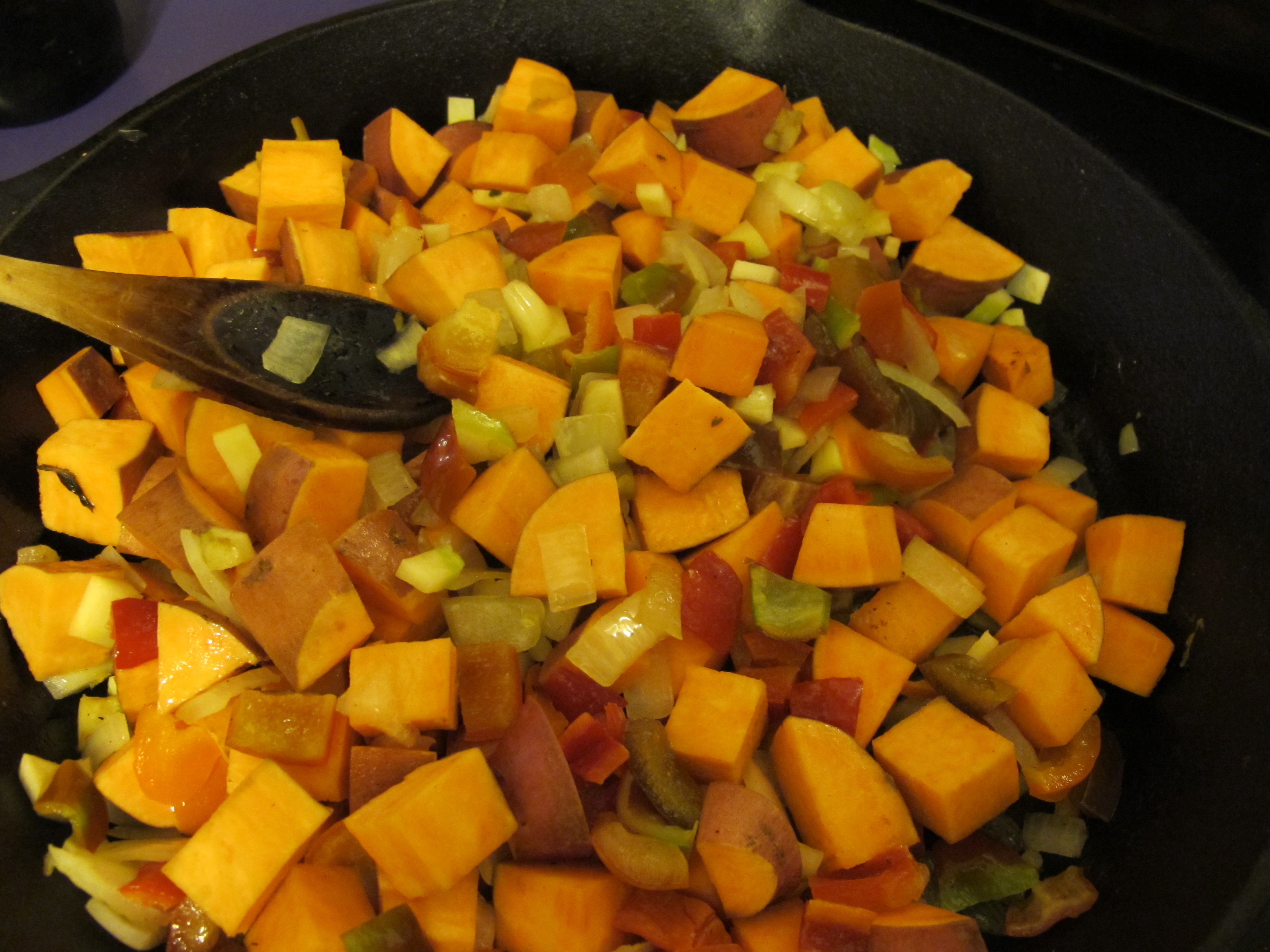
Sautéing veggies for black bean soup
Sauteing veggies for black bean soup

As I mentioned yesterday, I’ll be attending a vegetarian potluck tonight.  The theme is “colors of the rainbow.”  I’ll be making a winter squash dish or a roasted sweet potato dish — or perhaps both.  Any way you slice it, my color will be orange!

Browns’ Green Garden delivery service

Matthew has continued selling limited quantities of winter squash to Five Bistro throughout the winter.  For previous deliveries, he dropped by on his way home from the garden in the car.

For last week’s mid-week delivery, I loaded up the bike trailer, since we already had the produce at our place: fifteen pounds of squash and fifteen pounds of sweet potatoes.

IMG_1493[1]

A flatbed trailer would be much better suited to hauling cargo than the child trailer, but I manged to fit the produce AND a passenger.

IMG_1495[1]

With a squash on either side of him and sweet potatoes under his feet, Sir was a bit cozy on the way there (about 3 miles, I think), but he didn’t complain.  The delivery went smoothly and we visited a new park before heading home.

Here’s a recent menu item with our squash (in bold):

Benne‘sFarm half chicken,
Brown’s [Green] Garden buttercup pumpkin,
Ozark Forest oyster mushrooms,
Rissi Farm potato, braised napa cabbage,
bacon, grain mustard & pan jus

Fun to see our name on the menu (even if that’s not exactly the squash variety — I’m guessing they chose a simpler, more self-explanatory name for diners?)!

Amazingly enough, I’ve posted every. single. day. this week — pretty much a miracle.  The timing of this post is also amusing, given the inches of snow and ice currently covering our streets — I would not be attempting this delivery today unless I could get there on foot!

Using soil blocks to start seeds

Guest post by Matthew, AKA Farmer Brown
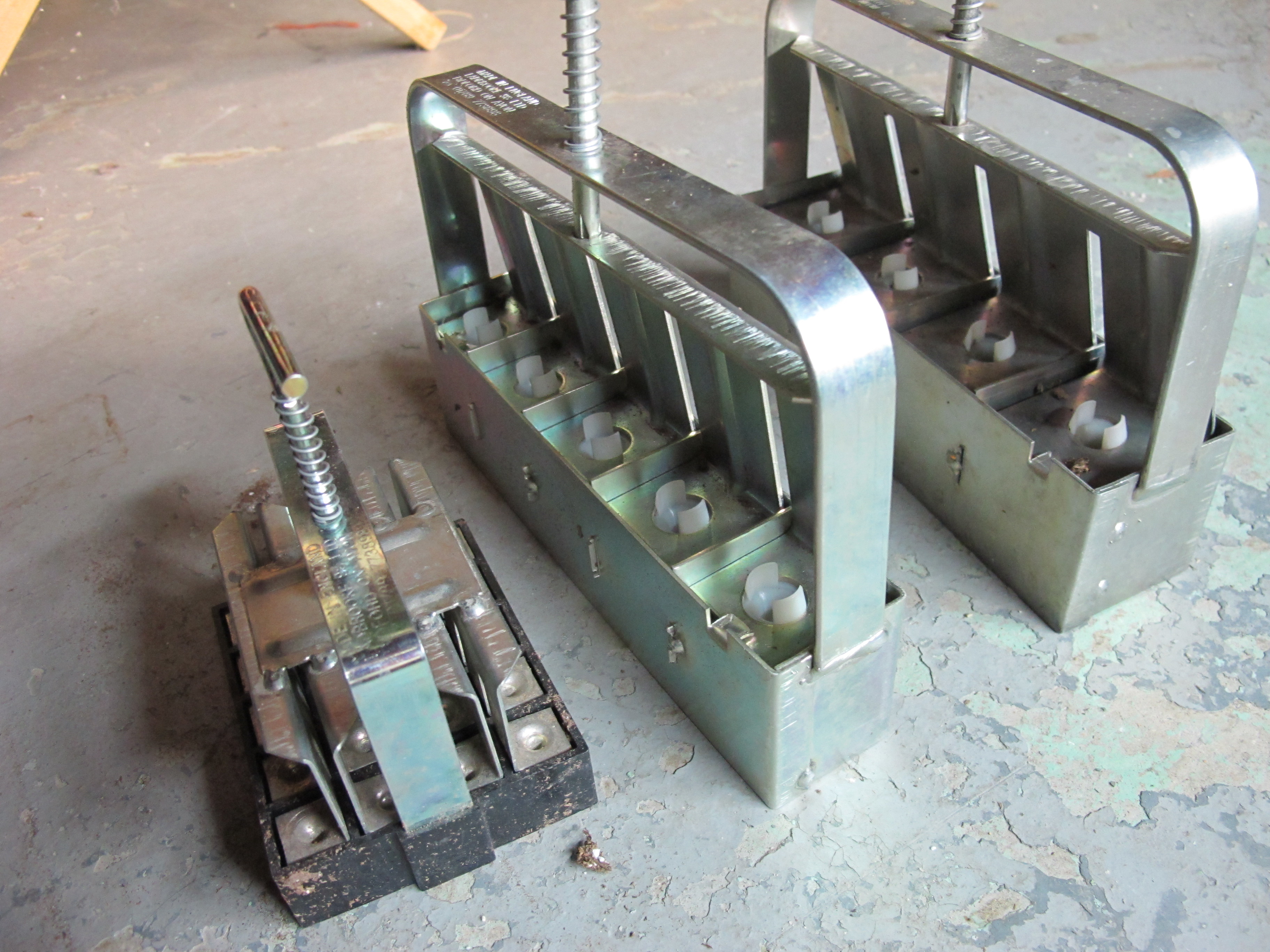
I’ve been using soil blocks to start seeds for the garden for a few years now.  I started with the affordable one that makes four 2”x 2” blocks, and later added the mini and a new five 1.5”x1.5” (after they decompress) blocker.
IMG_1437

I really like the 2” blocks, and I think the 1.5” one has potential, but I don’t think the mini is worth the bother, especially since my heating box space is not too precious, since I built it large enough for two flats at a time (three if I’m not worried about light).

Pros: Growing with soil blocks in trays leads to way less to sterilize than cell packs, plus easier to transplant and easier on roots than just growing in flats.  Also, despite reusing the cell packs, the flimsy plastic cracks after a few uses, so soil blocking = less plastic waste.

Cons: uses more soil than cell packs, because they require packed soil.

For seed starting soil, I’m currently using Pro-Mix, which comes in a compressed 3.8 cu ft block.  I’ve used a couple of other potting soils, and I’ve seen recipes for making your own.  I use this mostly because it’s affordable, and available easily near me, but I think most any general purpose seed starting/potting soil would work.  I’d prefer to make my own using coconut fiber instead of the peat, but practicalities of time lead me to compromises.

Materials
Soil blocker (a cookie cutter for soil)
Potting soil (bought or home-made)
Seeds
Flats (or trays) – sterilized with chlorine bleach solution if re-using and especially if found
A flat bottom container for the wet soil

IMG_1440

Using the soil blocker

1.       Moisten some soil the night before, with the goal of very wet but not soupy soil.

2.       Take the soil blocker and push down firmly into the soil.  I generally really pack it in.

3.       Twist the blocker right and left a bit to loosen the soil in the container from that in the blocker

4.       Tip the blocker slightly to release any liquid seal/suction and then pick it up

5.       Set it down on the tray and then

a.      Push down on both the blocker and the handle on the top of the blocker

b.      Gently allow the bottom half of the blocker to come upward as you keep pushing down on the handle

c.       Tip the blocker slightly to release suction

d.      Lift the blocker (leaving soil blocks behind)

e.      Repeat

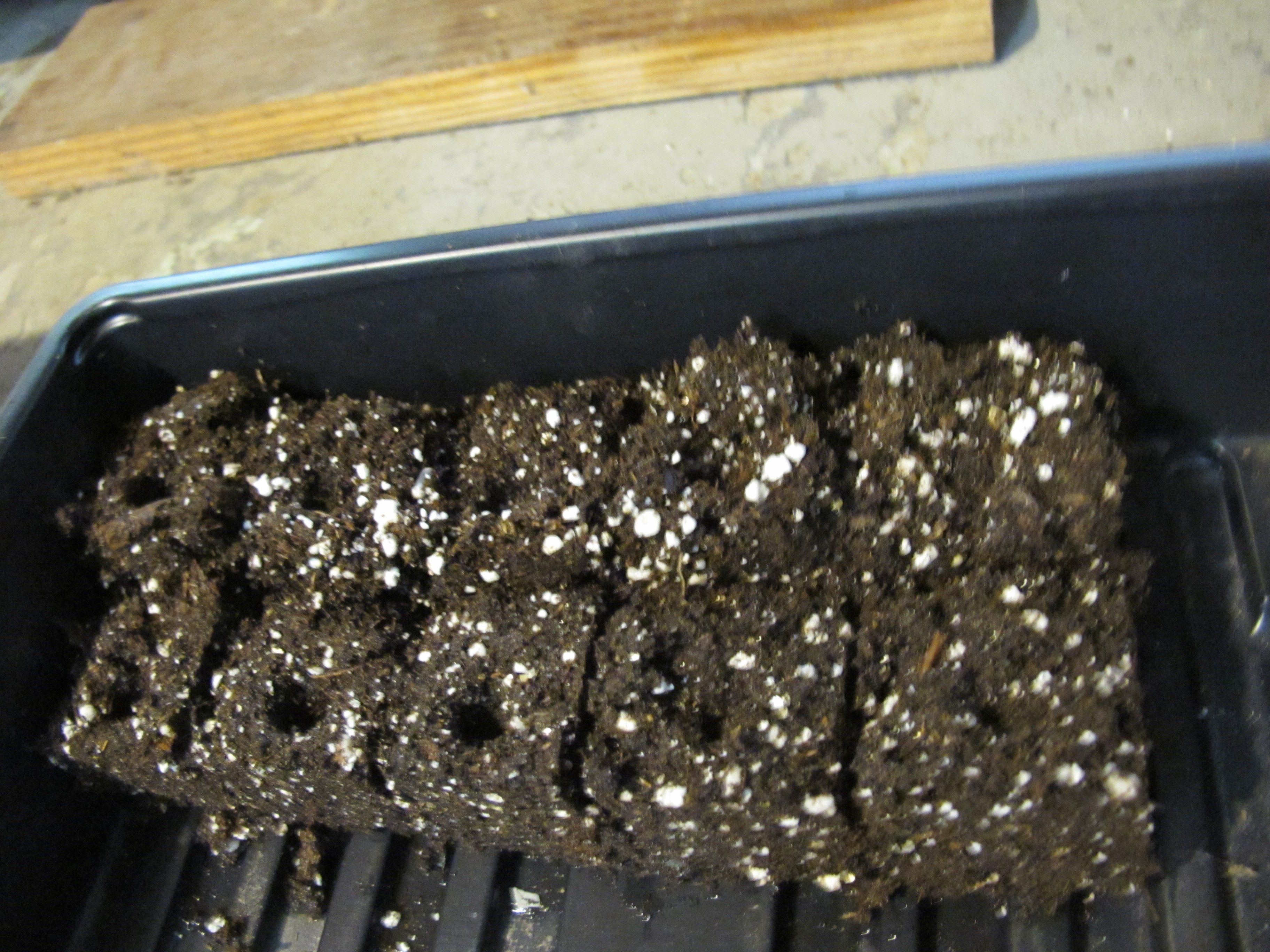
IMG_1441

This seems complicated, but it really is rather simple and fast once you have the hang of it.  I think it may be a bit faster, and is certainly more pleasant, than sterilizing cell packs for reuse.

Once I’ve completed a whole tray of soil blocks, I start seeding, either in the dimples, or on the surface depending on the seed.  I use a bit more of the moistened soil to fill the dimples and cover the seed (unless it’s something that needs light to germinate).

To Water:  I used to spray the blocks carefully with a mister, but now  I just use a watering can that gives a fairly gentle shower.  It does destroy the pretty, orderly look of the blocks, but they hold together enough that it’s still easy to separate the blocks for planting.

I do still grow onions in flats, and I grow my artichokes in cell packs so I can vernalize them, but for most of my other indoor seed starting soil blocks are my method of choice.