And so it begins

Free outdoor summer fun in St. Louis arrived last night with the first Wednesday night concert at the Botanical Garden.  One of the big perks of bike riding is attending events without having to worry too much about parking, traffic, etc.

Instead of rushing to get there early, we cooked a nice dinner (featuring local black beans and salsa so delicious that I could just eat it by the spoonful).  After a bit of digesting, we biked over to The Garden.

We arrived to find the bicycle racks full.  No worries, on to the Forbidden Light Posts.

Background: Until about a year ago, when The Garden finally installed decent bike parking, the bicycle rack was a classic fail: wheel bender style, not bolted to the ground, sitting in the middle of the parking lot with obvious signs that it had been hit by cars in the past.  Look my bike up there like a sitting duck?  No thanks.  Many other bikers obviously felt the same way; we preferred the safer and more secure alternative of locking our bikes to the light posts.  The Garden disapproved and sent their minions in golf carts to inform us about the “proper bike parking.”  Uh huh.  After several failed attempts to communicate like reasonable people and explain to security why their idea of bicycle parking was unacceptable (and several attempts to contact higher-ups at The Garden to discuss ideas for remedying the issue, which received no reply), we resorted to simply ignoring the security guards and going about the business of locking our bikes to the Forbidden Light Posts.

Whether it was through our civil disobedience, or the contact attempts, The Garden finally got the memo.  Since the installation, I have enjoyed the new bicycle accommodations on many occasions, but last night, with the “lot” full, we resorted to old patterns.  (This is not a complaint in any way — I love indications that lots of people are bicycling.  A full bike rack sends a powerful message!)  No one gave us trouble, which was good, because what would they have suggested?

We suggest doubling the amount of bicycle parking.  While  the current amount is more than enough (at least right now), for business as usual at The Garden, the bicycle parking will continue to fill to overflowing during special events.  For a relatively small investment of money and space (especially compared to car parking), they could accommodate all of the bicycles we saw last night, no light posts needed!

No Impact Man in the Lou

Colin Beaven, AKA No Impact Man, will be in St. Louis next Monday, June 7th to speak and sign copies of his book at the Schlafly branch of the Saint Louis Public Library (225 North Euclid Avenue, in the CWE) from 7:00pm – 8:30pm (event info here).

Though I admit I have yet to read his book, I’ve followed his adventures on his blog for awhile now, and I’m excited to hear him speak.  I just now requested the book from the library — with a bit of luck I’ll have it in my hands by Friday.

No cook couscous

I’m melting!  Or at least wilting — I do not like this heat one bit!  With almost a month until summer officially starts, we broke down and turned on the A/C before bed two nights ago (not green, but the reality of living in a brick oven).   GRRR!

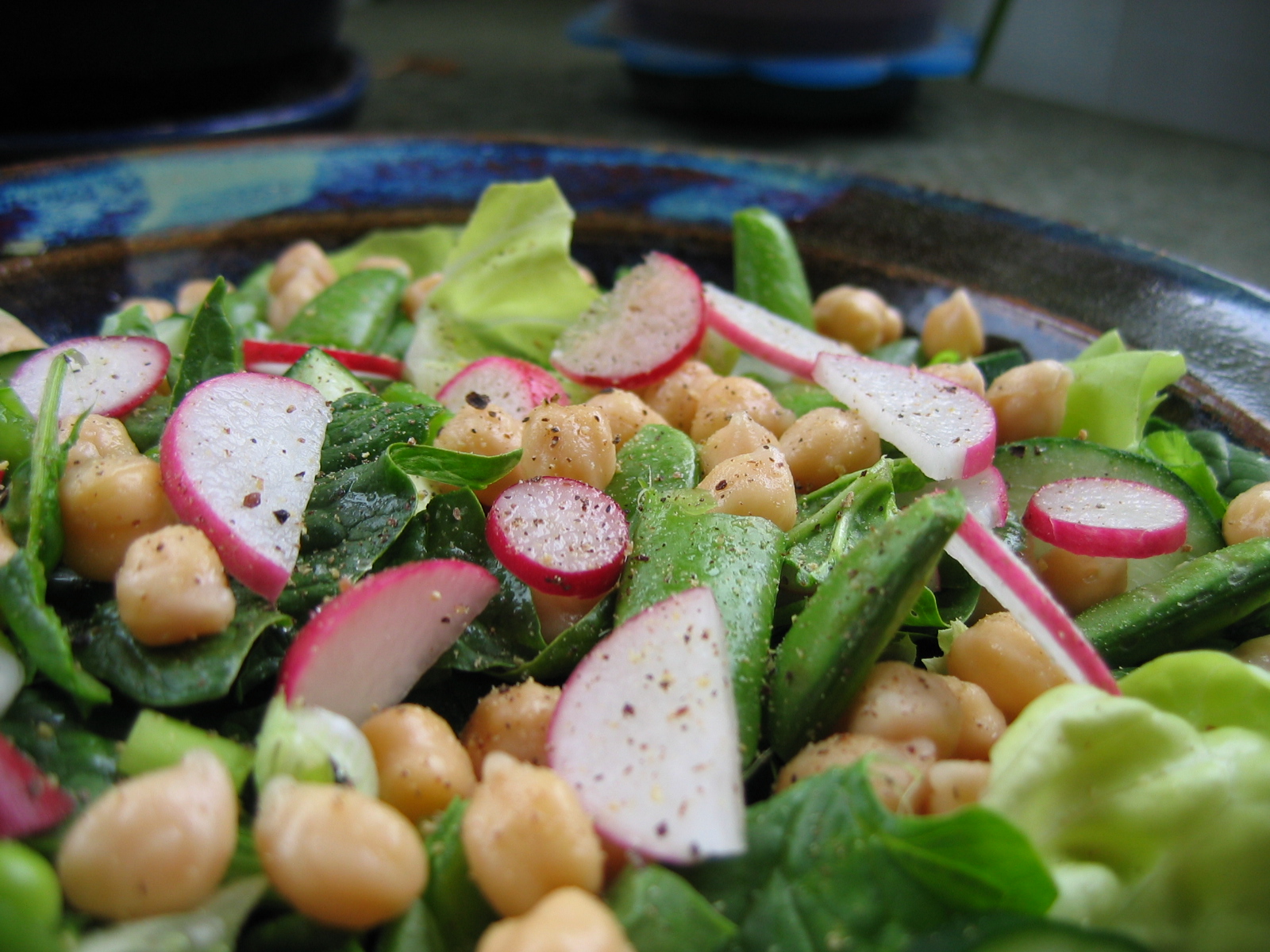
Mixed greens with radishes, sugar snap peas, garbanzo beans, onions, cucumbers, homemade vinaigrette, and sunflower seeds

With all this heat, ’tis the season for low- or no-cook meals.  Great big garden-fresh salads rounded out with a side of no cook couscous.  Couscous is technically a pasta, wheat-based and cut into tiny pieces.  Because the pieces are so small, you can “cook” couscous by simply adding the appropriate amount of water and waiting for it to absorb.  The golden ratio for couscous is 1 cup of grain to 1 1/2 cups of water.  I prepared a single serving: 1/4 cup dry grain + 3/8 cup water.  The couscous absorbed the water in about 15 minutes.  When the water was absorbed, I simply added a bit of olive oil and salt — one side of couscous, ready to go!

Notes:

  • Look for whole wheat couscous in bulk bins.
  • Couscous tastes great simply prepared, as suggested above.  Try adding chopped fresh herbs (parsley comes to mind) to spice it up a bit.
  • Couscous also works well as a grain base for vegetable stir fries.
  • I would never prepare a single serving of a grain that requires boiling (as most do), because it is much more efficient to cook multiple portions at once.  However, with the no-cook method, it doesn’t really matter, since it requires no energy.

Backpacks, racks, and panniers, oh my!

Recent question from reader Rebecca: “At the moment I’m using a backback, but it has limited capacity. So I’m wondering what you do… baskets? panniers? racks? I’d love any advice on that subject.”

Great question.  I used to be a backpack gal, too.

At first, I carried a regular back pack, plus a small gym bag.  I found that carrying two bags was awkward (and sometimes unsafe), so I switched to the internal frame backpack pictured above (yes, I’m in the picture too, hiding behind the pack).  With a volume of 50.5 L (3082 cubic inches), this pack easily handled everything I needed most days, and, with the waist belt and suspension system, felt pretty comfortable, even fully loaded, when riding my hybrid.

Once I switched to a road-style bike, with the bent-over riding position, the huge pack was a) more awkward and less comfortable and b) somewhat dangerous — when I turned to look over my shoulder, I couldn’t really see the road behind me — not good!

I took the plunge and bought a rear rack and panniers.

With a total volume (for the pair) of 20 L (1220 cubic inches), the panniers (Cartier by Axiom) provide much less space than my pack.  Although they come with a detachable over-the-shoulder carrying strap, it is not very comfortable, making these panniers great while on the bike, but not so good when you want to take them off and carry them around.  I hesitate to leave them on the bike, even when empty, because they’re not cheap.    For some errands, I need more volume (or a different configuration) than these provide.

I experimented with adding a milk crate (which is what my husband uses).

I like the milk crate because I can use whatever bag I want — just toss it in the crate.  With the milk crate and panniers, I have lots of carrying capacity, although the panniers are a bit difficult to access and pretty much impossible to remove while the crate is attached (which is good from a theft perspective, not so good when I want to remove them quickly).  For now, I just use bungee cords to secure the crate when I want extra space, but my hubby uses zip ties for a more permanent attachment (just make sure to carry a couple extra, as zip ties eventually wear out and snap).

Cool green tip: Over the weekend, I heard about people using cat litter buckets as make-your-own panniers (see here and here).  I wish I knew about this innovative reuse solution before I sunk $100 into my panniers.