Winterizing the sun porch

After a morning trip to the Botanical Garden, we spent a good chunk of Sunday afternoon winterizing our sun porch.

When we found this apartment, we were really excited about the south-facing sun porch, since it would get lots of sun (and solar heat) in the winter, meaning we could leave a lot of our potted plants out there instead of crowding them inside with us.  And while the porch did get fairly cozy last winter (except on the cloudy days), the heat dissipated all too quickly once the sun went down, leaving our plants vulnerable to freezing temperatures.

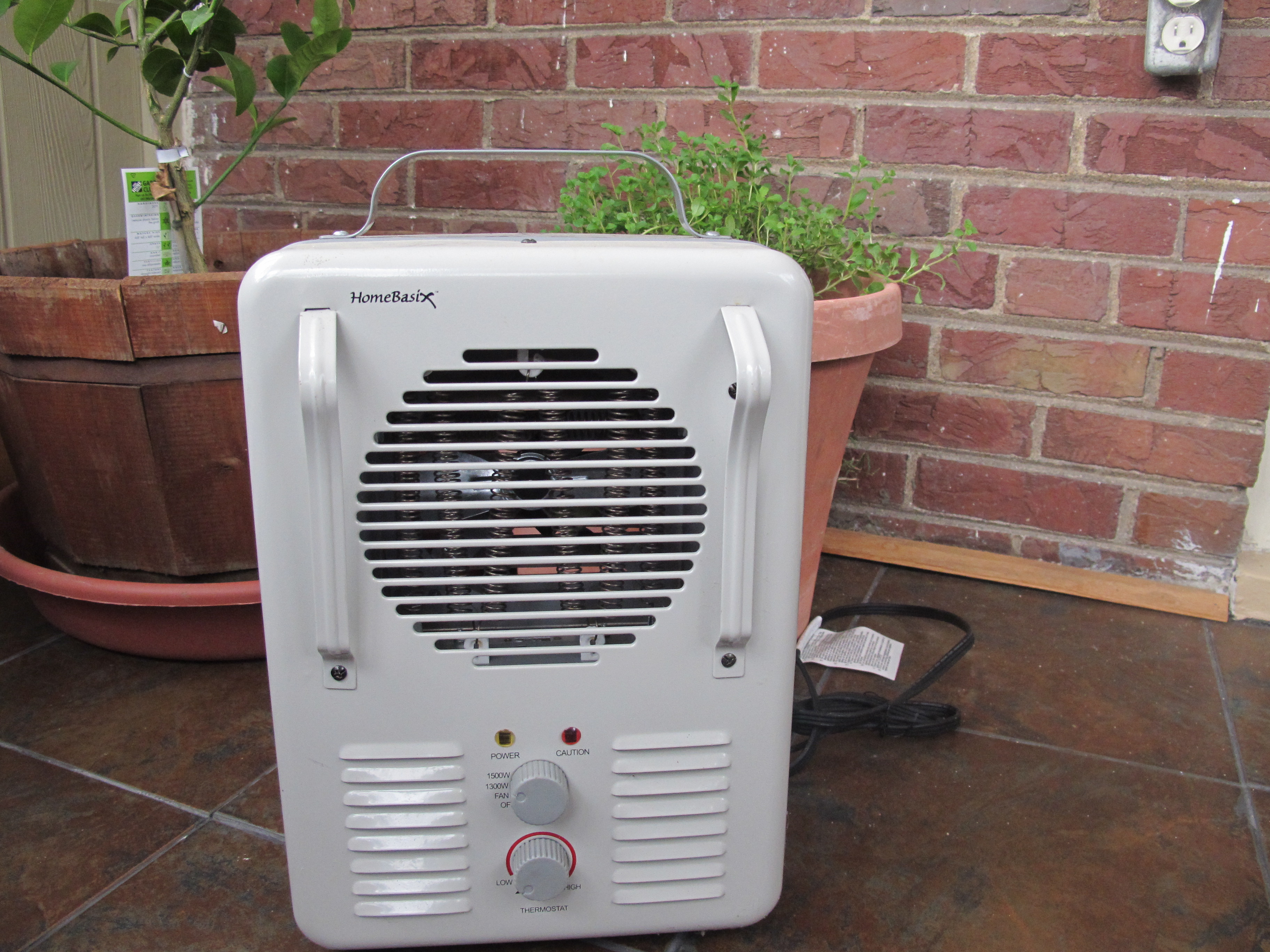
Our first step was to buy a small space heater.  It’s a milk house heater, and it has a setting where it will only kick on when the temperature dips below 32°F (this feature is not perfectly reliable, but it worked alright last year).
IMG_3295

We realized that even on the lowest, “prevent freeze” setting, this thing was going to be running all. the. time. on our drafty, uninsulated porch.  So at some point in the middle of last winter, we bought one of those window plastic kits in an effort to seal things.

It really made a difference in how much heat the porch retained, especially on windy days.  When spring arrived, we peeled off the plastic and realized it was in good enough shape that we could probably fold it up and reuse it.

The double-sided tape, however, definitely needed to be replaced.  The big box home improvement store we visited only sold the entire kit (which meant new plastic that we didn’t need), but we found a small hardware store that sold just the double-sided tape.  Of course buying the tape alone cost more than buying the kit — argh!

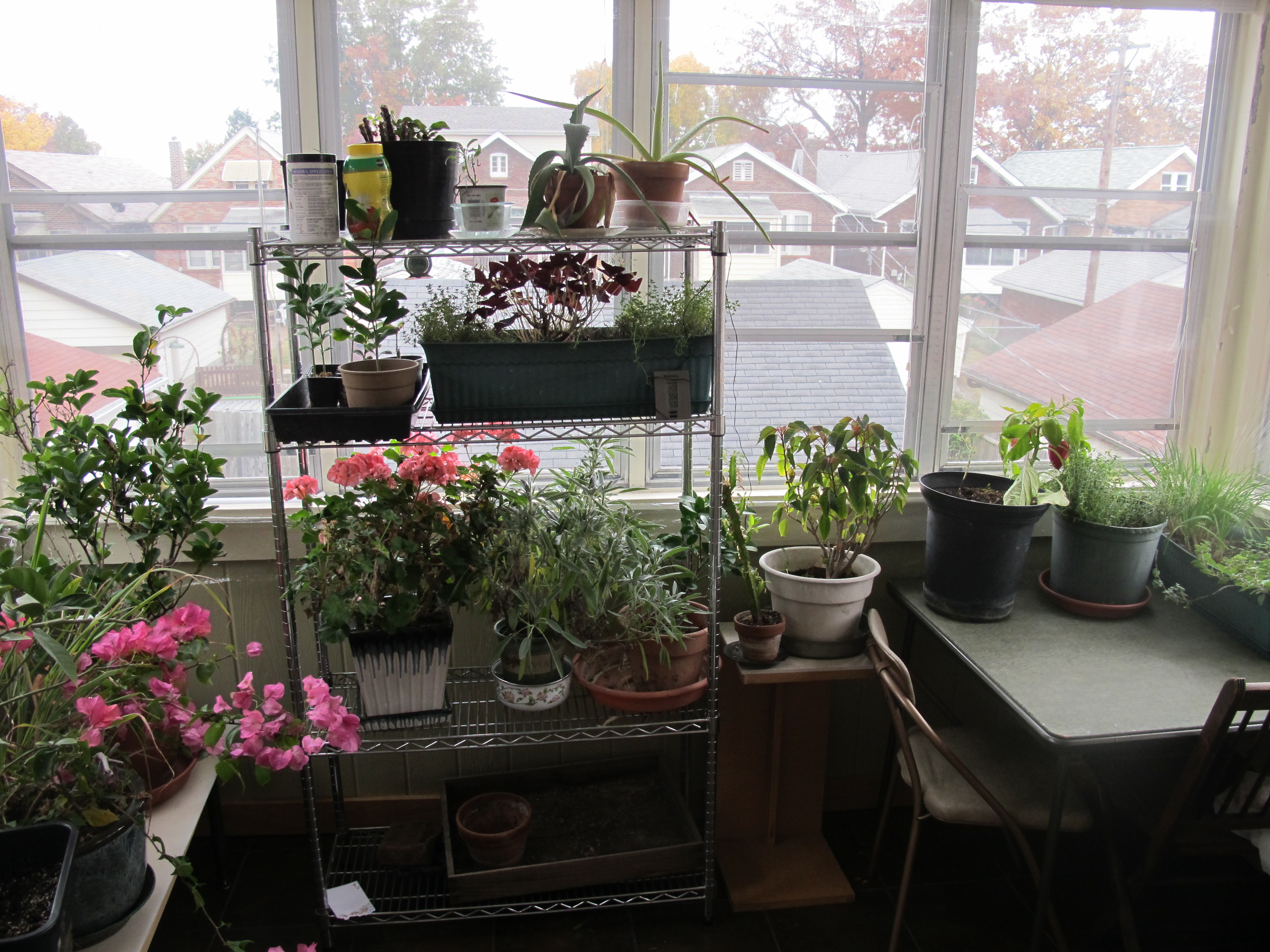
In the end, we had enough tape leftover from the two kits last year, and our reused plastic sheets worked quite well.  We rearranged the tables and shelves to maximize sun exposure and cleaned up a bit, while we were at it.
IMG_3292

You can’t really see the plastic in the photograph, but it’s there.  This arrangement leaves enough space at the table for me, so I can spend some time out there on the warmer days.  We got this up just in time for the cold weather tomorrow.

On the one hand, it seems a little crazy putting the various resources (our time, electricity, plastic and other materials) into keeping some potted plants alive, but the fact that a number of them are edible (herbs, lemon and key lime trees) justifies our efforts a bit, and it really is a lovely space now.  With the exception of very cold, cloudy days, the heater will only run at night, and perhaps not every night, depending on the severity of our winter.

Psst, psst: Deceived by EC

I last wrote about our “Elimination Communication journey” in November 2012.  We’ve made huge progress in the nine intervening months, which I want to share, but I also became thoroughly disillusioned by the promises made in the Elimination Communication (EC) literature, which feature anecdotes from the very rare (at least in the United States) families that achieve freedom from diapers before or very shortly after the one-year-of-age mark.

The EC literature creates unrealistic expectations, especially in the cultural context of the United States, where EC practice is very rare, and where many infants spend time in daycare facilities where pee and poop free-for-alls from undiapered bottoms would create serious sanitation and health problems, and where caregivers do not possibly have the time to put each and every baby on the potty every time the infant might be showing some need.

After thirteen months of largely wasted time and effort, followed by five months of one step forward, two steps back, I was coming to this realization for myself this past February, when I read the chapter on “natural parenting” in Jessica Valenti’s Why Have Kids?

She raised good questions and provided this thought-provoking critique of EC:

. . . EC also represents the white middle-class phenomenon of fetishizing a largely imaginary “third world” motherhood that’s supposedly more pure and natural than Western parenting practices.  A common refrain from EC advocates, for example, is that mothers in India or Africa don’t use or need diapers.  Never mind that there isn’t a monolithic “Indian” or “African” parenting experience (or that Africa isn’t a country), or that the mothers they’re referring to could be very happy to have diapers, were they available.  It’s easy to appropriate a condescending fixation on “underdeveloped” motherhood when you have the financial means and leisure time to pick whatever kind of parenting works for you at the moment.  This clueless racism is captured perfectly on Krista Cornish Scott’s website, where she assures readers that “EC is not just for African bush-women” (p. 20-21).

I wanted to laugh and cry at the same time as I read that chapter.  If I had actually owned any EC books (I checked them out from the library, of course), I might have planned a book burning.

Unfortunately, my epiphany came too late, long after I’d been sucked into the myth of a diaper-free baby.

Looking back on my EC experience
Feeling frustrated (with yourself and your baby) and discouraged with every wet diaper, like you must be doing something wrong, is not a healthy or fulfilling introduction to motherhood.

Between the normal first-year-with-a-baby, sleep deprived, what-the-hell-am-I-doing haze, plus my postpartum depression haze, I failed to recognize this for many, many months.  Many months when I could, and should, have been enjoying a cute little [cloth] diapered baby butt.  Though I don’t dwell on it, I resent the extra strain and stress I put  on myself (and Matthew), as well as the normal, cuddling with a tiny baby time that I lost to potty efforts and naked-baby-on-the-floor time.

If I had a do-over . . .
I would not even attempt to take my baby anywhere near a potty until at least six months.  Even that is probably crazy early.

For Sir, things really clicked shortly after he began walking and was able to get on and off the [little] potty by himself.  This age will differ for every infant, of course, but in Sir’s case, the walking happened at about 12 1/2 months, with the independent on and off the potty about a month later (this is not to say that he was “diaper-free” at this point).

While there’s no way to know for sure, I have a strong suspicion that the “potty work” and any small progress we made during the first thirteen months of Sir’s life could have been condensed into a single month when he was thirteen- or fourteen-months-old.

One month of effort vs. thirteen months of effort — which would you choose?

I’ve concluded (though again, every child is unique) that there is probably middle ground between the very early potty learning espoused by EC advocates and the much-later, don’t even think about it until the child is at least two-years-old position held by most Western child-rearing “experts.”

I’ll share more about that in an upcoming post on our experience with potty learning from months fourteen through twenty-four, by which point we were diaper-free except for naps and overnights.

An Earth Day reminder

With most places having Earth Day celebrations over the weekend, I lost track of the fact that today, April 22, is officially Earth Day.

As perhaps a little reminder from the universe to not take natural resources for granted, I turned on the kitchen faucet this afternoon to just a tiny little trickle of water that quickly faded to nothing.

With dinnertime fast approaching, I grabbed some leftover bean cooking liquid to cook the lentils and set to chopping veggies.  Over the next hour, I probably attempted to use the sink no less than ten times — to wash hands, rinse off a dish — you name it, it felt like every time I turned around I needed water for something, and I just couldn’t get it through my head that turning the faucet was not going to yield water.

I’ve had this same experience when we’ve had power outages — go into a room and flip a light switch, just expecting the light to turn on as usual, but, nothing.

Clean, running water, power at the flip of a switch — so many things that I take for granted on a daily basis . . . .

Ironically enough, we ended up buying bottled water on Earth Day.  My MIL swung by the store and grabbed a few gallons for us on her way to drop off Gabriel.

With no warning on the outage or obvious cause, I was prepared to be without running water until morning at least.  Instead, it felt like no sooner had I popped the top on the gallon of water and poured glasses for dinner, whoosh, we had water from the tap again!

It’s hard when we live in a country that has seemingly plentiful resources, but every now and then, we are reminded to be grateful, and, perhaps, to renew our attempts to use those resources carefully, in a manner that sustains the planet we all share.

Expanding our fleet

After saying for years that he could really use a back-up bike — something to ride when his usual bike is in the shop for repairs — Matthew began hunting in earnest this spring, trolling Craigslist and visiting some local bike shops to test ride different styles of bikes.

He found and test-rode a [Craigslist-ed] Surly Pacer  at about the same time he visited a local shop where he tried three bikes: a Salsa Casserole (yes, that is seriously a brand and model of bicycle, not a TexMex dish) and the Kona Ute (a longtail — be still my beating heart!) and MinUte.

While he liked the Konas (more on this below), he narrowed it down to the Salsa and Surly Pacer, which were fairly similar: both sturdy road bikes that would take a rear cargo rack and should hold up well for daily riding.  In addition to the ecological benefits of choosing a used bicycle, there are also significant cost savings.  After researching to make sure the Surly could be adapted to his needs (i.e., would take fenders and that rear rack), he opted for the used bike route.*

Actually setting it up with fenders and a rack was, of course, easier said than done.  In the end, it involved an extra bike shop visit, a new, narrower rear tire and drilling a couple of holes in the rear fender.

Late last week, it was finally road worthy, and not a moment too soon, as Matthew was starting to get buyer’s remorse, wondering if he should have gone with the ease and peace-of-mind of a new bike.  He’s still adjusting to the road bike position (his other bike is a hybrid, with a very upright riding position), but so far, so good, I think.

Now, to my favorite subject — the longtails.  He didn’t go into the bike shop intending to try a longtail, but when the Kona Ute presented itself, he took it for a spin.  He was impressed with the overall handling, and the fact that we could get a frame that would fit both of us is certainly attractive.

Unless we want to solely use the trailer for Gabriel (which I don’t), we’ll need some other option, as he probably will outgrow the IBert [front seat] before summer’s end.  While we could just attach a rear seat to one of our current bikes, it would mean sacrificing our rear cargo room, not a practical option when using a bike for transportation.  A longtail bike provides plenty of room for a little passenger and his (and your) stuff, not to mention groceries, towing other bikes   . . . the options are endless!

Given the rarity of longtail bikes in these parts, this will almost certainly be a new purchase.  We’ve narrowed it down to the Kona Ute (which I need to get into the shop and ride) and the Yuba Mundo.  None of our local bike shops carry the Mundo (the closest is in Columbia, MO), but fortunately, we ran into a family who is willing to let us test ride theirs.

I’m still not sure that we’ll end up going the longtail route, but I’m very excited about the possibility!

*For a nice guide on buying a Craigslist bike, check out this post from S. over at Simply Bike.

Multimodal transportation

This morning I had an interview in downtown St. Louis.  While many people who live in the surrounding suburbs seem to consider anything vaguely within city limits to be “downtown,” when I say downtown, I mean “within a few blocks of the Arch,” just so we’re clear.

Anyway, downtown St. Louis is a decent little hike from our place in south city — I estimated at least an hour each way by bike.  Given the time constraints with childcare, and the fact that I was not familiar with the destination building, in terms of facilities for making sure I was interview-presentable (nothing fancy needed, at least at this time of year,  but a restroom to duck into surreptitiously to give things a once-over/make last minute adjustments to assure at least a semi-professional appearance is always helpful), I more-or-less resigned myself to driving.  But the bike bug was still there in my head, saying, “Maybe .  .  .”

When Matthew decided to use a vacation day to take advantage of the amazing weather and get the garden started, planning to take Sir with him, the childcare situation changed, and I was no longer in a time crunch.

Further, if I took the car to my interview, Matthew’s trip to the garden would have involved his mom driving in to pick him up, and either my going out at the end of the day to get them, or her making another trip in at the end of the day.  My biking and freeing up the car for him to use would eliminate twenty-plus unnecessary car miles.

The last thing to overcome was my trepidation at making [what I was guessing to be] a ten-mile one-way trip, when most of my recent bike trips have maxed out at less than ten miles round trip.

The solution?  A bit of creative thinking, and a multimodal trip that involved car with bike rack, MetroLink (StL light rail system), walking, and biking before all was said and done.

Before heading to the garden, Matthew needed to swing by our old stomping grounds, the Salus Center, to pick up the seed potatoes he ordered, a stop that would take him very near the Grand MetroLink stop.  The MetroLink, would, in turn, take me within eight short blocks of my final destination, a distance that I could easily walk or bike.  For the return trip, I had the option of biking the entire distance, or once again taking MetroLink part way.

I chose the latter, disembarking with my bike at the Grand stop, and thoroughly enjoying the 5.7 bicycle miles on this crisp, sunny day.  Turns out riding the entire way would have clocked in at just under 9 miles, so I still rode a good chunk of the way, which increases my confidence for future trips downtown.