O Christmas Tree

Well, I’ve finally recovered from Thanksgiving (let’s just say our travels were a little stressful), which is a good thing, since Christmas is now upon us.  Unlike last year, when I was quite “blah” about the festivities, I’ve really been looking forward to them this year.

Maybe it helps that we have a bigger apartment, one without a queen-size bed in the living room, which gives us space for a tree and a few decorations.  We also have a mantle where we can hang our stockings.

When we moved here in June, I noticed a few items tucked under the basement stairs in a storage area, left by previous tenants long gone.  It smelled musty and looked dark and spidery, so I didn’t investigate too closely, but I noticed an artificial Christmas tree.  I assumed it was more or less junk, but you never know, so early last week, I braved the spiders and dust, and pulled out the box.

My efforts were rewarded with a simple 6-foot tree that was probably used once before, quite clean and in great condition, complete with a string of lights.  I set it outside to air out for a day anyway, and set about the more difficult task, convincing Matthew that this once, just this one year, it would be okay to have an artificial tree instead of a real tree, and it would save us the time and effort of hunting down a real tree* and the constant sweeping up of pine needles.  And heck, compared to last year, when we didn’t have a tree at all, this marked a real upgrade.

We agreed to use my found tree, and, with that decided, we spent Sunday making our apartment nice and festive.

IMG_0989

I have some fabric somewhere that will make a decent little tree skirt.  All of the ornaments on the bottom branches are made of wood or fabric, safe for curious little hands.  So far, Gabriel is nonplussed by the tree; unless we’re over by it, he more or less leaves it alone, which is fine by me.

Environmental-impact wise, both artificial and real trees have their downsides.  Finding a used artificial tree (whether that’s one that just happens to turn up in your basement, or one from Craigslist or a garage sale) certainly reduces the impact, but there are other options.  Instead of having an official Christmas tree, my MIL is decorating the fruit trees in her front yard, as well as her houseplants for indoor decorations.   While Christmas trees are a well-rooted tradition, there are plenty of ways to create a festive holiday space without a tree.

*While there are a number of tree lots in town, as well as cut-your-own tree farms nearby, most conventionally grown Christmas trees are sprayed with chemicals that I don’t want in my house.  In years past, Matthew went out to his grandparents’ and cut down a small field tree (i.e., a tree growing in an unmowed field where it would eventually be cut down anyway).

Psst, psst: EC at 16 months

Well, it’s been almost ten months since I wrote an official Elimination Communication (EC) update, though I wrote a summary in April and mentioned it briefly in August.

So, after more or less giving it up as a lost cause for a couple of months over the summer, I resumed the EC journey in August, when I became a temporary (?) SAHM.  I felt we were making enough progress that I made room for the little blue potty in our checked luggage when we traveled to Portland in early September.

However, we chose to use disposable diapers on the trip, and I despaired of any EC progress under those conditions.  Surprisingly, it almost seemed that he was MORE reluctant to wet the disposable diapers than the usual cloth.  On the occasions where we did some day trips from Portland in the car, we would often stop to find the diaper dry and a fussing baby very relieved to pee.

Since then, Gabriel figured out how to climb on the potty by himself, which seems like a big step to me.  Up until last Thursday, there was a lot of unproductive climbing on and off.  Then, he peed in the potty completely by himself (I was in another room) twice in one afternoon, though that feat has yet to be repeated.

He still lacks a consistent way to let us know he needs to use the potty.  One semi-consistent signal (that we do not want to encourage) is coming up and biting us, but even this is confusing, because he also uses it as a general “I want attention” signal.

I’m cautiously optimistic about our progress, though we clearly have a long way until we’re “diaper free.”  I still have my doubts about the usefulness of the work we put into EC in the early months (and hence, the whole method, really) — the subject could use better information about when it really makes sense to start putting time and energy into potty learning.

Past EC Posts
Baby steps
Psst, psst: Thoughts on EC so far
Psst, psst: EC at six months

An ode to my spatula

I don’t like waste, and wasting food, particularly very good food, ranks quite high on my list of things to avoid.  In some cultures, licking one’s plate is acceptable (or even expected) — in that sense, the privacy of our apartment is perhaps its own little subculture.

Licking your plate avoids food waste and ensures that you get every last bit of goodness, plus, you can put the plate straight into the dishwasher, no rinsing required (saving water), or set the dish aside to be reused.  But what about those pesky mugs and bowls where you can’t reach the bottom?

Enter the spatula.

Most any spatula will do, but a few years ago, I discovered the perfect implement at our local Italian grocer — a spoon-sized spatula with a silicone head and a wooden handle.  What started as a sometimes-used item quickly became an essential part of my place setting.

Eventually, I bought a second one to keep at my desk at work, and I often tuck one into my bag if I’ll be eating when out and about.  The spatula accompanied me to Portland, as well.  I still feel the need to use it discretely, but, where I would not lick my bowl in the lunchroom at work, I used my spatula with only minimal hesitation.  I believe I have yet to actually use the spatula in a restaurant, but that may only be because we don’t eat out all that often.

The spatula’s usefulness is not limited to the end of the meal.  You can use it throughout the meal to keep the sides of your dish clean — if you wait until the end of the meal to bust out the spatula, you’ll probably have you cooled, dried food that is impossible to remove.  Using the spatula as you go eliminates that problem.

While it may not be incorporated into dining etiquette books anytime soon, my place setting is incomplete without this useful, practical tool.

Do you go to great lengths to clean your plate or otherwise avoid food waste?  Please share your tips and ideas in the comments.

New to us: Shopping Craigslist and garage sales

I grew up with garage sales being a fairly regular Saturday morning activity, but it’s something that’s seldom been part of my adult life.  If I wanted to spend my weekends driving all over the metro area, I’m sure I could score a few good bargains, but if I’m in search of a specific item, it’s easier to turn to Craigslist.

I also strive to limit driving with Craigslist (CL) hunts, usually only looking at ads that list a location within five miles (or a bit more if it’s in a direction that I would be headed by car anyway, like near my MIL’s).  Biking to CL pickups is ideal, of course.

I found myself in just such a situation when I responded to an ad for a booster seat in “South City.”  The term encompasses a rather wide area, so I was delighted to find that the seller lived in my neighborhood, just seven blocks away.  Better yet, when I arrived to pick up the seat, she let me do some early shopping from her selection of toddler boy clothes that she was preparing for the neighborhood garage sale, so, for a very good price, and very little effort on my part, I took care of most of Gabriel’s winter clothing needs.

As an added bonus, I met another mom in the neighborhood, who we’ve since run into at the playground a couple of times, and who offered to contact me as her 4-year-old son continues to outgrow clothes.

While I prefer new to used in almost all areas anyway, used kids’ pajamas are particularly good in my book, since they likely have lower amounts of potentially toxic fire-retardant chemicals remaining.*  As an added bonus, somebody looks absolutely adorable in his “new” footie pajamas, and I rest easier knowing they’ve been through a number of wash cycles.

NOT spontaneously combustible, but possibly in danger of death by cuddles

Though I wasn’t initially planning on it, I took the time to check out some of the neighborhood garage sales that weekend (it was an organized event with over 30 sales on one Saturday).  Instead of lots of driving and in and out of the car, I spent a couple of lovely hours on a fall morning biking around my neighborhood.  For less than $15, I picked up five DVDs, a nice baby gate, and a couple of new toys for little Pookie.

I didn’t find anything that I was REALLY looking for (e.g., nice shoes for Gabriel, a coat rack for our front stairs), and it was money that I would not have spent if I hadn’t gone out, so I think it’s for that best that my garage sale-ing is self-limited.

*”Chemicals used in sleepwear labeled ‘fire resistant’ will remain in the fabric for at least 50 washes.”  Source here — see bottom of page for specifics on pajamas.  It’s not like mattresses or sofas or babies sleeping sweetly in their pajamas are prone to spontaneously bursting into flames.  It’s disgusting that the widespread use of TOXIC fire-retardant chemicals was introduced primarily as a precaution for fires started from another chemical nightmare — cigarettes.

Do you like piña coladas and getting caught in the rain?

And you probably like chocolate, if you have half a brain . . .

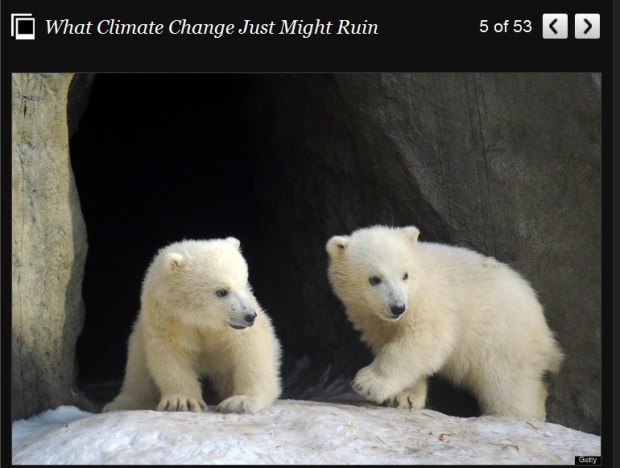
How about beaches, wine, peanut butter, beer, cute baby polar bears?

No, this is not a personal ad, but my half-hearted attempt to inject a bit of humor into a sobering topic.

Source: Huffington Post slide show

I just finished watching this slide show about what we (or future generations) may lose due to climate change.

Worth a look and then some action, taking steps to make our own lives more sustainable, but also speaking up: vote for elected officials with proven records of taking serious steps for sustainability; contact those politicians when important bills are on the table; contact businesses (big and small) who are not working toward a sustainable future and boycott their products.

Source: Huffington Post slide show

True, that in order to live more sustainably and save some of these things, we may need to consume less of them and buy varieties that are produced more responsibly, but that’s a fair trade when the alternative may be living in a world without [insert whatever motivates you here].