Catching my breath

Last week was a bit of a bear.  A jury summons coincided with a couple of big deadlines at work.  I managed to complete most of the work tasks over the [previous] weekend — which was good, but also left me rather drained at the beginning of the week.

I cooled my heels for two days in the jury gathering room, part of this debacle; they had far more jurors than expected, leading to some interesting times on Monday morning.  They never called my number, and I was released late on Tuesday afternoon.

Instead of spending Wednesday addressing my growing paid-work and housework lists, I was home with sick Sir.  Thank goodness he’s not sick much (knock on wood), because he transforms from a sometimes-challenging, but usually pretty easygoing and low-key kid to an ab. so. lute. bear when he’s sick.  From Wednesday through Friday, it felt like we just moved from one meltdown to another, with some snotty-nose-wiping in between.

His antics had me alternating from annoyance to unable to suppress my laughter at the absurdity.  On Thursday, I told him we had time to listen to two songs before his nap.  After the second song, he started requesting the third track on the CD, “Jimmy Cracked Corn.”  I told him we would listen to that after nap; he disagreed and collapsed to his knees, sobbing “Jimmy Cra Cor” over and over again, while bouncing up and down with snot and tears streaming down his face.  I was torn between trying to comfort him (and get him down for an obviously much-needed nap) and getting out the video camera (I chose the former).

Earlier that morning, he had a breakdown when Matthew left for work.  Gabriel didn’t get to the window in time to blow him a kiss, and that was all it took.  It started out sweet that he really wanted to blow Daddy a kiss, but after several minutes of inconsolable crying, the sweetness lost it shine, replaced by eye rolling and mutters of, “Good Lord, child!”

There were some okay moments, too, but by the time my MIL arrived to pick him up late Friday afternoon, I was beyond exhausted (turns out I was getting sick, too) and close to the end of my rope.  Gabriel had Baba time for the next 24-hours, and we managed to salvage Valentine’s Day and transition to a fairly nice, if low-key and still sick, weekend.

I’m looking forward to a more normal week and returned health for all of us!

Smells fishy . . . and I’m eating it

I’ve been toying with the idea of adding sardines to my diet for a few years now.  While I was pregnant, I took a fish oil supplement for omega-3s.  I decided I wanted to try some kind of fish-based source of omega-3s again.  A bit of research showed that you get more benefits from eating actual fish than from taking fish oil supplements – not surprising, as this is true of many nutrients: better from real food than from a pill.  So I decided to take the plunge.

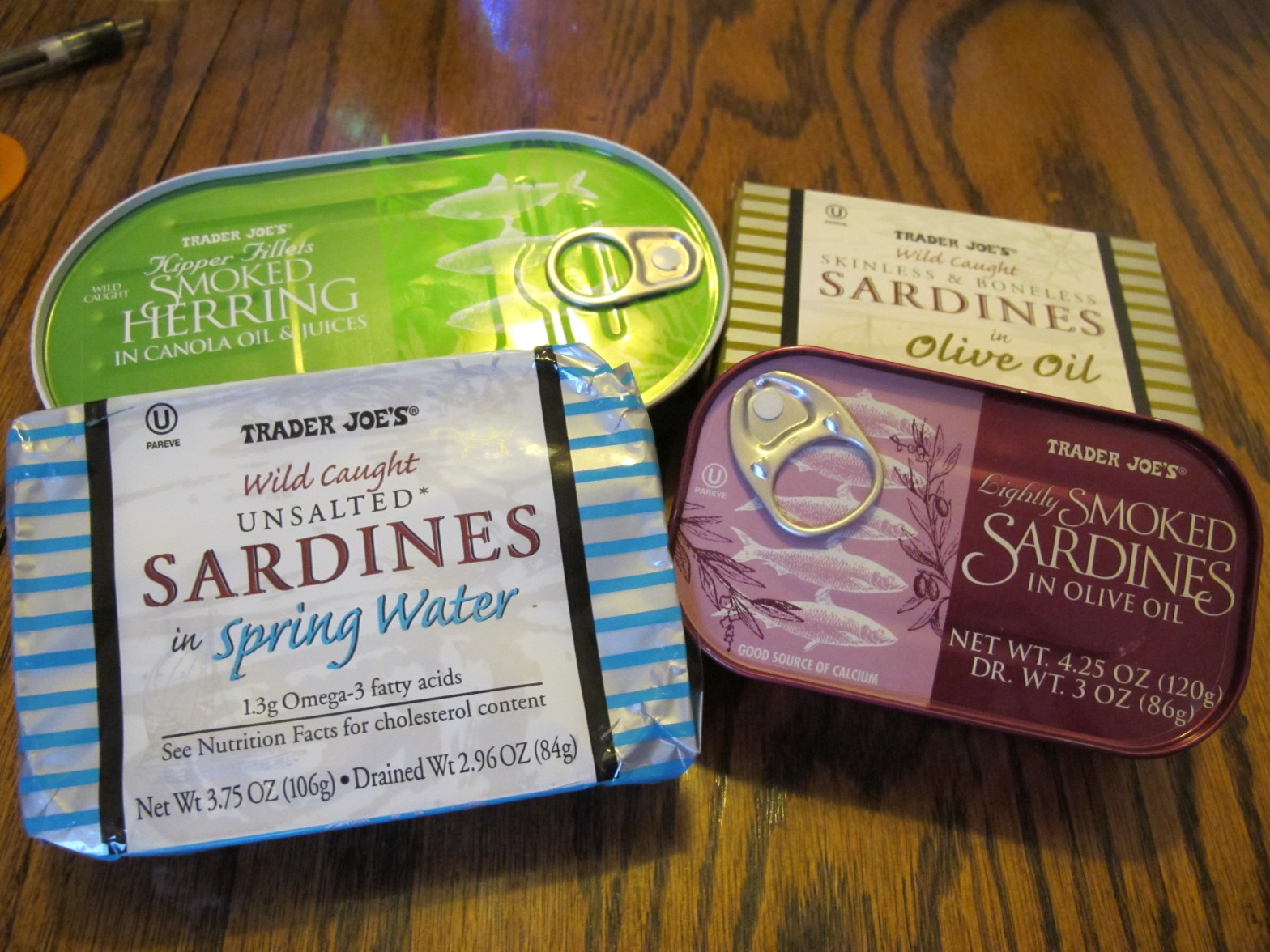
Two weeks ago, Matthew picked up a few tins of sardines for me.  I rather thought he would come home with one or two cans, but when he pulled out four (different varieties), I figured that would force me to try them enough to make a fair judgment and get over any initial uncertainty.

Sardine Trial (all from Trader Joe’s):

  • Wild Caught, Unsalted in Spring Water, 1 serving (2.96 oz.), 1.3g omega-3/serving
  • Wild Caught, Skinless, Boneless in Olive Oil, 1.5 servings (~2 oz/serving), 1.2g omega-3/serving
  • Lightly Smoked in Olive Oil, 1.5 servings (2 oz/serving)
  • Smoked Herring in Canola Oil 2.5 servings (~2 oz/serving)

IMG_3590[1]

I started with the Wild Caught, Unsalted.  As soon as I opened the tin, I was met with a very strong fishy smell.  The fish oil supplements were looking better and better.  Despite the claim that a single serving was the entire tin, I started with about 1/3 of the contents, mashed up with some dill potatoes.  It was awful.  I thought this wouldn’t be a big deal, because I used to eat canned tuna, but blech!

In the interest of giving it a fair shake, and giving myself the chance to get used to a new taste, I turned the rest of the tin into sardine salad by adding some mayo, mustard, plain yogurt, celery, onion and garlic powder, lemon juice, and salt.  Still awful, really, but over the next two days I managed to choke it all down on crackers.

At this point, I debated donating the three remaining cans to a food pantry.  I knew once I opened another tin, I would feel obligated to finish it, and did I really want that?

Not ready to call it quits, I decided to try an actual recipe, using the Wild Caught in Olive Oil to recreate this sardine pasta recipe (I used just one tin — half the amount of sardines the recipe calls for).  As soon as I opened this second tin of sardines, I realized it is true that not all sardines are created equal.  While this variety still smelled fishy, the scent was distinctly less strong than the first variety (reminded me of canned tuna) – a good sign.

I actually really enjoyed the pasta dish.  Gabriel gobbled it right up, too.  Matthew ate it, though he was a bit dubious (both of them missed out on that first awful tin of sardines).

I have yet to try either the smoked sardines or smoked herring, but I’m optimistic that the smoky flavor will make them seem less fishy.  I will probably try another round of sardine salad with at least one of these tins.

Environmental and health considerations
Tiny fish lower on the food chain (like sardine and herring) have less chance to accumulate toxins, like mercury, so they are one of the healthiest choices if you want to eat fish.

Both sardines and herring are on the Marine Stewardship Council’s list of best seafood to consume.  But, again, not all sardines are created equal when it comes to environmental impact, and I’m afraid most of what we bought from TJs falls into the Mediterranean, “avoid due to overfishing category.”  Apparently, I need to be looking for the Marine Stewardship Council’s blue label when I shop.

The packaging is a major down side of sardines.  First there is the obligatory tin (recyclable, yes, but still using resources).  Then, for two out of the four varieties I tried, the tin alone wasn’t enough.  One had a plastic outer wrapping and another was in a cardboard box – excessive packaging to be sure.

Real food vs. supplement
Not sure where I come down on this one.  If the omega-3 fats are truly better absorbed from the fish, that is a big plus, assuming you can stomach the fish.  On a per serving basis, the fish oil supplements generate much less waste.  It would probably take more than 30 tins of sardines to get the same number of servings as in a bottle of supplements.  This also makes the real food version more expensive, dollar-wise, than even a high quality supplement.

Practically, I don’t see myself eating sardines every day, while taking a supplement every day is relatively easy.  For now, I plan to combine the two, perhaps trying to eat some sardines once or twice a week, and take a low-dose fish oil supplement most days (still need to buy the supplement.

While not a realistic expectation, I’m a little bummed that my first “dose” of sardines didn’t make me feel like superwoman.  Ultimately, to maintain the added cost of either sardines or supplements, I would like to see some kind of results.  While not necessarily linked, there is some chance that the additional omega-3s will help my psoriasis (since the condition involves inflammation and omega-3 fats are supposed to reduce inflammation in the body) and they may also help my mental health.

If I keep this up, I guess I will technically be a “pescatarian” though I’ll probably continue to identify as a vegetarian.

I’m melting, melting

Okay, not melting exactly (it’s WAY too cold for melting), but I do feel like I’m falling apart.  Over the past year, I’ve accumulated a number of small-ish health issues: psoriasis, nail fungus, and back pain.  None of them are huge, but they are nagging things that won’t go away, no matter how much I ignore them.

Psoriasis
About this time last year, something funky started happening to the fingers on my right hand: itchy, red, very sensitive patches that eventually became swollen.  After a couple of months, when my half-hearted efforts to treat my [self-diagnosed] leprosy failed, I made it to the dermatologist, who, after a very cursory glance, proclaimed that I had eczema, not leprosy, and sent me on my way with a prescription for a topical steroid.

I never really used much of the huge tube of steroid cream, but my symptoms cleared soon after the doctor visit, largely due to the changing seasons (less cold, dry air) and possibly to some improvements in my mental state.  (Eczema and psoriasis are similar in that they are exacerbated by stress, anxiety, etc.)

It’s baaaaaaaacckk!  All good things must come to an end, and with the return of cold, dry winter air came the return of my skin condition.  With a new twist.  After a few weeks of the standard irritated skin on my fingers, I started noticing joint pain in the affected areas.  Matthew already suspected that my skin condition was psoriasis, not eczema, and this new symptom seems to confirm his suspicion.

Not only do I have psoriasis, I have a fun and relatively unusual manifestation — psoriatic arthritis — lucky me!  The joint pain is not constant; some days, I don’t notice this aspect at all, but there have been a couple of pretty bad periods, where I had to turn vegetable chopping duties over to Matthew because it hurt to hold the knife.

Anyway, since treatment of psoriasis and eczema is relatively similar, I’m working on using up that huge tube of steroid cream; applying fancy, expensive petroleum jelly (i.e., Aquaphor) every couple of hours; trying to work on some of the stress reduction stuff; and hoping the spring arrives soon.

Nail fungus
I’d never, ever had nail fungus.  Then, last February, I redeemed a pedicure gift card.  (Note that this was the second, or maybe third, pedicure I’ve ever gotten in my life.  It was likely also the last.)  A few weeks later I noticed an odd spot on the nail of my big toe.

I waited around a bit, hoping that it was a bruise under the nail and would just grow out, but after a couple of months, it became clear that the nail salon had given me a special gift — nail fungus!

Treatment options seem pretty limited, since I’m staying away from the oral anti-fungals.  This leaves topical anti-fungals, [very expensive] laser treatment, or alternate topical remedies.  For now, I’m applying Vick’s VapoRub twice a day, after soaking the toe in warm water (hoping this makes the nail more porous / the treatment more effective).  Like topical prescription anti-fungals, there’s a good chance I’ll have to keep this up daily FOR A YEAR.  Then, maybe, if I’m lucky, my nail will be healthy again.

Ongoing back pain
From October through December, I invested a significant amount of time and money in physical therapy for my back.  I felt like things were headed in the right direction, but I reached a point where I felt like I wasn’t making any more progress.

According to the therapist, the two rotated vertebrae were back in their proper places, and staying there, but I continued to have point pain whenever I pressed on one of the vertebrae.  This didn’t seem to be going away or getting better, and some of the PT exercises seemed to exacerbate it.

I checked myself out of physical therapy, hoping that my spine just needed a bit more time to get used to things being back in their proper places (after all, things had been out of whack for three months before I sought treatment).  But those hopes seem unfounded.

What to do?  More physical therapy (with a different therapist)?  Chiropractic?  (Was going to try chiropractic initially, but had a hard time getting a good provider recommendation.)  I also have not had any imaging done on the area, so I’m wondering about an MRI so we can see what’s really going on in there.

I’m not sure of my next step, but I probably need to do something.  The pain is limiting my physical activity (most activities don’t hurt while I’m doing them, but they lead to increased pain later, so I’ve been avoiding quite a few strengthening exercises) and making me feel old and grumpy.

Clearing the air

Shortly before Christmas, we noticed that our furnace was behaving oddly: cycling on and off frequently and failing to heat the apartment to the desired temperature.*

Our trouble shooting started and ended with the furnace filter.**

IMG_3586[1]

This picture would be more enlightening if I had the filthy filter side-by-side with a clean filter, but suffice it to say that the filter above is very, very dirty.

Although our landlord provides a basic, cheap furnace filter, we’ve been buying nicer (read: more expensive), allergen-filtering models.  These filters have a lifespan of UP TO three months, which we had been interpreting as “replace every three months or so.”  Turns out that furnace filters really do have a shorter lifespan when you’re running the heat (or A/C) more, which makes perfect sense: more [gunky] air through the filter means it gets clogged more quickly.

We swapped our gunky filter for one of the basic filters, and noticed an immediate improvement.  The airflow from the vents was once again strong enough to move the blades on our ceiling fan and move some hanging glass globes in our front room.

It was not until the next day that Matthew admitted that some of the black gunk on the filter came from burning candles.  We have (had?) a bit of a candle habit in the cooler months — often burning three or more larger candles (some with multiple wicks) for an hour or more in the evenings.

These are all lovely candles that we make every year with Matthew’s aunt (part of a cookies and candles holiday tradition), and as candles go, they seemed pretty harmless: unscented, cotton wicks, many made of 50% [recycled] beeswax (the other 50% being standard petroleum-based paraffin wax).

IMG_3584[1]

But when Matthew made the comment about the filter, my mind quickly made the logical leap to the fact that our lungs act as filters.  If that furnace filter was black with candle soot, what was our candle habit doing to our lungs?

After a bit of research, I’ve concluded that there is probably no such thing as a “healthy” candle.***  Petroleum-based candles emit a variety of nasty, toxic chemicals when burned.  Beeswax candles avoid many of the toxins in petroleum, but are not particularly clean burning (despite what those who market them want you to believe).  Most sources seemed to agree that adequate ventilation (i.e., an open window) was important to having decent air quality while burning any type of candle.

Sadly, this means the end of candle-lit dinners and evenings for us, at least in the winter, when we’re not going to be opening windows.  Sure, we may still light a candle every now and then, but nothing like before.

This decision was harder for and on Matthew than for me.  It’s not easy — we like our candles and they’re hard to give up, but, as Matthew pointed out, smokers like their cigarettes, too.  The fact that this seems to be a pretty clear-cut health issue makes it hard to ignore.

———————–

* 68° F during the day (when Matthew’s home; often lower when I’m home alone working) and 64° F at night, in case you were wondering.  I know these are NOT particularly frugal/green winter thermostat settings, but it’s a compromise and a concession to having a baby/toddler (who can’t re-cover himself at night if he kicks off the blankets) and a husband who gets very grumpy when chilly.

** This was an easy fix, but I have to say, one of the joys of renting was not being particularly worried either way.  If our furnace needs to be repaired or replaced, it’s on our landlord’s dime, not ours.

*** I’m not really satisfied with what I could find.  Some sources say the amount of toxins emitted are negligible, some claim beeswax is great, others laud soy wax.  We may revisit this issue and reconsider our candle-use policy in the future.  For now, we plan to mainly save candle-burning for outdoors.

Food philosophy: Fad diets

I was in the car returning from a Whole Foods/Trader Joe’s run last week, when the DJ on the radio station mentioned something about a new diet, the “honey diet.”  While I didn’t bother going to the station’s website for more details, the gist was “replace all white sugar with honey, eliminate all carbohydrates one [or two?] days a week, and, whatever you do, don’t. eat. potatoes.  EVER.”

Um, yeah, can you say, “Fad diet?”  Like a string of fad diets before, the “honey diet” picks something to villainize, in this case, the humble potato, along with carbohydrates in general.  Would potatoes be a problem if you’re sitting around all day consuming nothing but french fries (and oil and salt)?  Sure.  But potatoes, especially locally and/or organically grown potatoes cooked with the skins on, can certainly be part of a healthy diet.

I read the phrase “Paleo diet” before I heard it spoken anywhere, and in my head it was pronounced “pa-lay-o,” with the emphasis on the “lay.”  I didn’t realize it was referring to our Paleolithic ancestors, and thus pronounced “pay-lee-o” for quite some time.

My first reaction was, “Haven’t we already [more or less] done this?  It was called Atkins.”

Or, to paraphrase a quote from Zoolander,  “Atkins? Lo-carb? Paleo? They’re all the same [diet]. I feel like I’m taking crazy pills.”

The thing is, I agree with some of the Paleo principles, especially those of the “Eat real food” variety.  I also agree that there are benefits from minimizing some of the foods that Paleo says we should minimize or eliminate, like dairy and added sugar.  The diet also talks about eating eggs and meat from pasture-raised animals, another plus.

One of my problems with Paleo is the vilification of whole grains and legumes.  I just can’t get on board with eliminating two major categories of nutrient-packed foods, both of which can be good vegetarian sources of protein.

From an environmental and world-population standpoint, we can’t all eat a diet based on pasture-raised meat.  There were far, far fewer humans on this planet when our Paleolithic ancestors were running around, so it worked then.  Now?  Not so much.

The Paleo diet also doesn’t take into account the fact that the idealized Paleolithic humans had far different lifestyles and energy needs than we do today, nor the fact that few of our Stone Age ancestors lived past the age of thirty, meaning we don’t know how this diet will play out, health-wise, in an age when people are regularly living seventy years or more.

The blog post, Archaeologists Officially Declare Collective Sigh Over “Paleo Diet,” while apparently satirical, and not reflective of a real scientific conference, offers some good food for thought in the midst of an over-hyped fad diet:

What people seem to ignore, he said, was that the fresh fruits and vegetables forming the basis of the Paleo Diet were created by the same agricultural process that produced cereal grains. “Nearly every food item you currently eat today has been modified from its ancestral form, typically in a drastic way, ” he began. “The notion that we have not yet adapted to eat wheat, yet we have had sufficient time to adapt to kale or lentils is ridiculous. In fact, for most practitioners of the Paleo Diet, who are typically westerners, the majority of the food they consume has been available to their gene pool for less than five centuries. Tomatoes, peppers, squash, potatoes, avocados, pecans, cashews, and blueberries are all New World crops, and have only been on the dinner table of African and Eurasian populations for probably 10 generations of their evolutionary history.

“You really want to be Paleo? Then don’t buy anything from a store. Gather and kill what you need to eat. Wild grasses and tubers, acorns, gophers, crickets- They all provide a lot of nutrition. You’ll spend a lot of energy gathering the stuff, of course, and you’re going to be hungry, but that’ll help you maintain that lean physique you’re after. And hunting down the neighbor’s cats for dinner because you’ve already eaten your way through the local squirrel population will probably give you all the exercise you’ll ever need.”

In a world where we’re faced with an overabundance of unhealthy food choices (not to mention other barriers to healthy eating, like lack of time or money to prepare healthier foods), the black and white, “Eat this.  Don’t eat that,” structure of fad diets is seductive.

The trick is to build your own healthy eating plan, whatever that looks like for you, but which can probably include almost all food, in moderation, if most of your calories come from a variety of real, whole, unprocessed foods.  Look any “diet” over with a critical eye, take the good advice (if any), and leave the rest.  Fads come and go; healthy eating habits last a lifetime.

Now, if you’ll excuse me, I have some potatoes to cook.

Next up: “Great Grains,” my approach to carbohydrates.