Twisted vertebrae

Last Thursday’s post, where I shared my thoughts about bike facilities and infrastructure, garnered quite a few hits and is sparking some good discussions.  The thoughts I shared there had been percolating for quite some time, and it felt good to get them off my chest and out into the world.

While the post took quite a bit of time (and mental energy), it was far from the only thing noteworthy last week.

On Wednesday, I started physical therapy for mid-back pain that I’ve had since our trip to Wisconsin in July.  After three months of hoping it would go away on its own, I finally faced facts and sought answers and help.  Turns out that repeatedly twisting around in the car to tend to a toddler in the back seat = very bad for back (shocker!) — as a result, I have a couple of vertebrae that are rotated [slightly] out of place.

My doctor actually recommended that I visit a chiropractor (which I’ve never done), and then perhaps use PT as a follow-up.  Lacking a great chiropractic recommendation, I started with the PT (something I’ve done before for other back issues), and that’s the route I’m going for now.  I chose a therapist who uses manual techniques and myofascial release to encourage the muscles to relax enough to help things move back into place.  My initial visit left me quite sore the next day, but nothing that I couldn’t live with.

I can’t help but miss the health insurance I had three jobs ago (four, if you count my current part-time gig) which covered 100% of physical therapy.  Now it’s forty bucks a visit.  I know it could be worse, but that definitely stings a bit, and it adds up fast!  Hopefully this resolves quickly, but the fact that it’s been an issue for over three months now might not bode well.

Fortunately, biking doesn’t seem to be an issue, and I’m able to bike to my PT appointments, so I’ll probably be doing more biking during these next few weeks than I otherwise would.  There’s something very satisfying about feeling good enough to bike to health-related appointments, and it makes me thankful for relatively good, if imperfect, health.

Gym rat no more?

I intended to write a “Gym Rat” post back in May, when my beloved chain fitness center branch shut its doors with only a week’s notice.  I couldn’t feel too sorry for myself as a patron because the fitness center employees received the same minimal amount of notice regarding the end of their jobs.  Oof.

Last October, after debating which gym to join, I chose the closer (i.e., walkable), cheaper, now-shuttered option.  I quickly got in the habit of working out (i.e., lifting weights) there at least two, and often three, times a week.

Even with the $10/month unlimited kids’ room (i.e., childcare), I was paying less than $30/month total.  It was definitely money well-spent, as that gym helped save my sanity during the early part of this year, when wintry weather minimized outside time, leaving me stuck indoors with this.  For much of February and March, my two or three visits per week increased to four or five, as the kids’ room provided a much-needed break!

When they closed their doors in mid-May, my visits had already decreased, and with warmer weather and more built-in physical activity (i.e., active living — walking, biking, etc.), I’d been questioning continuing my membership.  They transferred our memberships to another [relatively nearby, but biking distance, rather than a 3-block walk] fitness center, which I tried I couple of times over the following month, before deciding it wasn’t the place for me.

After another month of no gym, a different fitness center’s $10/month with a $1 joining fee lured me back.  In a moment of weakness, I signed up for the free intro session with a personal trainer, a privilege I’ve waived at past gyms, given my training and years of experience lifting weights.

Ironically, that training session, meant to encourage me to pay for more training, contributed to my [almost-finalized] decision to leave the gym.  The session itself was good — personalized and challenging — but I realized afterward that almost all of the exercises the trainer gave me were using my own body weight, not free weights or weight machines, and thus were things I could do for free, at home.

Still, I was not convinced that I would actually do the exercises at home, where there are always a million-and-one other things that need doing, making it easy to put off the workout until it ends up not happening.

Then, a few weeks ago, as I was writing my “gratitude” post, I came across a NYTimes Well Blog post about a 7-minute workout that could be done almost anywhere.*  It almost sounded too good to be true, but something about it appealed to me.  Many of the exercises (there are 12 total) were identical or similar to those assigned by the trainer.

For whatever reason, this seems to be an at-home workout routine that I can maintain.  The short duration helps.  I mean, seven minutes?**  How can I not find just seven minutes at some point in the day to do this?

Instead of saying, “Oh, I’ll workout after I do x,y,z,” my mentality with this is, “Oh, I have enough time to squeeze in a workout before I do x,y,z.”  This shift in mentality is HUGE.

In reality, I’ve made the program my own, focusing on reps rather than strictly on time for a few of the moves where I want to focus on form (e.g., squats and push-ups), and adding in an extra move or two for shoulder and back muscles.  Even with these tweaks, a full circuit takes less than nine minutes, and once I get going, I usually end up doing the complete circuit twice.  For my fitness level, this provides a very good workout in barely more than 15 minutes!

While I did fall off the wagon a bit last week, I’m on track for maintaining a 2-3 times/week routine for almost a month now.

Since I have until the end of the month to decide, I should probably revisit the gym at least once before cancelling my membership (since I would pay a much higher fee to rejoin if I cancel), but I really don’t think I’m missing much.

*7-Minute Workout originally published as “High-Intensity Circuit Training Using Body Weight: Maximum Results with Minimal Investment” in the American College of Sport’s Medicine’s Health and Fitness Journal.

** I am using this circuit in addition to the “exercise” I get from active transportation.  Great full-body routine or no, seven minutes a day (much less seven minutes two or three times a week) is FAR below the minimum guidelines for daily/weekly physical activity.

Practicing gratitude

It seems that everywhere I turn these days, I get messages about gratitude.

“Cultivating Gratitude and Joy” was one of the main guideposts in Brené Brown’s The Gifts of Imperfection, which I read in May as a homework assignment for counseling.  Within days of reading that chapter on gratitude, and noting that it was perhaps something I should practice, I was on a flight home from D.C. and noticed the young woman next to me on the plane pull a small journal from her bag with something like, “Today’s Gifts,” written on the front.

When I relayed this to my counselor, she suggested that every night, I write down [at least] three good things that happened to me that day in my planner (i.e., something I already had — no need to go buy a special book).

I maintained this practice for about a week, and then it fizzled.  Until Monday, that is, when I saw a Facebook link to this article: Stop Glossing Over the Good Stuff.  The author received a wake-up call when a colleague challenged him with the question, “Are you really complaining right now?”

He goes on to relate the conversation and the psychology behind focusing on the negative and glossing over the positive, which is the default position for many of us.    Fortunately, anyone can shift this balance, though it does take practice.

On the same day I found the above-mentioned post, “Practice gratitude” was one item on this list of “Ten Simple Things You Can do Today that will Make You Happier.”  Hmm.

The idea of, and psychology behind, “training” your brain for positivity was explored further in “How to Rewire Your Brain for Positivity and Happiness.”

Since it appears I can’t escape this gratitude thing, I’m going to embrace it.

Three good things about this morning:

  1. A lovely bike ride to Local Harvest Grocery
  2. Gabriel looking forward to going to Mrs. L’s
  3. 10% off at the store

I will record at least three positive things in a journal (I already had one, and my planner was just too small) every day.  It’s a small step — the links above have more suggestions and ideas, but it’s a start.

I may or may not institute a weekly gratitude post here — not sure yet.  I also like the idea of stopping yourself every time you (or someone else) catches a complaint and listing three good things on the spot.

I have no illusions that making the shift from a negative focus to a positive one will be easy.  No, it will require work.  Practice.  Training.  But the benefits seem well worth the effort.  Will you join me?

Eat your greens!

When we learned that Matthew was going to be on anticoagulant medication (Coumadin/warfarin) for awhile, one of our big questions was about eating foods that are high in vitamin K.

Vitamin K plays a major role in blood clotting, as it is needed by many of the proteins that help blood clot.  However, that means vitamin K works at cross-purposes with the warfarin:

Large quantities of dietary or supplemental vitamin K can overcome the anticoagulant effect of vitamin K antagonists [e.g., warfarin], so patients taking these drugs are cautioned against consuming very large or highly variable quantities of vitamin K in their diets.  Experts now advise a reasonably constant dietary intake of vitamin K that meets current dietary recommendations (90-120 mcg/day) for patients on vitamin K antagonists like warfarin (source).

Foods highest in vitamin K include kale (660 mcg per half-cup cooked) and collard greens (520 mcg per half-cup cooked).  While the majority of the American public is not in danger of consuming high doses of vitamin K, and some would rejoice rather than mourn upon being instructed to severely reduce or eliminate these foods, our regular diet is a bit different than the majority of the American public, to put it mildly.

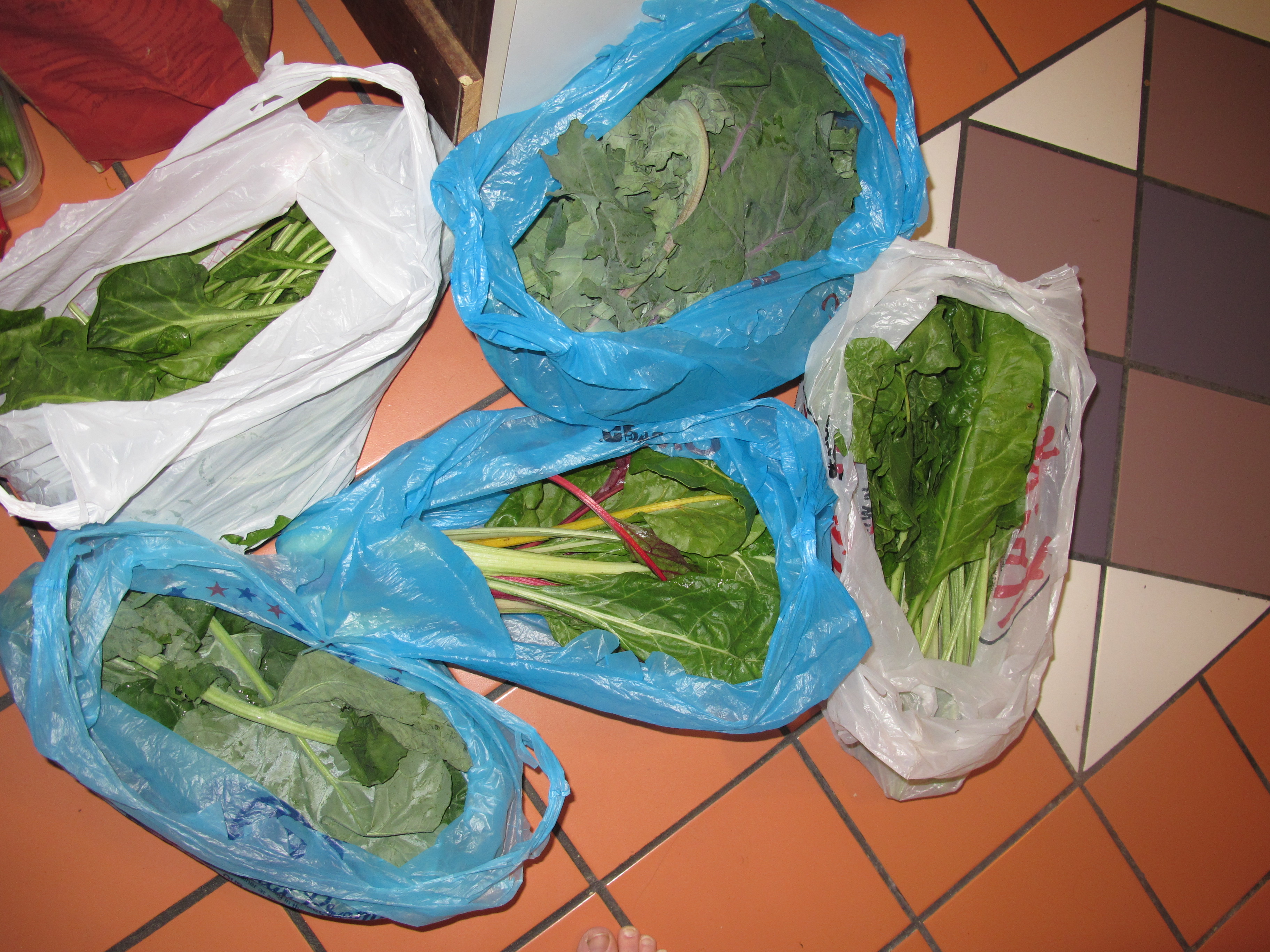
Matthew started taking warfarin just as our garden-grown greens (kale, collards, and Swiss chard*) really hit their stride.  We’ve been harvesting huge grocery bags full every week, and that seems to barely make a dent in the supply.

IMG_2792

Clockwise from top: kale (one of two varieties we grow), perpetual spinach chard, rainbow chard, collards, and some other kind of chard.

I prefer to be the one doing the harvesting, as Matthew’s idea of how many greens we can consume in a week (not to mention how much we can stuff into our poor refrigerator!) is a bit more optimistic than mine.

Fortunately, Matthew’s hematologist gave him the green light for continuing to eat a full serving of greens every day, with the caveat that he keep intake consistent.  Thus, while he previously wouldn’t have eaten a half-cup of cooked kale or collards every day, doing so is now part of his “medical” regimen.**

IMG_2797

The garden continues to produce in abundance, so supply is not a problem, though it was a bit tricky when we separated from the garden for our trip to Wisconsin.  We kept up the intake with lots of frozen grocery store spinach (560 mcg per half-cup cooked) — those little frozen boxes were convenient, but not near as tasty.

One thing I’ve discovered is that summer kale and chard do not at all resemble the tender leaves that I cook in spring, when I toss the still-damp, cut, rinsed leaves in our biggest cast iron skillet, cover to steam for a couple of minutes, and then finish uncovered, sauteing with a bit of oil, salt, and garlic.

Summer kale is a different beast entirely, with tougher, chewier leaves not suited for light cooking (or raw kale salads).  It will just laugh at those preparation methods as you sit trying to chew a mouthful of tough greens.

Much as I cringe at boiling those beautiful, nutrient-packed leaves, a girl’s gotta do what a girl’s gotta do.  Fortunately, there’s a happy medium between gross, boiled-to-death, pile of mush and too-tough-to-chew.

cooking hot-weather greens

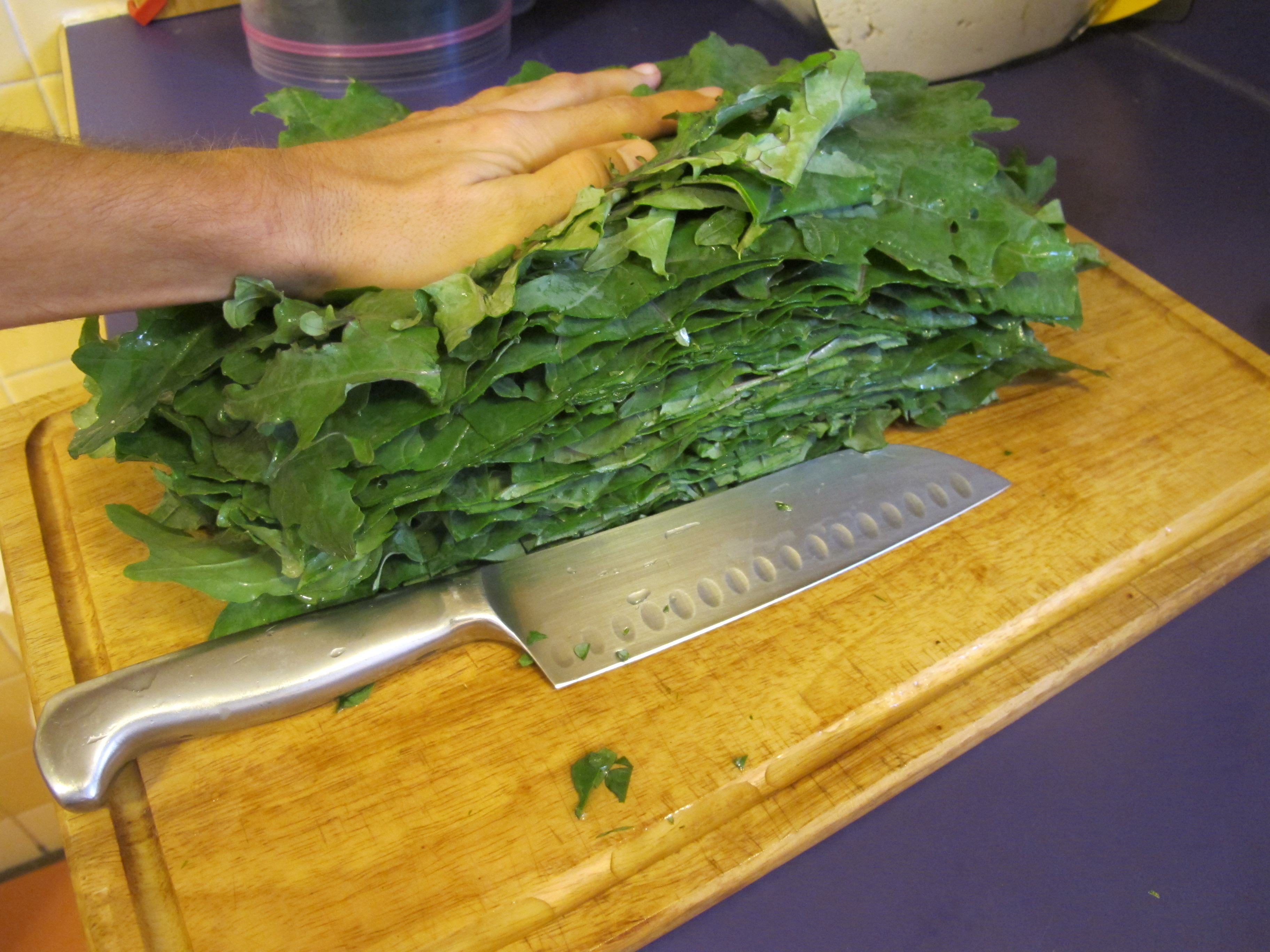
Wash and chop the greens.  Bring a large pan of salted water to a boil.  Add your prepped greens to the boiling water.  Return to low boil and cook for 10-15 minutes.  Drain.

Now the greens are ready to be sauteed with onion and garlic or tossed into some kale-quinoa quiche.

IMG_2798

A recent dinner: stuffed zucchini with a side of garlicky sauteed collards.

If greens are half the “superfood” that some people claim, Matthew is well on his way to becoming Clark Kent!

—————————-

*Chard is lower in Vitamin K, with about 360 mcg per half-cup cooked, which means eating about two servings  a day.

** This post is not intended as medical advice.  If you are on anticoagulant/blood thinner medication, consult your physician before increasing your intake of vitamin K-rich foods.

From garden to E.R.

The last weekend in June was not quite a normal weekend for our family.  It started out differently in a good way, with a dinner date on Friday night.

The following Saturday morning, I helped the boys get out the door to the garden as usual, then hopped on my bike to meet Rebecca, a fellow StL blogger (find her at Fiets of STyLe) who recently started bicycling for transportation.

A few weeks ago, Rebecca contacted me after she found my blog and we exchanged a few emails, leading to our Saturday morning coffee meetup (or, in my case, a muffin, since I don’t drink coffee) by bike.

This is the first time I’ve had the opportunity to meet a “blog friend” in person.  Our chosen meeting point, a small, locally-owned coffee shop in Webster Groves, ended up being closed, so we biked a few blocks further to another spot, where we chatted for over an hour, covering various aspects of biking, as well as other topics, including gardening.

Afterward, we each rode off in opposite directions, and I returned home for a normal Saturday of getting stuff done around the house.

Shortly before five, as I was in the midst of dinner preparations and awaiting the gardener’s return, my MIL called to inform me that they were awaiting an ambulance for Matthew, who started experiencing severe pain (i.e., pain so bad that he could not stand up straight and looked like he might pass out) as he was preparing to head home from the garden with Gabriel.

I went into extreme practical mode, packing snacks for a long E.R. wait and overnight stuff for Gabriel, as I waited for my MIL to come and pick me up (usually our one car situation works fine, but as usual, Matthew drove that one car to the garden, leaving me a bit stuck given the location of the hospital to which he was headed — in hind sight, I should have sent her directly to the hospital and called a taxi).

By the time I arrived at the E.R., Matthew had already been there for an hour, and I walked into the room to a very pale and pain-stricken husband.  They had already performed a chest x-ray to rule out lung problems (and had also ruled out appendicitis) and were waiting on a CAT scan of the abdomen.

The minutes and hours ticked by, as two rounds of morphine did nothing to lessen his level 10 pain, and we continued to have more questions than answers.  Finally, an abdominal ultrasound revealed some abnormalities near his gallbladder and liver, which they eventually diagnosed as a blood clot in his inferior vena cava (IVC) — scary stuff, as the next stop for blood in that major vein is the heart, and then onto the lungs, where a clot would cause a pulmonary embolism (probably TMI for those who aren’t science/medical nerds like me).

Anyway, with Dilaudid finally easing the pain, and heparin working to thin his blood, they admitted Matthew to the hospital, where he spent two fun-filled nights and days, including Sunday night where, after waking him for the third time due to concerns about his “low heart rate” (in the 35bpm range) the floor staff called in the doctor who said, “Yep, a low resting heart rate is normal for a  young, healthy, active male.”  Apparently they don’t see many of those in the hospital.

Given the poor sleep and constant poking and prodding at the hospital, he was quite relieved to be discharged late Monday afternoon, despite being sent home with a daily abdominal shot (a bridge blood thinning medication until they figured out his Coumadin dosage).

Somewhat miraculously (and against my better judgement), the doctors okay-ed our planned trip to Wisconsin, which included ten-plus hours in the car (prolonged sitting, such as on road trips or flights is a risk factor for developing blood clots), provided we stop at least every two hours for walking/stretching breaks and keep physical exertion to a minimum on the trip.

Turns out the physical activity was self-limiting, as he experienced continuing fatigue and low energy throughout the next week (and it’s continuing).  We definitely did not pull off any stunts like we did in Glacier, when, not exactly ones to ease into things, we arrived, staked a campsite, and immediately headed out for a challenging fourteen-mile hike.

Fortunately, other than the continuing fatigue (and an unrelated toe sprain that re-injured the toe he hurt last October), we had no health surprises while in Wisconsin.  Very fortunate, given that we were pretty much in the boonies of northern Wisconsin, with no cell phone reception (there was an emergency land line at the resort, but no phones in the units) and miles from medical facilities.

We’re back now (more on the trip later) and still have more questions than answers in many ways.  He’s followed up with his primary care physician (he didn’t have any follow-up visits before we went on vacation — I was less-than-thrilled about traveling with an unclear picture of what was going on), who’s questioning whether or not there is/was a blood clot.  There are more tests and follow-up visits to come, and orders to keep things low-key (again, the fatigue is keeping things in check) until they know more.