Lunches for the week

As I put away our leftover honey beans on Monday night, I happily realized that the fridge held enough leftovers to provide lunches for the rest of the week.  That knowledge removes the pressure to continue making big, leftover-yielding dinners, buying me an easy night or two of sandwiches, pasta, or leftovers for dinner instead of just for lunch.

In order to keep track of all the leftover goodness and avoid food waste, I grabbed a piece of scratch paper and sketched out our lunches for the week.

IMG_1558

The full lunch menu — most of the veggies in the dishes are locally grown:

Monday: Kale quinoa quiche with a side of squash
Tuesday: Black bean soup w/avocado and tortilla chips; side of collard greens
Wednesday: Rotini w/red sauce and sauteed eggplant, ‘shrooms, and squash
Thursday: Polenta topped with black-eyed peas, collards, and sundried tomatoes w/a side of roasted sweet potatoes
Friday: Honey beans, whole wheat bread w/olive oil, sides of squash and kale

On the top half of the page, I brainstormed dinner ideas based on what we had to use and what types of food (i.e., rice, lentils, tofu) we haven’t eaten in awhile.

IMG_1559

Our fridge full of leftover goodness (and a huge hunk of rising Danish pastry dough, second shelf from top, on the right).  A bit crazy, but I have a pretty good mental map of what is where, and this is nothing compared to high gardening season when we’re truly overflowing with fresh produce.

In case you were wondering, I have yet to use my “coasting” dinner (many weeks I don’t — it’s just nice knowing I have a cushion, if necessary).  Tuesday night I made risotto (recipe coming soon) and Wednesday night I made a variation of my Persian stew, with lentils instead of chickpeas and [garden!] cabbage instead of cauliflower.

Foodie Friday: Eating local in late winter

‘Tis the season for the annual, “What does a locavore eat in the winter?” post.  Quite a long list of things, actually.

We have our root cellared veggies: squash, sweet potatoes, and potatoes.  Then we have our canned tomatoes and tomato sauces, along with a small quantity of canned green beans.  Frozen garden goods include carrots, summer squash, eggplant, sweet (and hot!) peppers, beets, Swiss chard, kale, and sun dried tomatoes.  Oh, and let’s not forget the fresh carrots (from the low tunnels) and leeks (just out in the open) that we’re still harvesting!

We’ve supplemented our fresh and preserved produce with cruciferous veggies from farmers’ market: cabbage, broccoli, cauliflower, and some delicious Brussels’ sprouts.  Those items are on their way out though, so pickings will be a bit slim until spring.

We supplement the local food with onions and some store-bought frozen veggies, including peas and corn.

So, those are the raw ingredients in my kitchen.  Here are some recent creations:

  • Vegetable upside-down cake with our carrots, peppers, herbs, and garlic; local cauliflower; and frozen peas and corn
  • Farinata with carmelized onions and a side of roasted winter squash
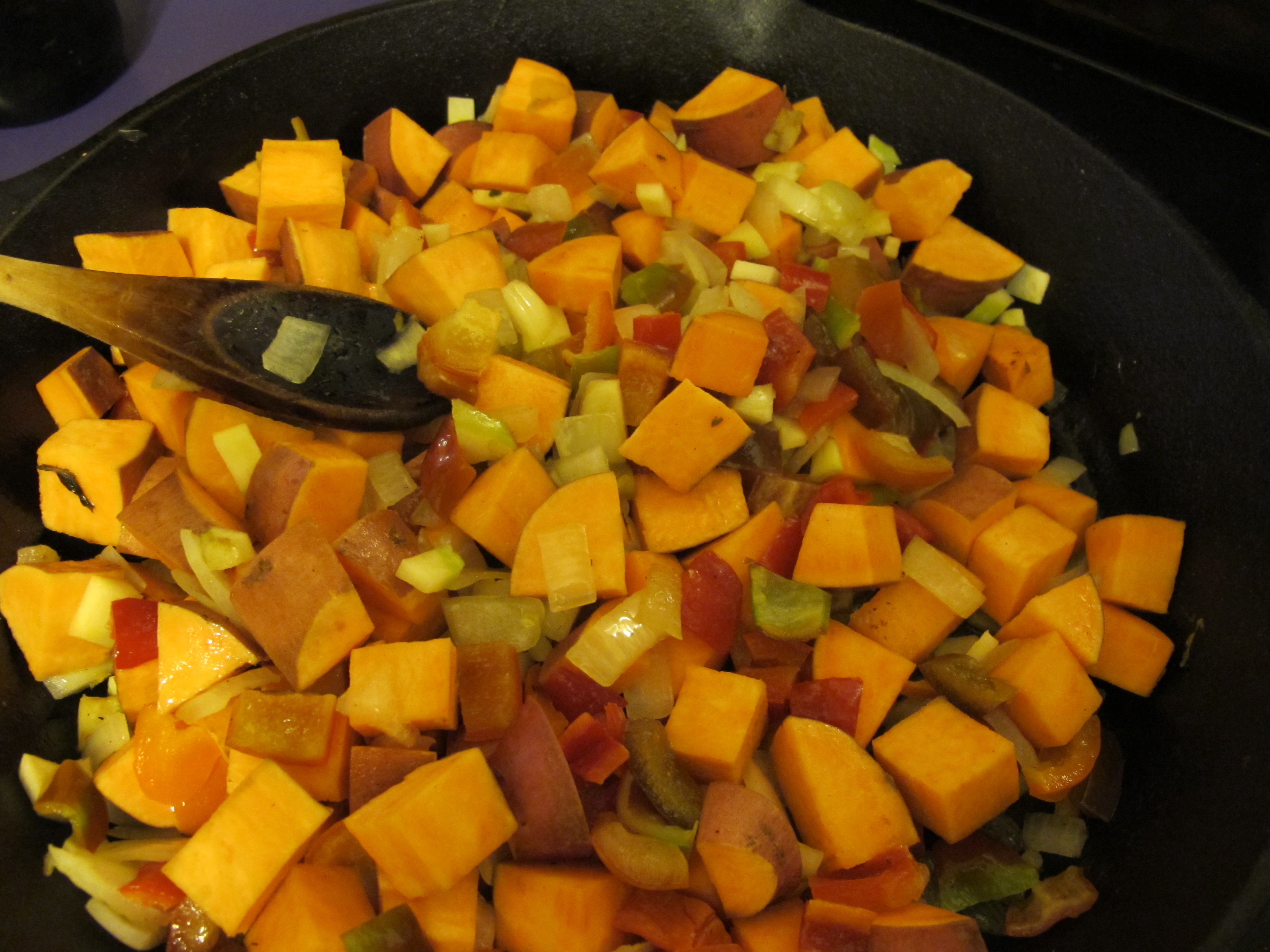
  • Black bean soup with our sweet potatoes and peppers
  • Baked potatoes with tempeh and sides of canned green beans and roasted beets
  • Split pea soup with our carrots and potatoes
  • Masaman curry with local cauliflower, our carrots and potatoes, and frozen peas
Sautéing veggies for black bean soup
Sauteing veggies for black bean soup

As I mentioned yesterday, I’ll be attending a vegetarian potluck tonight.  The theme is “colors of the rainbow.”  I’ll be making a winter squash dish or a roasted sweet potato dish — or perhaps both.  Any way you slice it, my color will be orange!

Browns’ Green Garden delivery service

Matthew has continued selling limited quantities of winter squash to Five Bistro throughout the winter.  For previous deliveries, he dropped by on his way home from the garden in the car.

For last week’s mid-week delivery, I loaded up the bike trailer, since we already had the produce at our place: fifteen pounds of squash and fifteen pounds of sweet potatoes.

IMG_1493[1]

A flatbed trailer would be much better suited to hauling cargo than the child trailer, but I manged to fit the produce AND a passenger.

IMG_1495[1]

With a squash on either side of him and sweet potatoes under his feet, Sir was a bit cozy on the way there (about 3 miles, I think), but he didn’t complain.  The delivery went smoothly and we visited a new park before heading home.

Here’s a recent menu item with our squash (in bold):

Benne‘sFarm half chicken,
Brown’s [Green] Garden buttercup pumpkin,
Ozark Forest oyster mushrooms,
Rissi Farm potato, braised napa cabbage,
bacon, grain mustard & pan jus

Fun to see our name on the menu (even if that’s not exactly the squash variety — I’m guessing they chose a simpler, more self-explanatory name for diners?)!

Amazingly enough, I’ve posted every. single. day. this week — pretty much a miracle.  The timing of this post is also amusing, given the inches of snow and ice currently covering our streets — I would not be attempting this delivery today unless I could get there on foot!

Sweet taters

While I’ve written quite a lot about our winter squash over the past couple of years, I’ve neglected the humble, but delicious, sweet potato.  While winter squash are great, they require scooping out the goop, and you often don’t know exactly what you’re going to get until you cook it.

In comparison, sweet potatoes require less prep, and they are consistently delicious.

IMG_1424

To give you a sense of scale, the knife in the sweet potato has a 6.5 inch blade.  This big guy weighed in at just under five pounds.  It really looked like it could have easily weighed ten pounds, but, while nice and solid, the flesh of a raw sweet potato is relatively dry.

We store them dirty (they keep better that way), so they all need a good bath and a bit of a scrub.  I soak the whole potatoes in a bowl of water to loosen the dirt, then use an old toothbrush to scrub them clean under a very small stream of running water.

Here are some smaller roots, immediately after harvest.  Matthew dug about 200 pounds of sweet potatoes from 10-12 plants last October.  These sustained shovel damage, so we used them immediately.

IMG_0679

The dry flesh of the raw sweet potato yields a rich, creamy product when cooked.  My favorite, easy prep method these days involves roasting.

roasted sweet potatoes

Recipe by Melissa

Ingredients
Sweet potatoes
Olive oil
Salt

Directions
Preheat the oven to about 400°F.*  Thoroughly clean the sweet potatoes, as described above.  Cut into similar size cubes (you can go smaller or larger depending on the final use, but similar size is important for even cooking).

Place the sweet potato cubes in a large, oven-safe, covered dish (I use a large Pyrex casserole) and toss with olive oil and salt.  Put the covered dish in the oven and roast the potatoes for 40-55 minutes, stirring halfway through.

Serve as a fabulous side dish, or toss into one-dish meals, soups, or wraps.  I often use sweet potatoes in place of carrots in this soup, and they substitute well in other recipes.

*Temperature is flexible +/- fifty degrees or so if you have other food that needs a specific temperature.   Roasting time may increase or decrease accordingly.

Sold on squash

When all was said and done, this year’s [winter] squash harvest topped 800 pounds.  That’s a lot of squash.

This picture shows the portion that Matthew harvested fully ripe.  We have this much again that should ripen and be good for eating down the road (though perhaps a bit less flavorful than the fully vine-ripened).

We also sold a total of 250 pounds of the squash harvest to Local Harvest Grocery and Five Bistro, so if you want a taste . . . .

The [modest] profit helps cover some of the costs that go into the garden every year, including seeds, straw for mulch, and soil amendments.  (Though we’ve played around with the idea of growing food for a living, I can’t imagine how much you’d actually have to grow to support yourself.)

The remaining squash leaves us with a decent bit to use throughout the next several months.  Fortunately, we like squash, and it’s really quite versatile: roasted and served as a savory or sweet side dish; cooked and pureed to make soup, custard, or pumpkin bread; cubed or diced and used in place of carrots in soups, stews, and other one-dish meals.  And don’t forget chocolate pumpkin cake!

With the cooler temps, I’m really enjoying excuses to turn on the oven (a complete one-eighty from my summer behavior of avoiding it at all costs).  If the oven will be on anyway, roasting a squash is an easy way to make use of the heat, since they can cook at whatever temperature you’re using for other recipes, as long as it’s in the 350°-450°F range.  Coconut oil is the secret ingredient.

quick roasted squash side

Pseudo-recipe by Melissa

Grab a squash, slice it, rub the slices with coconut oil, and sprinkle with salt if desired.  Lay slices flat in a single layer on a rimmed baking tray.   Bake for 15-25 minutes (depending on thickness of slices) at 350°-450°F, then flip each slice and bake for 10-20 additional minutes, until they reach desired tenderness.  Serve as is, or dress up with spices and herbs of your choice.