Finger-licking good vegetarian reubens

I’ve experimented with various ways to make vegetarian reuben sandwiches over the past few years.  The simplest: make as usual, just eliminate the corned beef.  The thousand island dressing and sauerkraut provide plenty of flavor (and salt!) — combine that with melty Swiss cheese and some good bread (rye or whole wheat), and you have a pretty delicious sandwich.

However, our new favorite version does include a corned beef substitute — tempeh.  This does not taste like corned beef, but it provides some nice additional texture, flavor, and protein to the sandwich.
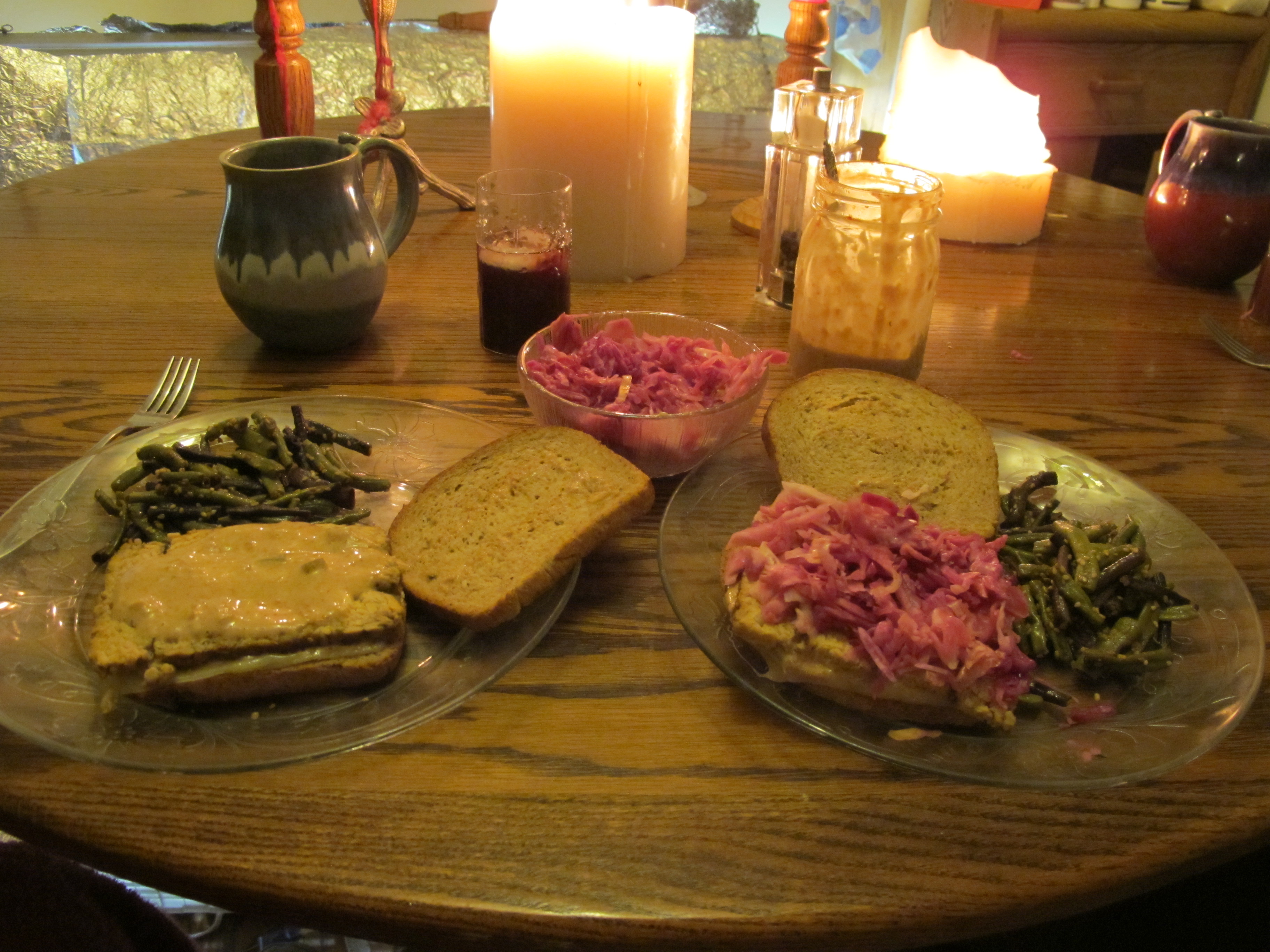
Finger-licking good vegetarian reubens (Makes 4 sandwiches)

  • 1 package tempeh, prepared per the directions here
  • homemade Thousand Island dressing (see below for recipe)
  • 1-2 c. Sauerkraut (homemade or store bought)
  • 8 slices of Baby Swiss
  • 8 slices of whole wheat bread (or rye, if you like, but we enjoy these on our homemade wheat bread)
  • butter, softened (but not melted)

Butter outsides of bread, then assemble sandwiches with cheese, tempeh slices, and a small amount of dressing.  (Save the sauerkraut and more dressing for after the sandwiches grill, to prevent soggy bread.)  Grill the sandwiches in a large frying pan over medium-low heat until cheese is nice and melty, and bread is lightly toasted, flipping to grill both pieces of bread.  After grilling, and just before eating, add sauerkraut and more dressing.

Have your cloth napkins ready — a good reuben should be nice and juicy.

Extra points for color with purple cabbage sauerkraut

Thousand Island dressing

  • 1/2 c. mayonnaise or plain yogurt
  • 1/4 c. ketchup
  • 1 T. finely chopped onion
  • Dash of Worcestershire sauce
  • Finely chopped dill and/or sweet pickles

I definitely ad lib on this recipe — no measuring involved.  Start with the quantities above, add finely chopped pickles as desired, and then adjust until you have the flavor and consistency you want.  I am spoiled because I make this with our super-flavorful homemade ketchup, but it should work with the any variety.

Ding dong, the books are gone!

After a weekend of waiting and wondering if the rescued math books would find a new home, I peeked outside late Sunday afternoon to an empty front porch!  🙂

I know this is just a small drop in the bucket, but these books will be helping kids learn math skills instead of just sitting in the landfill for the next eleventy hundred years.

I’m still on edge every time I take trash out to the dumpster (which, fortunately, is not all that often), afraid of what I’ll feel compelled to rescue next.

Good sauerkraut — make your own

Yesterday, I wrote about my hunt for good sauerkraut and how, while I found a great store-bought product, we ultimately decided to make our own.

Fortunately, making sauerkraut is quite simple.  For this batch, we started with the following ingredients:

  • 2 1/2 heads purple cabbage
  • ~3 T. pickling salt

  1. Shred the cabbage — we took a shortcut with the food processor.
  2. Put a layer of shredded cabbage in a clean crock, sprinkle with salt, and repeat until you use all of the cabbage.
  3. Place a clean dish towel over the top layer of cabbage; top with a plate that’s about the diameter of the crock (and fits inside the crock).
  4. Place some kind of weight on top of the plate — we used two quart canning jars filled with water as our weights.
  5. After a couple of hours, the salt should pull enough water fro the cabbage so that the liquid completely covers all of the cabbage.  This is very important — if there is not enough liquid, boil 3-4 cups of water, add 1 t. salt (making a brine), let cool, and add to crock.  Repeat if necessary until all of the cabbage is completely submerged.
  6. Now you wait — every couple of days, remove the weights and clean the plate and towel.  Check the liquid level after reassembling — you may lose some liquid with the towel.  If this happens, simply make more of the brine and add as necessary.
  7. You can start tasting the cabbage after 1 week, but it will take 3-6 weeks (depending on the temperature) to really ferment and become sauerkraut.

I intended to include our fabulous veggie reuben recipe in this post, but figuring out how to make the photo collages took a bit longer than expected, so I’ll keep you in suspense on the reubens for now (the bottom left picture in the collage provides a sneak peak).

For a bit more info on the sauerkraut making process, try here or here.

The hunt for good sauerkraut

Though I’m not sure if I like the term, you could definitely classify Matthew and I as “food snobs.”  For reasons including taste, health, and the environment, we tend to be pretty selective about what we put in our bodies, but, until I met Matthew, I never thought about sauerkraut as a food that could be better or worse.

Sauerkraut was something that came in a metal can and was purchased mostly for the purpose of making reuben sandwiches with the corned beef left over from St. Patrick’s Day dinner (and maybe on brats, but I didn’t really eat those much).  Despite my limited sauerkraut consumption, I always enjoyed the salty, tangy cabbage, but I was perplexed when Matthew started talking about “good” sauerkraut, and needing to look for it in the refrigerated section of the grocery store.

For a long time, the closest I came was a glass jar of sauerkraut, still unrefrigerated, but perhaps a slight upgrade from the metal can version.  Then, while browsing the refrigerator case that holds tofu and tempeh at Whole Foods a few weeks ago, I spotted Bubbies Sauerkraut — the last one on the shelf.  Live cultures and must be kept refrigerated?  Maybe I’d finally found it!  Compared to the metal can stuff, this was a bit pricey, but I was curious.

The verdict?  If we weren’t trying to save it for reubens, we might have polished off the entire jar the first time we opened it for a taste.  Salty, tangy, crunchy, and cut in the most beautiful, long, almost noodle-like, shreds.

Finally convinced that there was such a thing as superior sauerkraut, and with our naturopath’s recommendation that we eat more fermented foods, but not excited about buying more of our semi-expensive new find, we set out to make our own kraut (something Matthew was somewhat familiar with from his childhood).

Here’s a sneak peek at the beginning of our little experiment — full post, along with our vegetarian reuben recipe, coming soon!

Review: American Idle: A Journey Through Our Sedentary Culture

I just finished reading American Idle: A Journey Through Our Sedentary Culture, which has been on my list since I heard author Mary Collins speak at the Pro Walk/Pro Bike conference in September.  Reading a book about our sedentary lifestyles while sitting or lying on the couch struck me as a bit ironic, I must say.  Fortunately, at 168 pages, it’s a fairly short read, and I was not reading it in place of being physically active.

In researching the book, Collins traveled across the country, learning about various human movement patterns throughout history, and how it is that through the generations, we exchanged a very active lifestyle for a very sedentary lifestyle.

In addition to the obvious physical consequences of our sedentary lives (obesity and chronic disease), Collins explores the social, psychological, and cognitive consequences, as well as some not so obvious physical consequences (e.g., the loss of grace in our movements when we do move) of our inactivity.

Collins advocates for many of the things I hold dear: walkable/bikeable streets and community design that allows and encourages active transportation, which will only come about by collective will and government policies that recognize the dire need for these changes and make them a priority and a requirement in all sectors.

Like the Pro Walk/Pro Bike conference itself, reading American Idle stirred up a mixed batch of emotions for me.  On the one hand, I am working to promote active living, using many of the best practices outlined in the book.  On the other hand, in order to do this work, I significantly increased my sedentary behavior by trading a bikeable job for one that, for all intents and purposes, is accessible only by car.  I struggle with this contradiction on a daily basis, and the taste of warm weather and prime biking days only makes it harder.

Back to the book . . . . Recommended reading?  Yes.  I consider myself pretty knowledgeable in this area, yet Collins provided some new food for thought.

At my request, the Saint Louis Public Library now has a copy of American Idle, so if you’re local, you can check it out there 🙂