Preschool honeymoon ends

I feel like Gabriel’s first couple of months of preschool were a honeymoon period.  Sure, I had my initial qualms about giving up the convenience of childcare that was literally just a half-block away (or free public preschool that’s just a few blocks away), but, with the help of lovely fall weather, we settled into a pretty decent routine: Matthew taking G to school on Big Blue most days, and my MIL dropping G off in the afternoon (for the record, it would work for Matthew to pick G up at school most evenings, but my MIL likes spending the afternoon with G; they’re usually out and about anyway, so she just drops him off on her way home). About once a week, I take G in the morning so Matthew can make it to an early yoga class.

With the exception of a couple of rainy days, and a couple of mornings where I was headed somewhere in the car anyway, we’ve made it work with the bikes.  We even made it work on the cold mornings last week, bundling G up in layers for the ride.

And then yesterday it snowed.  It was little enough snow, and the streets were still warm enough, that the roads (even those they don’t treat or plow) are almost 100% clear this morning.  But there are still a few icy patches, and, not knowing exactly what the route would look like, Matthew opted not to bike.

A year ago, that would have been really easy — Matthew grabbed the bus and I walked G the half block to Mrs. L’s house.  Unfortunately, the bus that is so convenient for getting Matthew from our house to work is not terribly useful for getting G to preschool.

So this morning we spent ten minutes scraping off the car.  Ten minutes (sucking exhaust) in which I could have walked G to Mrs. L’s and been back inside our house already.*  Ten minutes in which I could have walked G to the neighborhood school and been on my way back home.  And it’s only the middle of November!

I’m hoping we’ll still be able to bundle up and bike most days, but if the precipitation this winter is anything like last, I’m afraid we’ll be car-bound more often than not over the next four months.**  Sigh.

It’s not forever — it’s just now, just this winter (okay, and probably next winter, too).  I don’t have to like it, but I imagine I’ll get used to it.

*To be fair, the beloved, oh-so-convenient Mrs. L’s is actually not an option anymore.  A month after G started preschool, I found out Mrs. L retired (which shot my back-up childcare plan!).
**Getting G to school without a car (on the days we feel conditions are not safe for biking) would be very tricky — transferring buses, waiting on lines that run infrequently, etc.  So, while part of me longs to be car-free, I am aware of our privileged position, to choose biking most of the time, while still having a car for bad weather, tricky timing, etc.

Small appliance extravaganza

I almost titled this post “Christmas in November,” but if you’ve gone anywhere near a retail location in the past week, you really don’t need a reminder that apparently Christmas now immediately follows Halloween.  (Try explaining to a three-year-old that we still have quite a ways to go until December 25 when you have reminders everywhere!)

Anyhow, I guess when it rains it pours, like last year when we replaced our toaster and toaster oven at the same time.

Food processor
The current small appliance extravaganza started with a new food processor, a decision that’s been a long time coming.  For the last ten years, I’ve been using a basic Black & Decker food processor.  I don’t use it all that often, but given the usual life span of such things, I honestly expected it to die a long time ago.  I’ve started making cashew butter fairly regularly (unlike peanut butter, I can make cashew butter cheaper than I can buy it), plus the occasional batch of sunflower seed butter.  It also gets some use making hummus and veggie burgers, as well as pureeing squash.  And it just keeps chugging.

The problem is not really one of aging, but a design issue.  The basic blend/process feature works fine, but the slicing/shredding blade is basically worthless.  We’ve lived without this feature for quite awhile, making slaw, kraut, and potato pancakes the old-school way, thinking eventually the motor would die and we’d upgrade, but the darn thing just keeps on kicking.  With plans to make a big batch of kraut (and after having recently made a big batch of root veggie pancakes, with only a little bit of shredded finger included), Matthew made the call to upgrade.

After consulting Consumer Reports, we settled on a Cuisine Art.  I must say, I was a bit underwhelmed when we took it out of the box.  Other than having a stainless steel base, it looked a lot like the Black & Decker — was it really worth 3-4 times as much?

Then Matthew tried slicing some chunks of cabbage and you guys!  Magic!  Beautifully shredded cabbage with the press of a button and really quiet (not whisper quiet, but quiet enough that I’m okay running it in our apartment after G’s in bed, which says a lot!  In comparison, I probably should have worn hearing protection when using the old food processor).  Anyhow, seeing is believing — this seems like a good purchase.  If it stands the test of time and I’m using it 10+ years from now, then we’re really golden!

IMG_5994[1]

Gabriel is starting to get really squirrelly when the camera comes out, but he actually asked to be in this picture — future small appliance model?

Electric mixer
No sooner had Matthew brought up getting a new food processor than our electric [hand-held] mixer began to die.  It will still, sometimes, function on the lowest speed, but that’s all we can get out of it.

We again turned to Consumer Reports and selected a fairly basic Kitchen Aid model (i.e., not the most expensive one that comes with all of the accessories).  I don’t expect this to be a major upgrade over what we had, but something that works will be nice.

Grain mill
This time last year, I borrowed my friend Kelly’s electric grain mill to mill our corn.  We really enjoyed using our home-grown corn meal and flour in corn bread and baked goods throughout the year.  Since it’s something we plan to continue growing, it [kind-of] makes sense to have our own mill (really, it would make the most sense to have one mill to share in some kind of neighborhood group, but since we don’t have that kind of set up . . . ).

Matthew found this grain milling attachment for our stand mixer.  I’m interested in seeing how it compares to the electric mill, which worked well, but, even on the coarsest setting, produced a corn “meal” that was more flour than meal (okay for some things, but really too fine for polenta and corn bread — we used our home-grown in combination with store-bought to get the right texture for those items).  The attachment takes up much less space than Kelly’s stand-alone grain mill, so that’s another plus.

And that’s a wrap on our purchases to date.  It seems a little extravagant, but we spend a lot of time in the kitchen, and having these tools does make cooking from scratch easier.  The kitchen is definitely where I would have the most difficulty being a minimalist!

I’ll write more about the grain mill after we’ve taken it for a few spins (if it doesn’t work well, we’ll return it).  I’m considering a soy milk maker, but I want to do a bit more research, including borrowing a friend’s machine to get a feel for the process and to make sure the product is something I want to consume.


Lemon chill

‘Twas an odd fall.  Despite not being overly warm (thank goodness), we didn’t have a frost until late in the game (average local first frost is October 15).  Garden-wise, this meant that many plants that would succumb to frost, like peppers and eggplant, hung around for a long time.  We almost skipped a frost and went straight to a freeze.

We’ve also had continued vole trouble at the garden, which prompted Matthew to dig all the parsnips, carrots, and celeriac, which, sans voles, could have been “stored” in the ground for awhile.

The timing of the cold and the root vegetable harvest overwhelmed our second refrigerators (plural, because my MIL also has a second refrigerator — crazy, right?), and we have two 5-gallon buckets of parsnips out in the garage.  Our second fridge is also extra stuffed because we have most of a bushel of apples in there, as well as some cabbage waiting to become kraut.

The sudden turn to wintry weather also meant the return of plastic on our sun porch windows.  We knocked this task out last night, after Gabriel went to bed.  The job was complicated by the fact that after using the same plastic for two winters, I’d decided [somewhat] that it was time for new plastic.

Of course, the only old plastic that I had actually discarded was the sheet that covered the biggest side of our sun porch, and none of the new plastic that we had on hand came in large enough sheets to do the job.  In the end, we taped two new pieces together for the big wall, and then reused the two sheets for the side windows (now on it’s third year).

The trickiest part about reusing the window plastic is that you need new tape every year, and it’s hard to find just the tape (and if you do find it, you pay nearly as much for the tape as you do for a kit with plastic plus tape).  Now that we’ve learned this lesson, we plan on ordering the tape online, ahead of time, in future years (of course every year we tell ourselves that maybe next year we won’t be dealing with this because we’ll be in a house).

Among other plants (citrus, figs, and herbs), the sun porch is housing this baby:

IMG_5946[1]

A “dumpster dive” potted Meyer lemon that I found abandoned in an alley last year.  (Fortunately, it was next to, and not in, the dumpster — not sure I could have wrangled it out.)  As a thank you for rescuing it and giving it a good home, this little guy produced 25 lemons this year!

IMG_5944[1]

We’re enjoying lemon bars and lemony salad dressing.  G enjoys being the official lemon picker when we’re ready to use one.

The porch task took almost two hours, but I’m glad we went ahead and finished it last night (even though it meant opening a new window plastic kit to scavenge the tape) when it was seventy degrees on the porch instead of today when it’s forty degrees!

Garlic taste test

Guest post by Matthew; a follow-up to this post about growing garlic in the Midwest.

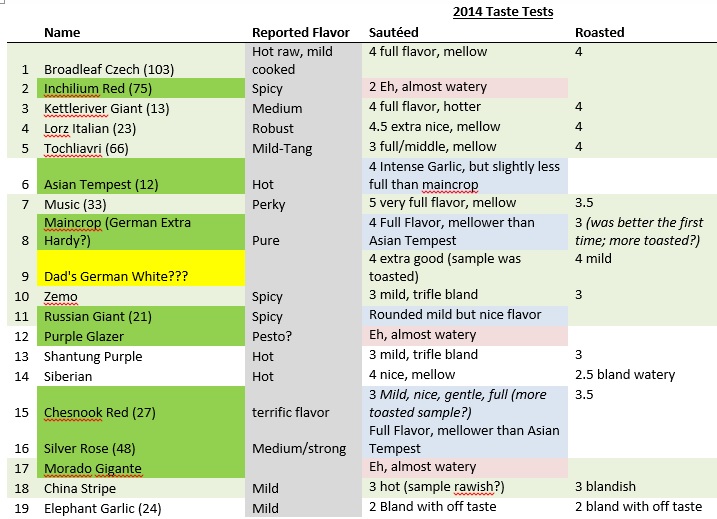
This was my second try at taste testing garlic, and I broke this year’s tests into two parts because I had 19 samples to try/compare.  I hope to do a tasting party at some point to get other opinions, but for now, all we have is my one set of taste buds.  (Melissa here to say that I did weigh-in on some of the garlic tasting!)

It’s also a tiny bit tricky thinking it was entirely fair, as some cloves were larger and needed longer to roast, or smaller and less time, and some seemed to sauté faster.  How do I get them all equally cooked?

That said, I think this is a reasonable testing and comparison.  I didn’t find the wine-like distinctions many garlic growers report in my cooked samples.  I don’t eat raw garlic (other than small amounts in pesto, hummus, etc.), so I didn’t bother tasting it that way.  I did find tastes that varied in being more or less full flavored, more or less hot, or neither and just downright watery.

My elephant garlic this year seemed to have an “off” taste in both roasted and sautéed tests.  Without the off flavor I don’t mind bland sometimes, for example, when I really just want the amazing creamy texture for a dip or soup that doesn’t need to be garlic-heavy.  Elephant garlic can be an easy way to get large amounts of mild, roasted garlic puree.

I don’t recall the off flavor from previous years, but coupled with my data that it just isn’t all that productive per square foot, it has been bumped way down in the pecking order of growing square feet.

I found my Inchilium Red to be rather bland, which is at odds with other taste tests, but could be my growing conditions, my seed stock, or weather conditions.  I’ll grow it another year or two, and do another taste test or so before I eliminate it overall.

I do have some low grade issues with brown spots on some of the garlic, possibly a fusarium (a fungus that can affect garlic) issue.  I rotate my crops, but I save my own seed stock.  I’m considering peeling at least one clove from every bulb next year to try to minimize how many spotted cloves get planted.

Otherwise, my tasting results are below.  You’ll notice that some are better roasters, others sautéed, and some are meh.  I’m using this data, and will be keeping track of how long each variety stores before deciding which ones I’ll grow long term, and which ones to cull from my stable.

I ranked each type and preparation on a scale of 1-5, where 1 is awful and 5 is awesome.

GarlicTasteResults

Combining the taste test data with the productivity, I think I’ll give everyone another chance, but if the data remains stable, I’ll probably keep the eleven below, and possibly some of the new ones I’m trying this year. That said, I’m eliminating eight varietals, which is a huge step forward for me!

TopGarlic

Biking with kids: Trailer bike vs. tandem

I started this post just two weeks after we got Big Blue.  Don’t get me wrong, we plan to get many more years of use carrying Gabriel on the longtail, but things change fast with kids, and finding a quality, used product takes time.

We still have awhile before G is ready to ride independently on the streets with us, so for now I’m considering options that would allow him to pedal with us.  Gabriel is now tall enough to fit many trailer bike set-ups, though I’m not quite sure that he’s developmentally ready for this step, but perhaps by next spring or summer.

The two main options for your child pedaling with you are some type of trailer bike or a tandem that has a rear (stoker) position that fits a small rider.

Trailer bikes
These are pretty common and easy to find.  You can get a new trailer bike for between $200 and $400, depending on brand and features.  A general pro is that we could purchase an extra hitch and/or rack (the Roland and Burley each attach to a custom rear rack), so that Gabriel could easily ride with either Matthew or me.  The trailer bike could be easily detached and left at school if one of us was doing drop-off and the other pick-up (or it could hitch a ride home in Baba’s car).

What’s in the running for us:

  • Roland add+bike: Very highly recommended by the folks over at Hum of the City — see their review here.  Of course, my number one trailer bike choice would have to be made in Germany and not widely available in the U.S.  Rumor has is that we could order one through J.C. Lind Bike Co. in Chicago, though this would easily be the most expensive option (with import shipping, probably around $500), and the one we are least likely to find used.
  • Something by Burley, either the Piccolo (pricier, but has gears and the option of converting to a stand-alone kid’s bike) or the more basic Kazoo.
  • The Weehoo iGo PRO: this seems like a cool concept, and the product gets great reviews.  If I found a great price on a used Weehoo, I might go for it.  In general, the Weehoo would be particularly good if you were concerned about your kid falling asleep or otherwise not staying on the bike.  Otherwise, I think I’d opt for one that gives more of a true riding a bike experience.

Given that this is something we’ll probably only use for few years, I doubt we’ll spring for the Roland, which means we’ll likely end up with one of the Burley options.  For a comparison of even more trailer bike options, see this guide over at Two Wheeling Tots.

Tandems
As far as I know, there are exactly two bikes that would fit the bill here.  I first became aware of the tandem option when I read about the Circe Helios on the Less Car More Go Facebook group.  The appeal is that either Matthew or I could ride as captain with Gabriel as stoker, OR Matthew and I could ride this bike together (if I can get over my control issues and deal with being stoker 😉 ).

Circe Cycles is based in the U.K., and they have exactly one U.S. dealer, located on the East coast.  On the low side, once we paid for shipping and such, I think we’d spend at least $2000 on this bike.  Given that we just recently made a big ol’ bike purchase (Big Blue), I’m not really sure this is in the cards.

Recently, a friend pointed out his Bike Friday tandem, which he’s been riding with his preschool-age grandson.  Bike Friday offers three models of their tandem (including a folding option).  The Family Tandem is the most basic, and it starts at $1300.  Quite a bargain for a tandem, but still an investment.

Both the Circe and the Bike Friday tandem use 20″ wheels, which makes for low step-over height, and they both claim to fit a relatively wide range of rider heights.  The suggested rider heights for the Circe Helios are 4′ 10″ to 6′ 5″ for the captain, and 3′ 6″ to 6′ 2″ for the stoker (though elsewhere on the website they mention 6′ as the max ideal stoker height).  I don’t have the exact numbers for the Bike Friday, but they are similar.

I’m not sure how a tandem would work for our everyday riding.  If we used a tandem to take Gabriel to school, then after Matthew or I dropped him off, we’d be riding around with an empty stoker seat.  I’m not sure how the bike would handle in this set-up.

At this point, it’s unlikely that we’d be able to ride either of the tandems before purchasing, which is a big downside (though it worked out okay with Big Blue).  I question whether Matthew and I, both on the tall side, would truly be comfortable on either of these bikes together, so being able to test drive would be really nice.

Next steps for us
I like the idea of the tandem, but I’m not sure I can justify the purchase.  Given both the versatility, lower cost, and greater availability of the trailer bikes, I imagine we’ll go that route.  I plan to keep an eye on Craigslist in the coming months (wish there were a way to set up an auto-alert!).