Using my words

I have a lot to share here, but it all feels trivial.  And I don’t feel fully qualified to talk about what isn’t trivial, as Heather so pointedly stated a few months ago:

Because who the hell am I? I am a white woman raised in a white household, a white woman who has experienced nothing but privilege her entire life. I have never known persecution or been maligned because of my minority status. I have never had to worry that the color of my skin would in any way cost me the slightest luxury or basic human right.


Yet who the hell am I to NOT talk about this?  Though I have yet to be there physically, most of my heart and mind feel stuck in Ferguson, MO.  This is important.  There is so much to read and process — so much background to understand about how we got to this point and so much wisdom and grace needed to begin to move forward, to change.

MotherTeresaQuoteRecommended reading

St. Louis: A city divided

What’s unusual about St. Louis — and goes a long way to explain the tension of the Ferguson protests — is not racism per se, but the way the metropolitan area has chopped itself into bits, remaining socially and economically segregated long after the racist laws were erased from the books.

For the Sake of Michael Brown

It may take a village to raise a child, but many administrators and parents in better-resourced parts of our region had no problem saying quite publicly that Michael Brown and his brothers and sisters did not belong in their village.

What I Did After Police Killed My Son

Our country is simply not paying enough attention to the terrible lack of accountability of police departments and the way it affects all of us—regardless of race or ethnicity. Because if a blond-haired, blue-eyed boy — that was my son, Michael — can be shot in the head under a street light with his hands cuffed behind his back, in front of five eyewitnesses (including his mother and sister), and his father was a retired Air Force lieutenant colonel who flew in three wars for his country — that’s me — and I still couldn’t get anything done about it, then Joe the plumber and Javier the roofer aren’t going to be able to do anything about it either.


Alternatives to guns?

Over the weekend, I asked Matthew, “Couldn’t police officers just use tasers and stun guns?”  You know, something less permanent than putting a bullet in someone?

After reading a bit more about the uses and limitations of such weapons, I think the answer is, yes, maybe, but not as long as everyone and his brother is running around armed with real guns in this country.

And, sadly, we seem headed in just the opposite direction, given what this situation has revealed about the militarization of police forces (haven’t read the book I link to, but it looks worth a read).

Walking in the street

While we have far from a full, clear account of exactly what happened between Darren Wilson (the police officer) and Michael Brown (the victim) on August 9, the accounts of Wilson initially stopping Brown because he was “walking in the street” really struck me.

For some background, the term “jaywalking” did not exist until the invention of the automobile in the early 1900s:

The term’s dissemination was due in part to a deliberate effort by promoters of automobiles, such as local auto clubs and dealers, to redefine streets as places where pedestrians do not belong.  (Wikipedia, emphasis mine)

If our streets were for people instead of for cars, would Mike Brown still be alive?

I don’t mean to over-simplify this, or direct attention away from the very important issues of inequality or injustice, but I can’t help but wonder.

White privilege

White privilege.  I think those are hard words to hear.  What do they mean?  What do they call us to do?

Yesterday, parishioner at my church recommended the book Witnessing Whiteness by Shelly Tochluk as a starting point for this important discussion.  I just requested a copy from the library.

If you’re in St. Louis, and want to be part of a discussion group, check out the YWCA (dates/times are for 2012 — I wrote to ask them to update the page, as I believe there will be a group starting in September 2014).

Say something

Despite living less than 18 miles from Ferguson, MO, I didn’t hear about the events that unfolded last weekend (and continue to unfold) until more than forty-eight hours later.  In a small cabin south of Crater Lake in Oregon, I received a garbled second-hand account of the rioting and looting from my MIL, who had just spoken to her brother.

I turned to the internet, where I learned about Michael Brown’s death at the hands of a police officer, and I watched with a breaking heart from hundreds of miles away: loss, hate, hope, anger, love, grief.

—————-

After nine years in St. Louis, I’m no stranger to the fact that the region has race issues.

I’m often struck by the make-up of crowds that I’m in, how in a city that is split almost exactly fifty-fifty between white and black, that racial mix is rarely represented at a given place or event.

In May, I took G to be tested to see if he would qualify for speech services through St. Louis Public Schools.  Our assigned testing site was Gateway Elementary and Middle School in north St. Louis City.  As we were leaving, we were caught in the halls during a class change at the middle school, and I was struck by the fact that I did not see a single white student in that hallway.  I wasn’t surprised, exactly, but all I could think was, “It’s the year 2014, and segregation is alive and well.”

This is not an accident, but rather the result of concerted historical efforts in St. Louis (as well as other cities), to separate white people and black people, and “protect property values,” through the use of [racially] restrictive covenants in real estate, which created white neighborhoods and black neighborhoods.

The effects of these covenants are still apparent in St. Louis City and the surrounding suburbs today.  For a closer look at how this played out in and near Ferguson, check out Jeff Smith’s excellent post, “You Can’t Understand Ferguson without First Understanding these Three Things.”

————-

I’ve been in Kinloch and other parts of north county.  I vividly remember an assignment in grad school, which involved visiting a number of parks in the metro area, assessing them from a usability perspective (okay, we say people should just get out and exercise — what are the sidewalks and the parks near their houses like — is that really feasible???).  For the exercise, we were assigned partners and a list of parks to assess, ranging from nice to not-so-nice.

My [white, female] partner and I were in a large, but clearly under-resourced, park in a predominantly African-American neighborhood in north St. Louis County (we may have actually been IN Kinloch, or not far from) when a couple of police officers approached and asked what we were doing there.

I don’t remember exactly what was said, but it was clear to my partner and I that the officers assumed that only thing white people could be doing in that park was buying or selling drugs.  We explained our assignment and showed them our park inventory sheet, and they let us continue.

I was fairly new to St. Louis at the time, and the encounter was both surprising and saddening.  Despite being across the street from a decent-sized apartment complex, we were the only people out in the park on a Saturday morning.  Was drug-dealing really the only thing that happened in that park?  Was the perceived (and perhaps real) danger just too high for residents to use the park for recreational purposes?

————-

I know people who live in Ferguson, including our real estate agent and a fellow CyclingSavvy instructor, who is also a small business (a bike shop, of course) owner there.  There is a great organic farm and farmer training program within the city limits, and a Saturday Farmers’ Market.  This is also Ferguson, MO.

But as the events of the past week demonstrate, there are some very real issues that we must face, not just in Ferguson, but in the entire St. Louis metro area (and in other parts of the country as well), issues stemming from a long history of racial injustice and disparities in education, healthcare, and economic opportunity.

At the same time as my heart breaks at the continued violence and unrest, there are many more heartening stories, and images, of a community and region pulling together.  My hope and prayer is that this won’t just “go away,” but will lead to real, honest dialogue; enlightenment; and then action to change things.  This process won’t be easy or painless, and change won’t happen overnight, but we can, and must, do better.


Test driving a Bullitt cargo bike

When we visited Portland two years ago, I had good intentions of visiting bike shops and test driving some cargo bikes, as I was already dreaming about adding something with serious kid- and cargo-carrying capacity to our fleet.  Alas, somewhere in the mix of vacation with a 14-month-old, this just didn’t happen.

Sadly, there are zero bike shops in St. Louis that carry cargo bikes (if I won the lottery, I’d open a bike shop specializing in family, cargo, and commuting bikes — anyone want to fund this???).*

Anyhow, when we were planning our return trip to Portland, just a few months after purchasing our own cargo bike, I prioritized trying something new-to-me.  A bit of research revealed that for $25 we could rent a Bullitt bicycle (a bakfiets or Dutch long-john cargo bike that I’ve read about over at Tiny Helmets Big Bikes) for a day from Splendid Cycles.  I emailed the shop owners, settled on a date, and that was that.

On Thursday morning, we blew right past Splendid Cycles and were partway down the Springwater Trail (along the Willamette River) before we realized we must have somehow missed the shop.  We backtracked and found the shop right at the trail head.

They put a lime green Bullitt up on the repair stand to look things over, while we browsed their other offerings and chatted with one of the owners.

IMG_5157

Can I sit in here?  Gabriel’s a fan of this model with the sweet rain cover.  Also love the detail work on the box!

IMG_5160

Gabriel checking out Big Blue’s (AKA Roadrunner) long-lost twin, with the Hooptie accessory (the wrap-around bar he’s holding onto).  I’m totally wishing we included one of these when we ordered Big Blue.  I imagine we’ll end up getting one, we’ll just have to eat the shipping cost.  With the Hooptie, we could carry Gabriel and one or two of his friends, which could come in handy.

Before we knew it, our rental Bullitt was ready to roll.  The guys at the shop assured us that we’d adjust quickly to the steering and general handling.  Specific tips were to not look at the front wheel, and that it would be trickiest at low speeds.  We’d decided Matthew would be driving it first, so he set out for a little trial run before hitting the streets.  (To Gabriel’s delight, Splendid Cycles is located right across from a concrete manufacturing plant with lots of big machinery — his idea of a “scenic” bike ride.)

IMG_5163

I waited with our borrowed bike and trailer . . . .

IMG_5164

Several minutes later, they returned, and Matthew announced he was good to go.

???????????????????????????????

With lunch and nap-time looming, we set out on our three-mile trip home, which was significantly uphill.  I could tell the hills required a good bit of effort (more effort than I exerted pulling the trailer), but all-in-all, Matthew made it look easy.

After lunch, we were all tired, so I didn’t get my shot at the Bullitt until after nap time (can’t believe I waited that long, after all the excitement).

After naps all around, we loaded the bikes and set off for a short jaunt to a neighborhood farmer’s market.  I hopped on the Bullitt, tried to turn the bike in the direction I wanted to ride, panicked, and dumped it in the middle of the [low-traffic, residential] street.

By “dumped,” I just mean that the bottom edge of the box met the asphalt (at very low speeds).  Gabriel was just fine, strapped into the padded seat in the box.  I imagine this is not an uncommon first experience riding this style of bike, but it was an inauspicious start, and did not exactly make me confident about handling the bike in traffic.

I picked it up, Matthew gave me a couple more tips and a pep talk, and we headed out.  Once I got the bike up to speed, all was well — the stops and starts were the tricky part.  Unfortunately, stops and starts are part and parcel of operating a vehicle in an urban environment.

I quickly realized that my beloved “balance stop” was not an option [for me] on the Bullitt.  I needed to plan on each and every stop sign being a “foot down” stop, or there was a good chance of tipping.  Fortunately, many of the bike boulevards in Portland minimize stop signs, so the stopping situation was less annoying than it would have been in St. Louis.

I made it the half mile to the farmers’ market, where we bought some fruit and tomatoes.  As we were reloading the bikes to continue to our next destination, Gabriel asked, “Daddy drive bike now?”

Matthew was astonished, because Gabriel is usually all-mommy, all-the-time.  The next words out of Gabriel’s mouth were, “Mommy makes it tippy.  Daddy drive.”  Thanks for the confidence boost, bud.

We explained that I really wanted to try riding the new bike some more, and we offered to let him ride in the trailer instead of the Bullitt’s box.  Even after our tip, he was a huge fan of his spot up front in the box (he’d been complaining that the trailer was bumpy, which it is), and he opted to stick with mommy.

At this point, he decided that if he was stuck with me as the driver, he may as well think good thoughts, because he said, “You can do it, Mommy,”  and then proceeded to chant, “Go, Mommy, go,” for ten blocks of uphill riding.

We made it with no more than a few wobbles, but by the time we reached our second stop, I was ready to be done with the Bullitt.  I could ride it, but it wasn’t particularly fun, so Matthew and I swapped back.

IMG_5178

Of course, we neglected to get any photos of me actually riding the dang thing, so we had to stage this the next morning.  Note that the kickstand (you can see one of the legs bottom center) is down.  Also, I’m sitting crazy high because it wasn’t worth adjusting the seat height for a photo op.

I’m glad we tried the Bullitt, but after twenty-four hours, I was happy to return it.  Neither Matthew nor I ever really got comfortable to the point that we could use arm signals, which is an important part of riding in traffic.  We agreed that both the trailer and the longtail are much more nimble and easier when climbing.

The Bullitt (or similar bakfiets-type bikes) seems like a great option for really flat places.  Anywhere with hills, I would only want it with an electric-assist (which we didn’t try).

On the other hand, if you live somewhere flat or want to go for the e-assist, I can see the appeal.  I think with more practice, I would have adjusted to the steering.  Gabriel really liked being up front, and the cargo capacity is impressive (you could carry even more by adding a rear rack).  Compared with wrangling things into the longtail’s bags (or onto its rack), the ease of just tossing things into the box is quite attractive.

When we returned the Bullitt, Joel at Splendid Cycles said they had sold FOUR Bullitts the previous day (all with e-assist), one locally and three shipping to all parts of the country (Colorado, North Carolina, and, not too far from home, Springfield, MO).

All in all, I’m glad we had a chance to try the Bullitt, but I’m looking forward to returning home to our longtail.  There’s no place like home, and there’s no bike like your own!

*Big Shark very briefly had a Kona Ute and MinUte, and I did just see a cycle truck at The Hub a couple of weeks ago, but options are VERY limited.

Portlandia

We spent Sunday at the airport . . .

IMG_4962

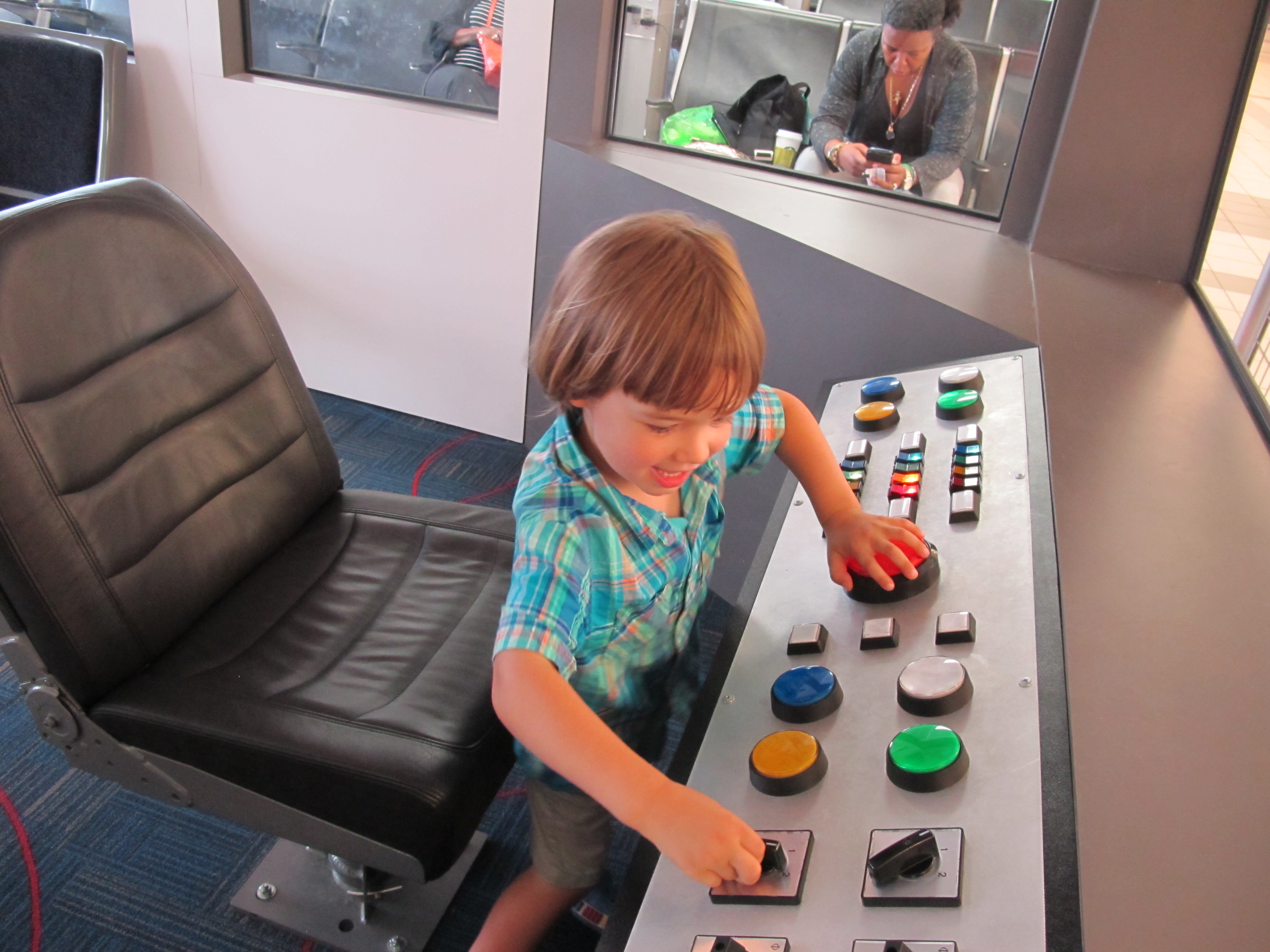
. . . where we took full advantage of the new play area near the C gates in the main terminal before boarding our flight.

IMG_4965

Flying direct was nice in many ways, but it did make for a long time in the air.  I was hoping someone’s nap would be closer to two hours rather than less than one, but at least he took a nap, and we managed the rest of the time without too much trouble.

I’m very glad we chose to put him in the car seat on the plane, as having a structured place (vs. swimming in an adult-sized plane seat and/or squirming all over our laps) really helped, both with napping and in general.

A little over four hours later, we arrived in Portland!  Hard to believe we were here almost exactly two years ago, when The Dude was a lot smaller and had a lot less hair.

Flashback photo
Flashback photo

IMG_4976

Our “settling in” day involved acquiring food and bicycles.  What more do you need?

After a morning grocery stock-up, we swung by my sister-in-law and soon-to-be brother-in-law’s place to pick up the bikes and trailer we’re borrowing for the week, then biked the five miles back to our rental house (similar to our last visit, we avoided streets with bike lanes as much as possible, sticking to “bike boulevards” (AKA neighborhood greenways) or plain ol’ streets.

IMG_4973

After nap time, we headed out to find a playground for Sir.  The closest playground happened to be located at Mt. Tabor Park, which put our hill climbing skills to the test.  In addition to the playground, we were rewarded with some great views.

IMG_4975

We’re looking forward to more outings by bike (being driven around in the rental car made me grumpy and carsick), including renting a Bullitt cargo bike from Splendid Cycles for a day!

Yesterday, Matthew and I enjoyed a day trip to Silver Falls State Park (just south of Portland) for some lovely waterfall-heavy hiking.

IMG_5005

We saw eight(!) waterfalls over the course of a 9-mile [loop] hike.

The only downside so far is HOT and no air-conditioning in our rental house, but it cooled off a decent bit yesterday (our hike was not hot, so we weren’t too tempted to go swimming), plus we’re moving to a different rental place that might have A/C and is more centrally located, to boot!*

*We’re not relocating because of the A/C, but rather had planned previously to spend the first few nights at my MIL’s rental before moving to our own place.

Get Out the Vote on August 5

This one goes out to all my fellow Missourians.  We have a primary election coming up next Tuesday, August 5.  It’s easy to let these things slip by, but there are two amendments that caught my attention in this election, one on farming/agriculture and the other on transportation.

Amendment 1 — Why I’m Voting NO
Described by proponents as a simple, innocent “right to farm” bill, this amendment would hurt small farmers and local agriculture by turning over farmland to agribusiness, including foreign corporations.

If you care about local food systems, sustainable growing practices, and/or small farmers, read more here and vote NO to Amendment 1 on August 5.*

Amendment 7 — Why I’m Voting NO
Amendment 7 proposes a statewide sales tax to fund transportation projects.  While I agree we may need some new tax revenue to pay for the upkeep of our roads, a blanket sales tax is not the way to do it:

Those who benefit the least from Amendment 7, people of modest incomes who do less driving and pay a disproportionate share of their incomes toward sales tax, will bear the greatest burden of this regressive tax. (source)

It would make far more sense, and be more equitable, to pay for these expenses with a tax on gasoline (i.e., a use tax), but this amendment actually prohibits a gas tax.  Read more here, spread the word, and VOTE!

*This also made the Huffington Post, from a Humane Society perspective.