I have fond memories of helping my mom make freezer jam from berries we grew or bought, including strawberries, black raspberries, and red raspberries.
My MIL makes lovely cooked jams/jellies/preserves, but I wanted to carry on my family’s tradition, so a few years ago, with a bumper crop of red raspberries, I bought some Sure Jell (fruit pectin) and started jamming.
Rewind! Did that recipe call for three cups of crushed raspberries and over FIVE cups of sugar?!? I wasn’t making berry jam, I was making berry-flavored sugar goo. Okay in small quantities, I guess, but not something I really want to consume frequently.
Unfortunately, traditional fruit pectin, like Sure Jell, relies on the sugar to work. If you reduce the sugar when using Sure Jell, you’ll get a runny, improperly jelled jam or jelly, also no good.
A little hunting led me to Pomona’s Universal Pectin. This pectin is activated by calcium, so you can use much less sugar, but still have well-jelled jam.
We have lots of strawberries coming in now, so I took advantage of the opportunity to try my first batch of freezer jam with Pomona’s pectin.
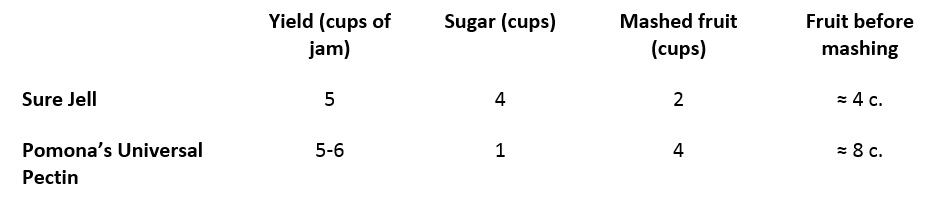
Here’s a comparison of fruit and sugar need to make five cups of jam with the two types of pectin*:
That means that the fruit:sugar ratio is 4:1, or four times as much fruit as sugar, using Pomona’s Pectin, but a frightening 1:2, or twice as much sugar as fruit, when using Sure Jell.
I carefully followed the package instructions for freezer jam that came with the Pomona’s pectin, and I’m happy to report that I have almost six cups of lovely strawberry freezer jam, with 1/4 the sugar (compared to making jam with Sure Jell).
Pomona’s Pectin is noticeably more expensive than other fruit pectins (and less widely available — check with your local health food store or WF; I’m pretty sure Local Harvest Grocery carries it, for StL folks), but it’s worth it to have a final product that is healthier and filled mostly with fruit rather than mostly with sugar! I’m looking forward to testing it with raspberries in a few more weeks.
UPDATE (5/29/14): I went back and sampled some jam after twelve hours in the freezer. Compared to the Sure Jell recipe, the jam made with Pomona’s froze a lot harder (i.e., more difficult to get out of the jar). Scientifically, this makes sense: sugar lowers the freezing point, so the higher sugar Sure Jell jam freezes less hard than the lower sugar Pomona’s jam. I think it’s worth the trade-off for a healthier jam, but I wanted to give a heads-up.
* The instructions with the Pomona pectin gave a range of sugar, from 3/4 c. to 2 c. to use for this amount of fruit. I stuck to the lower end of that range, using perhaps a slightly generous cup of sugar.
I spent the weekend in Iowa. When planning the trip, I had good intentions of finally trying the bus between St. Louis and my hometown in Iowa, but there’s a small airline that flies 8-seater planes between the two locations, and the plane is much faster (more on bus vs. plane in another post). Not the greenest option, but I made it a bit better by taking transit to and from the airport in StL.
My return trip could not have gone better, transit-wise: I boarded the MetroLink (light rail) at the airport just a minute before it departed, and I only had to wait a minute at my bus stop before my bus rounded the corner. Smooth travels!
On the bus ride, I couldn’t help reflecting on the differences between using transit and driving a motor vehicle.
Public transit is so much more personal. You see faces and hear voices. You start to imagine stories of peoples lives: the mother with her teenage daughter boarding together, the woman chatting with the bus driver. You’re connected by, if nothing else, your shared humanity with the other bus passengers.
This just doesn’t happen when we isolate ourselves in individual metal and glass cages. We are inside and insulated from our surroundings, and others — whether pedestrians, other m or cyclists, are out. We create an environment and conditions that make it very difficult to realize that these other road users are also people just like us, as highlighted in this video clip (WARNING: language not suitable for workplace, young children, etc.). The audience is laughing, but when you think about the implications and consequences of this mindset, it’s not funny.
Studies have looked at, and named, what I experienced yesterday as a bus passenger: the windshield effect / perspective, described here:
Observing the world from behind the wheel, it turns out, has a powerful influence on our judgments about places and even people.
Researchers found that people driving a car tend to view unfamiliar, less-affluent neighborhoods more negatively than people who were walking, biking or taking transit.
The windshield effect also contributes to the myth that other completely legitimate road users, including pedestrians and cyclists, and, yes, that bus that delays you for all of 10 seconds while you wait to change lanes, are “in the way.”
In the way of what??? That person walking across the street is just going about his business, getting from point A to point B, just like you are.
Even being aware of the windshield effect, and often being one of the “other” road users myself, I am still susceptible. Just hours after stepping off that bus, I drove our car to our garden. I was on an arterial road, with relatively light traffic, and I saw a man walking across the street in front of me (mid-block, no crosswalk).
My very first thought was, “What is that guy doing crossing the street like that?”
His presence may have necessitated my slowing for half a second, but he finished crossing well before I arrived at that point in the road. And the answer to my question, once I settled down and thought beyond windshield perspective, was that there was a very long stretch between stoplights and “official” crosswalks on this stretch of suburban arterial, and, in his place, I probably would have (and have, in similar situations) done exactly what he did.
Was my slowing down ever so slightly, and being aware of this fellow human’s place on the road, really that big of a deal?
NO.
Is it hard to work beyond, or fight back against, this windshield perspective?
Yes. But not impossible, and something we all must do if we want civility and compassion on our roads.
A couple of months ago, I explored options for toys that don’t reinforce the car culture, or, to put a positive spin on it, toys that build and reinforce bike culture. Unlike bicycle toys, books about bicycles are relatively easy to find (though still much less prevalent than books about cars, trucks, and other motorized machines), and acquiring said books was my mission this month.
Curious George Rides a Bike This was low-hanging fruit. Gabriel loves “cute-sy George,” and there’s a George book about almost every topic under the sun. We had previously checked out a cardboard book simply entitled Curious George Rides, and despite the front cover, which features George riding a bike, that book covered various forms of transportation, not just bicycles.
By contrast, Curious George Rides a Bike is just what I wanted. I like that the bicycles in the book have practical features, like fenders and lights.
Bear on a Bike This book is similar to Curious George Rides, in that Bear tries various forms of transportation, not just a bicycle. But the bicycle is featured on the cover and in the title, and, once again, we have a nice, practical bicycle, this time complete with a front cargo basket and a rear child seat for Bear’s little friend.
Franklin Rides a Bike A cute story about how Franklin overcomes his fear of riding without training wheels so he can keep up with all of his friends on their bicycle adventures. When reading together, I’ve been focusing on the theme of trying again if something doesn’t work the first time.
Sally Jean, the Bicycle Queen This may be the cream of the crop, and it doesn’t hurt that it is written and illustrated by bikey ladies. In her bio, the auther, Cari Best, writes about growing up with bicycles:
I rode my “new” bicycle everywhere with great pride . . . . I even pedaled to LaGuardia Airport and rode across the shadows of the giant planes parked on the ground.
I used to pretend that my bike was my car. We didn’t own one, and almost never took a vacation. But I didn’t miss going on car trips because I had my bike.
Sally Jean not only rides bicycles, she repairs them, too, and the book follows Sally Jean from her introduction to bicycles (riding on the back of Mama’s bike) to building her very own grown-up bike when she outgrows her kid bike. The strong female lead earned the book a place on the Top 100 Mighty Girl Picture Books list.
————-
Since picking these books up on Sunday, Sir seems to be at least a bit more interested in riding his own bike, and he is definitely enthusiastic about the books!
Any other great kids’ bicycle books that I’m missing? I’d love to add to this list.
Given the frequency of snow-pack and ice on the roads, combined with some very cold temps, I spent a significant portion of the winter hibernating, bicycle-wise (and in general — I don’t like driving a car on snowy, icy roads much more than I like biking on said roads, so, when possible, I just avoided going out, unless I could walk to my destination).
I’ve been making up for lost time these past few weeks, logging quite a number of bike trips and racking up the miles. Instead of having a hard time remembering when I last rode, I know have to think I minute to recall a day when I didn’t ride!
Friday: “Bike to Work Day” Bike to Work Day is kind-of odd when biking to work is your default, but it’s fun to have a day to officially celebrate our transportation method of choice. Even though I work from home, we all got in the spirit, and Gabriel and I accompanied Matthew most of the way to work, stopping at one of the official “refueling stations,” before heading to La Patisserie Chouquette for a bakery treat . . .
. . . only to find that their hours had changed, and they didn’t open until nine. Boo, hiss!
We salvaged the outing by biking to Rise Coffee instead, where we were offered a free shot of espresso (for all cyclists on BtW Day). We’re not coffee drinkers, but the barista was undaunted, and he made us each a honey piccolo (basically a milky, honey-sweetened espresso shot), to accompany our baked goods, which included a delicious rhubarb muffin and a cheddar chive scone, as well as a thumbprint cookie.
We had our snacks, and then I biked home to work.
Saturday: Velo in the City Last fall, I met a wonderful CyclingSavvy grad who was starting Velo in the City, a group for like-minded bikey people to meet up and enjoy social rides to various destinations in StL. The first event-to-be was scheduled for December, but cancelled due to weather, and then we just had months and months of winter weather.
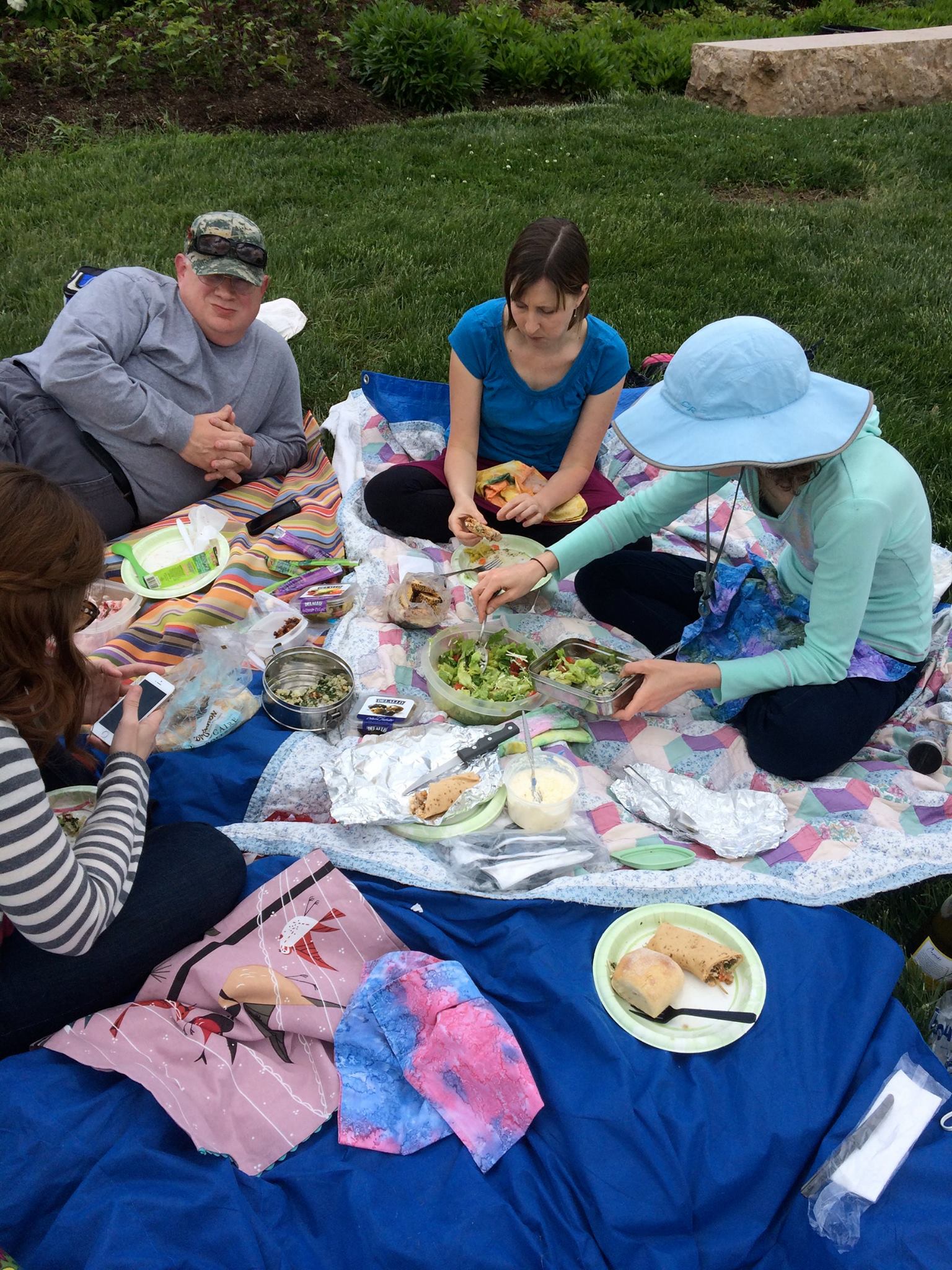
Six months later, Velo in the City had it’s inaugural event, a bike ride to Forest Park, complete with a potluck-style picnic in the park.
Photo courtesy of Monica
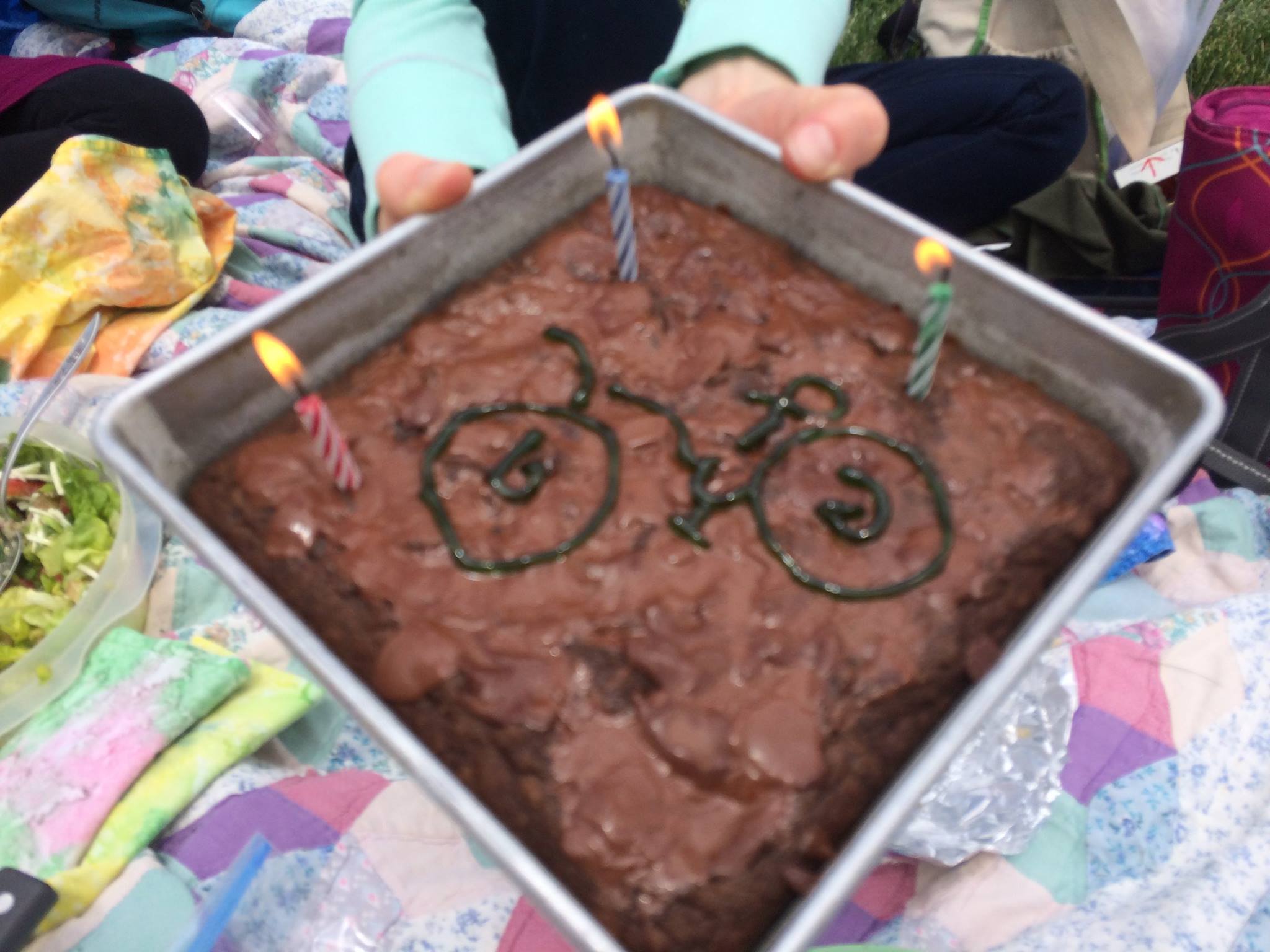
It was a perfect spring day, starting off cool, and warming up, but not getting hot, and the company was great, as was the food. We also had a birthday to celebrate, and a couldn’t resist a bikey cake!
Photo courtesy of Rebecca
I felt very content as we chatted and shared food, a nice, comfortable “these are my kind-of people” feeling. I’m looking forward to future events!
Sunday: Family Day After Saturday’s lovely ride, I just couldn’t stop thinking about being on the bike. We had plans for lunch at my FIL’s, which, at four miles away, is a relatively easy ride (both in terms of effort/energy expended and time required), but Matthew wanted to sneak in a couple more hours at the garden (at my MILs, which is 10+ miles).
In the end, I managed both. Sir and I biked to my FILs first-thing in the morning, left Roadrunner there, and continued on to my MILs by car with Matthew.
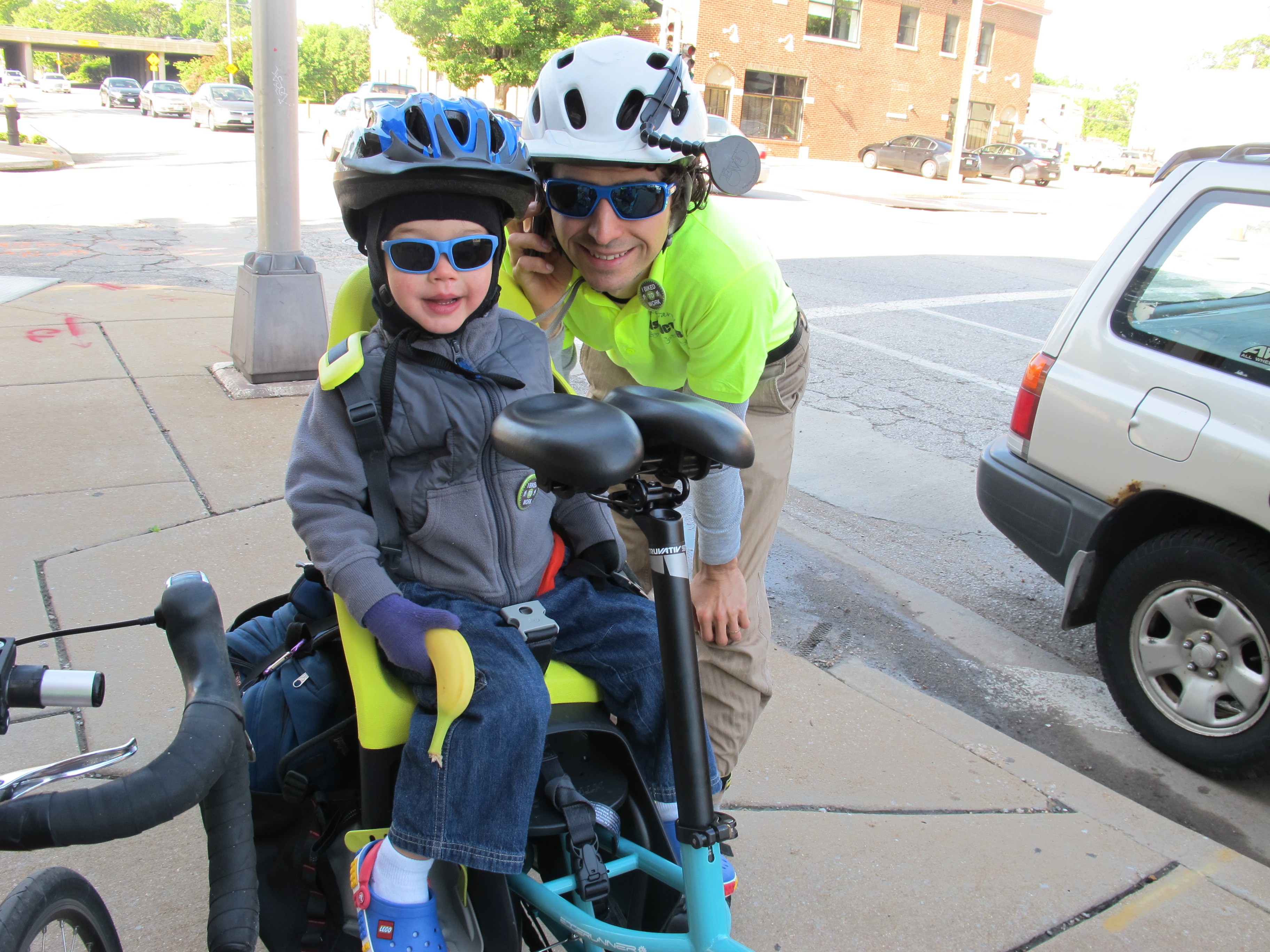
This was probably my longest ride on Roadrunner with a passenger, and it included two tough hills — the first one just steep and challenging, and the second, immediately after the first, tough because I’m still recovering from the first hill (this is not unlike the hill situation that either Matthew and I will be tackling regularly in the fall, on the way home from Sir’s preschool). I made it up both hills, slowly but surely, with my passenger chanting, “Go, Mama, go!”
And more bike I started the work week with a ride to the community college this morning (part of my circuitous route to possibly applying for SLU’s physician assistant (PA) program), for more tests to prove that I am, in fact, “college ready” (in case my undergraduate degree and my master’s, both from rather good schools, didn’t make that clear), and we’re going by bike to look at a couple of houses this afternoon. Pedals up and bike on!
This is probably the last “Biking with baby” post that I’ll write. Sir is certainly no longer a baby — he’s well into toddler-hood, and, in a few short months, he’ll be a [young] preschooler — but I started writing this post over a year ago, when he was about 19-months-old.
With the addition of our longtail with a rear child seat, we’ve now tried three out of the four main methods I can think of for transporting a baby or toddler by bicycle: trailer, front-mounted seat, and rear-mounted seat. That just leaves some type box bike on our “yet to try” list (maybe that will happen in Portland this summer!). So, let’s start at the very beginning, shall we?
Trailer Oh, the trailer. Going into this whole biking with a baby thing, the trailer was really the only option I knew of for riding with a little one, short of buying a box bike. (A trailer or a box bike really are the only options, short of carrying the infant on one’s body, for safely biking with a baby who is too young to support his/her own head, which usually happens around the 12-month mark.)
So, we did our research, decided that the Chariot Cougar trailers, with their built-in suspension systems, were the best-of-the-best, and finally found a good deal on a very good condition, 2-child model. We added the baby supporter accessory and were good to go. Kind-0f.
Ready to roll
In reality, biking with a small infant in a trailer is tricky. The baby supporter seemed necessary to keep him from just tipping over (even strapped in), and the optional neck/head support is not optional with a 6-month-old. However, it didn’t really work to use the head support piece AND a helmet (and at 6-months old, even with a big head, the smallest helmets were too big anyway). Even though I don’t [usually] preach about it, I’m a helmet girl myself, and riding around with a helmet on my head, but NOT on my baby’s head, always felt wrong.
Also, even with the baby supporter, Sir always slumped to one side or the other in the trailer, and, understandably, he was not happy about it. This continued to be an issue with the Chariot trailer even after he outgrew the baby supporter.
In hindsight, we would have been better served by a 1-child bicycle trailer. I’ve heard about people securing a standard infant car seat directly in a 1-child trailer. Using a car seat would have allowed us to start biking with Sir at an even earlier age, and it would have been easier to prop him up and eliminate the slumping/tipping problem we encountered.
In June 2012, just shy of Sir’s first birthday, my biking with babies world changed dramatically when I acquired an IBert front-seat. We kept the trailer for back-up, rain, cold, etc., but the Chariot rarely saw the light of day after that.*
Front seat Best. Thing. Ever. Our IBert front-seat was a total game changer in terms of biking with an infant/toddler! I cannot recommend a front seat enough, for all of the reasons that Scovers so succinctly over at Simply Bike.**
Riding with a front seat was easy from the get-go, and, now that I can compare, I can report that overall bike handling and balance was better with a front seat than with a rear seat.
But the real selling point of the front seat is the constant parent-child interaction and priceless bike-bonding time. You just don’t get that with a rear child seat (more on that in the next section).
My only complaint with the IBert is the strap system. The shoulder straps are widely spaced, and it was difficult to keep them from slipping off of Sir’s shoulders. Once he got bigger, the straps were also not long enough to really fit. Fortunately, there is a lap bar that also clicks into place, so even with the wonky shoulder straps, I always felt he was fairly secure.
At least on our older model, the strap also had to go over the head, which meant the helmet had to go on after clipping him in and come off before removing him from the seat — this was annoying in instances where we were making a very short stop, say, running into a store to grab one thing, and it would have been convenient to just leave the helmet on his head.
While there are a variety of options, I would say either the IBert or the Yepp Mini are the way to go here. While I really liked the IBert overall, given the issues with the straps, I would certainly look into the Yepp Mini, were I to do it all over again. But I also would not hesitate to buy the IBert.
The IBert is rated for children up to 38 pounds. Sir is just shy of that number, but, although the seat doesn’t officially have a height limit, at 39 inches tall, his legs have been pretty cramped in the IBert since last fall, and I’m now bumping my chin on his helmet. Time for something new.
Rear seat After a lot of research and pondering, we settled on a longtail bicycle with a rear child seat (Yepp Maxi) as the best option for biking with an older toddler. You can put a rear seat on almost any bicycle, but most set-ups come at the expense of cargo room, which we weren’t willing to give up, hence the longtail.
The longtail also provides a very stable base for the seat (especially with the heavy duty center kickstand), and, once he outgrows the Yepp seat (48 pound weight limit), we can add either the Hooptie accessory or just a standard handlebar, mounted to our seat post, along with a cushion, and continue to carry our growing passenger for many years.
Our longtail is great, but I do miss having my little guy right up front with me, between my arms. With him in back of me, I can usually hear what he’s saying perfectly well, but I don’t think he catches much of what I say unless I turn around, which is unsafe and unpractical to do all that much.
There are a few options that might get Gabriel in front of me again, and, ideally, we would have a second kid-hauling bike set-up anyway (say, if Matthew used the Roadrunner to drop Sir off at school in the morning on his way to work, but I needed to pick Sir up in the afternoon), but that’s for another post!
*We ultimately decided to part with the trailer this spring. It was tempting to keep it as a back-up and for bad weather, but it really didn’t make sense — the money and garage space went to the Roadrunner. I almost felt guilty selling it because having the child on the bike is just SO superior to pulling a trailer!
**More from Simply Bike on trailer vs. front seat here


![IMG_4125[1]](https://hergreenlife.com/wp-content/uploads/2014/05/img_41251.jpg)



 Her Green Life