Getting out on still-icy streets

Between Thanksgiving travel and the fact that I work from home and walk Gabriel to childcare a half-block away, trips by bike have been pretty minimal.  I rode to my [final?] PT appointment last Wednesday in fifty degree temps, and by Friday our streets were covered with a fun mix of ice and snow.

Not much ice and snow by most standards, but enough to make things interesting in a city that doesn’t plow or salt the side streets.  I don’t mean that these streets don’t get priority, I mean that these streets, including the street we live on and many of the surrounding east-west streets, don’t get plowed or salted EVER.  If it stayed below freezing until April, snow and ice that fell in December would STILL be there.  Fortunately, St. Louis winters tend to be pretty mild, current unseasonably cold December temps notwithstanding (ahem), and the ice usually melts in a somewhat reasonable amount of time.

Six-days post-precipitation most of the streets are clear, but, as of this morning, our street still had significant ice.  Matthew’s been busing to work since last Friday, and I’d been delaying errands, hoping for just a bit more thawing so I could get around by bike instead of resorting to the car.  We’ve both been missing the regular dose of physical activity!

This morning, I finally decided that enough was enough — it was time to venture out on the bike.  The view of our alley from my handlebars looked a bit dicey.

1211130927-00

This was by far the worst I encountered, and, despite a couple of deceptive clear patches, I didn’t even attempt to ride in the alley.  Instead, I walked my bike to the street, where I found [almost] nothing but clear pavement.

The risk, of course, is that a small patch of ice that would be completely inconsequential in a car can be a big deal on a bicycle.  I rode a total of two blocks that had a decent bit of ice on the roadway, and I rode very slowly and cautiously, sticking to the clear pavement in the tire tracks.  Other than those blocks, I stuck to larger, completely clear roads.

Given the roads I was using, and my flexible schedule, I realized later that I could have waited until after morning rush hour to run my errands, but the timing/heavy traffic thing didn’t occur to me in my haste to get out the door and on my bike.

It looks like our roads will be mostly clear just in time for some more wintry mix this weekend (boo, hiss).  I consider myself an [almost] all-weather cyclist, but I have a long way to go before I join the ranks of Miss Sarah.  On the other hand, it’s hard to feel like going to great lengths to prep for winter-weather riding in St. Louis, where we have relatively little snow.  Perhaps I just need to move somewhere with no winter weather!

Attending the St. Louis Regional Bike Plan workshop

Last Wednesday, I attended Moving to the Next Level: Lessons from Three Model Bicycle Friendly Communities, a workshop designed for regional planners and engineers and co-hosted by Great Rivers Greenway and Trailnet with speakers from Indianapolis, Minneapolis, and Memphis (Trailnet’s recap of the event here).

To be clear, I am neither a planner nor an engineer, and thus was not a member of their target audience.  Regardless, I decided it would be worth rearranging my schedule to hear about what was in the works and to know what messages those who control the destiny of our streets are getting.

The result?  I spent nearly five frustrating hours feeling like my brain might explode — not due to a headache (physically, I just felt exhausted), but rather due to the presentation of information in a format/venue in which alternate voices could not be heard.

Instead of reinventing the wheel, I’m going to share the text of an email I sent as a follow-up to summarize my concerns about the event.

——————–

I did my best to approach the event with an open mind,but as I sat there, I was truly bewildered and horrified by much of what I heard, and what our region’s planners and engineers were hearing.

The event was clearly not designed to allow discussion about the pros and cons of the various bike facilities that were highlighted, and I do not think commenting in that venue would have been welcome or productive.  However, I am concerned that the attendees departed with a rather one-sided view of what bicyclists want, not to mention having some dangerous myths reinforced.

  • The presentation of statistics on the “types” of cyclists was biased.  Are the 1% “strong and fearless” or are they educated and confident?  Instead of pandering to the myth of bicycling being dangerous and always requiring separate facilities, why don’t we work to make the, “interested but concerned,” educated and confident?
  • I’m guessing the majority of the attendees were not transportational cyclists, and no one mentioned processes for getting feedback and input from the people that are currently using our roads for cycling.  It’s easy to focus on what the “interested but concerned” believe would help them cycle more, but it might be more effective to focus on what the “educated and confident” feel is helpful.  The first is a theoretical proposition, while the second approach is informed by experience.  Most of the “educated and confident” were once “interested but concerned” — what helped them make the transition?
  • One recurring theme was “No matter what you do, you’re going to make somebody mad,” or “You can’t have happy cyclists AND happy motorists.”  Why not?  Education, along with facility enhancement such as sharrows and BMUFL signage, allows us to keep the road space we have accessible for everyone.
  • Andy Lutz (Deputy Directory/Chief Engineer for the City of Indianapolis) and David Peterson (Bicycle and Pedestrian Planner with the City of Minneapolis) both seemed very opposed to sharrows.  This was particularly disturbing, as the growing number of properly-placed shared lane markings in St. Louis are something that I appreciate as a cyclist.  Reducing or eliminating their use would be a step backwards, yet that’s certainly the message that was delivered to workshop participants.
  • Todd Waeltermann (Director of Streets, City of St. Louis) mentioned early in his report that when he started with the Street Department in the 90s, they “didn’t know what they were doing” when it came to bicycle accommodations.  That comment, combined with David’s photos and comments about old [dangerous] left-side and center bike lanes in Minneapolis made me wonder, do most planners and engineers really know what they’re doing now?  Right-side bike lanes (buffered or not) carry many of the same dangers as the left-side bike lanes, yet they are heralded as a step forward, as a way to make bicyclists “safer.”
  • While both Andy and David gave lip service to the importance of predictability, they both advocated practices, such as having [straight] sharrows for cyclists in the right-turn only lane, that are anything but predictable.
  • Both Andy and David talked about the cost of keeping bike lanes clear of debris and snow.  Integrating bicycle traffic onto existing roadways eliminates this challenge/cost.
  • Andy made multiple comments indicating his mindset was “if it’s up to [NACTO] standards, it’s safe.”  The fact that planners and engineers are not bothering to question these standards is disturbing.
  • When talking about “advisory” bike lanes (which I’d never heard of before the workshop, and which seem like a particularly poor idea), David said they, “help bicyclists stay where they’re supposed to be” (emphasis mine).  This statement, which undermines cyclists’ full rights to the road, also, at its core, supports the dangerous myth that our roads are first and foremost for motor vehicles.
  • Re. “advisory” bike lanes: The lack of center lines on the “advisory” bike lane streets is problematic.  Center lines facilitate lane control, which increases visibility and decreases conflict on the road.

While education was not the focus of the meeting, I was disappointed that none of the guest speakers mentioned his/her city’s efforts in this regard beyond an offhanded, “oh, and bicycle education,” type comment.  It seems that cities and communities want to replicate the infrastructure component of Denmark’s cycling scene while ignoring the fact that cyclist and motorist education is of huge import in that country.

As a cyclist and an active-living advocate I have a vested interest in how things play out in the region.  I am not sure where to go with these concerns, but I would be remiss if I didn’t try to find a way to connect with the other workshop attendees and offer an alternate perspective.

Grain mill test run and cornbread recipe

Matthew grew two types of grain corn this year, one for polenta and one for flour.  He harvested a number of lovely ears and removed the kernels, at which point we were stuck.

I attempted to “mill” some of the polenta corn in our food processor, which laughed at my efforts as the kernels spun around making quite a clatter, but coming no closer to becoming corn meal.  Next up was the coffee/spice grinder, which kind-of worked, albeit in very small batches and producing a grain with uneven texture (some almost as fine as flour, but other grains still very coarse).  Due to the presence of the very large grains in the final product, the polenta took over three hours to cook!

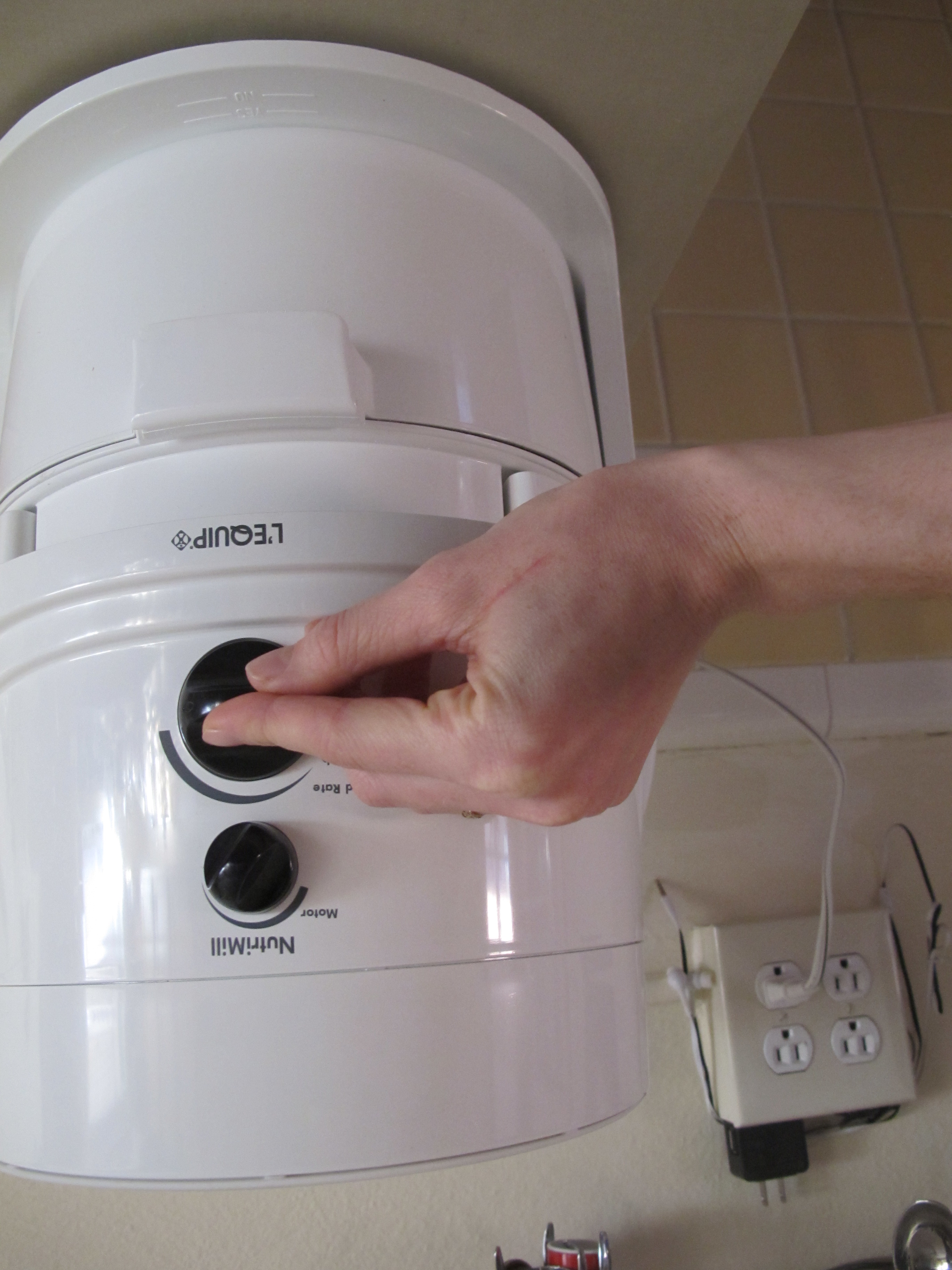
Fortunately, a friend has an electric grain mill, and she was willing to let me take it for a test run.  I wasted no time milling all of our corn before returning the mill.

???????????????????????????????

I originally planned to try other [gluten-free] grains after finishing with the corn, but that never happened . . .

IMG_3289

. . . because it literally took hours to get a relatively small amount of corn kernels through the mill.*  The corn kernels (bigger than popcorn kernels) were at about the upper limit as far as size of whole grains that would work in the mill.  I suspected that smaller grains (e.g., rice, quinoa, millet, etc.) would flow through much more quickly, and my friend confirmed this.

Despite the rather ridiculous time input, this was my best option by far for turning the corn kernels into a form we could eat, so I stuck with it.

Even on the coarsest grind and slowest motor setting (which is also supposed to contribute to a coarser grind), the milled “polenta” corn was really too fine for making polenta.  We’ll use it in cornbread and other baking where we would use “fine” corn meal instead.

Similarly, the milled “flour” corn came out much finer than I expected.  Even “fine” corn meal has some grit to it, but this was really more like flour.  Matthew later explained that this was due, in part, to the variety of corn — a type that was a low “flint” level, which is what makes corn meal gritty.

Other thoughts:

  • This grain mill is a beast — it takes up some serious kitchen counter real estate.  Granted, it’s the kind of thing that you would use every now and then and store elsewhere, but still.
  • On a related note, this would be an ideal appliance for some kind of neighborhood (or co-housing) appliance share.  It would be easy to share among a number of households, and that would also help lower the cost.
  • Along with beastly size, this machine roars like a beast.  The noise wouldn’t have been a big deal for short periods of time (<15 minutes or so), but the whole having to run it for hours thing got old fast.
  • The hopped did not really work for my big corn kernels.  I did a good bit of manually stirring the kernels in the hopper to help keep things moving.  I don’t think this would be necessary with smaller grains.
  • The lid on the compartment that holds the milled flour has a rubber seal.  While I understand the necessity of the compartment being well-sealed, this thing was ridiculously hard to remove!

While the idea of being able to turn any whole grain into flour is appealing, an electric grain mill is not on my purchase-soon list, especially with a price tag near $300.

Now that all this corny talk has whetted your appetite, here’s cornbread recipe that I’ve been meaning to share, based on this recipe at Kitchen Parade.  I discovered and adapted this recipe about a year ago, and it quickly became a favorite.

SKILLET CORNBREAD

  • 1-1/2 cups buttermilk (I used soymilk and vinegar)
  • 1/4 c. olive oil
  • 1/4 cup + 1 T. mix of sorghum and honey (or just honey)
  • 1-1/4 cups yellow cornmeal, preferably stoneground
  • 1/2 cup flour (I used half and half rye and rice flours to make a wheat-free, but NOT gluten-free, cornbread)
  • 1 teaspoon baking powder
  • 1 teaspoon baking soda
  • 1/2 teaspoon table salt
  • 1 egg

Preheat oven to 450°F.  Place a 9″-12″ cast iron skillet on the stove top over very low heat to warm gently.

Combine buttermilk, olive oil, honey, and egg.  In a separate bowl, combine corn meal, flour, baking powder, baking soda, and salt.  Mix wet ingredients into dry.

Melt butter in the cast iron skillet to coat, then pour in batter and bake for 15-20 minutes.  Time will vary based on size of skillet.

Note: I most recently made this recipe using our corn “flour” in place of the corn meal.  While the resulting product was quite delicious, the lack of grit in the corn created a product with a texture more like a muffin or cake than traditional corn bread.  In the future, I will use our home-grown corn meal/flour for the 1/2 cup of flour in the recipe, and stick with store-bought, fine corn meal for the 1 1/4 cups of corn meal.

*I was 100% on-board with keeping the mill gluten-free, since my friend’s husband has a gluten sensitivity, and being able to mill their own GF flour was a big reason they bought the mill.  However, this meant that I wasn’t able to try making my own whole wheat Cream of Wheat-esque cereal, something that my oatmeal-shunning hubby wants to try.

Over the weekend and in the works

I have a decent bit to share, but there’s that whole “time to write” thing.  My time promises to be even more crunched this week (physical therapy, no Mrs. L on Tuesday = one extra day with Gabriel, then spending over half of Wednesday at the Gateway Bike Plan Workshop), so here’s quick recap and preview of coming events!

Over the weekend
Matthew and I celebrated our 5th anniversary with a dinner date at Pastaria, followed by dancing at Casa Loma Ballroom.

It was our first visit to Pastaria — it lacked the ambiance for a romantic anniversary dinner, but we enjoyed our meal, nonetheless.  We ordered a ridiculous quantity of food: risotto ball appetizer, large kale salad, pistachio ravioli, butternut squash and sage pizza, and a side of roasted brussels.  We could have easily fed a third adult and maybe Gabriel, too!

The food was good, but too salty (Matthew’s currently reading Salt Sugar Fat: How the Food Giants Hooked Us).  Though I could have done with less salt, I really liked the kale salad.  I’ve made raw kale salads before, but theirs was special.  I particularly enjoyed the crunch of the toasted breadcrumbs in their version.

Afterward, we headed to Casa Loma, where we did not dance nearly enough to make up for our huge dinner!  Casa Loma was a first for me.  It’s a special place because it’s where Matthew’s grandparents (married for over sixty years now!) first met.  I imagine we’ll return, though we may to brush up on our ballroom dance steps at home first.

Saturday was a typical Matthew and G at the garden, me getting stuff done around the apartment, day, though that won’t be the case for much longer, with the garden mostly put to bed for the winter.

Sunday morning, Matthew and Gabriel headed out to Cedar Hill, near where Matthew grew up, to visit a family friend and buy some dried beans and other assorted goodies from his friend’s farm.

In the afternoon, we attended our first local CyclingSavvy “Advanced” session in St. Louis, an informal gathering for CyclingSavvy StL grads to share experiences and trouble-shoot challenges as a group.  It was great to see familiar faces and meet some new people, and we had some good discussions.

In the works

  • Milling corn — trying a friend’s grain mill
  • Skillet cornbread
  • Vole trouble — pestilence in the garden
  • Third cup’s a charm?

Hope to get these written sooner rather than later, but we’ll see!

Winterizing the sun porch

After a morning trip to the Botanical Garden, we spent a good chunk of Sunday afternoon winterizing our sun porch.

When we found this apartment, we were really excited about the south-facing sun porch, since it would get lots of sun (and solar heat) in the winter, meaning we could leave a lot of our potted plants out there instead of crowding them inside with us.  And while the porch did get fairly cozy last winter (except on the cloudy days), the heat dissipated all too quickly once the sun went down, leaving our plants vulnerable to freezing temperatures.

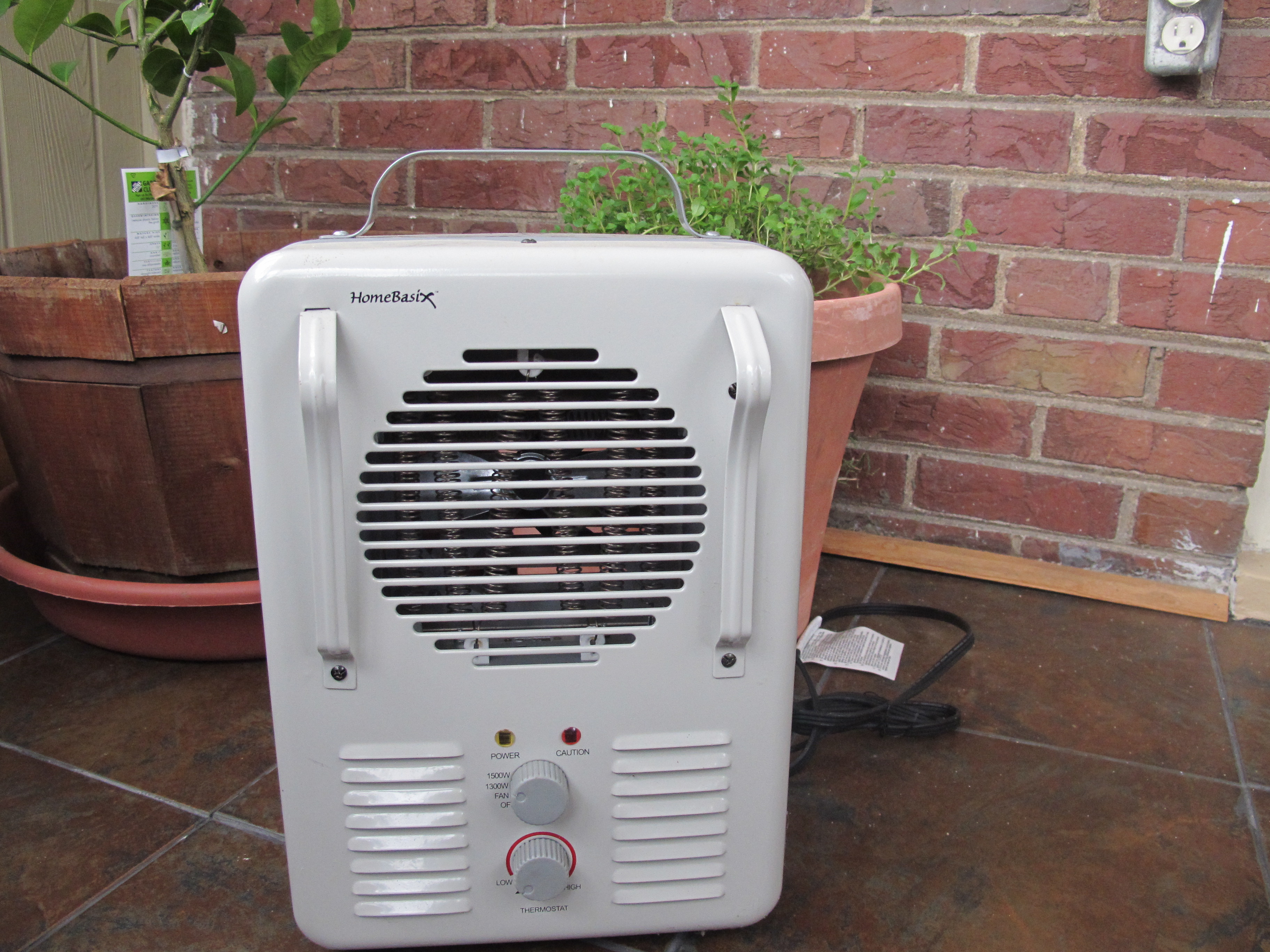
Our first step was to buy a small space heater.  It’s a milk house heater, and it has a setting where it will only kick on when the temperature dips below 32°F (this feature is not perfectly reliable, but it worked alright last year).

IMG_3295

We realized that even on the lowest, “prevent freeze” setting, this thing was going to be running all. the. time. on our drafty, uninsulated porch.  So at some point in the middle of last winter, we bought one of those window plastic kits in an effort to seal things.

It really made a difference in how much heat the porch retained, especially on windy days.  When spring arrived, we peeled off the plastic and realized it was in good enough shape that we could probably fold it up and reuse it.

The double-sided tape, however, definitely needed to be replaced.  The big box home improvement store we visited only sold the entire kit (which meant new plastic that we didn’t need), but we found a small hardware store that sold just the double-sided tape.  Of course buying the tape alone cost more than buying the kit — argh!

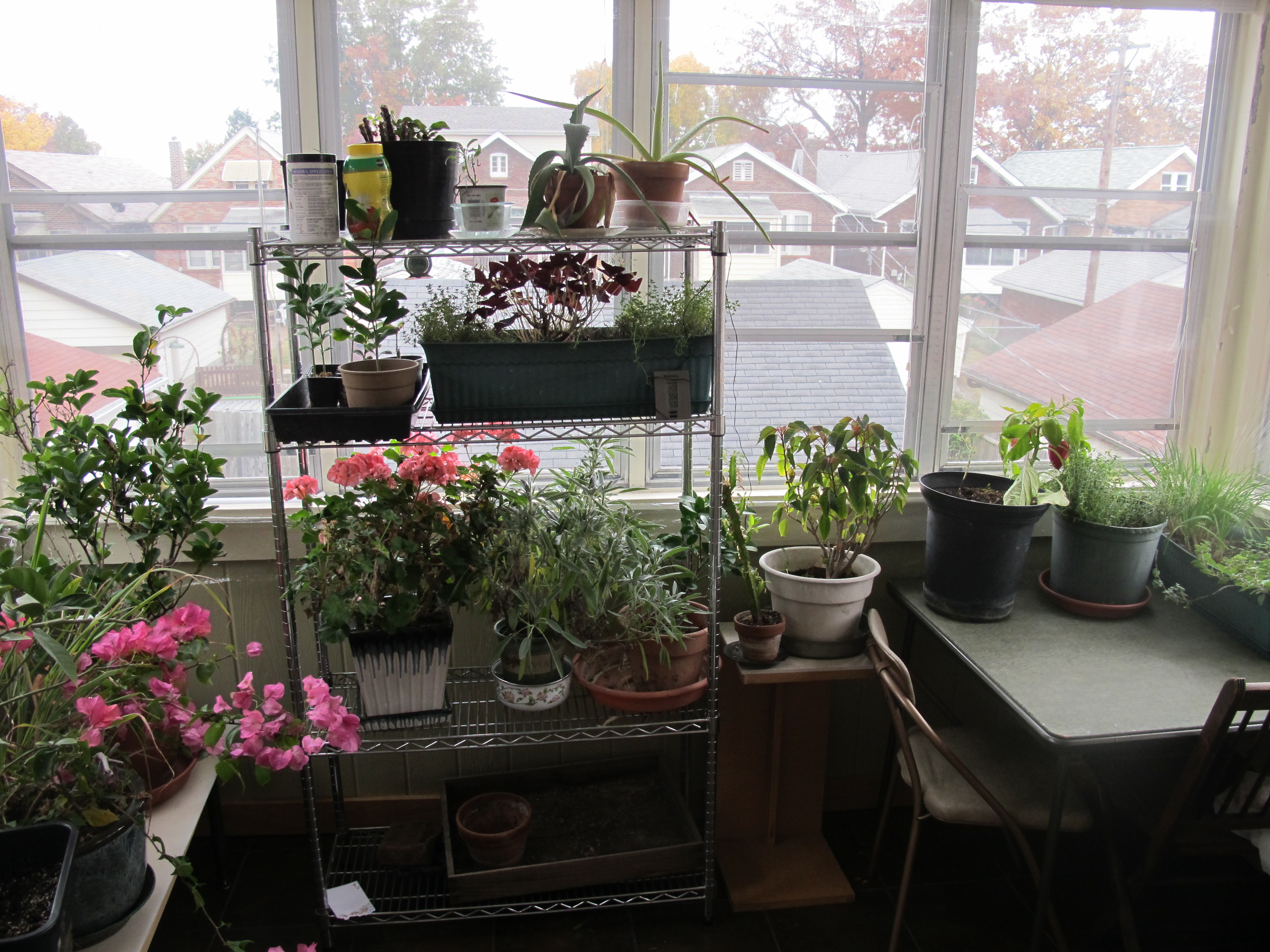
In the end, we had enough tape leftover from the two kits last year, and our reused plastic sheets worked quite well.  We rearranged the tables and shelves to maximize sun exposure and cleaned up a bit, while we were at it.

IMG_3292

You can’t really see the plastic in the photograph, but it’s there.  This arrangement leaves enough space at the table for me, so I can spend some time out there on the warmer days.  We got this up just in time for the cold weather tomorrow.

On the one hand, it seems a little crazy putting the various resources (our time, electricity, plastic and other materials) into keeping some potted plants alive, but the fact that a number of them are edible (herbs, lemon and key lime trees) justifies our efforts a bit, and it really is a lovely space now.  With the exception of very cold, cloudy days, the heater will only run at night, and perhaps not every night, depending on the severity of our winter.