Just another manic Monday

Wish it were Saturday . . .

Self-portrait on the bike

Or Sunday . . .

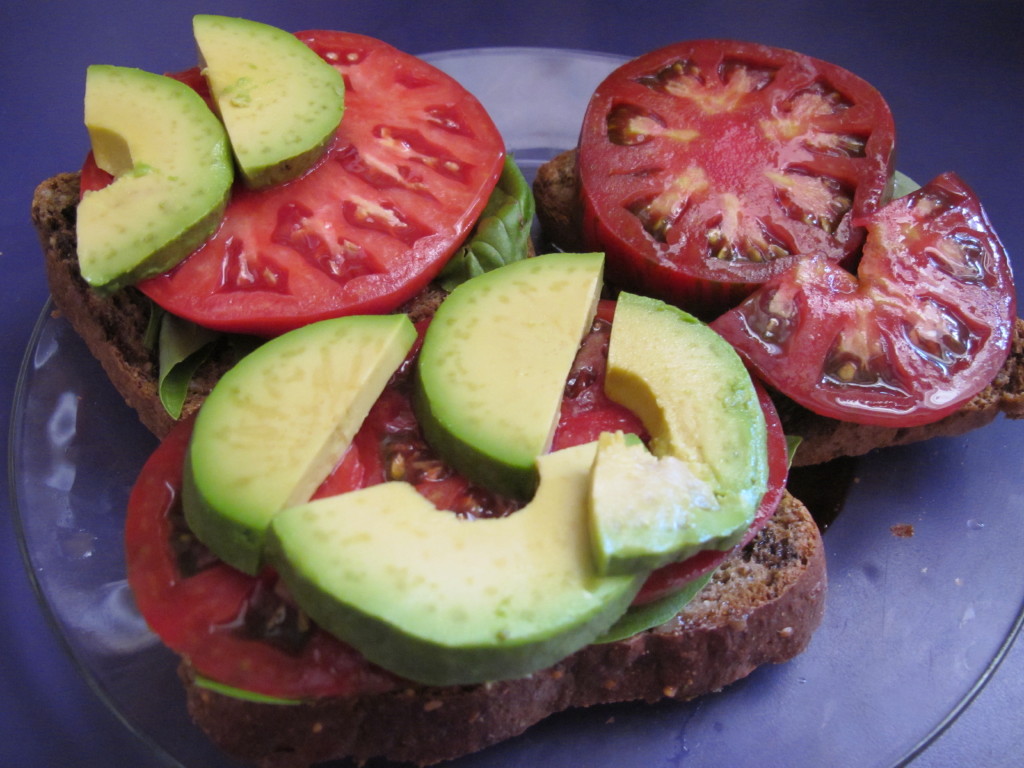
First-of-the-season Caprese sandwiches

. . . but the mania is mostly of my own making.  I took the day off to “relax,” which quickly turned into a long to-do list, which mostly involves wrangling fresh produce.  There were also some adventures with grilling — in the end, I prevailed, though it made the day much crazier than planned.  Off to deal with a HUGE zucchini.

Irrigation system

Another gardening guest post courtesy of Matthew, AKA Farmer Brown.  For all things garden-related, check out the new Browns’ Green Garden page.

Background
I’ve been gardening for a while now, and I’ve watered by hand, from rain barrels, with a sprinkler, and with soaker hoses.  By hand can be very precise, and allows use of rain barrels, but takes a lot of time once you have a larger garden.

Watering with a sprinkler saves a lot of time, but is relatively wasteful of water.  You lose some of the water to evaporation (depends on relative humidity, wind speed, and time of day), but all that wet foliage also increases the risk of a number of plant diseases.

Watering with soaker hoses is more water efficient than the sprinkler, but one soaker hose costs a decent bit, and then you must leave it in place and move the connector hose between soaker hoses, or laboriously move the soaker all around (soakers are easier to use with row gardens, but row gardens do not use precious garden space very efficiently, so I use 4’ wide beds, which require soakers to be snaked among the plants.

I’ll still use my rain barrels, both by hand watering and watering with a hose.  I’m also still pondering setting up a siphon system to increase the storage and move the water closer to the destination, but this system promises to dramatically decrease the time watering (my mom was moving the sprinkler to four locations to water the whole garden), decrease water use, and decrease plant diseases in my garden.  Here’s hoping it delivers.

Switching to drip irrigation
Drip systems take significant money and time to set up (and to learn enough about them to order one), but they allow a gardener to deploy the system and leave it in place, deeply watering the whole garden by timer without getting foliage wet.  While they cost a lot, they cost less than enough soaker hoses to water a garden, and entail much less effort than moving a hose about, and much less risk of damaging plants with hoses.  They do require the gardener (and anyone else in the garden) to be careful not to damage the system.

Thanks to a biodiversity grant from Slow Food St. Louis, I’ve taken the leap and invested in a drip system.  It took me about eight hours, spread out over a number of days, to understand the parts of the drip system, how the parts go together, the different flow rates of different components, costs and benefits of high vs. low flow, and the various calculations you need to make.

I knew I was just doing garden beds, so I simplified matters by only investigating emitter tubing and drip tape.  Using the Dripworks’ T-Tape estimator, I determined that with low flow T-Tape I could do my main garden on one zone.  Later I learned, luckily in time, that to do such a large zone I’d need to use 3/4” mainline tubing to allow sufficient flow rate to support such a large zone (most kits include the more standard 1/2” mainline tubing which can only handle 240 gallons per hour, but 3/4” supports up to 480 gallons per hour).

I debated drip tubing vs. drip tape, but the tape costs about a quarter as much and was available as lower flow with more emitters per linear foot and theoretically lasts pretty well.   I decided that the tape was worth a try, especially since the price of doing the whole garden with tubing would have been a much larger expense, and the benefits of the system are greatest with as much of the garden covered by it as possible.

I also realized I could save money, time, and water by doing each 4’ bed as a valved barb (so the water supply to the bed can be turned off), a run of drip tape, a T shaped connector, two short bits of drip tape, a 90 degree connector, and two more runs of drip tape.
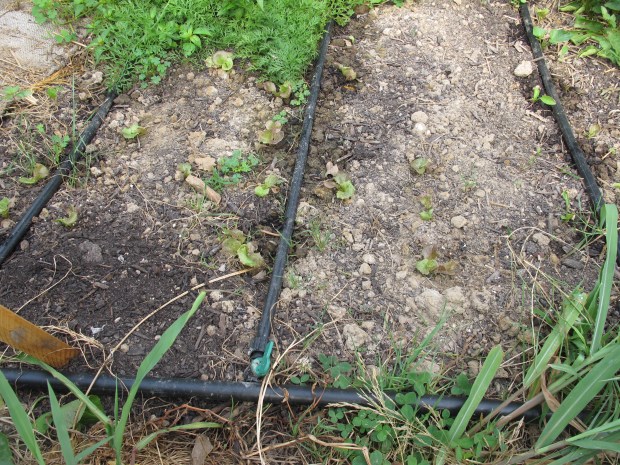
It took about sixteen hours to install, and I learned that while most instructions say to tighten drip locs for drip tape by hand and fold ends of drip tape once or twice, if you want them not to leak you should tighten with pliers and fold ends of drip tape twice.

There are many drip irrigation suppliers and companies out there; these are the two I used.  I purchased most of my supplies from Irrigation Direct with their competitive prices and free shipping, but they don’t make or carry low flow drip tape, so I got low flow drip tape (T-Tape) from Dripworks.

Bike bans, cuteness, and fun in the kitchen

A couple more photos from our trip at the beginning of the month before returning to the home scene.

Very bummed to see this sign on a road in Ames, Iowa:

Sec. 4.15. BICYCLES PROHIBITED ON GRAND AVENUE.
The riding of bicycles, tricycles or unicycles on the roadway of Grand Avenue in the City of Ames, Iowa, is prohibited. Any person who shall ride a bicycle on the traveled portion of the roadway of Grand Avenue between Lincoln Way and 30th Street in the City of Ames shall be in violation of this section.

Ugh.

On to happier things, my beautiful boy after spending some time in the wading pool with his cousin.

Despite more rounds of sickness, the refrigerator drama, and job hunting (and with it, the search for new child care arrangements), we’ve found time to continue settling in to the new apartment.

Finally hanging the pot rack was a big deal for us.  We need every bit of counter top and cabinet space in the kitchen, and this is a great solution.

We’ve debated adding a second one, and I’ve looked at several DIY pot rack options, maybe someday.  I’d love to hang our cast iron pans, but I would worry that the rack would come crashing down under all the weight.

Tomato season is in full swing, along with eggplant, summer squash, and cucumbers.

We’re enjoying finding new ways to create delicious one-dish meals featuring toms, eggplant, and squash (some recipes coming soon), including this ratatouille-style dish that also featured our freshly dug fingerling potatoes.

Cucumber soup

Until we have a garden in our backyard, growing our food is mostly Matthew’s domain, and these days, I rarely venture out to our commuter garden.  However, before we left for our trip a couple of weeks ago, I headed out for one final picking.

I harvested a boatload of cucumbers and hatched a half-baked plan to take the cukes to Iowa with us and make refrigerator dills for my family.  We nixed that plan, and the cukes sat in our dying fridge for a week.

We returned to a fridge full of still okay cukes.  After staring them down for a few days, I decided the best way to use a large number of cucumbers was some kind of chilled soup.

Some searching yielded a variety of recipes, many that only used one cucumber (that would never do!).  The most promising involved cucumbers and avocado, but, while I want to give that a try someday, I was determined to work with ingredients I had on hand, so avocado was out.

I needed something in place of the avocado to make the soup thick and rich, since cucumbers are mostly water.  The secret ingredients?  Rice and tahini.

Chilled cucumber soup

Recipe by Melissa
Serves 4-6

Ingredients
3-4 pounds cucumbers
1 cup cooked brown rice
1/3 cup good olive oil
1/2 t. salt
1/4 t. freshly ground black pepper
1-2 T. tahini
2 t. Greek spice mix (or blend of other fresh and/or dried herbs)
1-2 cloves garlic, crushed
1/3 c. chopped onion
1 c. corn (optional)

Directions
Trim and discard the ends of the cucumbers.  If using larger cukes with a lot of seeds, cut in half longways and scoop out and discard the seeds.  Dice the cucumbers.  Set aside 2 cups of diced cucumbers.

In batches, puree all ingredients, except for the reserved diced cukes and the corn, in a blender or food processor.

Try a sample, and add more salt, pepper, or herbs to taste.  Mix in the diced cucumbers and garnish with corn.  Serve chilled.

I feel like I’m taking crazy pills

Two weeks ago yesterday, we discovered, after I had a sip of relatively warm and slightly “off” milk, that the refrigerator in our new apartment was hovering between 46°F and 50°F (recommended safe temp for food is around 37°F).

The soonest a repair person could come was two days later, so we decided to buy dry ice in an attempt to keep our food good (though for all we knew it had been at unsafe temps since we’d moved in).  Given my previous dry ice escapades, Matthew went on the ice run.

Tuesday rolled around and the repairman finally showed up.  After asking me a few questions and poking around the fridge for five to ten minutes, he declared that nothing was wrong with it.

I felt like he thought I was either crazy or lying.  And I thought the same of him, given that our thermometer, which we’d tested for accuracy, had clearly showed unacceptable temps (though they seemed fine when he was there, due to the dry ice, which I pointed out to him).

Ten days, one more repair visit (in which they replaced the unit’s internal thermometer), multiple runs for both dry ice for the fridge and then regular ice for keeping food in coolers, much time wasted, lots of worry and debate over whether or not we should discard everything in the fridge to be on the safe side, and one tearful call to the landlord later, we received a new fridge.

Of course, the delivery truck arrived just as I had stepped out of the shower, in a rush to get ready to get Gabriel to the doctor and Gabriel waking from his nap with a diaperful of diarrhea, but that’s a different story for a different day.

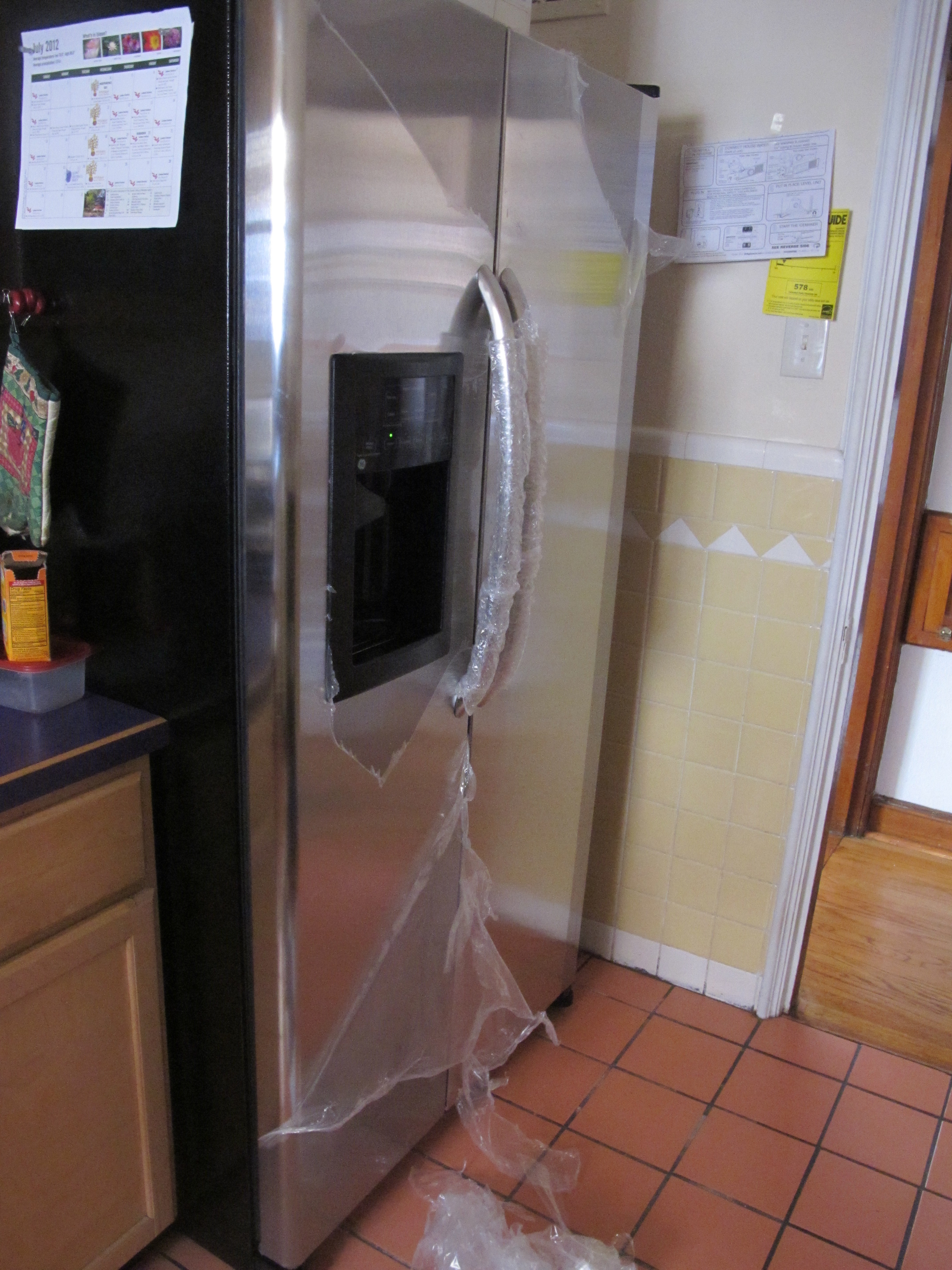
Fortunately, our landlord was there to handle the delivery.  I returned home to my lovely shrink-wrapped fridge.

The stainless steel doors were completely covered in plastic that was a huge pain to remove, not to mention the waste.  I would prefer a slightly scuffed and imperfect fridge to all of that junk.

While this is not the fridge we would buy for ourselves (freezer on bottom models are most efficient and we really don’t care about ice/water in the door), having a fridge that we know is keeping our food at safe temps is a big relief.  Now we can get back to making and and fully enjoying delicious meals with our amazing garden bounty!