Frugal foodie

Is “frugal foodie” an oxymoron?  Is it possible to eat high-quality, ethically and sustainably grown food on a limited budget?

This is a tough one, and one that I’m struggling with now, as we look for ways to trim our monthly expenses.

According to various sources, U.S. households spend a smaller portion of household income on food than households in any other country.  It is possible to eat very cheaply here.  It is even possible to eat a relatively healthy diet without spending all that much money.

We consciously made the decision, as our income allowed over the years, to shift a higher proportion of our spending to food.  I’m well aware that the items I put in my shopping cart are not always the cheapest.  I’m prioritizing things that are important to me: fresh produce, local products, organic products, fair-trade or ethically grown and produced products, eggs and dairy that are local and/or free range.  But that often comes with added cost.

And now I’m rethinking that cost.  I want to buy the product that has the lowest environmental impact and is [theoretically] the healthiest choice, but it’s not [financially] sustainable with our current income.

It’s become a bit of a balancing act — there are some things on which I try not to compromise: only organic (or local, if I talk to the farmer) when it comes to produce’s “Dirty Dozen” and organic (or at least non-GMO) soy, wheat, and corn products.  I highly prefer my dairy to be organic, but I’ve compromised on a couple of cheese purchases lately — the “good” stuff is SO expensive.  I’ve been avoiding replenishing our butter supply — since chemicals/toxins often concentrate in fat, butter is one of our priority organic purchases, but at more than double the cost of conventional . . . oof!

At Matthew’s urging, we went ahead and bought several pounds of organic, fair trade chocolate from a company that helps West African cocoa farmers, but we’re also buying some more affordable (and less Earth- and people-friendly) chocolate, so, yeah, compromises.

Strategies

  1. Eat at home / cook your own food: your money goes MUCH further this way.
  2. Shop around.  I’m the last person in the world to drive all over town just to get one item here or there, but I tend to know the best places to buy particular items.  Unless it’s urgent, I try to wait until I will be at or near that store again.
  3. Shop bulk bins for beans, grains, flour, etc.
  4. If you have storage, you can special order a entire bag of flour, sugar, grain, etc. (usually 10-50 pounds, depending on the item) from most grocers with bulk sections for a discount.
  5. Stock up when it’s on sale — having a deep freeze can help with this one.
  6. Grow your own — while there is noticeable start-up cost (seeds, mulch, soil amendments) to growing our own produce, having our own supply of many fruits and vegetables enables us to eat well without completely breaking the bank.  The cost of purchasing large quantities of some of the higher dollar produce we grow (e.g., raspberries and heirloom tomatoes, to name a couple) would be staggering.
  7. If you can’t grow your own, consider purchasing a CSA share.

What do you think — is it possible to be a “frugal foodie?”  What are your tips and tricks for saving money and still eating well?  And on what foods do you or don’t you compromise?

Of flame throwers and door zones

Digging out
Last Friday, with our street still sloppy, the UPS truck finally made it down our street (two days late) to deliver my new snow boots.  With temperatures in the 40s and 50s, our ten inches of snow is almost entirely gone.  Guess I’ll have to try out the boots later.

On Sunday, we were returning from brunch at my FIL’s when I witnessed not one, but two, rather insane snow-removal methods in my ‘hood.  Method 1 involved using a garden hose to spray water on the snow-covered parts of the sidewalk.  I was still trying to wrap my head around that one, when, less than a block later, it got better.  Method 2 involved a propane tank (like you would use for a gas grill) powering what appeared to be some kind of jury-rigged flame thrower.  The inventor of said device was directing the flame at some ice near the edge of the road.

The kicker is that it was 55º F at that point, so a good old-fashioned shovel, not to mention just leaving it there to melt, would have been more effective and less-wasteful of resources.  We were in a bit of a time crunch to get Sir home for his nap, or else I would definitely have photo evidence of Method 2.

Open with care (and don’t EVER ride in the door zone)
Saturday afternoon we took Sir to the zoo.  I snagged a street parking spot and proceeded to almost take out a kid (couldn’t have been more than fourteen) on a bicycle.  Since the very dangerous practice of door zone cycling is relatively common, I do try to check before I open the car door, but this particular time, I didn’t.  Fortunately, the kid swerved out of the way — very fortunately not into the path of an overtaking vehicle.  I don’t know if I would have even been aware of the near disaster if not for his startled, “Oh, shit!” as he swerved and rode on his way.  Yikes!

I wanted to give him a CyclingSavvy card, but I didn’t react quite quickly enough to run after him.  There was, however, a suspiciously similar-looking bike locked up outside the zoo entrance, so I tucked one of the cards into the helmet.

Aldi by bike
The clear roads mean that biking is a go once again.  The amount and longevity of snow and ice so far this winter is making me rethink not needing snow tires.

Yesterday, I road my bike to my nearest Aldi grocery store.  For various reasons (I’ll save my thoughts on Aldi for another post), I had never visited this Aldi location, despite living just over a mile away for a year-and-a-half.

The trip was mostly an excuse and motivation to step away from the computer and get outside for a bit, spurred by their weekly advertisement mentioning that they now carry [some] organic produce.  I bought some citrus fruit (the main item on my list) and a couple of other items, which ended up filling the milk-crate on my bike.

Working girl
For the past week, I’ve been rather busy with paid work, which means spending a lot of time with Microsoft Office products, completing tasks that require a good deal of focus and attention to detail.  This is something I do well, but it leaves my more creative side (including the ability to write here) locked-up and whimpering in the corner, hard-pressed to produce, even if I did want to spend more time in front of the computer.

Polar vortex

Saturday afternoon, temperatures soared into the low 40s.  There was still some slush and ice on our street, but most roads were completely clear, so I headed out for what may have been my last bike ride for a decent while here.

While we didn’t technically need any groceries, we liked the idea of having more eggs and milk on hand.  My first stop was Schnucks (a Missouri grocery chain), which probably would have been a bit crazy on a Saturday afternoon anyway.  Combine that with a forecast of ten inches of snow and sub-zero temps, and you have crazy-town!

Had I driven the car, I would have wasted lots of time and gas circling the packed parking lot waiting for a space.  As it was, I biked right up to my customary cart-return bike lock-up spot.  Talk about prime parking!

Inside the store, my bike helmet doubled as a mini shopping basket.  In addition to soy milk, I grabbed some citrus fruit.  Unfortunately, my choice of transportation didn’t save me from the long check-out lines.  It was interesting to see what other people “needed” to stock up on before the storm.  An employee was going through the lines offering free cookies, in an attempt to appease the masses, I guess.

That crazy ordeal finished, I headed to my much-lower-key second stop, Local Harvest Grocery, for eggs, dairy milk, and steel cut oats.  And our local foodie magazines!  I started to get overheated and had to stop and ditch my coat on the ride home.

After Gabriel woke from his nap, we headed out to play in the last remains of snow in our north-facing front yard.

IMG_3537

We would have had much more snow to work with on Sunday, but we feared conditions would not be conducive to much outside play time.  Make snow-people while the sun shines, right?

Sunday morning dawned with falling snow and a little boy requesting “out.”  At that point, we still had temperatures in the 20s, so we bundled up and headed out.

IMG_3542

Matthew and I shoveled show and we did some front yard sledding before walking down the street to a slightly larger hill at the park.  We’d already been outside for quite awhile at that point, and Gabriel didn’t last long.

We have a children’s lift-the-flap book about winter fun that ends with the child’s mother showing up with hot cocoa, and when we reach that page and open the flap, Gabriel excitedly proclaims, “Mama!  Ha co-co!”  He needed little coaxing to head inside for his own mug.

IMG_3551

Hot chocolate with whipped cream — mmm, mmm good!

IMG_3550

We spent the rest of the day hibernating as the wind picked up and temperatures dropped.  I made a big batch of granola in the morning, and Matthew made an apple pie in the afternoon.

Almost all schools and many businesses are closed today, but Mrs. L was willing to take Gabriel, even though none of the other kids she watches were planning to venture out.  While I wouldn’t have bothered to clear the car or risk driving on these streets, bundling up for the half-block walk to her house was no big deal.

I did end up carrying Gabriel most of the way, due to the high snow drifts (I didn’t think to walk in the tire tracks on the street until I was headed back home).  Matthew bundled up and walked to the bus stop in pre-warmed mittens and boots, where he fortunately had a short wait.  With this much snow on the streets, I’m not sure when we’ll be back on the bikes, but for now, I’m thankful for a warm apartment and being walkable to [some] places.

Food philosophy: Fad diets

I was in the car returning from a Whole Foods/Trader Joe’s run last week, when the DJ on the radio station mentioned something about a new diet, the “honey diet.”  While I didn’t bother going to the station’s website for more details, the gist was “replace all white sugar with honey, eliminate all carbohydrates one [or two?] days a week, and, whatever you do, don’t. eat. potatoes.  EVER.”

Um, yeah, can you say, “Fad diet?”  Like a string of fad diets before, the “honey diet” picks something to villainize, in this case, the humble potato, along with carbohydrates in general.  Would potatoes be a problem if you’re sitting around all day consuming nothing but french fries (and oil and salt)?  Sure.  But potatoes, especially locally and/or organically grown potatoes cooked with the skins on, can certainly be part of a healthy diet.

I read the phrase “Paleo diet” before I heard it spoken anywhere, and in my head it was pronounced “pa-lay-o,” with the emphasis on the “lay.”  I didn’t realize it was referring to our Paleolithic ancestors, and thus pronounced “pay-lee-o” for quite some time.

My first reaction was, “Haven’t we already [more or less] done this?  It was called Atkins.”

Or, to paraphrase a quote from Zoolander,  “Atkins? Lo-carb? Paleo? They’re all the same [diet]. I feel like I’m taking crazy pills.”

The thing is, I agree with some of the Paleo principles, especially those of the “Eat real food” variety.  I also agree that there are benefits from minimizing some of the foods that Paleo says we should minimize or eliminate, like dairy and added sugar.  The diet also talks about eating eggs and meat from pasture-raised animals, another plus.

One of my problems with Paleo is the vilification of whole grains and legumes.  I just can’t get on board with eliminating two major categories of nutrient-packed foods, both of which can be good vegetarian sources of protein.

From an environmental and world-population standpoint, we can’t all eat a diet based on pasture-raised meat.  There were far, far fewer humans on this planet when our Paleolithic ancestors were running around, so it worked then.  Now?  Not so much.

The Paleo diet also doesn’t take into account the fact that the idealized Paleolithic humans had far different lifestyles and energy needs than we do today, nor the fact that few of our Stone Age ancestors lived past the age of thirty, meaning we don’t know how this diet will play out, health-wise, in an age when people are regularly living seventy years or more.

The blog post, Archaeologists Officially Declare Collective Sigh Over “Paleo Diet,” while apparently satirical, and not reflective of a real scientific conference, offers some good food for thought in the midst of an over-hyped fad diet:

What people seem to ignore, he said, was that the fresh fruits and vegetables forming the basis of the Paleo Diet were created by the same agricultural process that produced cereal grains. “Nearly every food item you currently eat today has been modified from its ancestral form, typically in a drastic way, ” he began. “The notion that we have not yet adapted to eat wheat, yet we have had sufficient time to adapt to kale or lentils is ridiculous. In fact, for most practitioners of the Paleo Diet, who are typically westerners, the majority of the food they consume has been available to their gene pool for less than five centuries. Tomatoes, peppers, squash, potatoes, avocados, pecans, cashews, and blueberries are all New World crops, and have only been on the dinner table of African and Eurasian populations for probably 10 generations of their evolutionary history.

“You really want to be Paleo? Then don’t buy anything from a store. Gather and kill what you need to eat. Wild grasses and tubers, acorns, gophers, crickets- They all provide a lot of nutrition. You’ll spend a lot of energy gathering the stuff, of course, and you’re going to be hungry, but that’ll help you maintain that lean physique you’re after. And hunting down the neighbor’s cats for dinner because you’ve already eaten your way through the local squirrel population will probably give you all the exercise you’ll ever need.”

In a world where we’re faced with an overabundance of unhealthy food choices (not to mention other barriers to healthy eating, like lack of time or money to prepare healthier foods), the black and white, “Eat this.  Don’t eat that,” structure of fad diets is seductive.

The trick is to build your own healthy eating plan, whatever that looks like for you, but which can probably include almost all food, in moderation, if most of your calories come from a variety of real, whole, unprocessed foods.  Look any “diet” over with a critical eye, take the good advice (if any), and leave the rest.  Fads come and go; healthy eating habits last a lifetime.

Now, if you’ll excuse me, I have some potatoes to cook.

Next up: “Great Grains,” my approach to carbohydrates.

Grain mill test run and cornbread recipe

Matthew grew two types of grain corn this year, one for polenta and one for flour.  He harvested a number of lovely ears and removed the kernels, at which point we were stuck.

I attempted to “mill” some of the polenta corn in our food processor, which laughed at my efforts as the kernels spun around making quite a clatter, but coming no closer to becoming corn meal.  Next up was the coffee/spice grinder, which kind-of worked, albeit in very small batches and producing a grain with uneven texture (some almost as fine as flour, but other grains still very coarse).  Due to the presence of the very large grains in the final product, the polenta took over three hours to cook!

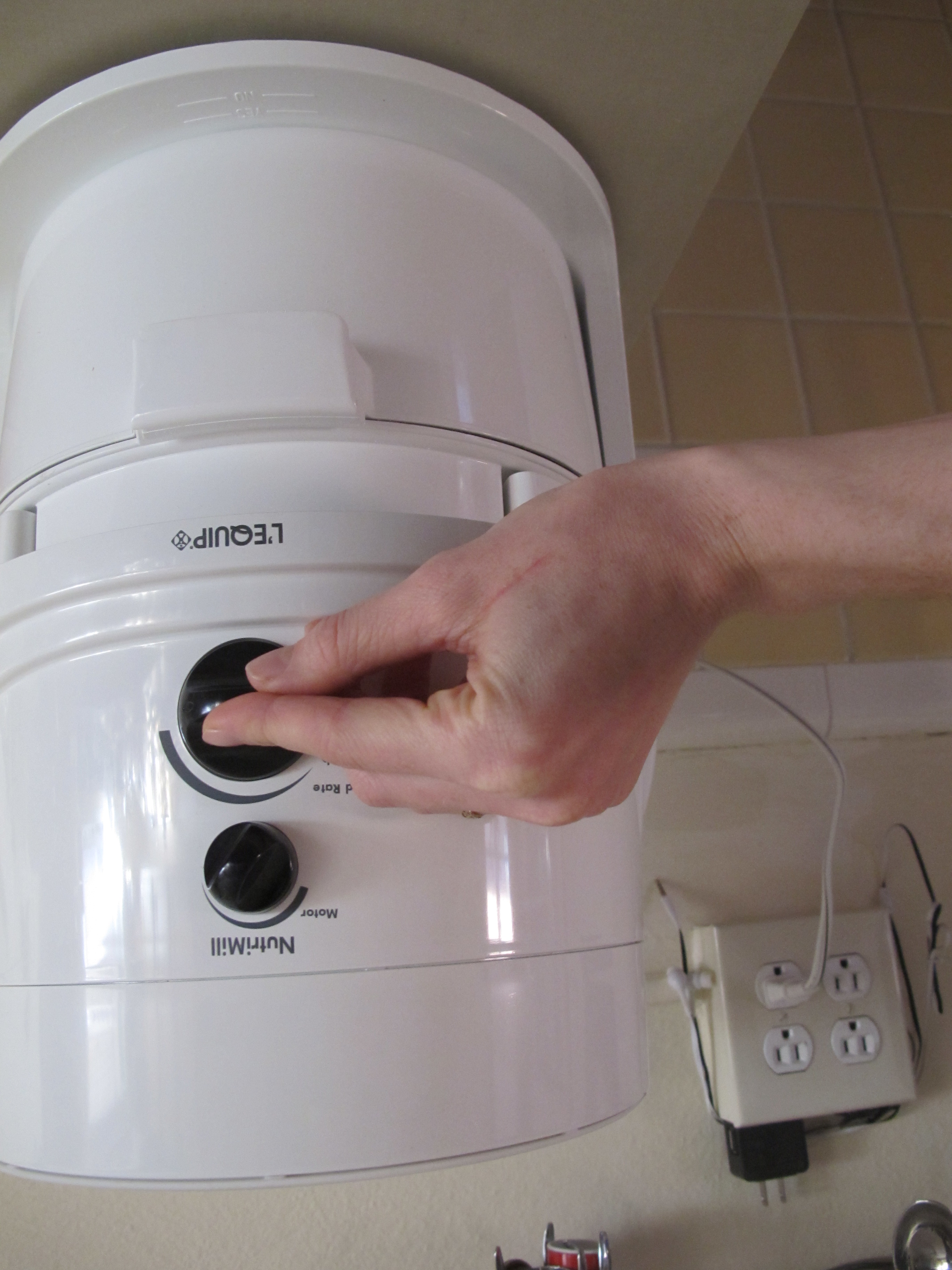
Fortunately, a friend has an electric grain mill, and she was willing to let me take it for a test run.  I wasted no time milling all of our corn before returning the mill.

???????????????????????????????

I originally planned to try other [gluten-free] grains after finishing with the corn, but that never happened . . .

IMG_3289

. . . because it literally took hours to get a relatively small amount of corn kernels through the mill.*  The corn kernels (bigger than popcorn kernels) were at about the upper limit as far as size of whole grains that would work in the mill.  I suspected that smaller grains (e.g., rice, quinoa, millet, etc.) would flow through much more quickly, and my friend confirmed this.

Despite the rather ridiculous time input, this was my best option by far for turning the corn kernels into a form we could eat, so I stuck with it.

Even on the coarsest grind and slowest motor setting (which is also supposed to contribute to a coarser grind), the milled “polenta” corn was really too fine for making polenta.  We’ll use it in cornbread and other baking where we would use “fine” corn meal instead.

Similarly, the milled “flour” corn came out much finer than I expected.  Even “fine” corn meal has some grit to it, but this was really more like flour.  Matthew later explained that this was due, in part, to the variety of corn — a type that was a low “flint” level, which is what makes corn meal gritty.

Other thoughts:

  • This grain mill is a beast — it takes up some serious kitchen counter real estate.  Granted, it’s the kind of thing that you would use every now and then and store elsewhere, but still.
  • On a related note, this would be an ideal appliance for some kind of neighborhood (or co-housing) appliance share.  It would be easy to share among a number of households, and that would also help lower the cost.
  • Along with beastly size, this machine roars like a beast.  The noise wouldn’t have been a big deal for short periods of time (<15 minutes or so), but the whole having to run it for hours thing got old fast.
  • The hopped did not really work for my big corn kernels.  I did a good bit of manually stirring the kernels in the hopper to help keep things moving.  I don’t think this would be necessary with smaller grains.
  • The lid on the compartment that holds the milled flour has a rubber seal.  While I understand the necessity of the compartment being well-sealed, this thing was ridiculously hard to remove!

While the idea of being able to turn any whole grain into flour is appealing, an electric grain mill is not on my purchase-soon list, especially with a price tag near $300.

Now that all this corny talk has whetted your appetite, here’s cornbread recipe that I’ve been meaning to share, based on this recipe at Kitchen Parade.  I discovered and adapted this recipe about a year ago, and it quickly became a favorite.

SKILLET CORNBREAD

  • 1-1/2 cups buttermilk (I used soymilk and vinegar)
  • 1/4 c. olive oil
  • 1/4 cup + 1 T. mix of sorghum and honey (or just honey)
  • 1-1/4 cups yellow cornmeal, preferably stoneground
  • 1/2 cup flour (I used half and half rye and rice flours to make a wheat-free, but NOT gluten-free, cornbread)
  • 1 teaspoon baking powder
  • 1 teaspoon baking soda
  • 1/2 teaspoon table salt
  • 1 egg

Preheat oven to 450°F.  Place a 9″-12″ cast iron skillet on the stove top over very low heat to warm gently.

Combine buttermilk, olive oil, honey, and egg.  In a separate bowl, combine corn meal, flour, baking powder, baking soda, and salt.  Mix wet ingredients into dry.

Melt butter in the cast iron skillet to coat, then pour in batter and bake for 15-20 minutes.  Time will vary based on size of skillet.

Note: I most recently made this recipe using our corn “flour” in place of the corn meal.  While the resulting product was quite delicious, the lack of grit in the corn created a product with a texture more like a muffin or cake than traditional corn bread.  In the future, I will use our home-grown corn meal/flour for the 1/2 cup of flour in the recipe, and stick with store-bought, fine corn meal for the 1 1/4 cups of corn meal.

*I was 100% on-board with keeping the mill gluten-free, since my friend’s husband has a gluten sensitivity, and being able to mill their own GF flour was a big reason they bought the mill.  However, this meant that I wasn’t able to try making my own whole wheat Cream of Wheat-esque cereal, something that my oatmeal-shunning hubby wants to try.