Farinata, farinata

Dormez-vous? Dormez-vous?

For some reason, farinata makes me start singing that song in my head.  I’m sure it’s not an indication that I’m crazy or anything, just a little different perhaps (spatula fetish, anyone?).

Anyway, we’re talking about farinata, a flatbread from the Liguria region of Italy, not the French song Frère Jacques.

We first encountered farinata in Cinque Terre.  Upon our return, I discovered a big bag of chickpea flour at an international grocer, and I’ve been experimenting with my own version ever since.

I combined aspects of these two recipes to create my current incarnation of farinata.

Farinata

Recipe  by Melissa

Ingredients
1 c. chickpea flour
1 3/4 c. water
1/2 t. salt
2 T olive oil, plus more for pan
chopped onion (opt.)
fresh rosemary
freshly ground pepper
2-4 T. white flour
Shredded cheese for the top* (a soft cheese that melts well works best — we like creamy Havarti)

Directions
Combine chickpea flour, water, salt and olive oil.  Whisk until smooth, and set aside for at least 2 hours, or up to 12 (I usually make this in the morning to cook at dinner time).

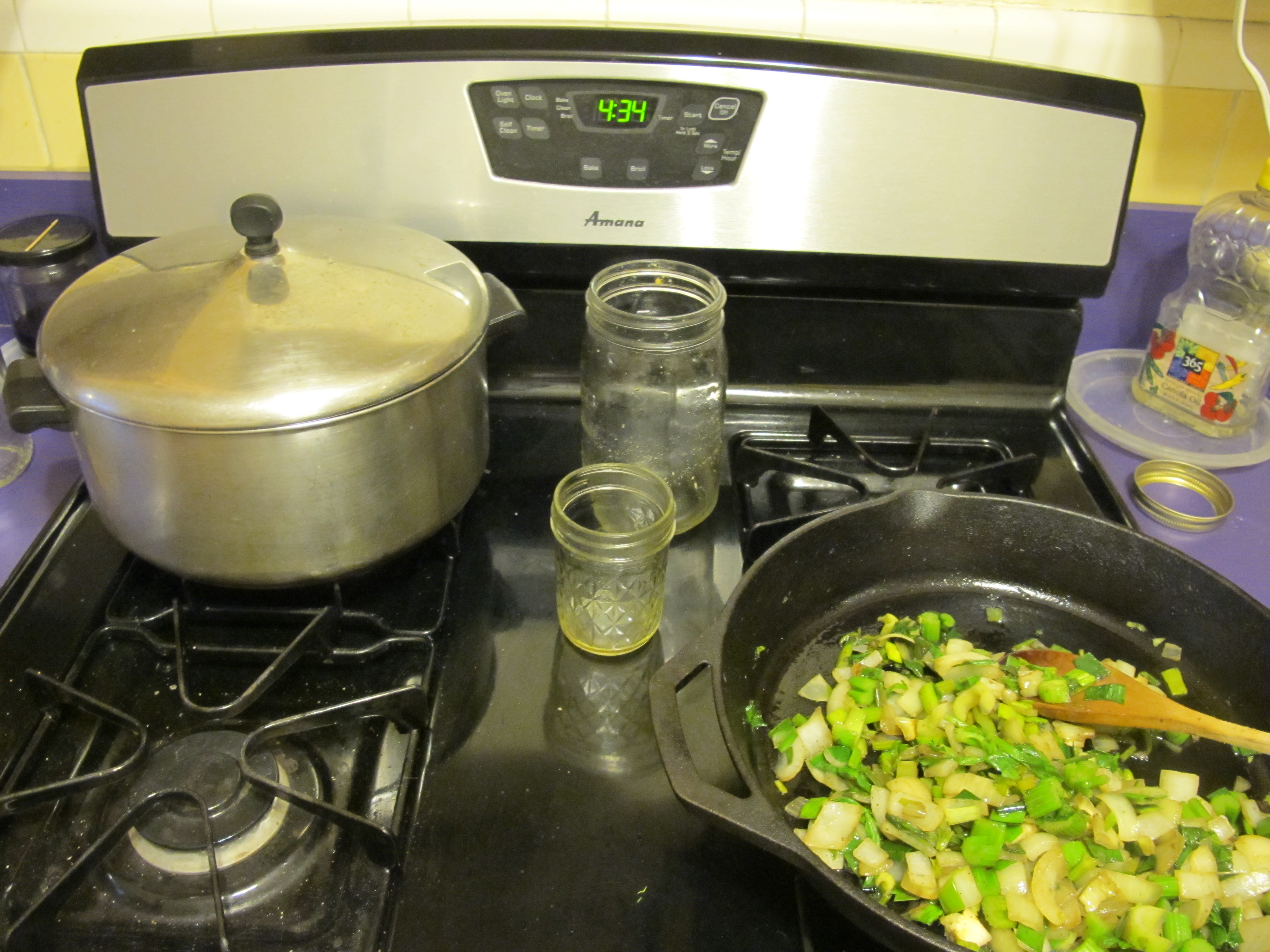
Preheat oven to 450 degrees.  Saute the chopped onion in a large cast iron pan with generous olive oil (ours is about 10-12 inches across, which works well for this size recipe).  Add the rosemary and pepper to the batter and whisk to combine.

The batter will be fairly runny, like pancake batter.  I’ve found that adding a couple tablespoons of white flour at this point helps the overall consistency.

Once the oven is hot, and the onions are sauteed, pour the farinata batter over the onions and put the pan in the oven.  Bake for 20-25 minutes, then add the shredded cheese and return to the oven for a few minutes to melt the cheese.  Enjoy right out of the oven.

*For a dairy-free version, top with red sauce and/or sauteed vegetables.  Of course, these additional toppings are also good with the cheesy version.

A Snotty Vegetarian — To Be or Not To Be

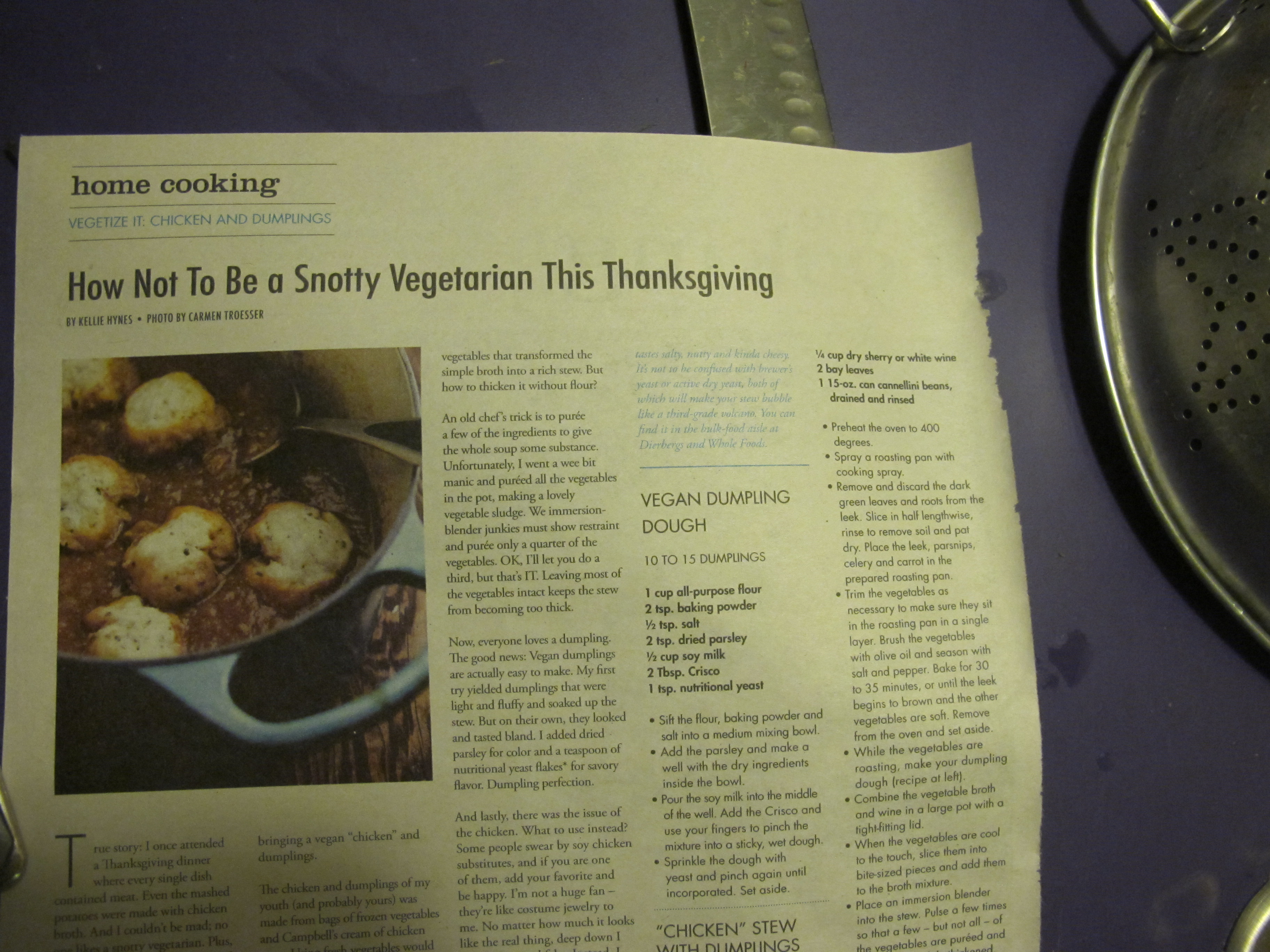
I came across this article as I perused the November issue of Sauce :

And now I’m faced with a dilemma.  You see, I was so planning on being a snotty vegetarian this Thanksgiving.  The experience would look great on my resumé, right up there under “Snotty Bicycle Health Freak.”  Heck, it may be just what I need to get my resumé noticed.

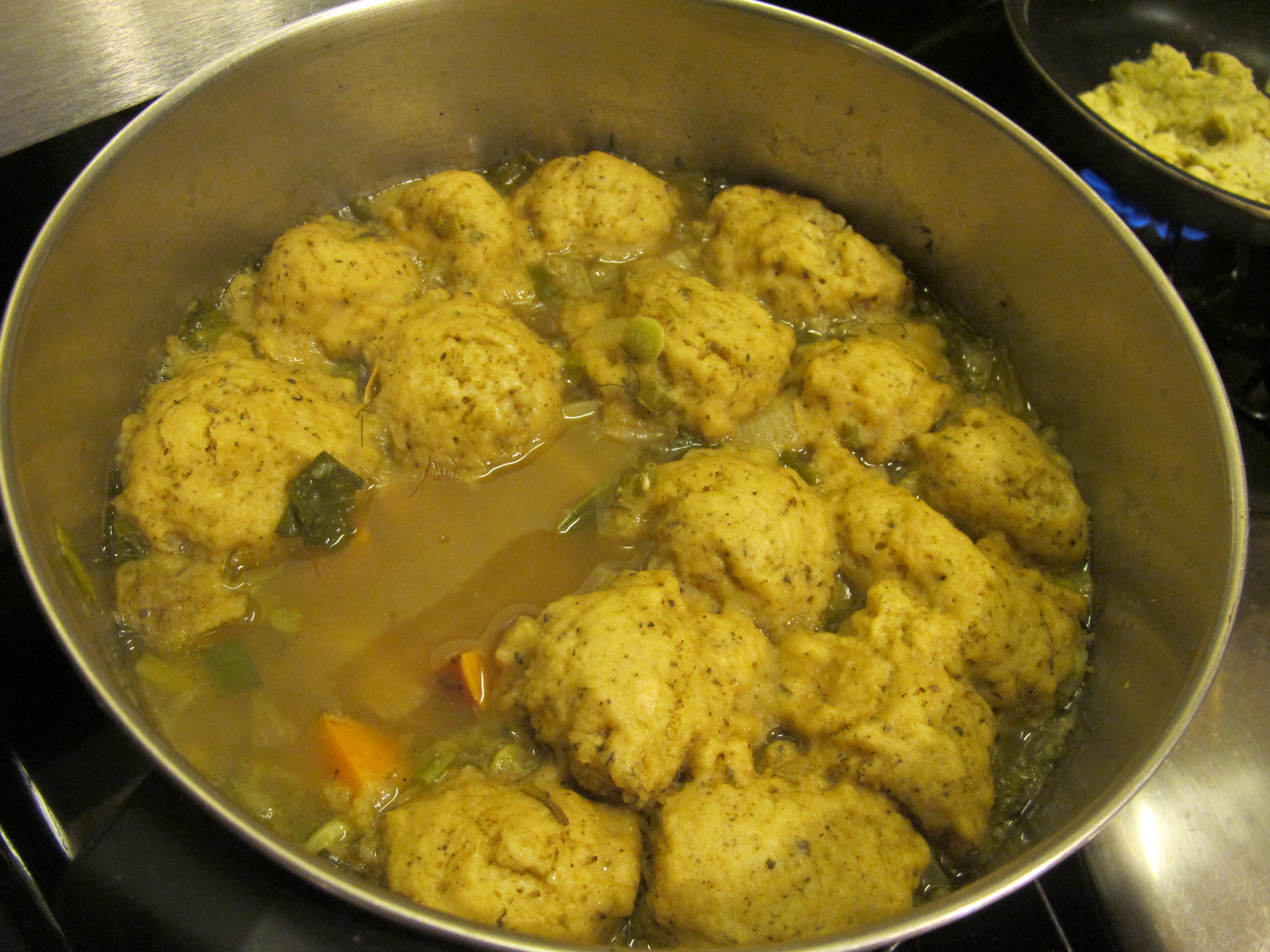
But now that I’ve made a batch of the vegetarian dumpling soup from the aforementioned article, I feel like I really have no excuse.

As much as I enjoy my chickpea flour dumplings (great flavor plus a nutritional boost from the bean flour), I’m glad I opted to follow the recipe and try something new.

As usual, I didn’t follow the recipe too closely: whole wheat pastry flour and butter for the dumplings, and lots of variations when it came to the soup/stew, but that’s the beauty of a soup.

I didn’t roast any veggies for my soup, but I did have some roasted veggie broth on hand from deglazing a baking tray earlier in the week.  I’d used [most of] our leeks in another soup, so I just used onion, plus a bit of leftover leek greens (yes, you can those).

Instead of carrots, I used sweet potato, which I adore in soup, plus that’s what we had on hand from the garden.  I’m still figuring out how to hit that  sweet spot with the sweet potatoes: melt-in-your mouth tender, but not mush.  These were close, but a little overcooked.

I used lima beans instead of the called-for cannellinis.  I really liked the limas, but a white bean would definitely work, as would garbanzos.  Either way, I applaud the author’s decision to skip fake meat (she said snottily).

The dumplings were beautiful, fluffy little pillows that rounded out the soup nicely.  To avoid soggy leftover dumplings, cook as directed, then immediately transfer the cooked dumplings to a separate dish and refrigerate in a separate container (i.e., not sitting in the soup).

Since I made this soup late last week (and just finished the leftovers for lunch yesterday), I most likely will not be using this recipe for Thanksgiving this year.  Instead, I’m thinking something featuring tempeh, and I’m browsing recipes, including those here and here, for inspiration.

Stuffing the turkey

We found a nice 30-pound bird for our Thanksgiving meal.

“Wait a minute,” you say, “I thought you guys were vegetarians.  What are you doing eating turkey?”

We’ve always said if we WERE to return to eating meat, it would be from animals raised humanely, with organic practices and plenty of time in pasture, supplemented by high quality feed, if necessary.

Well, we found a nice free-range turkey . . .

. . . whose diet was supplemented with only the best home-grown food.

Plus a few treats to really fatten him up . . .

He looked like he would have some really nice thigh meat . . .

.  .  .  so we couldn’t resist!

For those of you looking for something other than turkey, come back tomorrow for some vegetarian Thanksgiving menu inspiration.

All three Browns said bleck and frowned

While we harvested an abundance of some squash (i.e., tomatoes and squash), there were many others where we just had enough for enjoying fresh.  For a couple of weeks over the summer, we feasted on delicious edamame — simply steamed in the pod, popped out, and lightly salted (optional).  The flavor was so fresh, with a sweetness reminiscent of sweet corn, distinct from edamame I’ve eaten in the past.

Gabriel enjoyed it just as much as we did, and it was a great way to round out his meals.

While we had enough that we could have frozen a couple of bags, we opted to just enjoy it fresh, saving ourselves the work and reserving the freezer space for other produce.

A couple of weeks ago, I made a dish using frozen store-bought edamame (the same variety we’ve used in the past) and, wow, was it flavorless!  We all had the same disappointed reaction, remembering the homegrown deliciousness.

I couldn’t help but be reminded of the page in Tippy-Toe Chick, GO!, one of Gabriel’s favorite books, where the chicks react to the news that they have to wait for chicken feed instead of eating “sweet itty-bitty beans and potato bugs” in the garden:

All three chicks said, “Bleck!” and frowned.

That’s how these three chicks feel about store-bought edamame these days.  Even though it’s months away, we’re all eagerly awaiting next summer’s harvest.


An ode to my spatula

I don’t like waste, and wasting food, particularly very good food, ranks quite high on my list of things to avoid.  In some cultures, licking one’s plate is acceptable (or even expected) — in that sense, the privacy of our apartment is perhaps its own little subculture.

Licking your plate avoids food waste and ensures that you get every last bit of goodness, plus, you can put the plate straight into the dishwasher, no rinsing required (saving water), or set the dish aside to be reused.  But what about those pesky mugs and bowls where you can’t reach the bottom?

Enter the spatula.

Most any spatula will do, but a few years ago, I discovered the perfect implement at our local Italian grocer — a spoon-sized spatula with a silicone head and a wooden handle.  What started as a sometimes-used item quickly became an essential part of my place setting.

Eventually, I bought a second one to keep at my desk at work, and I often tuck one into my bag if I’ll be eating when out and about.  The spatula accompanied me to Portland, as well.  I still feel the need to use it discretely, but, where I would not lick my bowl in the lunchroom at work, I used my spatula with only minimal hesitation.  I believe I have yet to actually use the spatula in a restaurant, but that may only be because we don’t eat out all that often.

The spatula’s usefulness is not limited to the end of the meal.  You can use it throughout the meal to keep the sides of your dish clean — if you wait until the end of the meal to bust out the spatula, you’ll probably have you cooled, dried food that is impossible to remove.  Using the spatula as you go eliminates that problem.

While it may not be incorporated into dining etiquette books anytime soon, my place setting is incomplete without this useful, practical tool.

Do you go to great lengths to clean your plate or otherwise avoid food waste?  Please share your tips and ideas in the comments.