Steamed potatoes

Round two of the Great Potato dig commenced on what may have been the hottest day of the year.  Our camera rested in air-conditioned comfort before I cruelly pressed it into service in the heat of the day.  It protested with a foggy lens.

Steamy!

Our little helpers were out playing and asked if we could put them to work.  Um, did you really just ask that?  Quick!  Put them to work before they change their minds!  They didn’t stay long, but we had fun.  Far too many kids (and adults) have no idea where food comes from — we’re happy to help remedy that 🙂

Lentil love

For some reason, I put lentils in a little box where the only use was for stews and soups, i.e., dishes in which I cooked them to mush.  A scrumptious lentil salad (with nice, firm lentils) at a recent church potluck reminded me of the versatility and deliciousness of lentils.

As I browsed Show Me Vegan the other day, I came across this post about Snobby Joes, a vegetarian version of sloppy joes made with, you guessed it, lentils!  Seriously, you have to try this recipe — so good! Click here for the recipe at Post Punk Kitchen.

Growing up, my mom made delicious sloppy joes (except for that one time she left the pan on the stove and almost burned the house down).  I was a bit nervous about how Snobby Joes would stack up next to my memory of my mom’s sloppy joes (the kind with ground beef).  The answer?  This recipe will be part of our regular rotation from now on.

In addition to tasting great, the lentils in Snobby Joes provide lots of healthy plant protein.  On a budget?  This dish leaves you with plenty of green in your wallet.

My Variations

If you’re swimming in tomatoes right now, like we are, you can use fresh tomatoes in place of the tomato sauce and paste.  Just puree some chopped fresh tomatoes in the blender until you have at least 1 1/4 cups of tomato sauce.  This will work best if at least some of the tomatoes are paste tomatoes (less water content).  If you don’t have any paste tomatoes, simply suck out the tomato juice from the cut slices before adding to the blender.  (Alternately, you could squeeze the juice into a bowl and drink it, but Method #1 dirties fewer dishes.)

Cooking the lentils for 20 minutes is important.  More cooking, and you’ll get lentil mush.  Less cooking, and they’ll be a little crunchy.  The fear of mushy lentil scared me into under cooking mine a bit this time around, not bad, but I’ll go for the full twenty next time.

Don’t have buns?  Bread or English muffins work well also.  We enjoyed these on our homemade 100% whole wheat bread.  Open-faced creates the perfect bread to filling ratio.

Photo courtesy of our dying digital camera — gotta love planned obsolescence!

Entry to Nupur’s Blog Bites 5: Sandwiches and Wraps

Wood and wheat

Every time I look at other apartments, our wood floors lure me back.  Today, I dug in and gave them a much-needed cleaning.  We sweep them pretty regularly, but cleaning the floor is one of those things, like making the bed and showering, that give me pause, because as soon as I clean it, it’s just going to get dirty again.  (I definitely recommend that you NOT clean the floors before company comes, because large numbers of people tramping in are a surefire way to dirty the floor quickly.)

I started with a thorough sweeping, supplemented with a bit of vacuuming for the hard to reach spots.  No carpet means easy, usually electricity free, cleaning.  I even swept the stairs — no sense leaving them with dirt to track onto the clean floors.

Next came a bucket with a bit of cleaner and water.  I used Biokleen All Purpose Cleaner.  (I’m sure there are some great homemade green cleaner recipes out there — anyone want to share?)  The trick is to make a pretty dilute solution.  You don’t want it soapy, or you’ll have to go back over the floors with water.  I prefer a single pass.

While I was on my hands and knees washing the floor, my bread sat on the sidelines, rising.  Two 100% whole wheat plus* loaves that don’t look like doorstops = success.

Clean enough to eat off of, if you like that sort of thing 😉

*I started with this basic 100% whole wheat bread recipe that makes two loaves.  I experimented by adding wheat berries, millet, steel cut oats, sunflower seeds, coarse corn meal, sesame seeds, and poppy seeds.  These additions totaled no more than a combined 3/4 of a cup for the two-loaf recipe.  The trick with the seeds and grains is using a presoak.  I soaked the millet and wheat berries overnight.  I soaked all of the other goodies for about an hour, starting with boiling water.

Sausage on the side

Everything about the vegetable and sausage panini at Bixby’s in the Missouri History Museum sounded good to me.  Everything but the sausage, that is.  I would have ordered sans sausage, but my grandpa offered to eat the sausage.  I doubt they would have lowered the price of the sandwich if I omitted the sausage, which would have annoyed me, so this worked out well all around.


Reluctant dairy queen

Shortly after I stopped eating meat five-and-a-half years ago, I also eliminated almost all animal products from my diet.  I traded in cow’s milk for soy milk, and stopped buying eggs, cheese, and other dairy products.  To make this manageable, I never set a hard and fast, “Thou shalt not eat any animal products” rule, so if you offered me a nice homemade baked good, I enjoyed it, knowing full well that it had eggs in it.

I was a bit more stringent with the dairy, especially avoiding cheese and other fatty dairy products. My dairy avoidance was due, in part, to some anti-dairy explanation of milk as, “Filtered cow’s blood.”  Scientifically, that may be true, in a sense, but stating it as such shows some definite anti-milk bias.  Though if you want to talk about bias in the dairy industry, the pro-milk studies funded by dairy associations would be a better starting point.  I digress.  (I have other issues with/questions about milk, both on the environmental and health fronts, but I’ll save those for another day.)

Time passed, and my not-so-hard-and-fast rule turned into a less-hard-and-fast rule, and next thing you know, I’m writing posts like this one.  Since writing that post, we continue to purchase raw milk, though we switched to another local dairy, Greenwood Farms, because they sell certified raw milk, meaning they test their milk regularly and comply with stringent standards.  For all I know, Lavy Dairy’s milk MAY meet those same standards, but I do kind of like having the assurance.  Greenwood Farms milk does have a couple of downsides: 1) It costs more than 3 times (!) as much as the certified organic milk from Lavy Dairy and 2) Greenwood Farms uses standard plastic (read: non-reusable) milk jugs.  On the upside, they offer pick-ups at Tower Grove Farmers’ Market, which, compared to driving to Silex, MO, is almost as good as home delivery.

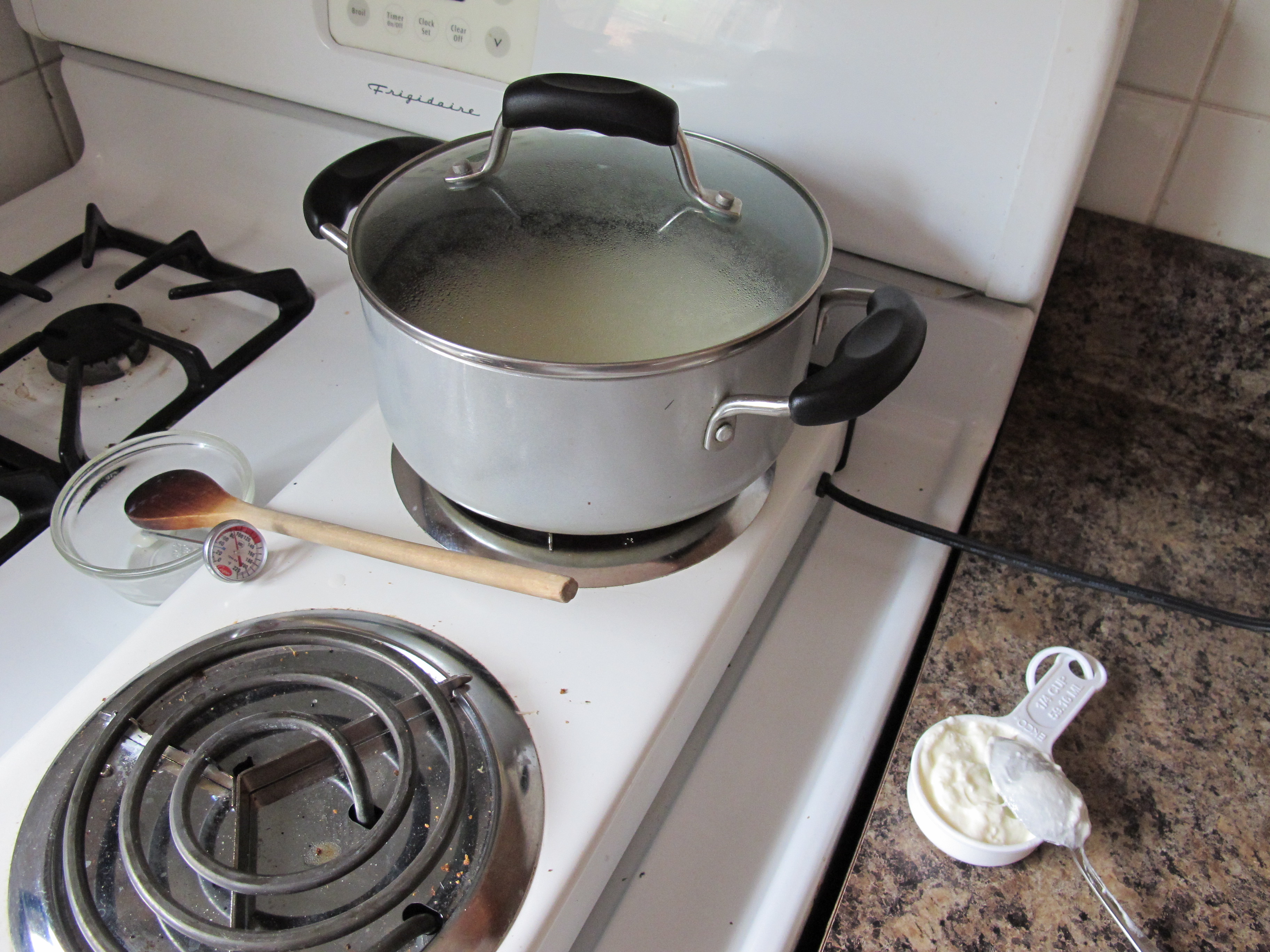
Although freezing milk, which we did with our large Lavy Dairy purchase, does not ruin it, it does change it a bit, and we prefer to avoid that with our premium-price product.  However, for two people who don’t actually drink milk, consuming a gallon of the stuff before it goes bad presents a bit of a challenge (it seems to stay good for about 10 days, which is similar to the point when pasteurized milk goes bad).  We plan to experiment with cheese making, but we don’t have the cultures and vegetable rennet.  In the meantime, we’ve been making yogurt and ice cream.

After several edible but imperfect yogurt attempts (flavor not quite right, too thin, strange consistency), I remembered that we had a yogurt maker growing up.  A quick call to my mom confirmed that said yogurt maker still existed, plus two others that my parents acquired at garage sales over the years, all sitting in the basement, quite neglected.  While I certainly was not about to go out and buy a yogurt maker, I happily adopted one of my parents’ trio.

I greeted the new appliance with some suspicion, since it just barely felt warm when I plugged it in to preheat it.  After about seven hours, I very skeptically opened one of the yogurt containers to find . . .  perfect yogurt!

What with the milk, homemade yogurt and ice cream, and local cheese purchases, I somehow find myself eating dairy (often a relatively small amount that wouldn’t count as an official “serving”) at least once a day, if not more.  I’m not sure how I feel about that.