Carbon fast – Day 16

Consider composting your food waste.  Put the nutrients from food waste back into the soil, not into a landfill.  Learn more about composter options for indoors and outdoors.

This tip comes as I am one week into my vermicompost experiment.  So far, so good.  My little helpers sustained one casualty so far — a little guy that crawled (or fell) out one of the drainage holes in the bottom and dried to a crisp before I found him (tear).  As I’ve mentioned before, if you want to learn about composting with red worms (i.e., vermicomposting), check out the book Worms Eat my Garbage.

While you can just throw everything in a pile outside, there are some simple tricks that can make the composting action in the pile more efficient — specialized container definitely optional!  Here are some composting-related links that may be of use:

HowToCompost.org

10 Tips for Making Better Compost

Compost Made Easy

Daily action from http://www.lcwr.org/lcwrsocialjustice/eoclentcalendar2010.pdf

Carbon fast – Day 15

Be aware of how much food you discard this week.  Look for opportunities to avoid wasting food by planning well and eating leftovers.

What's in your fridge?

I found these stats on food waste startling:

“The U.S. Department of Agriculture (USDA) estimates that Americans waste 30 percent of all edible food produced, bought, and sold in this country, although it acknowledges that this figure is probably low. Recently, two separate groups of scientists, one at the University of Arizona and another at the National Institutes of Health (NIH), published estimates of 40 percent or more. Add up all the losses that occur throughout the food chain, the NIH researchers say, and Americans, on average, waste 1,400 calories a day per person, or about two full meals.”¹

This article explains why/how this egregious level of waste occurs — it will help you start thinking about food waste and ways to reduce it.

Veggies lost their luster?  Cut them up and make a soup or stew.  Fruit on its last legs?  Toss it into the blender with some milk, juice, or yogurt to make a smoothie.

What are your tips and tricks for avoiding food waste?

Daily action from http://www.lcwr.org/lcwrsocialjustice/eoclentcalendar2010.pdf
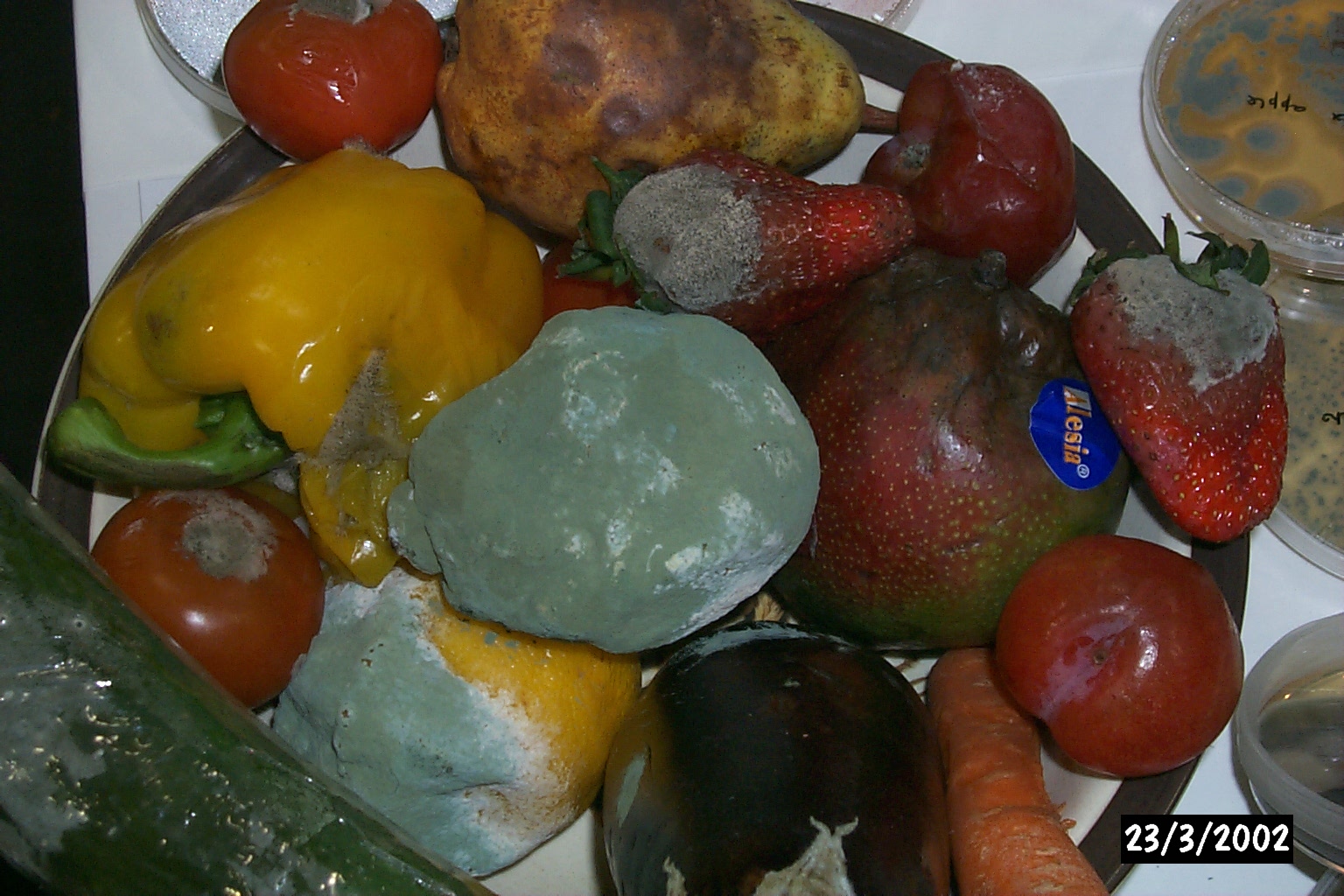
Image of rotting food from http://www.fungi4schools.org/Documentation/Photo_Gallery.htm

1. Wright, Laura.  “How to Wage War on Food Waste.” Available on the web at http://www.onearth.org/article/how-to-wage-war-on-food-waste

Carbon fast – Day 10

Look to purchase locally grown food today.  Plan to walk to a farmers’ market this weekend or consider joining a community-supported agriculture (CSA) group that delivers local produce (www.localharvest.org).

If I designed the calendar, I would have saved this tip for as late in the game as possible to increase the chances that farmers’ markets would actually be open in central and northern latitudes.  They failed to consult me on this, but, by some stroke of luck, the local eating tip just so happens to coincide with the Schlafly/Maplewood winter market tomorrow (Saturday, February 27th).  While produce will be limited at this time of year, you can shop for local eggs, cheese, jams, salsas, and meat (if you swing that way).  Click here for more details.

Daily action from http://www.lcwr.org/lcwrsocialjustice/eoclentcalendar2010.pdf

Carbon Fast – Day 3

Go meat-free today.  Choosing meat-free meals is one of the most powerful things you can do to reduce your carbon footprint.

Yesterday and today’s carbon fast actions barely created a ripple around here.  Before I became vegetarian, the Fridays of Lent required a bit more thought, and they often included some type of fish.

Despite some potential health benefits and (perhaps) having a smaller carbon footprint than meat, fish and other seafood still have environmental costs.  In the Midwest, most seafood must be shipped a good distance to reach our stores and tables.  Demand for fish leads to overfishing, a serious problem in many parts of the world, especially marginalized areas where people rely on the sea for their food.  Fish farming, commonly used for salmon, involves feeding the fish lots of unnatural food, like corn, along with artificial coloring to provide that nice “healthy” pink hue.

Daily action from http://www.lcwr.org/lcwrsocialjustice/eoclentcalendar2010.pdf

Craving

Wild mushroom tamales with an adobo cream sauce

Oh, Fresh Gatherings, why must you tease me this way?

The Nutrition and Dietetics department at SLU runs Fresh Gatherings — they source much of their food locally and make delicious, healthy dishes.  In a past life, I could easily walk there for lunch.  Now, lunch there is pretty much out of the question, since they’re only open on weekdays.  I torment myself by continuing to receive their weekly menu emails.  Excuse me while I wipe the drool off of my keyboard.