Pumpkin lasagna

Two months ago, I wrote about an amazing pumpkin lasagna that we Matthew made, wherein I promised a recipe “soon,” and left you hanging.  Soon has come and gone, but we recreated the lasagna for our New Year’s Eve meal, making [an almost] vegan version to accommodate my current dairy-free diet.

We originally made an only-slightly-adapted version, using some cashew butter, but retaining the cream and Parmesan cheese.  The recipe here is vegan, except for our homemade noodles, which contain eggs.  Once again, we benefited from having homegrown Swiss chard and squash prepped (from the deep freeze this time), as well as the noodles made up from a previous night.

Happy cooking and eating!

Pumpkin Lasagna
By Matthew
Adapted from Food & Wine

Ingredients (makes 8 very generous servings, or 12 smaller portions)
4 tablespoons olive oil
1 ½ cups onions, chopped
2 pounds Swiss chard, washed well and chopped
2 1/2 teaspoons salt
1 1/2 teaspoon fresh-ground black pepper
2 Tablespoons sage
1 teaspoon freshly grated nutmeg
6 cups pumpkin (or any winter squash) puree (or two large cans)
9 amaretti cookies, crumbled
1 1/2 cups heavy cream
1  cup bread crumb topping (see recipe below)
1/2 cup cashew butter
3/4 cup warm water
1/2 cup soymilk
1 recipe homemade spelt pasta cut into angel ribbon lasagna (or 9 whole wheat no bake lasagna noodles)
 

Directions
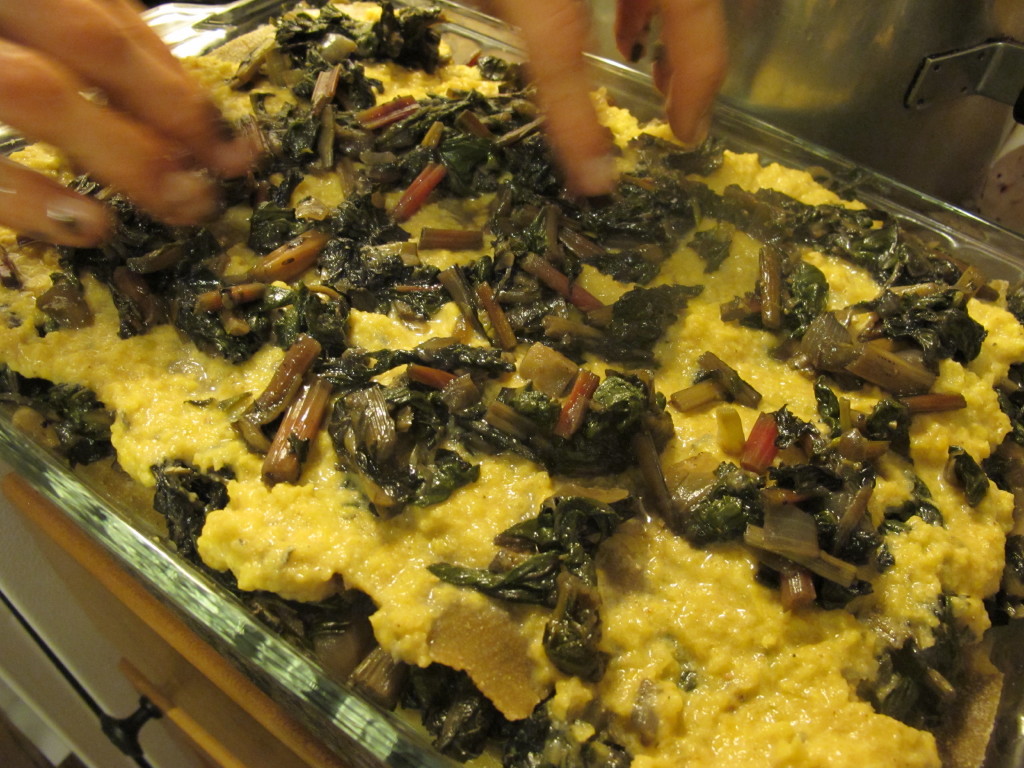
In a large cast iron or nonstick frying pan, heat the oil over moderately low heat. Add the onions and cook, stirring occasionally, until translucent, about 5 minutes. Increase the heat to moderately high and add the chard, 1 teaspoon salt, 1/2 teaspoon pepper, 1 Tablespoon sage, and 1/2 teaspoon nutmeg. Cook, stirring, until the chard is wilted and no liquid remains in the pan, 5 to 10 minutes.

Combine the cashew butter and warm water to create a cashew sauce.

Heat the oven to 400°. In a medium bowl, mix together 6 cups of the pumpkin, amaretti cookie crumbles, cashew sauce (from previous step), and the remaining 1 1/2 teaspoons salt, 1 teaspoon, pepper, 1 Tablespoon sage, and 1/2 teaspoon nutmeg.

Pour the soymilk into a 9-by-13-inch baking dish. Top the soymilk with one
third of the noodles, then spread 1/3 of the pumpkin mixture over the noodles. Layer half the Swiss chard over the pumpkin and top with a second layer of noodles. Repeat with another layer of pumpkin, Swiss chard, and noodles.

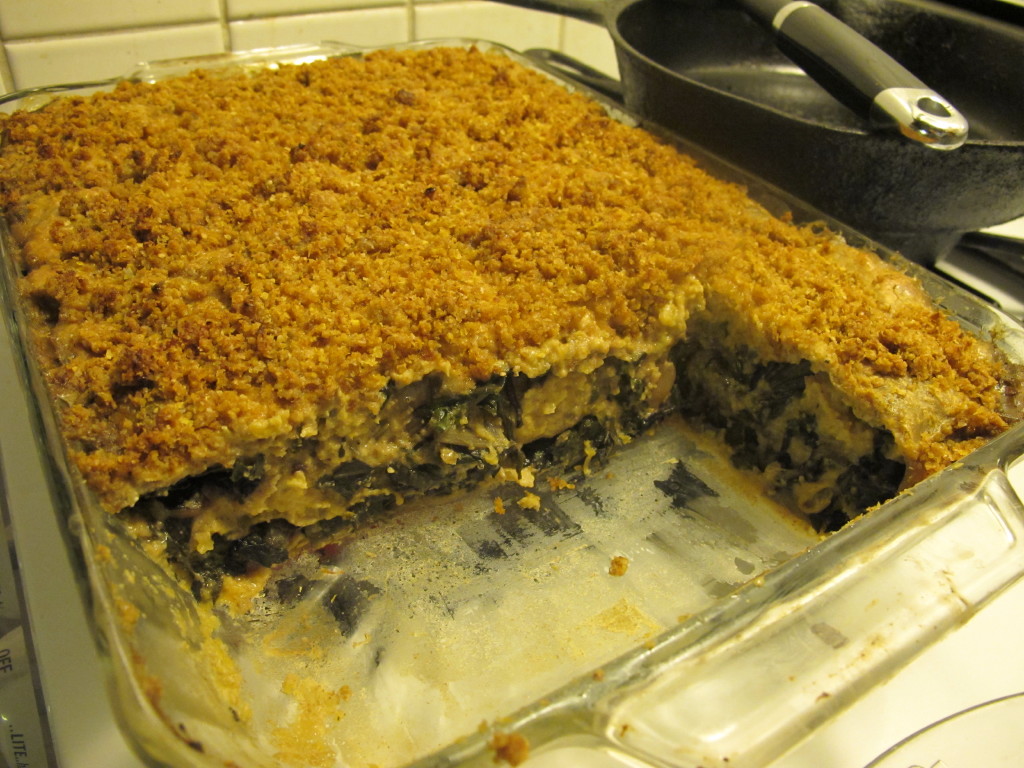
Spread the remaining pumpkin mixture evenly over the top of the lasagne, and sprinkle with the bread crumb topping.  Cover with a cookie sheet on a higher oven rack and bake for 20 minutes. Uncover and bake until golden, about 15 minutes more. Let cool, to set up, for 10 minutes before cutting.
Bread crumb topping
I created this topping as a substitute for the Parmesan cheese in the original recipe.  It came out quite well.

Ingredients
2/3 c. whole wheat bread crumbs
1/3 c. wheat germ
1/3 c. nutritional yeast
1/2 t. garlic powder
1/3 c. vegan butter substitute, like Earth Balance

Directions
Combine dry ingredients in a bowl.  Use a pastry blender to cut in the Earth Balance, creating a crumbly mixture that you can sprinkle on top of the lasagna.

Garden goods

Despite the craziness of having a baby in the middle of the summer, we managed to have a great year garden-wise.  Understandably, my involvement in the actual gardening, and in putting up the food, was even more limited than usual.  I just sat on my butt all day cared for a very demanding baby and enjoyed eating the garden’s bounty.  We canned some green beans, and my mother-in-law canned tons of tomatoes and froze lots of other veggies for us.

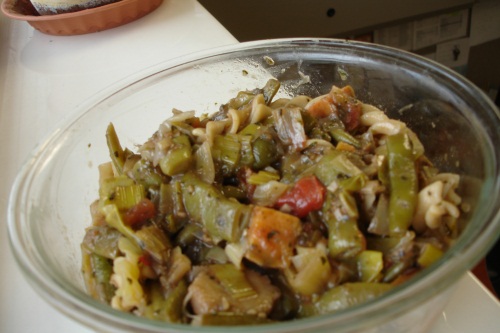
Last week, we made one of our favorite soups, Country Vegetable Soup with Pasta, almost entirely with garden goods, including fresh tomatoes in mid-December (picked green before the frost in early November, and ripened slowly inside since then).

Homegrown goods in our soup included leeks, tomatoes (fresh, not canned), onion, celery, sweet potatoes (subbed for carrots in the recipe, because that’s what we had), green beans (from frozen), and basil (also frozen) for the pesto.  We didn’t have any zucchini, so we just subbed more of the other veggies. Hearty and delicious, and so fun to have grown almost all of the ingredients!

In the end, the only non-garden item in the soup, other than the pasta, was the garlic.  We had a nice garlic harvest, but at the rate we go through garlic, I’m not sure we’ll ever be able to grow enough (though Matthew’s working on it 🙂 ).

Eating in

A year ago yesterday, we donned our wedding attire and headed out to celebrate our anniversary at one of St. Louis’ top-ranked, award-winning restaurants.  A place known for a small, seasonal menu, top quality ingredients, and prices to match.

Sadly, but perhaps not surprisingly, these food snobs connoisseurs found that the dinner did not live up to the hype.  Our meal was good, but nothing to write home about.  We ordered our standard “a few dishes to share,” but Matthew felt the atmosphere and attitude of the staff was not conducive to this, which further downgraded the experience.

Enter last night, and a much better anniversary dinner in our own kitchen, lovingly prepared by chef Matthew: marinated tofu and pear salad, pumpkin lasagna, and apple pie for dessert.*  Complete with candles, wine, and a nice, relaxed atmosphere, we agreed it was a major upgrade from last year.  That type of a dinner for two would easily cost $70+.  We enjoyed a delicious dinner for a fraction of the price, with most of a large pan of lasagna to enjoy later in the week.

While having a baby requires compromises and cutting back in some areas, we’re finding it’s essential to continue some activities from before baby.  For us, growing, cooking, and eating amazing food (okay, mostly Matthew on the “growing” aspect) fall into that category.  Yes, we are both exhausted and time is precious, but for us, this is worth it.  While in some ways it makes life more crazy, in other ways it helps preserve our sanity.

——————————-

*Meal ingredients from the garden: mixed greens for the salad, “pumpkin” puree (technically some variety of winter squash), onions, Swiss chard, and sage.  Other local ingredients: pears and apples.

I’m planning a full recipe post later, but we adapted this recipe to make our pumpkin lasagna, using our homemade pasta for the noodles.

Planting garlic: Excitement and agony

A guest post by Farmer Matt

Who doesn’t get excited by growing gorgeous, flavorful bulbs of garlic with names like Music, Cherokee Red, Broadleaf Czech, Tochliavri, Inchelium Red, and Elephant Garlic?  Some people advocate planting around here in August, others in October after the first frost.  Last year I planted in August with good results, this year, due to the little one, I’m finally got it in on October 8 (no frost here yet), so we’ll see how it does.  For seed stock, I saved garlic from this year’s crop to replant and bought new varieties from Seed  Savers.  Time and conditions permitting, I may buy some Elephant garlic from Whole Foods and try to get that in as well.

Soil Prep
I definitely recommend planting garlic sometime in the fall for harvest early the following summer.  I plant it in well worked soil with good drainage and plant it in beds to avoid compacting the roots; this also makes it easier to apply a heavy layer of mulch.

Planting
Gently separate cloves, leaving as much of the paper wrapper on them as possible; plant 6-8” apart, or 12” apart for Elephant garlic.  Plant cloves pointed-end up, cover with ½-1” of soil, and then mulch with leaves, ideally chopped.

Harvesting
I cut off scapes in the spring when they’re about 12” long, and harvest when the plant’s leaves start to yellow, checking the bulbs for the cloves bulging through the wrappers to confirm that it’s time to harvest by gently digging the plants up from below.

The agonizing part is that with garlic the “seed” is exactly the same clove you want to eat.  Even worse, it’s one of the few plants where planting the largest cloves makes a big difference in the size of the bulb you’ll harvest next year, so you have to plant your most beautiful, gorgeous garlic to keep your quality high.  As I’m working on increasing my planting stock and my harvest, I had to plant most of my garlic.  I planted about 175 cloves, roughtly 30 bulbs.  My mother and my family have eaten maybe 8 bulbs each so far, and we both have 8 bulbs left, so we’ve used 32 of the smallest bulbs, and I’ve replanted half of this year’s harvest.

Eating for two

I’m taking this eating for two thing very seriously.  After all, I do have a big baby to feed (10 lbs, 2 oz at birth and 10 lbs, 5 oz at 1 week).  Fortunately, we have an abundance of delicious food in our refrigerator (and freezer).

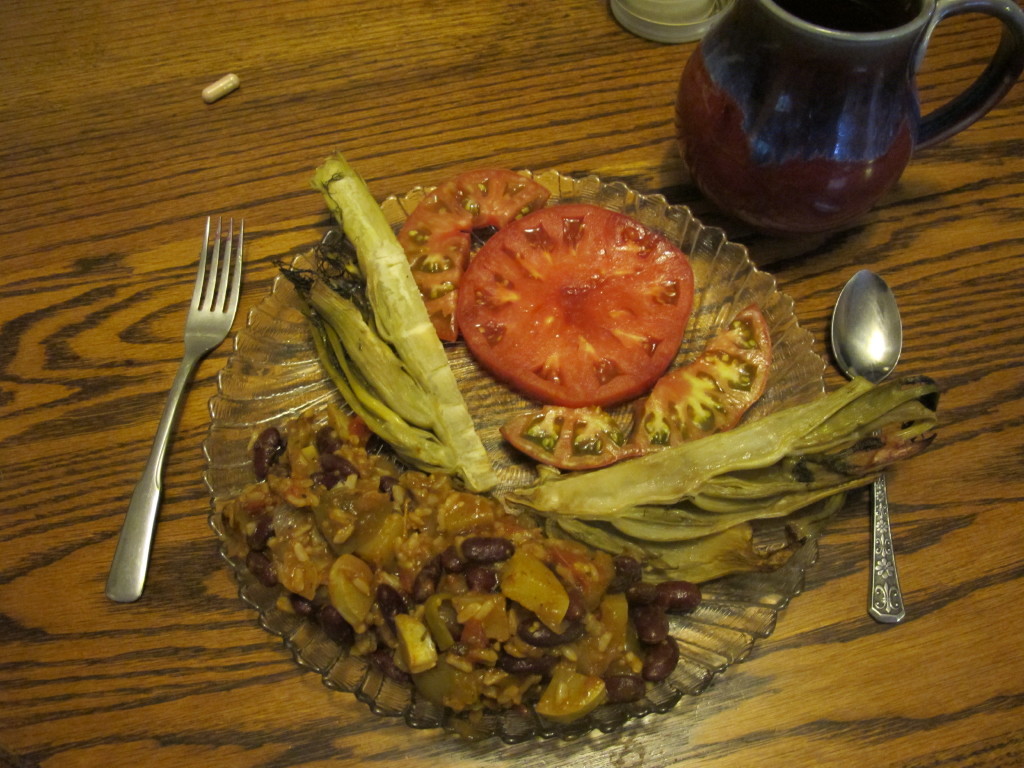
Red beans and rice, with sides of roasted fennel and sliced garden tomatoes

We have tons of amazing stuff coming in from the garden — tomatoes, potatoes, Swiss chard, kale, summer squash, onions, cucumbers, green beans — and we’ve found time to do a bit of cooking here and there.  We’ve also had family and friends deliver some delicious food, which has been very helpful 🙂

Gazpahco, Asian cole slaw, and grilled cheese with tomato and homemade dill pickles

Hungry baby, hungry mama!