Good sauerkraut — make your own

Yesterday, I wrote about my hunt for good sauerkraut and how, while I found a great store-bought product, we ultimately decided to make our own.

Fortunately, making sauerkraut is quite simple.  For this batch, we started with the following ingredients:

  • 2 1/2 heads purple cabbage
  • ~3 T. pickling salt

  1. Shred the cabbage — we took a shortcut with the food processor.
  2. Put a layer of shredded cabbage in a clean crock, sprinkle with salt, and repeat until you use all of the cabbage.
  3. Place a clean dish towel over the top layer of cabbage; top with a plate that’s about the diameter of the crock (and fits inside the crock).
  4. Place some kind of weight on top of the plate — we used two quart canning jars filled with water as our weights.
  5. After a couple of hours, the salt should pull enough water fro the cabbage so that the liquid completely covers all of the cabbage.  This is very important — if there is not enough liquid, boil 3-4 cups of water, add 1 t. salt (making a brine), let cool, and add to crock.  Repeat if necessary until all of the cabbage is completely submerged.
  6. Now you wait — every couple of days, remove the weights and clean the plate and towel.  Check the liquid level after reassembling — you may lose some liquid with the towel.  If this happens, simply make more of the brine and add as necessary.
  7. You can start tasting the cabbage after 1 week, but it will take 3-6 weeks (depending on the temperature) to really ferment and become sauerkraut.

I intended to include our fabulous veggie reuben recipe in this post, but figuring out how to make the photo collages took a bit longer than expected, so I’ll keep you in suspense on the reubens for now (the bottom left picture in the collage provides a sneak peak).

For a bit more info on the sauerkraut making process, try here or here.

Spank it oh pita

Huh?  Oh, right, that’s supposed to be “spanakopita,” as in the delicious Greek spinach and phyllo concoction, but my mind tends to twist the word in a creative way.  I can’t see or say the word without “spank it oh pita” popping into my head, and now I’ve corrupted you, too.  (You can thank me later.)

Anyhow, with only a bit of help from yours truly, Matthew made spanakopita on Saturday night, using the Barefoot Contessa’s recipe.  This recipe yields a delicious spinach pie, which of course we double (after baking and cooling, we cut one pie into wedges and pop it in the freezer for future meals).  For a double recipe, we go a little light on the feta cheese (we used about 3/4 lb instead of 1 lb for the double), and the 1/4 lb (1 stick) of melted butter for the phyllo in a single recipe is plenty for a double recipe.

The finished product, golden & flaky

The directions say to “cool completely and serve at room temperature,” but we never wait that long.  We can always eat the leftovers at room temperature 😉

Steaming spanakopita

We enjoyed our distinctly not cool spanakopita with a side of the most delicious oranges ever.  Local Harvest had a limited quantity of citrus that someone brought directly from California after a trip — not at all local, but perhaps the freshest and most truly ripe oranges I’ve had the pleasure to eat.  They were also organic and unwaxed, so I zested each and every one before eating.

Eating garden fresh in February

I’m always delighted when I look at my plate and realize that a large portion of the food on it came from our garden (or local sources).  A couple nights ago, we tossed together a relatively quick meal, almost all home grown.

From the top: roasted, shredded beets with butter and salt(actually from my father-in-law’s garden), a veggie saute made from frozen green beans and corn, plus roasted winter squash (sauteed in olive oil and seasoned with fresh ginger, horseradish, and soy sauce), and noodles with canned sauce from our garden tomatoes.  Yum 🙂

Two for two

Sauce Magazine, my favorite StL foodie mag, scores high points for the recipes in its February 2011 edition.  On Sunday night, we made Acquacotta, a delicious and hearty soup, though it left us wondering what kind of Italian peasants can afford 10 oz. of dried porcini mushrooms.  We made it with our homegrown celery, herbs, leeks, and tomatoes, plus some local dried mushrooms — though we did not have 10 ounces!

Last night, Matthew made Navratan Korma, an Indian vegetable dish.  We both enjoyed it and think the leftovers will be even better, as the flavors have more time to meld.   Matthew dug into our freezer for garden/local green beans, carrots, yellow squash, and cauliflower, plus potatoes from our crop and our canned tomatoes.

This is the time of year when all the work of chopping, blanching, and canning, plus Matthew’s work in the garden really pays — in delicious dividends!

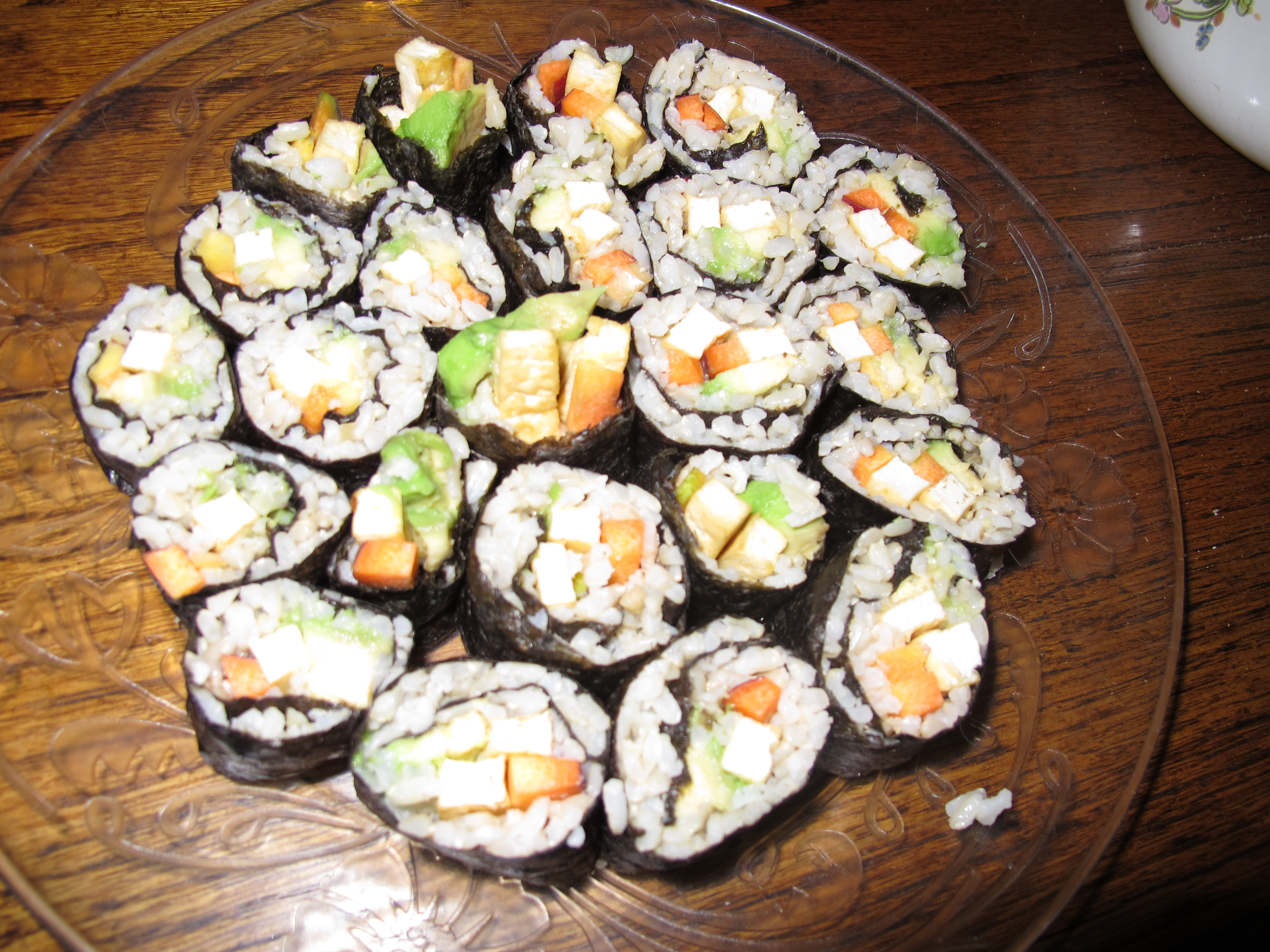
Sushi shortcut — the purists will cringe

I enjoy sushi, and since we don’t go out to eat all that much, it’s something that I’d like to make more at home.  My first attempt awhile back involved buying and cooking the special sushi rice, only to read in the instructions that the sushi rice, once cooked, cannot really be saved for another day — it becomes hard and inedible if refrigerated for any length of time.

Now, if I’d read this instruction ahead of time, I would have simply prepared less rice, and it wouldn’t have been a big deal.  With the rice already prepared, however, we over-stuffed ourselves with sushi to avoid wasting any.

The other day, I was flipping through a cookbook, looking for something else, when I spotted a sushi recipe that used brown rice.  Not only is brown rice healthier than sushi rice (which is white rice), it’s something we often have on hand, already cooked.  No special rice to mess with?  Sounds good to me!

Easy Vegetarian Sushi

  • nori seaweed sheets
  • rice vinegar
  • seasoned rice vinegar
  • cooked brown rice
  • avocado
  • carrots, cut into matchstick-sized pieces
  • tofu, cut into small strips and lightly browned on stove-top
  • soy sauce and wasabi for dipping

Start by mixing the cooked brown rice with some seasoned rice vinegar.  If you don’t have seasoned rice vinegar, make your own by adding some sugar and salt to regular rice vinegar.  Set aside, and prepare carrots, avocado, and tofu.

Lay out a nori sheet, shiny side down.  If you have a sushi mat, you can use it here, but it’s not essential.  Cover most of the nori with a thin layer of the seasoned brown rice, leaving a one inch gap at the top.  Place the other fillings in a line across the sheet, an inch or two from the bottom of the sheet.  (I didn’t take a photo at this stage, so instead you can enjoy my awesome drawing.)

Make a mixture of [unseasoned] rice vinegar and water in a small bowl and dip your fingers before rolling the sushi.  Roll the sushi, starting from the bottom of the sheet — moisten your fingers in the vinegar and water as necessary.

Let the rolls rest, covered on a plate, for 10-15 minutes before cutting them.  To cut, dip a sharp knife in the water and vinegar mixture and cut to desired size.

Dip sushi pieces in soy sauce spiced with wasabi.  I made this sushi to go with the Asian dumpling soup last week.

Notes:

  • You can use almost anything you want to fill the rolls, just don’t try to stuff too much in there, or they won’t stay together well.
  • Many wasabi pastes have scary ingredient lists, including unnecessary food dyes.  I found powdered wasabi with a simple ingredient list: horseradish plus tumeric and spirulina for natural coloring.  Just mix a bit of the powder with a bit of water to reach desired consistency.