Our big blue bin

On Monday or Tuesday night, Matthew informed me that St. Nick had brought us something extra this year.
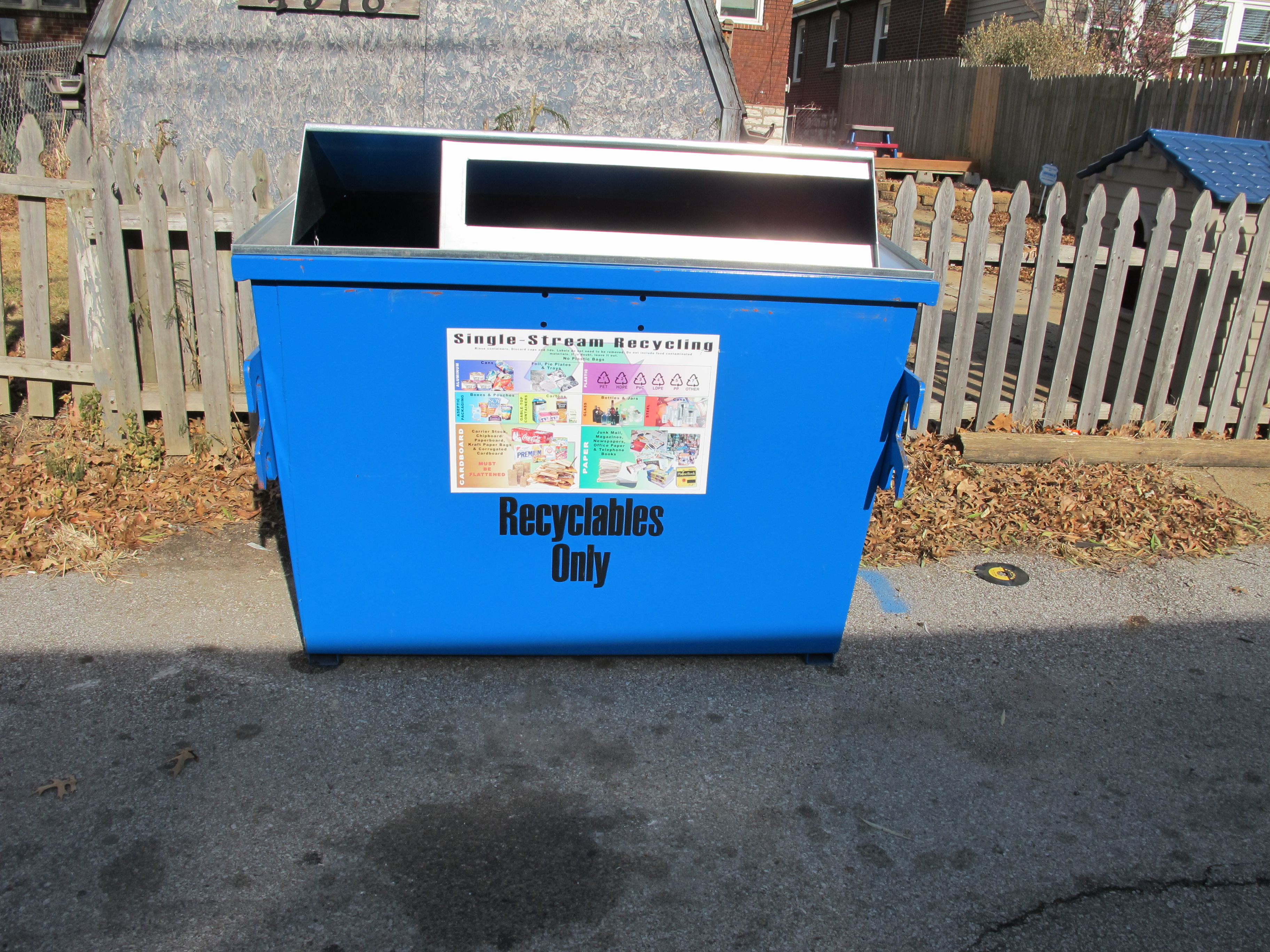
For the last two years, we had curbside recycling pickup, and our landlord paid the low rate that the city subsidized. With the start of the city’s new recycling dumpsters in the alleys, they dropped the subsidized curbside service.

Problem was, the city is rolling out their program slowly, and while some relatively nearby alleys had their bins in November, the only info I had said that they all should be in place by March 2011. I was preparing for the reality of having to drop our recycling off somewhere for up to 4 months (and the idea of driving somewhere to recycle really rubs me the wrong way), so I was super excited to hear the news about the bin in our alley.

The only thing that kept me from running out to see it right when Matthew told me was the fact that I was comfortably curled up on the couch and the temps outside were under 20 degrees.

Despite my excitement, I would be remiss if I did not point out, as I’ve mentioned before, that recycling is only a stop-gap measure, and not an ultimate solution to our problem of over-consumption and too much waste.

Environmental sustainability really depends on us practicing the other R’s: Reduce and Reuse. I’ve also heard mention of a fourth R, Refuse (as in refuse disposable packaging, containers, etc.), which I see as being part of Reduce.

Sprouted

We didn’t grow spaghetti squash this year, so I bought a couple of small ones at the farmers’ market several weeks ago.  They’ve been sitting on the counter, waiting to be used.

I’ve been eating A LOT of pasta lately, so in an effort to mix things up a bit, I decided to prepare a spaghetti squash.  I cut into it, and was surprised to see that the seeds had sprouted.

Since many types of sprouts are quite tasty, I tried one — ick!  Very bitter.  Fortunately, the squash itself was fine.  I just scraped out the sprouts along with the seeds, and proceeded with the prep:

  • Cut in half lengthwise and scrape out the seeds.
  • Place cut side down in a glass dish with about an inch of water.
  • Microwave for 10-12 minutes, or until squash is tender.
  • Let cool slightly, then use a fork to scrape out the spaghetti-like strands.
  • Season to taste with olive oil, salt, pepper, herbs of your choice.
  • Also good topped with olives or capers.

A fashionista, I am not

Sometime between when high school ended (many, many moons ago) and now, I became anti-clothes shopping.  The majority of my wardrobe dates back to college or earlier.  I’m sure that owning and wearing many of the clothes I wore in high school will not earn high marks on the fashion scale, but fashion’s never really been my thing.

I bought my two main pairs of gym shorts in 7th and 8th grade, and am just now thinking about retiring them.  The elastic waist band seems to be giving out, as evidenced by the blue pair nearly falling down on my last run.

In general, I prefer clothes that are NOT trendy, so it won’t matter if I’m still wearing them in 10 or 20 years.  In order to insure that my clothes last 10+ years, I have a couple of tricks.

First, if it’s not dirty (i.e., stained or distinctly sweaty/smelly), don’t wash it!  Excess washing is hard on clothes, not to mention the environmental impact in terms of water use and energy if you’re washing on warm or hot (if you’re doing this, switch to cold water washes).  I may have a bit of an advantage here — I seem to sweat somewhat less than the average bear, but you may be surprised at how long you can stretch things.  Also, the infrequent washing works best if your clothes don’t spend time in a heap on the floor — this makes them look wrinkly and dirty, even if they aren’t, plus it’s hard to tell what’s dirty or not.

Second, when you do wash your clothes, line dry them.  The dryer may be even harder on clothing than the washing machine.  You can extend the life of your clothes and save energy at the same time — double green bonus!  If you’re tight on space for clotheslines, either inside or out, there are many options now for collapsible drying space that takes up minimal space when not in use (check out the links in this Tiny Choices post for some options).  Due to limited yard space, we just use the clotheslines in our basement year-round.

Third, invest in good quality clothing.  A $75 top that lasts 10+ years is a better investment than a $20 top that lasts less than two years.

That said, almost all clothing does eventually wear out, or cease to fit in one way or another, and taste in clothing does change.  So what’s a greenie to do when she does want to buy some new clothes?  Come back later this week to read about my recent attempts to purchase clothes.