Dinner at Local Harvest and a winery trip

After some house and apartment hunting on Wednesday afternoon, our hungry crew (our little fam + Matthew’s mom and sister) needed a place for an early-bird dinner.  Enter Local Harvest Cafe.

Although I’ve been there many times, this was the first visit that necessitated a high chair.  In reply to my tweet asking if they had high chairs — they do (funny how you don’t notice these things when you don’t have kids), they also said they had wooden veggies for baby entertainment.

Sir enjoyed the real food far too much to need the wood version, and I don’t blame him.  We started with some wonderful vegan meatballs made from sweet potato and eggplant, served with a chimichurri sauce.  This was my favorite dish, but also the one thing we didn’t photograph.  Fortunately, the rest of the meal was well-documented.
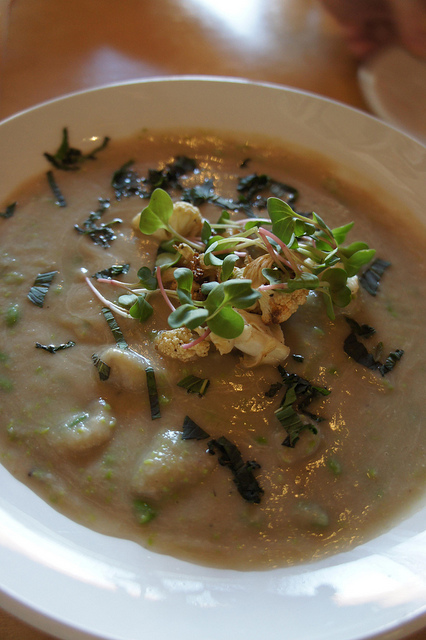
Matthew and I split the house made gnocchi in cauliflower-pea soup (above), which was that evening’s green plate special, and the chard-wrapped tamales with mushroom filling, served with a side of purple slaw (below).  I love the colors on the tamale plate.

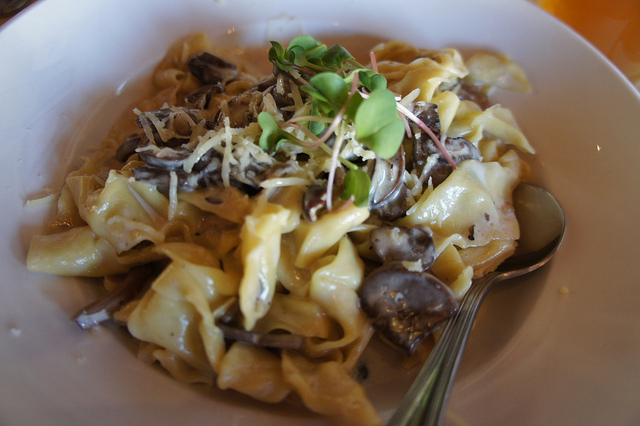
Pam and Rachel shared the wild mushroom stroganoff.  Matthew tried a bite, and proclaimed it the best stroganoff ever, with lots of mushroom flavor — we plan to return soon and order this dish ourselves.
Unfortunately, we didn’t get any photos of Sir enjoying the delicious offerings, but if you’re hoping for a cute baby picture, don’t despair!

We started the holiday weekend early with a trip to Montelle Winery on Friday afternoon.  Despite buying local wines almost exclusively since I’ve lived in St. Louis, I’ve never actually visited one of the wineries.
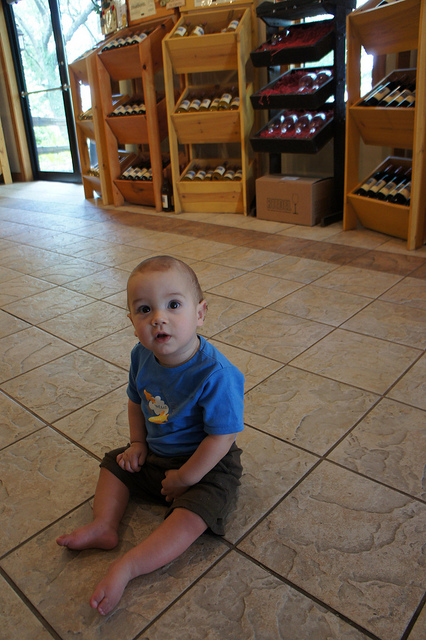
Gabriel checked things out from the floor while we tasted wines, and later enjoyed the scenic view from the large deck.

While at the winery, we were in the midst of negotiating a verbal offer on a FSBO house.  Between that and a fussy, refusing-to-nurse baby, it was pretty impossible to focus on the wine or relax and enjoy the beautiful scenery.

I’ll admit that I was longing for some baby-free time to really enjoy the wine and setting, but I guess we’ll just have to make another trip to wine country, sooner, rather than later, I hope!

All photos in the post courtesy of Gabriel’s Aunt Rachel.

Trailers, longtails, and iBerts, oh my!

Last week, I shared some green baby strategies, one of which was, “Wait on it.”  While I’ve done a good job on that in general, there are a few things that I wish I had waited on, one of those being the bicycle trailer.

Despite the fact that we’ve had it for over eight months now, I can still count our “biking with baby” trips using my my hands.  I need both hands, not just one, but still.

Sure, there have been mitigating factors: waiting until Sir was a bit older and had decent head/neck control, ordering the baby supporter accessory, winter weather, carrying the trailer in and out of the basement because we have no garage . . . but enough with the excuses!  An average use of once a month at most?  Not good!

Given that we found a high quality, good condition, used trailer for a reasonable price, I’m not sure it was a bad purchase, at this point it just does not seem like a good purchase, either.

Ever since I saw this post on the Momentum magazine blog, I’ve been thinking about options that don’t involve a trailer.  A longtail bicycle, like the Yuba Mondo featured in that post (and here, as well), seems like a great option.

In my excitement, I dug a little deeper into the world of longtails, and found some reviews and comparisons of various bikes including the Yuba Mondo, Surly Big Dummy, and the XtraCycle Radish.*  Based on our initial research, we lean toward the Yuba for it’s combination of features that meet our needs and being a good value.

A couple weeks after my longtail excitement, I read S’s post on front-mounted seats on Simply Bike.  While I like the idea of a longtail, I’m less excited about the price tag — far more affordable than a car up front and down the road, but still overwhelming to my frugal sensibilities.

With a front-mounted seat, you don’t sacrifice the cargo room on the rear rack as you would with a rear-mounted seat, and you don’t have to deal with the weight and bulk of a longtail (especially a factor in our case, with carrying it up and down stairs).

Also, your little one is right up front, experiencing the ride with you, which appeals to me.  While Sir does not seem to mind riding in the trailer, he doesn’t seem particularly excited about it either, and I can’t really blame him.

When thinking about biking with baby options, front-mount seats were not even on my radar, but based on the post I mentioned above, the main contenders are the Yepp Mini, the iBert, and the Bobike Mini.**

Immediately after reading about front-mount seats, I saw an iBert on Craigslist.  For better or worse, I didn’t feel ready to grab it up without more research on the various options, including which seat styles work with which bicycles, and that seat is now gone.

For now, we’ll continue using the trailer, if less often than I would like.  And I’ll be dreaming about front-mount seats and longtails.

*For more info, check out these resources:
Heavyweight Showdown: Big Dummy vs Yuba Mundo
Cargo Bikes in Momemtum Magazine
Beautiful Bicycles: Yuba Monda Cargo Bike
The Best Cargo Carrying Bikes Of 2012: A Review

**See comments to S’s post for feedback on front-mount seats:
Front mounted bike seat for a child: what are your favorite options?

How to buy a used freezer

A few months before I started this blog (which is almost three!), we bought a deep freeze.  I’ve written about the freezer and its energy use a few times, and mentioned various frozen food more than a few times, but some recent reader questions prompted this post with more details.

Are you thinking about buying a freezer?  Here are a few things to consider.

How to you plan to use the freezer?
The answer to this question will determine what size freezer you need (or if you really need a freezer at all).

We use our freezer for three primary things: 1) Frozen produce (from the garden and farmers’ market). 2) baked goods — we bake all of our bread, and the freezer space allows us to make 4-6 loaves at a time, and 3) bulk dry goods — various flours, nuts, and seeds — the freezer protects against rancidity and various pest invasions.

Regarding size of freezer, you want enough capacity, without having excess space.  A full freezer is more efficient than one with a lot of extra space.  We have a 15 or 16 cubic foot chest freezer.  There are times when we could use a bit more space, but for us, this is a decent balance between too small and excess capacity.

Freezer or second fridge?
Your answer to the first question will also provide a partial answer to the question of freezer vs. second refrigerator.  As long as you’re using them fairly regularly,  bulk dry goods should keep equally well at refrigerator temps.  However, long-term storage of items in categories one and two in my list requires freezing.  Ditto for meat, if that’s part of your diet.

A second refrigerator will give you SOME extra freezer space, but that freezer is not the same as a deep freezer (either chest or upright).  A deep freezer maintains a colder temperature than the freezer compartment of a refrigerator, which means that frozen foods (produce, meat, baked goods) stay better, longer in a deep freezer.*

Chest or upright?
Volume for volume, chest freezers are hands-down more energy efficient than upright freezers.  Here’s a little snapshot from the Energy Star freezer comparison chart:

These are all for the same brand of freezer.  If you compare the two larger models, the 22 cu. ft. chest uses about 2/3 the energy of the 20 cu. ft. upright.

So a chest freezer is the obvious winner, right?  Well, they have two main drawbacks: 1) finding things in a chest freezer can be trickier than an upright and 2) chest freezers are not frost-free, which means every now and then (once a year or less, unless you have the freezer somewhere really warm, like a garage), you have to take everything out of the freezer and remove the ice that builds up on the sides.

For us, the energy savings of the chest is worth the drawbacks (more on how we deal with those in an upcoming post).

Used or new?
Used is the way to go, especially for a chest freezer.  Unless it’s truly ancient, most run-of-the-mill chest freezers will be more efficient than new upright freezers, even if the chest freezer does not have an “Energy Star” rating.

After just a bit of searching, we found our 15 cu. ft. chest freezer on Craigslist.  It was less than five years old, and they accepted our offer of $75 ($100 asking price).  Over three years later, it’s still going strong.

Tips on buying used
If you’re going with used, make sure the unit is plugged in before you arrive.  Bringing a thermometer to check the temperature wouldn’t be a bad idea, but we didn’t think about it when we bought ours.

Also, if getting the freezer from its original home to its new home requires tilting it or turning it on its side, there IS a risk of ruining the compressor.  To reduce the risk, minimize the time that the unit spends in a compromised position, and, once it’s settled in its new home, wait for six to twenty-four hours before plugging it in to give the coolant time to resettle.

*A deep freezer maintains a temperature of less than  0° F (actual temp varies by model and setting), while the freezer compartment of a refrigerator usually hovers right around 0° F.

Related posts:
Deep freeze
Energy Hog

Fennel pesto

In last week’s garden post, I mentioned Matthew’s biodiversity micro-grant award to grow celeriac and paw paws. However, he actually proposed growing three items, not two, with fennel being the third item.

Poor little fennel felt a bit left out after my omission, so today he’s getting his very own post.

If you’ve bought fennel at the grocery store, you probably got something that looked like this:

Fenouil
Fennel (Photo credit: Wikipedia)

Mostly bulb, some stalk, and perhaps a spattering of feathery fronds.

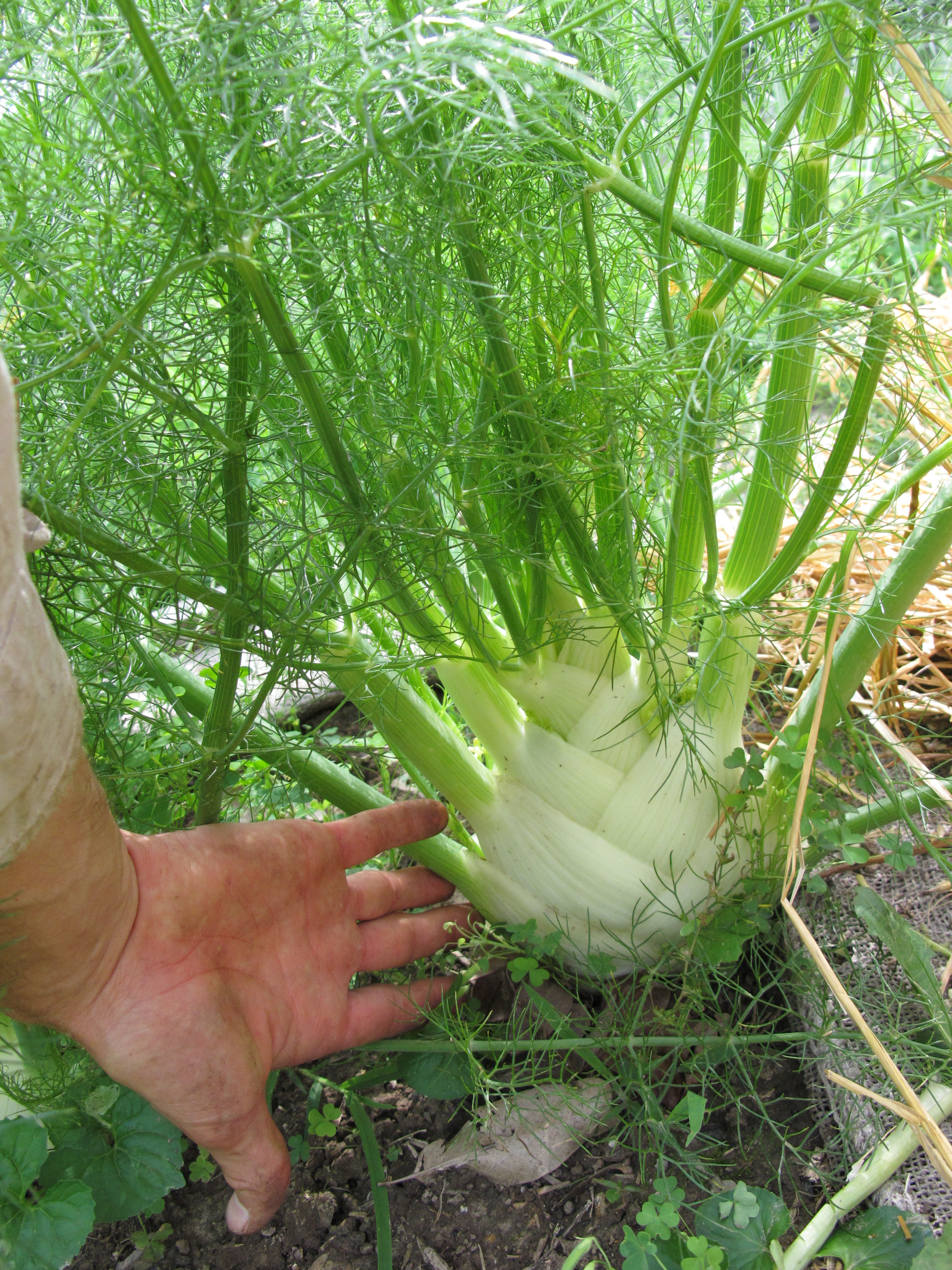
Like a lot of supermarket produce, it looks rather different than the straight-from-the-garden version:

Our fennel (June 2011)

See all the featheriness on top?  The fronds do not keep nearly as well as the bulb, hence the missing top half on most grocery store fennel.

Though this year’s crop is nowhere near that size, we harvested a couple of bulbs for early eating (also making room for the remaining plants to grow larger).  After roasting the bulb, we were left with a lot of fronds, which, I’ll admit, sat in the fridge for quite a few days.

They were at the “use it or toss it to make room for other things” stage.  In Stacy’s recent post about CSA membership, the discussion turned to how to use everything that’s part of the weekly produce delivery.

I hate to waste food, so I chopped the fennel fronds and created a twist on the traditional basil pesto.   If you’re lucky enough to pick up a fresh, locally grown fennel bulb at the farmers’ market or receive one as part of a CSA box, you can make use of the flavorful fronds with this recipe.

Fennel pesto

Recipe by Melissa

Ingredients
1-2 c. chopped fennel fronds and stalks
3/4 c. olive oil
2-3 cloves garlic, peeled and chopped
1/4 t. salt
1/4 c. pistachios (I used roasted & salted)
Opt. 1 T. lemon juice, or to taste*

Directions
Add all ingredients to blender or food processor and process until desired smoothness.

Serving Suggestions

  • Stir into a grain, protein, veggie dish.  I combined cooked couscous, rice, and lentils with chopped raw carrots, summer squash, and kohl rabbi.  Mix in the fennel pesto, adjust salt as needed, and you have a quick, easy meal.
  • Add extra lemon juice (and perhaps a bit of water) to create a tasty salad dressing.  If you still have the fennel bulb, make a salad with a bed of greens, roasted fennel and/or thin slices of raw fennel,
    pistachios, and olives.
  • Use any way that you would use basil pesto, e.g., on top of pasta, as a pizza sauce, etc.
  • Spread onto bread for a simple appetizer or as a sandwich ingredient.

*I didn’t add lemon juice in my original recipe, but  it would be a nice addition.

Related post: Monumental fennel (with recipe for roasted fennel)

Since today is Bike to Work Day, here’s my post from BtW Day last year, when I was 32 weeks pregnant: Finally Bike Somewhere Day.

Active transportation tastes better

Our housing hunt continues, and, the day after my birthday, we both took the day off and spent the morning running around (in a car unfortunately) with a realtor looking at houses.

We planned to wrap things up by late morning and follow the house tour whirlwind by treating ourselves to lunch.  Due to excellent efficiency (and a few houses that we weren’t able to see), we were finished before eleven — too early for lunch — so we headed home.  After being in and out of the car all morning, a separate car trip just for lunch was the last thing I wanted.

Bicycles were an option, of course, but I really wanted to WALK somewhere.  Unfortunately, we don’t have many options within walking distance (if you discount a few fast food joints, which are not even on our radar).  My criteria for a walkable non-fast food restaurant led us to La Tropicana, a restaurant we’ve been talking about trying for quite some time now.

After a bit of back and forth with the waiter and chef, we ordered some vegetized versions of a couple of their standard menu items.  While I enjoyed the meal, getting to and from the restaurant on my own two feet was truly my favorite part of the outing. It felt both novel and right at the same time, and reminded me of our time in Italy last year.

I’m a little bummed that we’ve lived here for four years and just now ventured into La Tropicana — within weeks of a move that will most likely take us to a different neighborhood.  We don’t eat out often, but having a good choice within walking distance is worth a lot.  I hope we’ll have some walk & dine options in our new neighborhood (location TBD), because walking to a meal is the best seasoning.