Seriously people?

I don’t say much about my work here, in the interest of keeping work life separate from personal life.  Most days, I feel fortunate to be in a line of work that is in keeping with my interest in active transportation and health.  Other days, I just want to bang my head against the wall . . . .

I recently conducted a survey on walking and biking to school, and I couldn’t believe this response from the parent of a 9-year-old who lives six or seven blocks (residential blocks with sidewalks and low speed limits) from the school:

Reason for disinterest in walking school bus or bike train: “prefer to drive [child] myself”

Sadly, there were other, similar responses.  In my mind, this is inexcusable, both from a health and a resource standpoint.  There’s a reason we have a huge childhood obesity problem and the attitude behind statements like this play a big part.

I know, I know, there are millions of excuses, some legitimate, but most not.  Parents’ fear the risk of very rare events that get lots of media coverage, like kidnappings, and fail to see the much more real risk of a sedentary lifestyle: obesity, type 2 diabetes, and a host of other chronic diseases and health problems.

Don’t want your child to walk alone?  Okay, then get off the couch and walk with them. You’ll be doing something good for yourself and your child.  And I could cease the head banging over here.

Chicken and ducklings

I have a certain in-law who, since childhood, has enjoyed eating “chicken and ducklings,” a dish perhaps better known as chicken and dumplings.  Being vegetarian, my version of this dish contains neither chicken nor ducklings, but it’s packed with tons of flavor, protein, and other goodness to warm you from the inside out.

As you’ll see, the recipe is just a starting point.  You could make the dumplings and add them to just about any broth-y vegetable soup, and it would be delicious.  Last night, Matthew made our Country Vegetable Soup using dumplings instead of pasta.

Chicken and duckling soup
Recipe by Melissa

Ingredients
1 c. orange lentils*
4-5 c. water
6c. veggie broth (can subs. water and extra spices)
bay leaf
thyme, marjoram, oregano, cumin (season to taste)
olive oil
1-2 c. onion and/or leeks
1 bulb garlic
2-4 stalks of celery
2 c. carrots or sweet potatoes or butternut squash
3-4 c. cabbage (it will cook down!)
optional other veggies — see directions for ideas
1 recipe Bean Flour Ducklings Dumplings (recipe below)

Directions
Place lentils and bay leaf in large pot and cover with water.  Bring to a boil and turn down to simmer.  You may need to check back and add more water or broth as they cook.

Chop your veggies.  The ingredient list is just a starting point.  You can add or subtract veggies as you wish.  Green beans, potatoes, frozen corn, and/or frozen peas work well here, too.

If you haven’t already made the dumpling batter, make it now.

Saute onion/leeks and celery in olive oil until tender, about 10 minutes.  Add garlic and saute for an additional minute.  Add herbs and spices to the mix.

Check on lentils.  When they are starting to fall apart, add the sauteed mix, along with the other chopped veggies**, and more water or stock to the lentil pot.  Bring back to a boil, and then lower to a simmer.  If using water or no-sodium broth, you will need to add salt.  Start with 1 t. and add more to taste.

Once all veggies are in the pot, drop in dumpling batter by the spoonful.  You will need enough extra broth in the pot for the dumplings.  If your pot is too full, you can cook the dumplings in a separate pot of broth.  Cover pot and cook dumplings for 15 minutes.

Serve, let cool a bit so you don’t burn your mouth, and enjoy!

*Split and hulled, these tiny lentils break down very quickly and will dissolve, creating a thick, rich base for the soup.
**For ideal veggie cookage, start by adding the veggies that take longer to cook, like potatoes, sweet potatoes, carrots, etc.  Let simmer for 10-15 minutes, then add tender veggies, like cabbage and green beans.  Many frozen veggies can be added right at the end of cooking, and they’ll help cool the soup for eating.

Rides and eats

Strangely enough, I’ve done more biking in the past 3 1/2 weeks (late December and early January), than in all of September, October, and November combined.  The rides themselves have been relatively short (3-4 miles), running errands here and there, but just getting out somewhat regularly feels great.

On Saturday morning, I ran a couple of errands by car, due to some remaining ice from the mid-week snow.  Once off of our tiny street, I realized conditions were bikeable.  When I arrived at the library and found no [car] parking spaces, I really wished I’d chosen two wheels instead of four — lesson learned!

While out and about, I stopped by the winter farmers’ market.  Some beautiful cabbage, along with a few bags of frozen green bell peppers, a couple of fresh sweet red peppers, and a few pears made the trip well worth it.  I bought enough cabbage that we might do a new round of sauerkraut, though we’ve really been enjoying the cabbage cooked in various ways, and I want to get around to making a slaw/salad with some of it.  Cold weather cabbage tastes so sweet and delicious!

Speaking of sauerkraut, and deliciousness, we made reubens over the weekend — so messy and so good!  The kitchen’s been a busy place lately, and I have a couple of fun new recipes to share soon, one for a nice, warm soup and the other for an amazing bread — very high quality bike fuel 🙂

Pumpkin lasagna

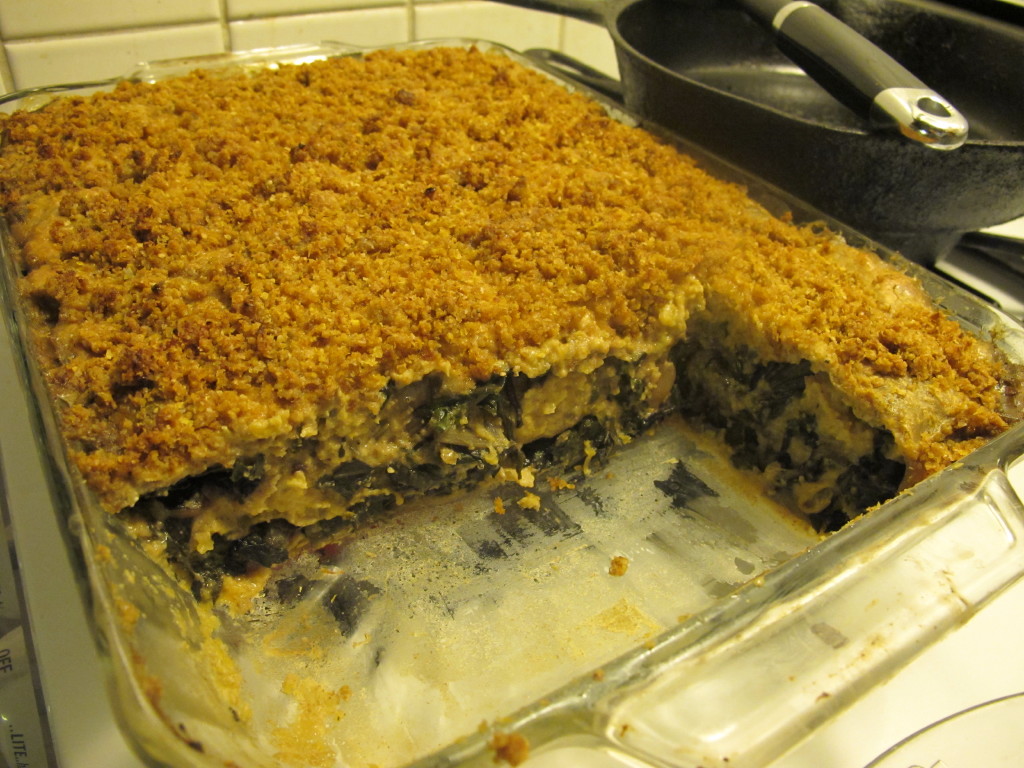
Two months ago, I wrote about an amazing pumpkin lasagna that we Matthew made, wherein I promised a recipe “soon,” and left you hanging.  Soon has come and gone, but we recreated the lasagna for our New Year’s Eve meal, making [an almost] vegan version to accommodate my current dairy-free diet.

We originally made an only-slightly-adapted version, using some cashew butter, but retaining the cream and Parmesan cheese.  The recipe here is vegan, except for our homemade noodles, which contain eggs.  Once again, we benefited from having homegrown Swiss chard and squash prepped (from the deep freeze this time), as well as the noodles made up from a previous night.

Happy cooking and eating!

Pumpkin Lasagna
By Matthew
Adapted from Food & Wine

Ingredients (makes 8 very generous servings, or 12 smaller portions)
4 tablespoons olive oil
1 ½ cups onions, chopped
2 pounds Swiss chard, washed well and chopped
2 1/2 teaspoons salt
1 1/2 teaspoon fresh-ground black pepper
2 Tablespoons sage
1 teaspoon freshly grated nutmeg
6 cups pumpkin (or any winter squash) puree (or two large cans)
9 amaretti cookies, crumbled
1 1/2 cups heavy cream
1  cup bread crumb topping (see recipe below)
1/2 cup cashew butter
3/4 cup warm water
1/2 cup soymilk
1 recipe homemade spelt pasta cut into angel ribbon lasagna (or 9 whole wheat no bake lasagna noodles)
 

Directions
In a large cast iron or nonstick frying pan, heat the oil over moderately low heat. Add the onions and cook, stirring occasionally, until translucent, about 5 minutes. Increase the heat to moderately high and add the chard, 1 teaspoon salt, 1/2 teaspoon pepper, 1 Tablespoon sage, and 1/2 teaspoon nutmeg. Cook, stirring, until the chard is wilted and no liquid remains in the pan, 5 to 10 minutes.

Combine the cashew butter and warm water to create a cashew sauce.

Heat the oven to 400°. In a medium bowl, mix together 6 cups of the pumpkin, amaretti cookie crumbles, cashew sauce (from previous step), and the remaining 1 1/2 teaspoons salt, 1 teaspoon, pepper, 1 Tablespoon sage, and 1/2 teaspoon nutmeg.

Pour the soymilk into a 9-by-13-inch baking dish. Top the soymilk with one
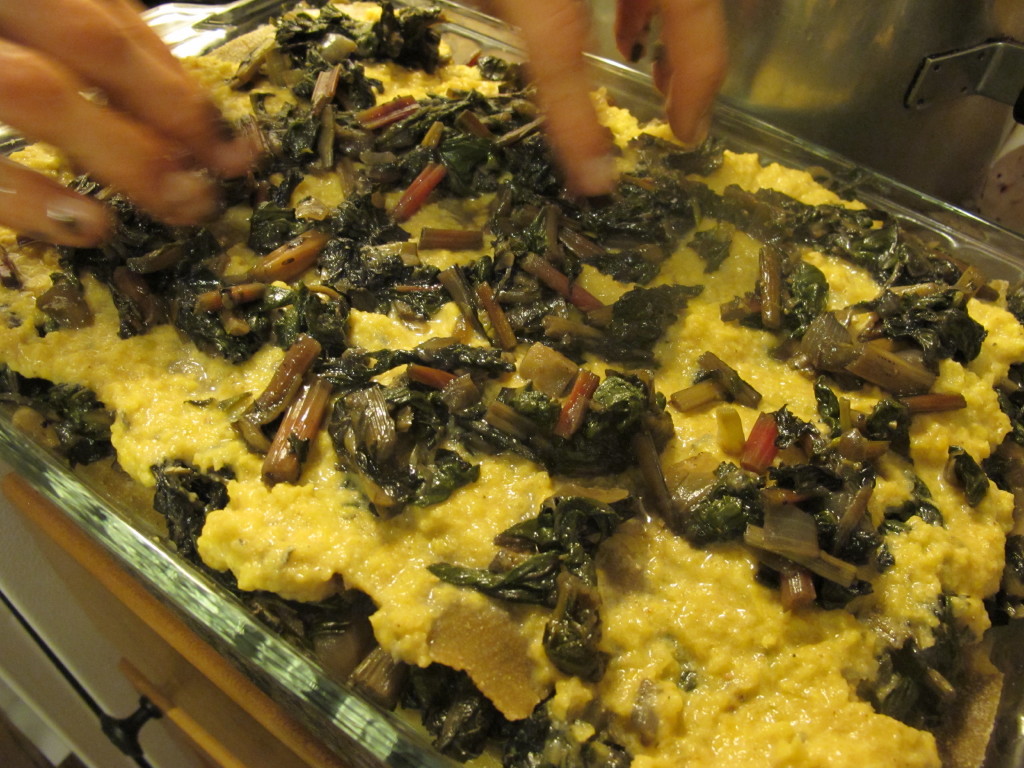
third of the noodles, then spread 1/3 of the pumpkin mixture over the noodles. Layer half the Swiss chard over the pumpkin and top with a second layer of noodles. Repeat with another layer of pumpkin, Swiss chard, and noodles.

Spread the remaining pumpkin mixture evenly over the top of the lasagne, and sprinkle with the bread crumb topping.  Cover with a cookie sheet on a higher oven rack and bake for 20 minutes. Uncover and bake until golden, about 15 minutes more. Let cool, to set up, for 10 minutes before cutting.

Bread crumb topping
I created this topping as a substitute for the Parmesan cheese in the original recipe.  It came out quite well.

Ingredients
2/3 c. whole wheat bread crumbs
1/3 c. wheat germ
1/3 c. nutritional yeast
1/2 t. garlic powder
1/3 c. vegan butter substitute, like Earth Balance

Directions
Combine dry ingredients in a bowl.  Use a pastry blender to cut in the Earth Balance, creating a crumbly mixture that you can sprinkle on top of the lasagna.


Lids at last

Don’t let the food fool you, this post is actually about the container.  Though I must confess that I still own and use plastic (gasp!) containers on a regular basis, I am adamant about glass for some things, particularly warm or hot food.

I just don’t trust plastic, even the “BPA-free” plastic.  I figure it just contains some yet-to-be discovered, and perhaps worse, toxin leaching into my food.  I cringe when I see coworkers nuking their lunches in plastic containers — yikes!

Unless the food cools to room temperature first (at which point we’re probably in the bacteria-growth danger zone), we store all of our leftovers in glass containers.  We also use glass to transport our lunches for easy microwave heating at work.

Though it’s a compromise because it still involves plastic, we’ve found that glass containers with plastic lids work well.  This container style forms a relatively good seal for transporting the food to and from work, which can involve a good bit of jostling.  If we fill the containers to the brim, we refrigerate and put the lids on after the food is cool, and we remove the lids before reheating the food — one of those “not perfect, but good enough” solutions.

With normal use  and wear (i.e., not getting dropped on a hard surface), the glass containers have quite a long life.  That makes the plastic the weakest link.  After a couple of years of regular use, the plastic lids started showing their age, cracking at the edges, no longer forming a good seal.

Over a year ago, I searched for replacement lids in vain, frustrated that I couldn’t buy just a lid to go with the container that was still in perfectly good shape.  I’m rather certain I contacted the company directly and was told they didn’t make replacements — argh!  In the meantime, we wanted to expand our glass container collection and reluctantly purchased two sets of the same style, knowing about the lid issue.

For some reason, Matthew or I resumed the lid hunt a couple of months ago, and this time we our search ended in success! (3/4/14 Link Update: find replacement lids here.)

To maximize the shipment, we ordered a couple of spare lids for each size of glass container, including some for my MIL who has the same containers with the same lid issues.  (Speaking of the shipment — ridiculously over-packaged!  Must remember to add “please minimize/avoid plastic when packing.”)  While it’s frustrating knowing that these lids will also wear out, I’m happy to get more good use out of the glass.