Carpool — new and improved

My carpool ended abruptly a couple of months ago, with the departure of my carpool buddy.  Toward the end, our carpool days dwindled, due to different schedules, leaving me discouraged about the whole carpool thing.

Fast forward to now, and my new carpool.  I almost don’t want to write about this, because I’m afraid it will disappear.  A couple of weeks ago, I discovered that a new coworker drove almost my exact route on the way home.  Toward the end, our paths diverged, but she couldn’t be that far away.

Like a good, patient stalker, I waited a few days before broaching the carpool idea with my coworker.  She was not only interested in carpooling, but also open to the idea of me biking to her house and paying gas money.  Who’s excited now?

It just so happens that she lives less than two miles from me, with a nice, easily bikeable route between our dwellings.  I’m not thrilled with the lack of indoor bike storage accommodations for my precious, so I’m working on equipping the old bike with a rear rack and crate.  I found a used rack at Bicycle Works and, for now, I’ll just use the crate I have on my other bike.  While I was happy to get a used rack, the price tag was barely lower than new — annoying!  Also annoying — the fact that the design of my old bike is such that attaching the rack presents a bit of a challenge.

Those little bumps in the road can’t dilute my overall excitement about the new arrangement.  Although my commute is far from car-free, bicycling is back in the picture, and I’m one happy girl!

The least of the three R’s

Recycling resides at the bottom of the three R hierarchy in terms of environmental benefit.  First comes Reduce, then Reuse, and then, finally Recycle.  Recycling is nice, but it means that some object was produced in the first place, often with the intent to be “disposable.”  When, and if, that item makes its way into a recycling plant (after consuming energy to transport it there), it requires inputs of energy, water, and other products to first break it down and then make it into something new.

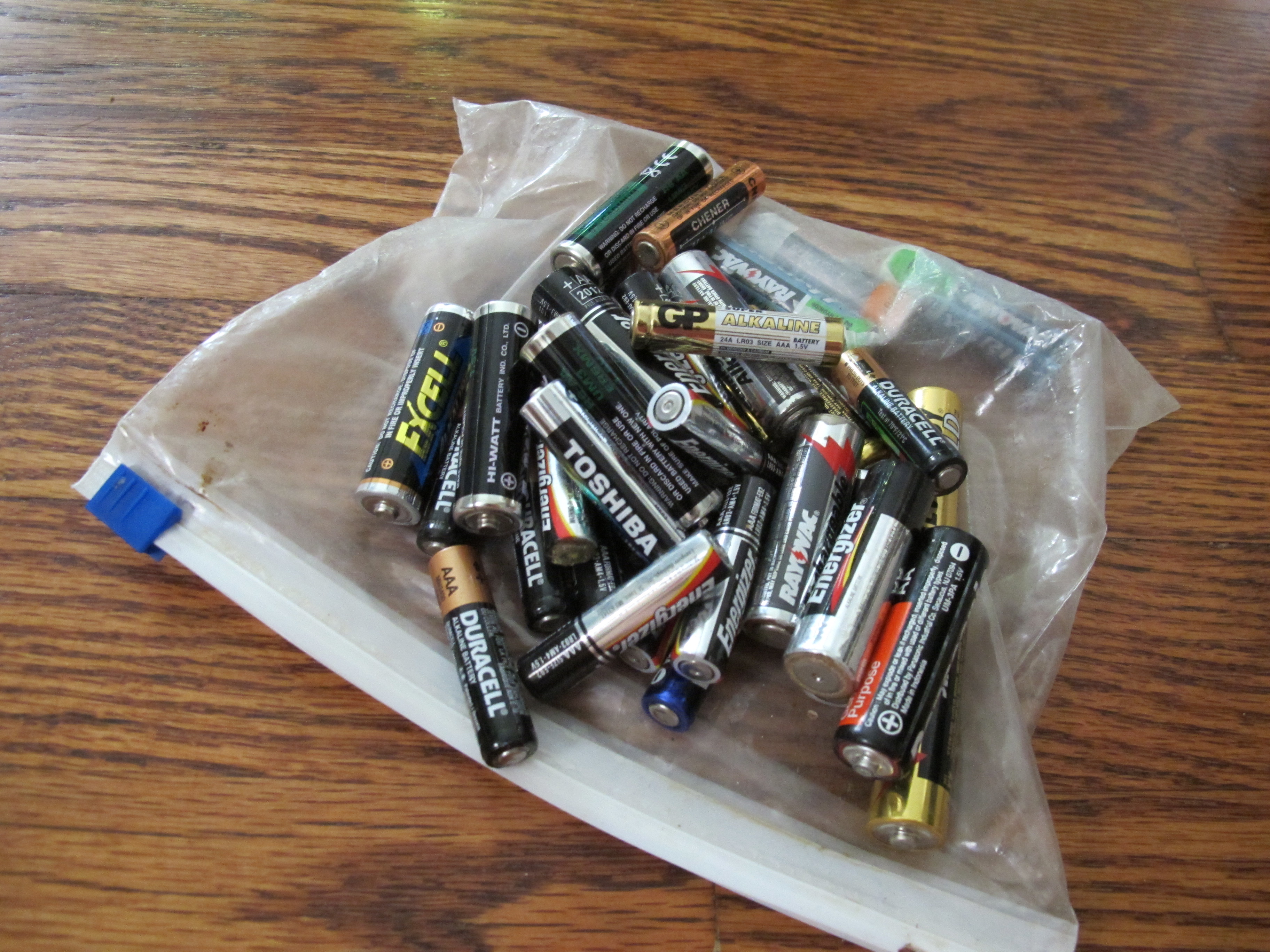
So I’m kind of ashamed to show you this:

I’m not sure how we ended up with this many spent non-rechargeable batteries!  We only buy rechargeables, but products that come with batteries have disposables in the package.  It’s not like we use lots of battery powered “stuff,” but we’ve been saving these for awhile.

My church offered a battery recycling collection box — time for these babies to go!  I balked when I read that each battery had to be in its own plastic bag to reduce risk of fire/explosion.  I resisted my temptation to rebel and just throw the whole bag in there.  A bit more research uncovered an alternative to the individual bagging — simply place tape over the positive terminal of each battery — still some waste involved, but much less.  As an added bonus, I avoided having a burnt down church, or some poor postal worker killed by a battery-induced explosion, on my conscience.

In a bit of a recycling blitz, I also pulled out some old tennis shoes for a shoe recycling collection for the Shoeman Water Project.  Reusing or recycling shoes, and using profits to dig wells in developing counties?  Sounds good to me!

I delivered the batteries and shoes by bicycle, of course.  And now back to reducing and reusing 🙂

Stick with the bar

I heard a short story on NPR this morning about liquid body washes outselling bar soap for the first time.  Liquid body washes are doubly un-green — both more expensive (wastes green from your wallet) and worse for the environment.  On the cost side, liquid body wash is mostly made of water, so you’re paying a premium for water with some added soap.  This also adds to the environmental cost — with all the extra water, the bottles of body wash occupy more cargo space, requiring more trucks on our roads and more burned fuel.

Body wash comes in plastic bottles, creating more waste than bar soap packaging.  At best, people recycle those bottles (using lots of water to rinse them thoroughly), and, at worst, many head straight to our landfills.

Your best bet is bar soap, the more minimal the packaging the better.  Make bar soap greener:

  • Recycle the paper or cardboard packaging.
  • Buy from a local soap maker — some may skip the packaging altogether, especially if you ask!
  • Keep the bar of soap in a dry corner of the shower to minimize waste.
  • Use less soap — you can probably get by with less than you’re using right now.  Your skin will thank you!

Fleet maintenance

I’ve always been a practical shoe kind of girl, but it took Matthew’s urging to get me into Birkenstocks.  Before I tried Birks, I never realized that, no matter how “comfortable” the shoe, pretty much all shoes are not shaped like feet.  The toe area should really be the widest part of the shoe, not the narrowest!

My feet carry me lots of miles, both walking and pedaling, and I want that to continue for a long time.  And I don’t want bunions!  Foot shaped shoes equal healthy, happy feet 🙂

I own two pairs of sandals and one pair of clogs.  Add in Matthew’s, and we have quite the collection.

On the green side, these shoes can be re-soled, so you can keep a pair around for awhile.  I pulled our fleet out a couple of weeks ago to carry out some preventive maintenance on the cork foot beds.  Buying durable goods and making them last is a good green investment.

Trash vs. treasure

This post started as a comment on “The last antique” over at The Green Phone Booth.  It quickly grew to a length that seemed a bit cumbersome for a mere comment:

After reading the comments thus far, one thing that sticks out is want vs. need. Sure, holding out for that perfect piece of furniture (the one that looks nice, fits in your space, is good quality, at the right price) at an estate sale or on Craigslist can be frustrating, but do you really NEED it enough right now to settle for something that may not last, something made unsustainably?

The answer will be different for everyone and vary depending on the item in question and other specifics of the situation. However, it provides a good starting point for evaluating potential purchases. You may be able to find creative ways to do without for just a bit longer, giving you time to find what you really want in the quality used market.

We successfully used this method for our desk, and we’re currently keeping an eye out for a nice, new-to-us couch.  In the meantime, we’re holding on to our slightly uncomfortable, not so fashionable, but still sturdy, estate sale bought couch.