Bicycle beginnings — Part 2, in The Lou

College degree in hand, with my parents’ minivan and my compact car both bursting at the seams, my left-out-in-the-elements-for-four-years bicycle did not make the cut come moving day.  I removed my lock and left it at the bicycle rack outside my dorm for some lucky user.  In retrospect, I should have made a bit of an effort to find it a new home, but that didn’t happen.

I arrived in my hometown with five weeks to figure out my move to St. Louis (the biggest city by far that I’d ever lived in), including where the heck I was going to live.  For some reason, living close to school/work appealed to me even at that time, perhaps primarily for the savings on gas money.  At any rate, knowing relatively little about the St. Louis area, I discarded any apartments that were in the suburbs, and focused my hunt for housing within a mile or two of the Salus Center (which houses Saint Louis University’s School of Public Health), which served as the hub of my life for the next two years as a full-time grad student and part-time research assistant.

I settled on a room in a house (shared with three med students) almost exactly a mile east of Salus.  Prior to the move, my dad found a nice, sturdy 80s or 90s era Schwinn mountain bike for fifteen dollars at a garage sale.  My initial plan was that I would walk to school most days, but over two those two years, I can count the number of times I walked on one hand.  Biking was faster, and, while I felt relatively safe in my neighborhood, there were places and times where being able to move at speeds greater than those I could attain on foot enhanced my perceived safety.

I’m really not sure of my ratio of biking to driving in those early days, but it was certainly skewed in favor of biking.  I absolutely refused to pay for a parking pass, and, while there was some [free] street parking available, that served as a disincentive to driving.  I was mostly a fair weather biker, and I certainly didn’t have any fancy gear.  No fenders, cargo racks, or lights, I rode with my books and lunch in a simple backpack, often with the addition of a small duffle slung across my body on the days I hit the gym (fortunately, there was a small, but completely functional fitness center in the basement of the Salus Center).

Seven months after the move, I met a fellow student and bike commuter.  Hearing that he had three miles to ride after class on a chilly, rainy night in January, I offered him a ride home (bike and all, since I’d purchased a truck rack for my car).  He declined, but that was not that last I’d see of the man who I’d later marry.

Matthew’s longer commute encouraged me to push the limits as far as where I could travel on my bike, and, in addition to school/work, I was soon making many of my weekly Soulard Farmers’ Market trips by bike, returning home on Saturday morning with my backpack full to overflowing, with the overflow hanging in bags from my handlebars (classy, I know).  Eventually, I followed Matthew’s lead and upgraded to an internal frame backpack, which eliminated the need for me to carry two bags on “gym days,” and, with the hip belt, helped take some of the weight off of my shoulders and back.

Fast forward a bit (May 2007), and, with a Master of Public Health degree in hand, I was planning my next move.  My housing had served me well for two years, but I was ready for a change.  With job status uncertain, I hedged my bets on finding employment in St. Louis (and ideally near SLU), and found a new rental house (this time with only one roommate).  My new digs in the Tower Grove South neighborhood were closer to Matthew, but a bit farther from the Salus Center (where I did end up taking a full-time position two months after graduation).

Shortly after graduating, I won a bicycle in Trailnet’s Bike Month commuting promotion, so I had a new ride to go with my new, longer commute (around two miles instead of the previous one mile), the hybrid Schwinn Voyager.  By this time, I had added front and rear lights to my set-up (Matthew insisted when I was biking to and from a night class), and, after seeing the benefits of fenders for wet-weather riding, I added those to my set-up as well.  We continued to push each other to “go by bike” rather than car.

Summer of 2008 – another year, another move, or, rather, two moves, back to back.  First, I moved to yet another rental house, a move that changed my commute route, but only slightly increased the distance, to about 2.5 miles one-way.  However, immediately on the heels of that move, my employer moved from Saint Louis University to Washington University (specifically, WashU’s North Campus near Skinker and Delmar).

This made my commute nearly six miles each way.    I adjusted to the new distance rather quickly, and I felt a sense of pride every afternoon when I made it up the never-ending hill that, for local readers, is southbound Macklind coming from Manchester.  It only took me one day of my new route to realize why they called my then-neighborhood The Hill.

However, if you’d suggested two years prior that I use a bike to cover that distance and those hills, I probably would have looked at you like you were crazy.  But with over three years of bike commuting experience under my belt, I was up for the challenge.

Justifying the purchase by looking at what I was saving in gas and parking by biking instead of driving, I upgraded to a lighter, faster bike (Baby Jake) after five months of the new commute. With this upgrade, I also ditched the backpack for a rear cargo rack and panniers (milk crate added later).

I rode that route for almost a year-and-a-half, until I traded my bike commute for a car commute and a job encouraging other people to ride bikes more.  This was a tough transition.  Over the two-and-a-half years that I worked in Jefferson County and commuted by car, I continued to use my bike as much as possible for other trips – grocery, library, events in Forest Park, music at the Botanical Garden, and, on a couple occasions, to our commuter garden.  In the meantime, I became a much more educated cyclist, increasing my already-substantial comfort and knowledge operating my bicycle on the road.

That more or less brings us up to the present, minus the whole “adding a tiny, loud, fussy human-ish thing” to the picture, and figuring out how to transport said thing by bike.  You can read more about that here.

The point is, I didn’t just wake up one morning and start biking instead of driving.  Whether you’re in a dense urban core, a less dense urban area (like St. Louis), a suburb, or a smaller city/town, there’s a good chance that you can turn at least one car trip into a bike trip.

Sit down and make a map with your home as the center.  Now map destinations you visit on a weekly basis – how many are within two to three miles?  That’s a relatively easy distance to cover on bike.  At a moderate pace, you can bike three miles in twenty minutes (or less).  You’ll have saved money on gas, enjoyed the health benefits of physical activity, and helped to lessen your impact on the planet.  Just like that.

Foodie Friday: Eating local in late winter

‘Tis the season for the annual, “What does a locavore eat in the winter?” post.  Quite a long list of things, actually.

We have our root cellared veggies: squash, sweet potatoes, and potatoes.  Then we have our canned tomatoes and tomato sauces, along with a small quantity of canned green beans.  Frozen garden goods include carrots, summer squash, eggplant, sweet (and hot!) peppers, beets, Swiss chard, kale, and sun dried tomatoes.  Oh, and let’s not forget the fresh carrots (from the low tunnels) and leeks (just out in the open) that we’re still harvesting!

We’ve supplemented our fresh and preserved produce with cruciferous veggies from farmers’ market: cabbage, broccoli, cauliflower, and some delicious Brussels’ sprouts.  Those items are on their way out though, so pickings will be a bit slim until spring.

We supplement the local food with onions and some store-bought frozen veggies, including peas and corn.

So, those are the raw ingredients in my kitchen.  Here are some recent creations:

  • Vegetable upside-down cake with our carrots, peppers, herbs, and garlic; local cauliflower; and frozen peas and corn
  • Farinata with carmelized onions and a side of roasted winter squash
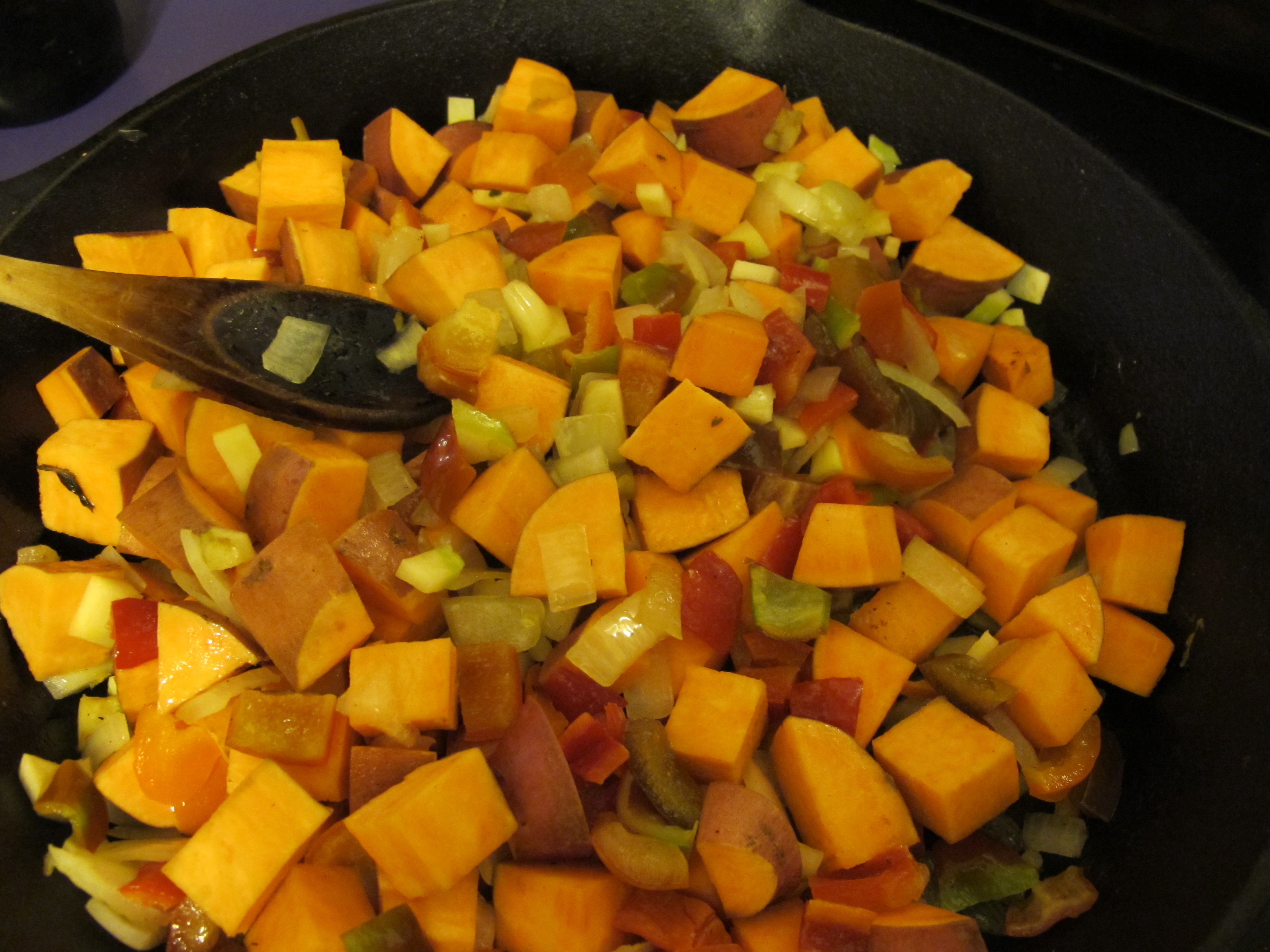
  • Black bean soup with our sweet potatoes and peppers
  • Baked potatoes with tempeh and sides of canned green beans and roasted beets
  • Split pea soup with our carrots and potatoes
  • Masaman curry with local cauliflower, our carrots and potatoes, and frozen peas
Sautéing veggies for black bean soup
Sauteing veggies for black bean soup

As I mentioned yesterday, I’ll be attending a vegetarian potluck tonight.  The theme is “colors of the rainbow.”  I’ll be making a winter squash dish or a roasted sweet potato dish — or perhaps both.  Any way you slice it, my color will be orange!

Using soil blocks to start seeds

Guest post by Matthew, AKA Farmer Brown
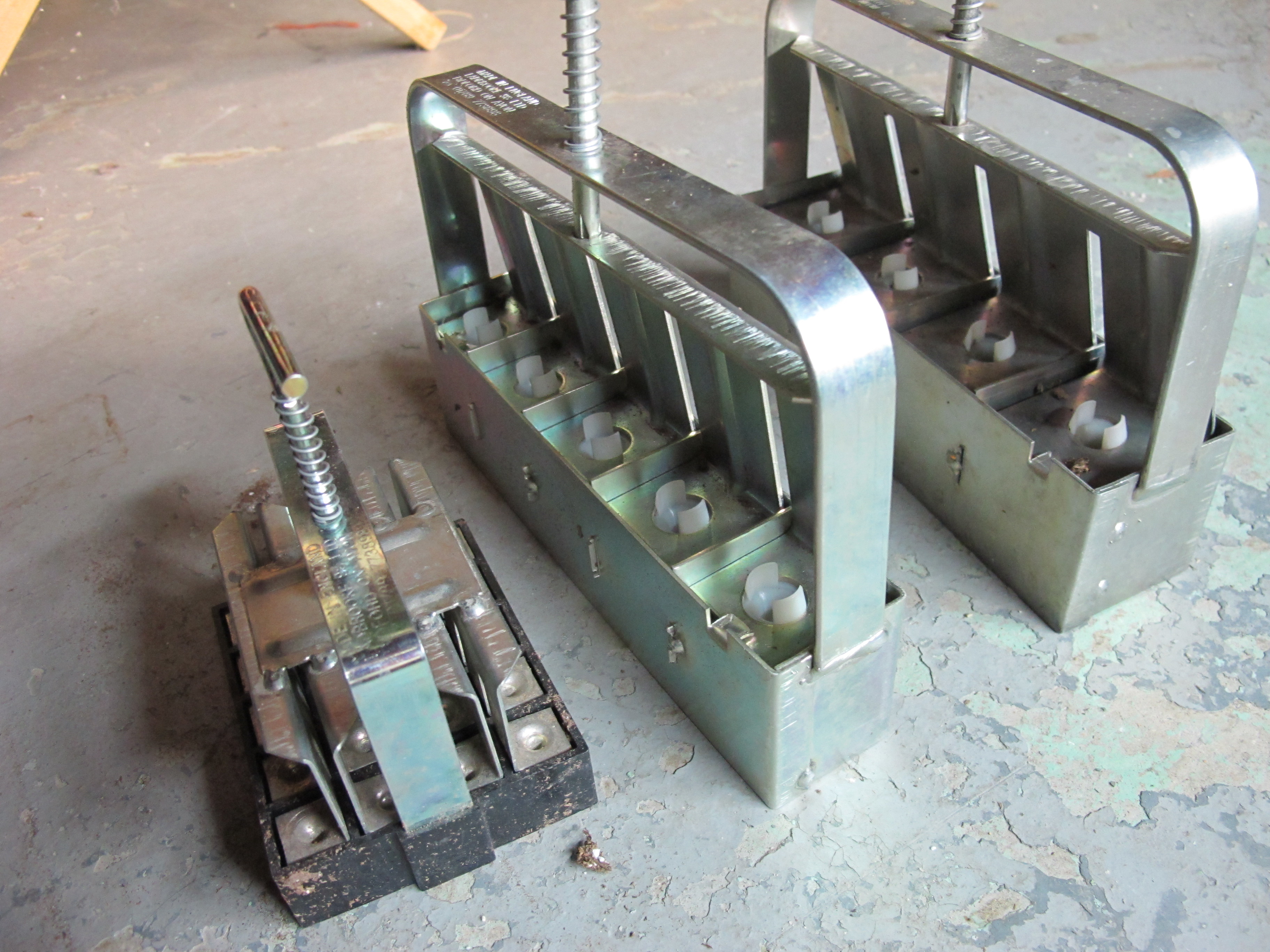
I’ve been using soil blocks to start seeds for the garden for a few years now.  I started with the affordable one that makes four 2”x 2” blocks, and later added the mini and a new five 1.5”x1.5” (after they decompress) blocker.
IMG_1437

I really like the 2” blocks, and I think the 1.5” one has potential, but I don’t think the mini is worth the bother, especially since my heating box space is not too precious, since I built it large enough for two flats at a time (three if I’m not worried about light).

Pros: Growing with soil blocks in trays leads to way less to sterilize than cell packs, plus easier to transplant and easier on roots than just growing in flats.  Also, despite reusing the cell packs, the flimsy plastic cracks after a few uses, so soil blocking = less plastic waste.

Cons: uses more soil than cell packs, because they require packed soil.

For seed starting soil, I’m currently using Pro-Mix, which comes in a compressed 3.8 cu ft block.  I’ve used a couple of other potting soils, and I’ve seen recipes for making your own.  I use this mostly because it’s affordable, and available easily near me, but I think most any general purpose seed starting/potting soil would work.  I’d prefer to make my own using coconut fiber instead of the peat, but practicalities of time lead me to compromises.

Materials
Soil blocker (a cookie cutter for soil)
Potting soil (bought or home-made)
Seeds
Flats (or trays) – sterilized with chlorine bleach solution if re-using and especially if found
A flat bottom container for the wet soil

IMG_1440

Using the soil blocker

1.       Moisten some soil the night before, with the goal of very wet but not soupy soil.

2.       Take the soil blocker and push down firmly into the soil.  I generally really pack it in.

3.       Twist the blocker right and left a bit to loosen the soil in the container from that in the blocker

4.       Tip the blocker slightly to release any liquid seal/suction and then pick it up

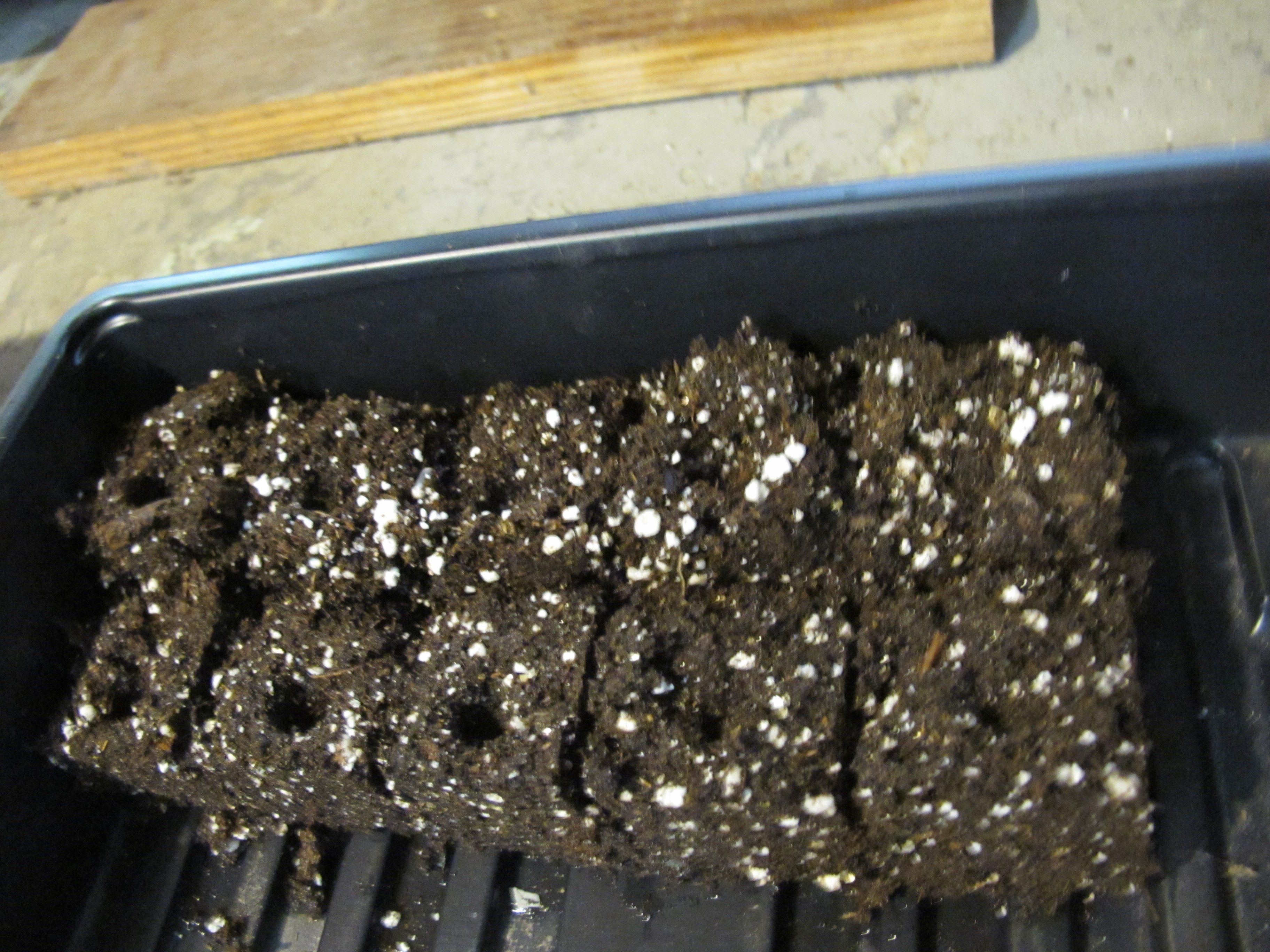
5.       Set it down on the tray and then

a.      Push down on both the blocker and the handle on the top of the blocker

b.      Gently allow the bottom half of the blocker to come upward as you keep pushing down on the handle

c.       Tip the blocker slightly to release suction

d.      Lift the blocker (leaving soil blocks behind)

e.      Repeat

IMG_1441

This seems complicated, but it really is rather simple and fast once you have the hang of it.  I think it may be a bit faster, and is certainly more pleasant, than sterilizing cell packs for reuse.

Once I’ve completed a whole tray of soil blocks, I start seeding, either in the dimples, or on the surface depending on the seed.  I use a bit more of the moistened soil to fill the dimples and cover the seed (unless it’s something that needs light to germinate).

To Water:  I used to spray the blocks carefully with a mister, but now  I just use a watering can that gives a fairly gentle shower.  It does destroy the pretty, orderly look of the blocks, but they hold together enough that it’s still easy to separate the blocks for planting.

I do still grow onions in flats, and I grow my artichokes in cell packs so I can vernalize them, but for most of my other indoor seed starting soil blocks are my method of choice.

Makeshift root cellar

A root cellar ranks high on our garden-related wish list.  A well-designed root cellar would maintain temperatures and humidity ideal for storing much of the food we harvest in the summer and early fall and eat throughout the winter, including potatoes, onions, sweet potatoes, cabbage, carrots, and squash.

Until we have a place of our own to garden and implement an “official” root cellar, we’re working with what we’ve got.  Until this year, that mainly involved basements — at Matthew’s mom’s house and at our apartment.  However, due to heat bleed-off from furnaces and duct work, most basements are actually warmer than ideal for root cellaring, and ours, with two (and in previous years, four) furnaces and duct work for two (or four) units is certainly no exception.

Once cold weather settled in for the season, we realized that the coldest place in our apartment was the front stairwell, just inside the front door.  We put a thermometer down there and discovered temperatures in the mid-50s (versus the 60-some-degree basement).

IMG_1367

While it’s not the most elegant storage solution, the space we’re using is more or less behind the door, so it’s out of the way.

The crate is full of potatoes, covered to prevent light damage.  It’s important to go through and de-eye the potatoes every couple of weeks.  We’ve had some that store better than others, but even the ones with rather shriveled skins taste good, they’re just a bit more work to clean.

The sweet potatoes at our place are a few steps up, in paper bags, though the bulk of our harvest of sweet potatoes and squash is still out at my MIL’s.

IMG_1366

We bought a bushel (about 50 pounds) of organic apples on our way to Iowa for Thanksgiving.  While they would keep better at cooler temps (like in the super-insulated straw bale building at the orchard), this was an okay compromise — there was no way we could fit them in the refrigerator.  Gabriel will often walk in the door, pick up an apple from the box, and take a bite, clearly indicating what he would like for a snack.

We’ve eaten or dried many of the apples.  The remaining apples have good flavor, but the texture is definitely best for cooking or drying at this point.

When we discovered our uninvited guests (of which we just found another a few days ago, argh!), I feared that they would be all too happy to invade our “root cellar,” but that hasn’t been the case (knock on wood).

Ghost of Christmas past

So Christmas is old news, seeing as how we’ve already rung in the New Year, but better late than never.  Unless you’re having any VERY belated holiday celebrations, you probably don’t need my fun green gift wrapping break through, so I’ll tuck that idea away for next year.

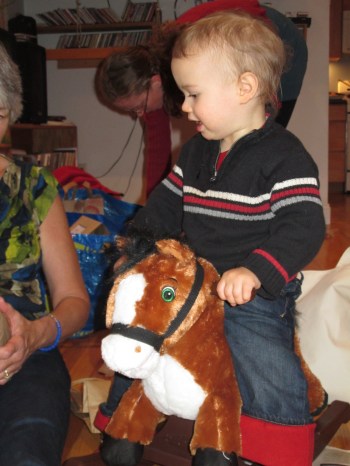
As expected, Sir did not lack for Christmas gifts.  The highlights included a pony from his great grandparents . .  .

IMG_1111

Of course, everyone knows that it’s best to ride bareback . . .

IMG_1176

. . . while holding a hairbrush.

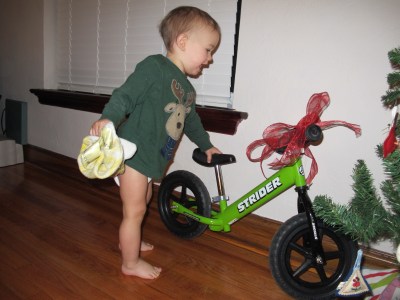
Speaking of riding, one week before Christmas, I found a Balance Bike on Craigslist.  We’d debated Balance Bike versus regular bike with pedals and cranks removed, but the good deal, combined with the timing and the fact that we hadn’t done much in terms of Christmas shopping, sealed the deal.

IMG_1183

He’s not quite ready for it, but he’s very interested, and all signs indicate that he’ll be ready to cruise come spring.

I’m happy to report that all of his Christmas gifts (from Matthew and me) are of the new-to-us variety, though I did find out the hard way (almost empty toy shelves at the SVdP thrift store) that I am not the only parent to buy secondhand for Christmas — must plan ahead for that in future years.

I particularly delighted in the gift my sister gave us — beautiful homemade stockings.  I knew I wanted something special, and liked the idea of making them myself, but I lacked the equipment/skill/time to do so.

IMG_1211

Aunt Mollie to the rescue!  It’s so fun to know that we’ll be hanging these stockings for many years to come.

Here’s hoping that 2013 is off to a good start for all of you!