Eating through last year’s crops

Spring has sprung, and while we’re already enjoying freshly harvested produce, we’re still eating through the tail end of our 2011 harvest.
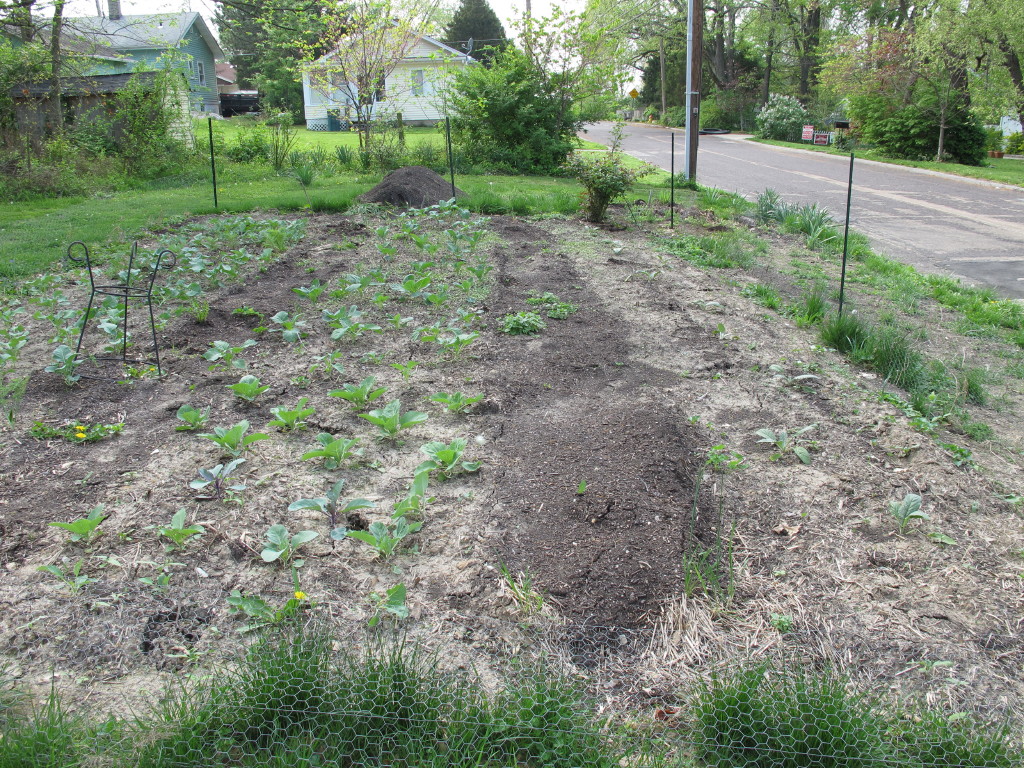
The cruciferous plot

We finished the last of the onions at the end of March.  We dug the onions at the end of June, which means we had garden onions nine months out of the year — not bad!  We made it that long even though some of the stored onions went bad, despite our drying and storing efforts.

We already have some Egyptian onions coming in from the garden, but not enough for our everyday needs.  Going to the store to buy a bag of onions the other day felt strange.  I guess if we were hardcore locavores, we would do without onions right now.

The potatoes lasted a similar period of time from harvest to depletion — harvested in late July and finished in early April.  They made their final stand in a delicious potato salad Matthew’s mom made for our Easter gathering.

So what’s left?

Non-processed, root cellar-type items

  • Two HUGE sweet potatoes
  • A few assorted winter squash

Canned

  • A few jars of green beans
  • Tomatoes and tomato sauce
  • Catsup
  • The shelves are not as full as they were here!

Frozen

  • Six one-quart bags of cooked, pureed winter squash
  • Six bags of Swiss chard
  • Maybe some other stuff that I’m not thinking of right now.  We have a very official system for tracking this that I will show you someday.

Matt’s mom also discovered some frozen garden veggies with 2010 dates on them in her deep freeze, so we’re helping take care of those.

Though I often bemoan the amount of Matthew’s time that goes into the garden, and his lack of free weekends during a majority of the year, we DO get quite a bit of food from his efforts.  Since he’s unlikely to give up gardening any time soon, it’s good to focus on the delicious results as much as possible.
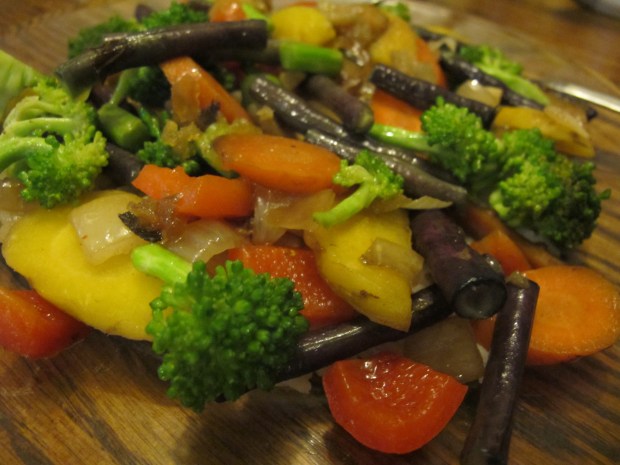
Rainbow on my plate

Weekends these days

So I was all prepared to write a post comparing recent weekends to past April weekends, complaining about how I don’t get to bike or do anything anymore but after last weekend, I can’t truthfully write such a post.

Matthew, in his infinite cleverness, discovered that we don’t actually have to disassemble the trailer to get it in and out of the basement.  If we partially flatten it and remove the hitch arm, we can then take it through the door sideways, with the wheels still in place.

While carrying a bicycle up the stairs, then hauling up the trailer, then attaching said trailer to my bike is not exactly easy while keeping tabs on a nine-month-old, this new discovery makes it a bit less of a production.

Last Friday morning, I loaded Sir into his chariot for our first solo bike outing.  On previous outings (here and here), Matthew pulled the trailer, so it was also my first time pulling the trailer with him in it.

(The hardest part was getting him into the darn baby supporter — there’s this piece that you have to pull over the baby’s head, and it’s very awkward.  They really need to tweak the design to make it more user-friendly.  I think I can modify it, but I haven’t had a chance to see if my idea will work yet.)

Anyway, we biked to the park for a short visit.  On the way home, while waiting to make our left turn onto Kingshighway, I got some kind of, “You’re not seriously going to [something unintelligible] on Kingshighway . . . ?”

Why, yes, I am going to operate my vehicle on this street, just like you’re going to operate your vehicle on this street, thank you very much.  I really need to remember to carry Cycling Savvy flyers with me and be ready to hand them out.

Later that day, we were back on the bike to check out some real estate.  I looped a cable through part of the frame of the trailer for locking up, and Sir grabbed it and seemed to be using it as an “oh shit handle” during our ride.  Sir, please, I’m not that crazy of a driver.

Our new Saturday routine involves sending Gabriel out to the garden with Matthew, which gives me some much-needed time to myself.  I spent last Saturday biking around gathering ingredients for Matthew’s birthday dinner.

Despite no baby on board, I hitched up the trailer, which allowed me to easily carry my final load of a 3+ liter tin of olive oil, a half gallon of soy milk, a half gallon of dairy milk, some bulk bin dry goods, a gallon of apple cider vinegar, and  few other odds and ends.  With just my milk crate, or even my milk crate and panniers, that load would have required some stops back at the apartment between stores.

After all the biking with the trailer, my Sunday morning ride, just me and Bub was a breeze.

While life IS very different these days, I reclaimed some of the joys of weekends past, and I hope to do more of it in the future.

Psst, psst: Thoughts on EC so far

Commenting on Kath’s EC post on Baby KERF helped me reflect more on our elimination communication (EC) journey thus far.*  If you like the “journey” metaphor, I will say that, after nine months of this journey, most days it feels like we’re still trying to pull out of the garage.  There have been a few periods where we made it part way down the driveway, maybe even out into the street, but then we remembered we forgot something and had to go back to the house.

While I’m trying to be patient, and understanding, and optimistic, I fall short much of the time.  Despite all my best intentions to be realistic and not set my expectations too high, especially once he started daycare (where they refuse to sit him on his potty), it’s hard.

So, given my experience thus far, what would I do differently?

  • Wait to start EC until baby is about 6 weeks (or more?), instead of from birth, which is when many cultures that have retained this practice start.
    • During those first weeks, you can watch your baby for elimination signals and try to get a sense of his timing and patterns, but, especially if you’re a first-time mom, you’re dealing with enough other [non-literal] shit.
  • As with any other baby-advice/parenting book, don’t expect YOUR child to match the description of “most other children” — you will just be frustrated.
  • Sleep is more important than diaper-free!  Practice EC during the daytime ONLY.  My initial zeal for trying to catch Every.  Single. Pee. probably contributed to some sleeping problems for bébé.
    • Instead of observing The Pause (a la French parents) when he gave a little cry at night or during nap times, we would rush right in, un-diaper him, and set him on the pot.  Not only were these efforts usually unproductive, but they deprived him of the chance to learn to consolidate his sleep and get the rest he needed.

The anecdotes in the EC books bias one toward thinking the practice is easy and straightforward — if you build it, they will come, and all that jazz.

And maybe it works that way for some people, but when it didn’t for us, it just created one more frustration, one more reason to question my parenting decisions and abilities, at a time that was already stressful and fraught with uncertainty, all fueled of course by sleep deprivation and my struggles with PPD.

I really, really like the idea of EC and I really want it to work.  Most of it makes sense to me in theory, but in practice things just don’t fall into place.  Is it because we’re only part time and the daycare situation?  Because we have yet to go “cold turkey” and ditch the diapers, as some suggest?

Either way, I’m not quite ready to give up — maybe we’re just days from a developmental milestone and a big breakthrough, but I think it’s important to share a perspective that differs from that in most EC literature.

*If you’re new to the blog, you can read more about our EC journey in the “Psst, psst” series:

Book review: Bringing up Bébé

A few weeks ago, we heard an NPR interview with Pamela Druckerman, the author of Bringing Up Bébé: One American Mother Discovers the Wisdom of French Parenting.

We liked what we heard, and Matthew and I both requested the book at the [city] library the next day.  However, our positions in the hold queue made me wonder if we’d actually get a chance to read the book before Sir headed off to college.

Fortunately, Matthew also requested the book from the county library, which had many more copies, and we had the book in our hot little hands a few weeks later.  (We’re still waiting in the city library queue.)

Unlike traditional parenting books, Druckerman’s writing is witty and entertaining, part personal tale, part ethnography of French parenting, and part practical ideas to try in your own family.

Like the advice in most baby/parenting books we’ve read, we’ll take some and leave some (notably, leave the negative perception and infrequent practice of  breastfeeding in France).  The book offered reinforcement for many practices we’re already trying to implement.

Things to incorporate (or continue):

  • Waiting — teaching patience; we will respond to your needs, but not always immediately
  • Independent play
  • Introducing a wide variety of [healthy] food
  • Setting clear boundaries and enforcing them firmly and consistently, while giving room to explore and grow within that framework
  • Maintaining our identity as adults, with our own interests and needs

Overall, Bringing Up Bébé left me contemplating a move to France, with its crèches and state-run preschools, approach to introducing food (and the importance they place on good food), and practice of integrating children into the family and society (from infancy), rather than the family’s life revolving around the child.

Hallelujah . . .

This slideshow requires JavaScript.

IT IS RISEN!

Could I be any more sacrilegious?  Well, probably, but I’ll refrain.

And in the interest of preserving my immortal soul ;-), I’ll share this Lenten prayer that my wonderful faith community prayed every Sunday during Lent this year (better late than never on the posting).  As with faith-related stuff I’ve shared before, the values and vision reflected here can and should be embraced by all humankind, regardless of faith or belief system.

Prayer During Lent

Blessed God, these are some of the thing that belong to our vision of a healed future…

A world that uses resources only as fast as they can be replaced, so that the wealth of today does not destroy hope for tomorrow.

Leaders who are honest, respectful, and more interested in doing their jobs than in keeping their jobs.

Material sufficiency, health and security for all.

Work that dignifies people and enables all to thrive.  Incentives for people to give of their best to society, and to be rewarded for it.  And at the same time, ways of providing sufficiently for people under any circumstances.

An economy that is a means, not an end, one that serves the wellbeing of the community and the environment, rather than demanding that the community and the environment serve it.

The kind of agriculture that builds soils, uses natural mechanisms to restore nutrients and control pests, and produces abundant, uncontaminated food.

Print and broadcast media that reflect the world’s diversity and, at the same time, bind together the cultures of the world with relevant, accurate, timely, unbiased, and intelligent information.

Reasons for living and thinking well of oneself that do not require the accumulation of material things.

Help each one of us, God, and all of us together to believe in the possibility of such a future, and by loving and by hoping and by working, according to what each of us has to contribute, to help it to come true.

Amen.

Adapted from a prayer by: Center of Concern, Wednesday, July 20, 2011

https://www.coc.org/